

An initial rental is not a deposit in the way most people mean it. A deposit usually sits with someone and can come back to you. An initial rental is rent paid in advance: it is part of what you pay to use the car, and it lowers your monthly payments because you have already covered some of the rent. If you want a lease with nothing upfront, that is possible too, and the monthly payments rise to balance it. At Lease World we arrange both kinds, including no deposit options, so the useful question is which structure suits your cash and your plans.
TL;DR
- The initial rental (also called the initial payment or upfront payment) is rent paid in advance, usually quoted as a multiple of your monthly payment.
- It is not a security deposit, so do not plan on it being handed back at the end of the lease.
- A bigger initial rental means lower monthly payments, a smaller one means higher monthly payments. Compare quotes on total cost over the term, not on the monthly figure alone.
- Other costs sit outside both: insurance, fuel, servicing (unless included), and mileage or damage charges.
- Drivers who want to keep cash free can ask for a quote with a low or no initial rental and compare it with a higher one.
Table of Contents
- Why the two words get mixed up
- What an initial rental is and how it is written
- How the initial rental changes your monthly payment
- Is the initial rental refundable?
- Choosing the right initial rental for your situation
- How to compare quotes with different initial rentals
- Costs that sit outside the initial rental
- Our view: pick the profile around your life, not the headline price
- Get quotes at two different initial rentals
- FAQ
- Sources
Why the two words get mixed up
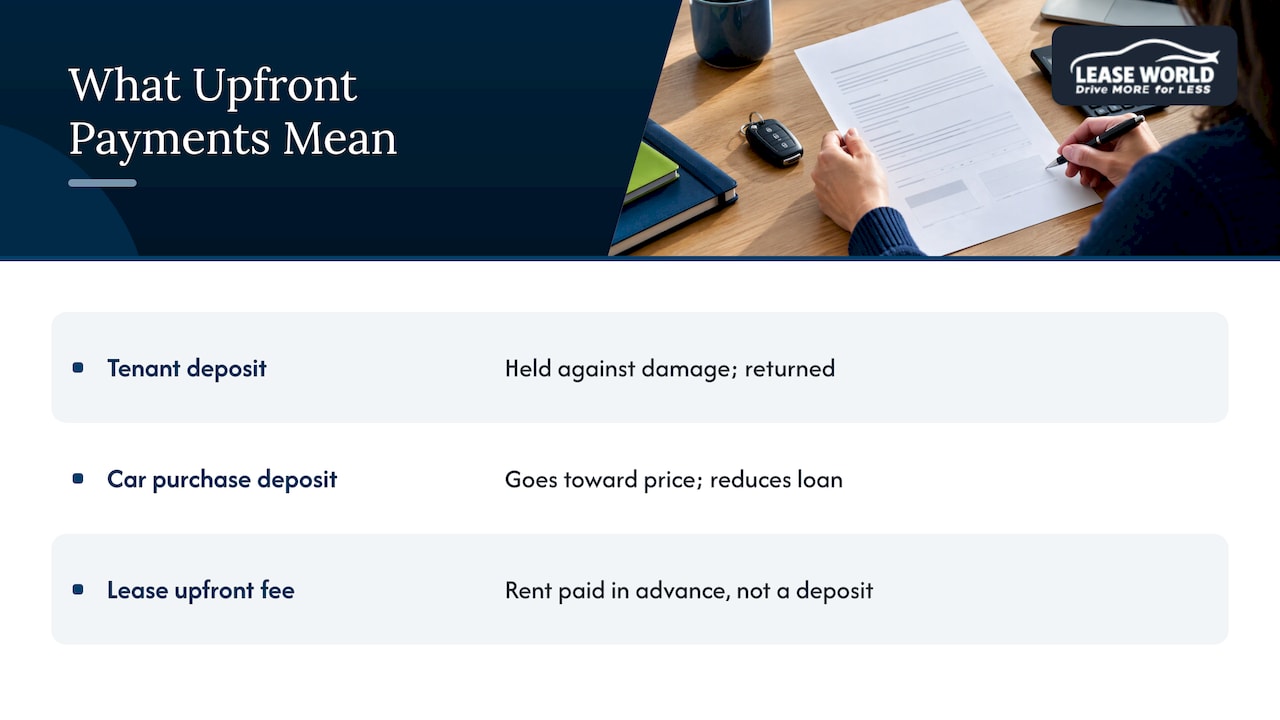
In everyday money, a deposit is a sum you hand over that is tied to something later. A tenant's deposit is held against damage and returned. A deposit on a car you are buying goes towards the price and reduces the loan. Leasing is closer to renting, so the same word creates confusion.
Car leasing is usually called personal contract hire (PCH) for private drivers and business contract hire (BCH) for companies. MoneyHelper, the government-backed money guidance service, describes personal contract hire as renting a car for a few years with fixed monthly payments, an upfront fee, and no usual option to buy the car at the end. Notice the wording: an upfront fee, not a deposit that secures the car.
Some quotes and websites do say "deposit" because that is the word customers search for. If you see it on a lease quote, read it as the initial rental unless the paperwork says otherwise. The contract itself is where the difference is defined, so look for the heading that says initial rental, initial payment or advance rental.
What an initial rental is and how it is written
Most lease quotes show the payment profile as two numbers, such as 3+35 or 9+23. The British Vehicle Rental and Leasing Association (BVRLA), the trade body for the sector, explains in its consumer leasing tips that the first figure is the number of monthly payments made upfront, followed by the monthly payments for the rest of the term.
So on a 36-month lease:
- 1+35 means one month's rental upfront, then 35 monthly payments.
- 3+35 means three months' rental upfront, then 35 monthly payments.
- 9+35 means nine months' rental upfront, then 35 monthly payments.
You can see two things from this. First, the initial rental is calculated from the monthly figure, so it is never a separate fee floating on its own. Second, the total number of payments is the lease length, so an upfront payment of three months still counts towards the 36 months of rent.
Our own initial payment guide goes through the same idea with more examples.
How the initial rental changes your monthly payment
The link is direct. The more rent you pay at the start, the less is left to spread across the monthly payments, so those get smaller. The less you pay at the start, the larger each monthly payment becomes.
Here is an illustrative example. The figures are invented to show the arithmetic and are not a Lease World quote.
| Quote A | Quote B | |
|---|---|---|
| Profile (36 months) | 3+35 | 1+35 |
| Monthly payment | £220 | £236 |
| Initial rental | £660 | £236 |
| Other 35 payments | £7,700 | £8,260 |
| Total over the lease | £8,360 | £8,496 |
Quote B asks you to find £424 less at the start, and the monthly payment is £16 higher. Over the term you pay £136 more in total for that flexibility. Neither quote is wrong. The question is whether keeping £424 in your account for three years is worth £136 to you.
The pattern in real quotes will differ by vehicle and funder, and a quote with a large initial rental will not always be the cheapest overall. That is why comparing the total is the safer habit. Our guide to low initial rental lease deals covers this trade-off, and how monthly payments are built explains what else goes into the figure.
Is the initial rental refundable?
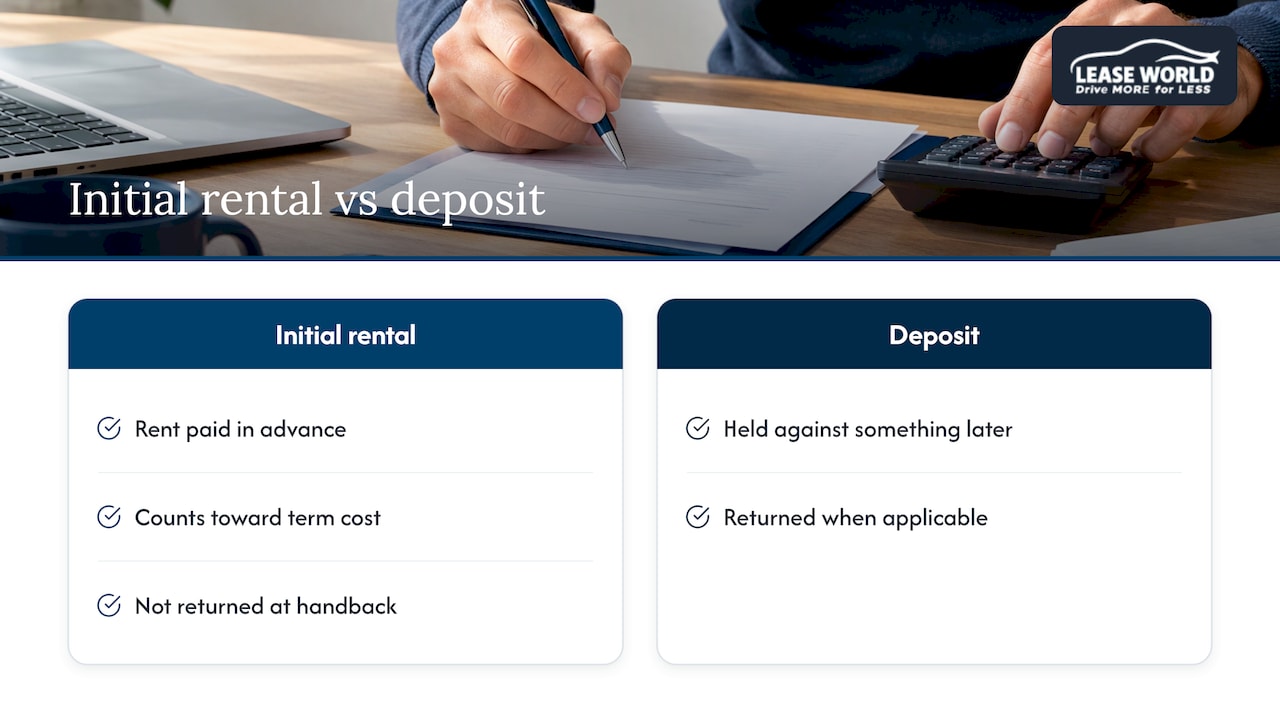
Treat it as not refundable. Because it is rent paid in advance, it has already been counted against the cost of using the car for the term. It is not parked somewhere to be returned when you hand the car back. This is the main practical difference from a deposit.
The point that matters most is what happens if you end the lease early. Early termination terms are set by the funder in your contract and normally involve paying a share of the remaining rentals, so you should not assume any part of an upfront payment comes back. Read the early termination clause before you sign and ask your broker to explain it in plain figures. If there is any chance your circumstances will change during the term, a shorter lease may fit better, and we also arrange short-term vehicle leasing.
Choosing the right initial rental for your situation
There is no universal best profile. The right one depends on how much cash you want to commit, how steady your monthly budget is, and how long you plan to keep the car.
If you want the lowest outlay at the start
Ask for a quote with a single month upfront, or none. Monthly payments will be higher, but you keep your savings available for insurance, a house move or an emergency. This suits drivers whose income arrives monthly and who prefer predictable outgoings to a large first payment. Our no deposit leasing guide explains the £0 upfront route.
If you want the lowest monthly payment
A larger initial rental, such as six or nine months, brings the monthly payment down. This suits drivers who have savings set aside and want a smaller commitment each month. Our guide on getting the lowest monthly lease payment shows how the initial rental interacts with term and mileage.
If you are a driving instructor
Your car is your working tool and your income can vary through the year, so a steady monthly figure matters. A modest initial rental that keeps the monthly payment comfortable in a quiet month is often easier to live with than a very large upfront payment. We offer dedicated driving instructor car leasing, with deals across makes such as Ford, Toyota and Kia.
If you work for the NHS
Shift patterns and pay dates are regular, which makes a fixed monthly payment easy to plan around. Decide how much you would rather pay at the start and how much each month, then ask for quotes at two or three profiles. We have an NHS staff car leasing service for this.
If you lease through a business
Businesses often weigh the same trade-off through cash flow: a smaller initial rental keeps working capital available, while a larger one lowers the monthly cost. Tax treatment is separate. Whether VAT on a lease can be reclaimed, and how rentals are treated in your accounts, depends on the business and the vehicle, so confirm the position with your accountant or HMRC's VAT guidance. BVRLA's guidance also points out that business quotations may exclude VAT while consumer lease payments include it, so check which basis a quote uses. See our business car leasing page for the business route.
How to compare quotes with different initial rentals
Quotes only compare fairly if you line up the same things. Use this routine.
- Match the term and mileage. A 36-month lease with 8,000 miles a year is not comparable with a 48-month lease at 10,000 miles.
- Write down the profile. Note whether it is 1+35, 3+35, 9+35 or something else.
- Work out the total. Multiply the monthly payment by the number of monthly payments, then add the initial rental.
- Divide by the months. Dividing the total by the lease length gives an average monthly cost that you can set side by side with another quote.
- Check what is included. Ask whether maintenance, road tax and any fees are in the payment.
- Then decide on cash. If two totals are close, pick the profile that leaves you most comfortable.
Step 5 is where many comparisons go wrong. A quote that looks cheaper may leave out something another includes. Our guide to comparing car lease deals shows the checks in more detail. Part of what we do is compare contract hire agreements for you and lay them out so the total, the profile and the inclusions are easy to read side by side.
Costs that sit outside the initial rental
Whether you choose a big initial rental or none, other costs remain. MoneyHelper notes that insurance, fuel and servicing can stay the driver's responsibility, and it warns about mileage and damage penalties. BVRLA adds that you should choose a mileage allowance that reflects how much you really drive, and check whether maintenance is part of the rental.
- Insurance: needed from day one of the lease.
- Fuel or charging: your running cost, whatever the payment profile.
- Maintenance: only covered if you have an optional maintenance package or it is included in the quote.
- Excess mileage: charged per mile over the agreed allowance. Our article on unlimited mileage leases shows how high the per-mile rates can run.
- Return condition: the funder inspects the car when it goes back. Keeping the cabin clean and protected, for example with an interior ceramic coating, is one way owners look after a car's finish and upholstery during a lease.
Our piece on the hidden costs of leasing lists the rest. Electric car drivers have a few extra items to weigh, covered in electric car leasing costs.
Our view: pick the profile around your life, not the headline price
We are a family-run broker, and the question we hear most often is whether a lease needs a deposit. The honest answer is that it needs a payment profile, and you get to choose it.
Some drivers want a larger initial rental because they have the savings and prefer a lower monthly bill. Others want a low or no deposit option so their cash stays free. Both are sensible, and both are available, because we compare contract hire agreements across funders and build a quotation around what suits you.
Our approach is fixed monthly payments with no hidden fees, so the profile you choose is the profile you see. Ask for the same car at two different initial rentals and look at the total for each. When you can see the numbers side by side, the right choice is usually obvious.
Jason
Get quotes at two different initial rentals
If you are deciding between a smaller and a larger upfront payment, the quickest way to settle it is to see both with the same car, term and mileage. We offer personal car leasing with fixed monthly payments, no deposit options and free UK delivery on eligible vehicles, and our team can set out the options for you.
To start, send us a leasing enquiry with the vehicle you want and tell us how much you would like to pay upfront, or that you would like nothing upfront.
FAQ
Is an initial rental the same as a deposit?
No. An initial rental is rent paid in advance and counts towards the cost of the lease. A deposit is normally money held against something and returned or credited later. Some quotes use the word deposit loosely, so check the contract wording.
Can I lease a car with no initial rental?
Yes. Many leases are available with little or nothing upfront. The monthly payments are higher to make up the difference, so compare the total over the term. We arrange no deposit options on cars and vans.
Does a bigger initial rental make the lease cheaper overall?
It lowers the monthly payment, but the effect on the total depends on the funder's pricing, so you cannot assume it. Multiply the monthly payment by the number of payments, add the initial rental, and compare the totals for each profile.
What does 3+35 mean on a lease quote?
It means three monthly payments upfront, followed by 35 monthly payments, so a 36-month lease in total. The BVRLA describes this notation in its consumer leasing advice.
Do I get the initial rental back if I end the lease early?
You should not expect to. It is rent paid in advance, and early termination is governed by the terms in your contract, which usually involve charges. Read that clause before signing and ask us to explain it.