

Check your contract for the annual mileage and the per-mile excess charge, the initial payment, and whether it references BVRLA fair wear and tear standards. Those three details predict most of the nasty surprises on a car lease. Beyond the advertised monthly figure, watch for:
- Initial payment (often shown as "X+35" or similar)
- Administration and acquisition fees
- Optional maintenance and servicing packages
- Fully comprehensive insurance and gap cover
- Fuel or charging costs
- Excess mileage charges
- Fair wear and tear versus damage charges at return
- Early termination fees
- VAT and small contractual extras
Lease World has spent years untangling these agreements for private and business drivers, and the BVRLA publishes the industry standard most funders use to judge condition at handback. Read your contract against both before you sign anything.
TL;DR:
- Most unexpected costs stem from mileage overages, with rates up to 30p per mile, meaning 9,000 extra miles can cost over £1,000 at lease end.
- An upfront initial rental rarely reduces total costs, serving mainly as a cash flow decision rather than a discount, and refundable conditions vary.
- Administration and acquisition fees, often negotiable, can range into hundreds of pounds and are sometimes hidden within your lease documentation.
- Skipping maintenance packages shifts repair costs onto the driver, which is manageable for low-mileage drivers but costly for high-mileage ones.
- Preparing early for return with independent repairs and document checks can significantly reduce wear-and-tear charges and hidden fees.
Table of Contents
- What are the hidden costs of leasing a car?
- How does the initial payment affect your total cost?
- Why do leasing quotes carry administration fees?
- Do you need a maintenance package on a lease car?
- Why is leasing insurance often more expensive?
- What running costs should you budget for beyond the lease payment?
- How much can excess mileage charges really cost?
- What counts as fair wear and tear on a lease car?
- What else gets you charged when you return a lease car?
- Does VAT change what you actually pay for a lease?
- What happens if you end a lease early?
- How can you avoid hidden costs before, during, and after your lease?
- How does Lease World help you avoid these costs?
- Key Takeaways
- Where to check the details yourself
- Sources
- FAQ
What are the hidden costs of leasing a car?
The phrase "hidden costs of leasing" is slightly misleading. Nothing is technically hidden. It is written into the contract, but scattered across pages of terminology that most drivers never read properly before signing. The real risk isn't fraud, it's assumption. You assume the quoted monthly figure is the whole story, and it rarely is.
The standard list of extra costs that quotes may not include stretches from the obvious (insurance) to the easily missed (a £2 congestion charge you forgot to pay, now with a £70 admin fee attached). Some of these charges are unavoidable. Others exist purely because the small print wasn't checked at signing.
- Costs baked into every lease: initial rental, VAT, insurance
- Costs you can influence: mileage allowance, maintenance package, damage risk
- Costs that only bite if something goes wrong: early termination, repossession, missed payments
How does the initial payment affect your total cost?
The initial payment, often called the initial rental, is the upfront sum paid before your monthly payments start. Contracts frequently show this as something like "6+35", meaning six months' rent paid upfront followed by 35 further monthly payments. A "9+47" structure follows the same logic over a longer term.
Paying more upfront lowers your monthly figure, but it rarely lowers the total amount you pay over the life of the contract. It's a cash flow decision, not a discount. A larger initial payment can genuinely help if you'd rather have predictable, lower monthly outgoings, but it ties up more of your money earlier and it's usually non-refundable if you need to exit the agreement.
Before signing, check:
- How the initial rental appears on your schedule of payments
- Whether it's refundable under any circumstances
- Whether a smaller initial payment with a slightly higher monthly figure suits your cash flow better
Why do leasing quotes carry administration fees?
Admin and acquisition fees are one-off charges, typically named things like "documentation fee," "processing fee," or "arrangement fee." They generally run into a few hundred pounds and either appear as a separate line item or get folded quietly into the monthly rental.
If a fee appears on your paperwork that you don't recognise, ask for an itemised invoice explaining what it covers. Many of these charges are negotiable or at least clarifiable once you ask the funder directly what it's for.
- Common names: documentation fee, arrangement fee, acquisition fee
- Ask: "Can you send me an itemised breakdown of this charge?"
- Watch for small recurring admin charges disguised as one-off costs, they add up over a three or four-year term.
Do you need a maintenance package on a lease car?
Manufacturer warranty covers mechanical faults, not wear items like tyres, brake pads, or servicing. That distinction catches a lot of first-time leaseholders out. An optional maintenance package typically bundles servicing, MOT (once the car's old enough), tyres, and sometimes brake consumables into a fixed monthly add-on, which is exactly the trade consumer cost guides point to when comparing exposure at lease end.
Skipping the package saves you money monthly but shifts every repair bill onto you, paid as and when they land, sometimes at the least convenient moment.
- Included in most packages: servicing, MOT, tyres
- Usually excluded: accident damage, misuse, tyres damaged by kerbing
- Best for: higher-mileage drivers who want a fixed, predictable running cost
Pro Tip: If you do a lot of motorway miles, price the maintenance package against two replacement tyres. On many mid-size cars, that's most of the annual package cost right there.
Why is leasing insurance often more expensive?
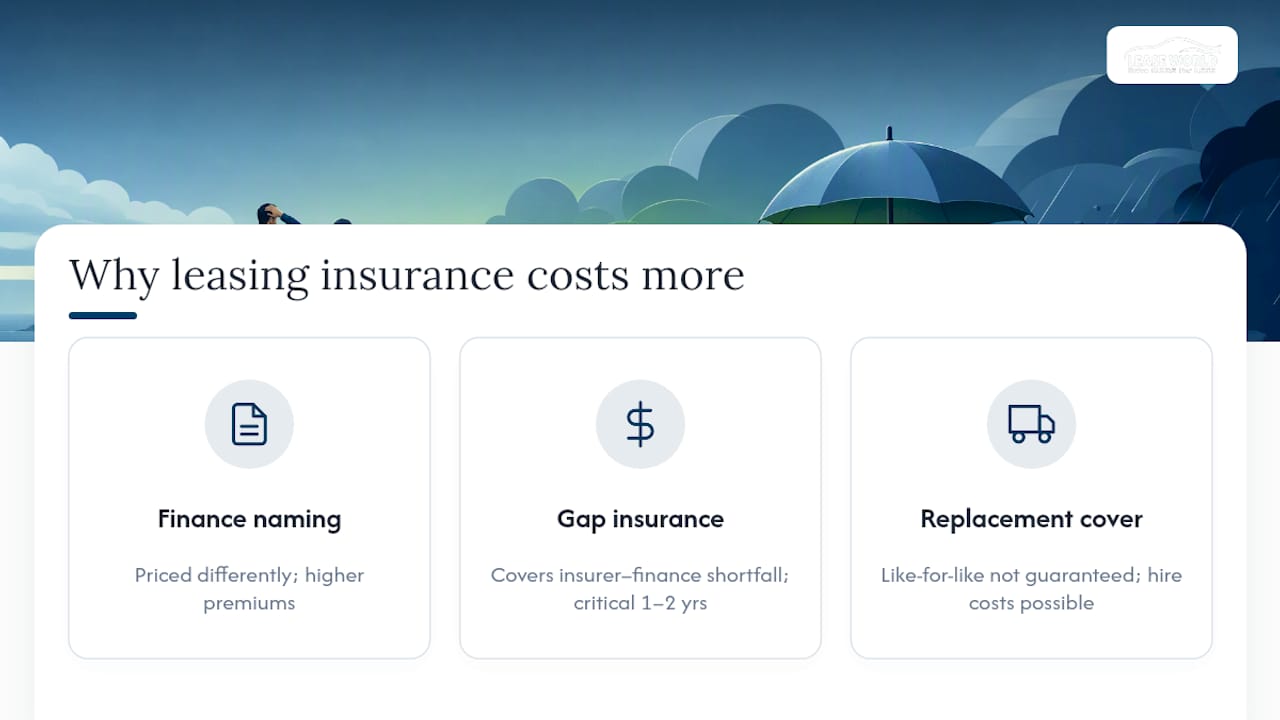
Every lease agreement requires fully comprehensive cover, and you'll need to name the finance provider as the vehicle's legal owner on your policy. Some insurers price this differently to a standard owned-car policy, and premiums can come out higher than drivers expect, a point several cost overview guides flag as an easy budgeting miss.
Gap insurance covers the difference between what your motor insurer pays out after a total loss and what you still owe the finance company. It matters most in the first year or two, when a car's insured value can trail behind the settlement figure owed, particularly if the vehicle was written off shortly after delivery.
Check your policy wording on courtesy cars and replacement vehicle cover too. Not every comprehensive policy includes a like-for-like replacement while your lease car is being repaired, and that gap can leave you paying for a hire car out of pocket.
What running costs should you budget for beyond the lease payment?
Fuel and charging costs sit entirely outside your monthly lease figure, and they vary hugely by vehicle type. A petrol or diesel car's running cost is fairly predictable once you know its real-world mpg. Electric vehicles are trickier: home charging overnight is cheap, but relying on public rapid chargers regularly can push your per-mile cost close to, or above, a petrol equivalent.

Model your typical mpg or MPGe against current fuel and electricity prices before committing to a monthly budget, and factor in congestion charges, tolls, or workplace charging costs if they apply to your commute.
How much can excess mileage charges really cost?
Excess mileage is priced per mile, and the rate typically falls somewhere between 3p and 30p per mile, depending on the vehicle and contract. That range sounds small until you run the maths on a driver who's underestimated their annual mileage.
Say you agreed to 10,000 miles a year on a three-year lease, but actually drive 13,000 a year. That's 9,000 excess miles by the end of the contract. Excess mileage charges can result in fees amounting to a substantial additional cost when you return the car, depending on your contract's per-mile rate and the total excess miles driven.
Here's how to estimate your risk before it happens:
- Add up your predictable driving. Daily commute, school runs, regular weekend trips.
- Multiply by 52 weeks, then add irregular trips like holidays or long-distance visits.
- Add a buffer of around 1,000 miles to cover anything you haven't accounted for.
- Compare that total against your proposed contract mileage before you sign, not after month six.
If you're borderline, Autotrader's guidance is blunt: underestimating mileage to shave a few pounds off your monthly payment is a false economy, because the excess charge at the end almost always outweighs the saving. You generally have three options if you're likely to go over: pay the excess at collection, buy additional miles mid-contract (often cheaper per mile than the default excess rate), or increase your allowance at signing when you first spot the risk.
What counts as fair wear and tear on a lease car?
The BVRLA fair wear and tear guide is the industry standard funders use to judge condition at handback. It defines fair wear and tear as the deterioration you'd reasonably expect from normal use over the contract term, distinct from damage caused by impact, neglect, or poor repairs. Anything falling outside that standard can trigger a charge.
Common chargeable items include:
- Stone chips larger than the guide's threshold size
- Tyres worn below the legal limit or unevenly worn
- Dents, scuffs, and scratches beyond superficial marking
- Stained or torn upholstery
- Missing equipment, from parcel shelves to spare wheel kits
Acceptable deterioration reflects age and mileage. Damage from impact, neglect, or poor repair sits outside that standard entirely, and that's the line funders use to decide what gets charged.
Two steps cut your dispute risk sharply. Book a full daylight appraisal 10 to 12 weeks before your lease ends, giving you time to arrange repairs independently rather than paying the funder's collection-time rates. And use a tool like BVRLA's Return Ready to check likely chargeable damage against the standard before the car's even collected.
Pro Tip: A £40 stone chip repair done at your local body shop can prevent a £150 charge at collection. The gap between DIY-arranged repair and funder-arranged repair is often several times the original damage cost.
What else gets you charged when you return a lease car?
Beyond bodywork and interior condition, funders check the car comes back complete. A protective step some drivers take here is interior ceramic coating, which can reduce staining and wear charges on upholstery over a long lease term.
- Both sets of keys — a missing key can cost more to replace than most people expect, since it often needs reprogramming to the vehicle.
- Charging cables and accessories (EVs especially) — missing leads are chargeable as replacement items.
- Service book and full service history — gaps in stamped servicing can be read as neglect, even if the work was done.
- Wiped satnav and infotainment data — clear your personal details before handover.
Keep every service receipt for the full contract term. It's your evidence the car was maintained properly, and it directly protects you against wear-and-tear disputes.
Does VAT change what you actually pay for a lease?
Business lease quotes are usually shown excluding VAT, while personal lease quotes should include it, but it's worth double-checking which you're looking at before comparing prices. A quote that looks cheaper than a rival's may simply be excluding VAT that gets added later.
Road tax (VED) is included in most personal lease agreements for the contract term, but check explicitly rather than assuming, since some business agreements handle it separately. Scan the full schedule of payments for recurring small charges too, some contracts include modest ongoing admin or documentation fees that don't show up in the headline monthly figure.
What happens if you end a lease early?
Early termination almost always costs more than people expect.
Missing payments is worse. Arrears trigger late fees first, then potential repossession, and both leave a mark on your credit file that can affect future finance applications, including your next lease.
If you think you'll struggle to keep up with payments, contact your funder before you miss one. Ask specifically about voluntary termination provisions, which under certain conditions allow you to hand the car back once you've paid a set proportion of the total agreement, often a cheaper route than defaulting.
How can you avoid hidden costs before, during, and after your lease?
Most hidden costs are avoidable with the right checks at three points in your contract's life.
At signing:
- Set a realistic annual mileage using your actual driving pattern, not a guess.
- Ask for the exact pence-per-mile excess rate in writing.
- Check whether maintenance is included, and get a quote both with and without it.
- Confirm the contract references BVRLA fair wear and tear standards.
- Compare quotes on a like-for-like basis, including VAT and any admin fees.
During the lease:
- Keep every service receipt and invoice.
- Track your mileage every few months against your allowance, not just at the end.
- Book minor repairs (chips, scuffs) as they happen rather than letting them accumulate.
Before you return the car:
- Book a full appraisal 10 to 12 weeks before handback.
- Get independent quotes for anything that needs fixing.
- Be present at collection and request a copy of the condition report on the spot.
Pro Tip: Photograph every panel, wheel, and interior surface the day you get the appraisal done. Timestamped photos are the single strongest piece of evidence if a wear-and-tear charge gets disputed later.
How does Lease World help you avoid these costs?
Lease World builds transparency into the process from the first quote rather than leaving you to decode the small print alone. Every contract comparison shows the initial payment, monthly figure, and mileage terms side by side, so there's nothing buried in a separate document.
- No-deposit options for drivers who'd rather not tie up cash upfront
- Optional maintenance packages explained clearly before you decide, not after
- Guidance on setting a realistic mileage allowance at signing to avoid excess charges later
- Dedicated support if you have questions about wear-and-tear terms or pre-return guidance
- Complimentary UK delivery on eligible vehicles, with no surprise delivery charges added late
The goal is straightforward: fewer surprises at the end of your contract because the terms were clear at the start.
What surprises leaseholders most, and how to plan around it
The cost that catches people out most often isn't a big one. It's the accumulation of small assumptions, an admin fee nobody explained, a mileage limit set optimistically rather than realistically, a scuffed alloy left unrepaired because it seemed too minor to bother with. None of these individually break a budget. Together, they can add hundreds of pounds to a bill that should have been predictable from day one.
The single most useful habit is treating your contract as a working document, not paperwork to file away. Check your mileage against your allowance every few months. Fix small damage as it happens. Ask questions the moment a fee looks unfamiliar. That habit alone prevents most of the costs covered in this article.
— Jason
Get a transparent lease quote with no buried extras
You now know where the extra charges tend to hide, and the fastest way to stop worrying about them is to start with a contract that's clear from day one. Lease World lays out the initial payment, monthly figure, and mileage terms together in every quote, so you're comparing the full cost, not just the headline number.
If you're currently weighing up your options, browse personal car leasing deals to see fixed monthly payments with no-deposit options, or head straight to the enquiry form for a personalised quote and a contract review before you commit to anything. Support on contract queries comes at no extra cost, whether that's checking a mileage allowance or clarifying what a maintenance package actually includes.
Key Takeaways
Hidden leasing costs come from unclear mileage terms, optional add-ons, and end-of-lease condition disputes, not from fraudulent charges.
| Point | Details |
|---|---|
| Check mileage first | Compare your realistic annual mileage against the contract allowance before signing, not after. |
| Excess mileage adds up fast | Rates of 3p to 30p per mile mean 9,000 excess miles can cost over £1,000 at handback. |
| Fair wear and tear has a standard | The BVRLA guide defines acceptable deterioration versus chargeable damage at return. |
| Appraise early | Book a pre-return check 10 to 12 weeks before handback to arrange cheaper independent repairs. |
| Lease World shows the full cost upfront | Contract comparisons include initial payment, mileage terms, and maintenance options with no buried fees. |
Where to check the details yourself
- BVRLA: the fair wear and tear standard and return process funders use.
- Autotrader/Octane Finance: plain-English excess mileage explainers and rate ranges.
- Finder: a broader cost overview covering insurance and maintenance extras.
Sources
- The industry fair wear and tear standard (BVRLA fair wear and tear guide)
- Returning your leased vehicle | BVRLA
- Excess mileage charges on a lease car explained... and how to avoid them | Autotrader
- What are the extra costs on a car lease? | Carwow
- How much does car leasing cost? | Finder
FAQ
What is the 90% rule in leasing?
Focus instead on the documented factors that actually drive cost: mileage allowance, initial payment, and wear-and-tear terms.
What are some examples of hidden costs on a car lease?
Common examples include excess mileage charges, administration fees, gap insurance, optional maintenance packages, and end-of-lease repair charges for damage outside the BVRLA fair wear and tear standard.
What is the 1.25% rule of leasing?
This isn't a standard term used in UK consumer car leasing guidance, and no verified definition applies to typical contract hire agreements. Rely on the actual figures in your schedule of payments rather than rule-of-thumb calculations that don't apply to your contract type.
What is the 1.5 rule when leasing a car?
Like the other percentage "rules" sometimes mentioned online, this isn't a recognised standard in UK leasing. The reliable approach is checking your own contract's pence-per-mile excess rate and initial payment structure directly, ideally with support from a broker like Lease World if any term is unclear.