

A high mileage lease is a contract hire agreement with an annual mileage allowance set above the standard range. Brokers typically structure allowances in tiers: standard (5,000–15,000 miles per year), high mileage (15,000–30,000 miles per year), and bespoke (above 30,000 miles per year), with high mileage defined as well above the national average and priced to reflect the greater depreciation the funder expects. Three things to know immediately:
- Higher agreed miles mean higher monthly payments, because the car is worth less at the end of the term.
- Exceed your agreed allowance and you pay an excess mileage charge, stated in pence per mile in your contract.
- The contract type matters: PCH (Personal Contract Hire), PCP (Personal Contract Purchase), and business contract hire each handle mileage and end-of-term liability differently.
Before you read further, check your actual annual mileage. If you regularly cover more than what is commonly considered a standard annual mileage, a high mileage car lease is worth pricing properly rather than squeezing into a low-allowance deal and paying penalties later.
Key takeaways
A high mileage lease costs more per month than a standard deal, but it is almost always cheaper than paying large excess charges at handback on a low-allowance contract.
| Point | Details |
|---|---|
| Definition | A high mileage lease sets an annual allowance in the 15,000–30,000 miles per year range, priced to reflect greater depreciation. Bespoke deals may allow allowances above 30,000 miles per year. |
| Monthly cost impact | Higher agreed mileage reduces residual value and raises monthly payments accordingly. |
| Excess charge risk | Rates typically range from 5p to 45p per mile; check your contract's schedule of charges before signing. |
| Best approach | Calculate total cost of a higher allowance versus expected excess charges before choosing your mileage tier. |
| Lease World | Lease World compares funders and negotiates bespoke allowances for high mileage UK drivers. |
This article is general information, not a substitute for advice from a qualified financial advisor. Consult a qualified financial professional about your own circumstances before acting on anything here.
Table of Contents
- What counts as high mileage on a UK lease?
- How agreed mileage changes your monthly payments
- How excess mileage charges work and what they cost
- How PCH, PCP, and business contract hire treat mileage differently
- How to secure a high mileage lease deal in the UK
- Who should consider a high mileage lease?
- How Lease World helps UK drivers find high mileage deals
- A worked cost example for a higher mileage allowance
- Three things to remember about high mileage leases
- The case for erring on the side of more miles
- Get a tailored high mileage quote from Lease World
- Sources
- FAQ
What counts as high mileage on a UK lease?
Official UK transport data puts the average annual mileage per driver at around 7,000 miles. Against that benchmark, higher annual mileages are considered well above the national norm, and most brokers treat 15,000 miles per year as the threshold where a high mileage option becomes relevant.
UK brokers typically structure allowances in three broad bands, with broker pages commonly presenting high‑mileage options in the 15,000–40,000 miles per year band and describing the trade‑off between higher monthly cost and avoiding excess fees High Mileage Car Lease Deals | Carwow:
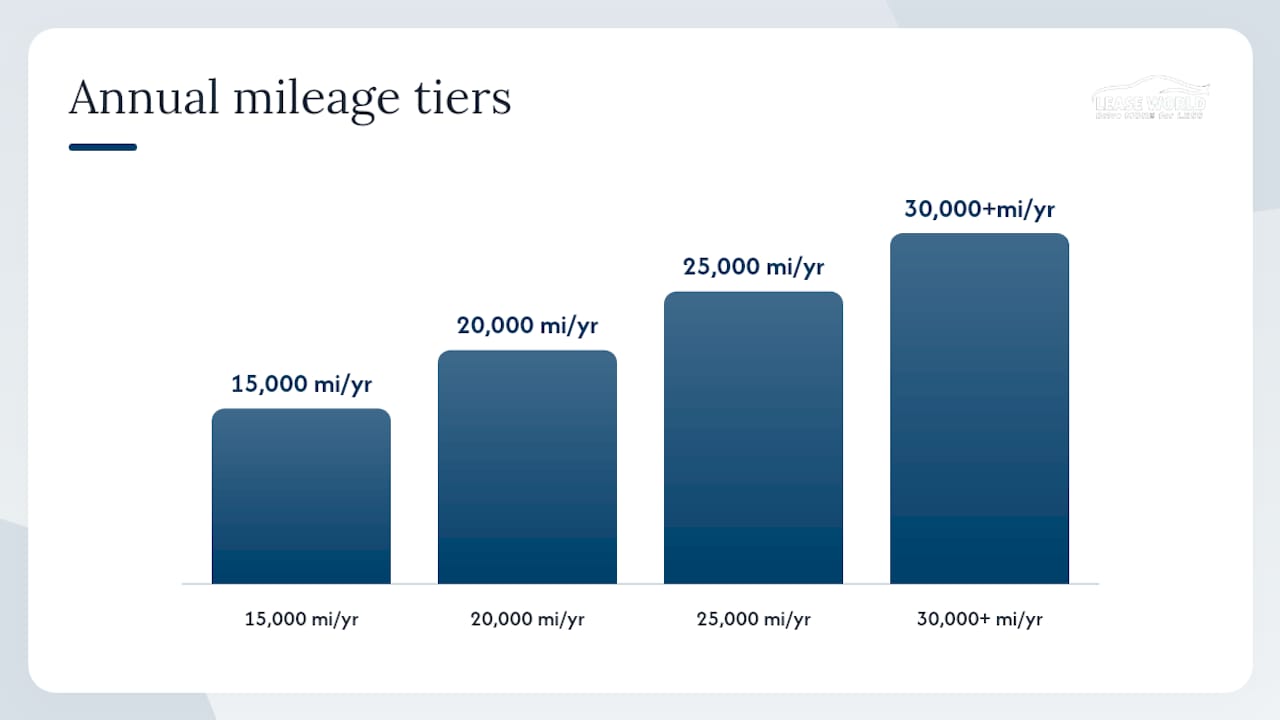
- Standard: 5,000–15,000 miles per year. The default range on most lease deals.
- High mileage: 15,000–30,000 miles per year. Priced at a premium but widely available from most funders.
- Bespoke: Above 30,000 miles per year. Requires a tailored quote; not all funders will offer it.
To see how annual allowances translate into total contract miles, the table below shows the maths across common term lengths:
| Annual allowance | 24-month total | 36-month total | 48-month total |
|---|---|---|---|
| 10,000 miles | 20,000 miles | 30,000 miles | 40,000 miles |
| 15,000 miles | 30,000 miles | 45,000 miles | 60,000 miles |
| 20,000 miles | 40,000 miles | 60,000 miles | 80,000 miles |
| 25,000 miles | 50,000 miles | 75,000 miles | 100,000 miles |
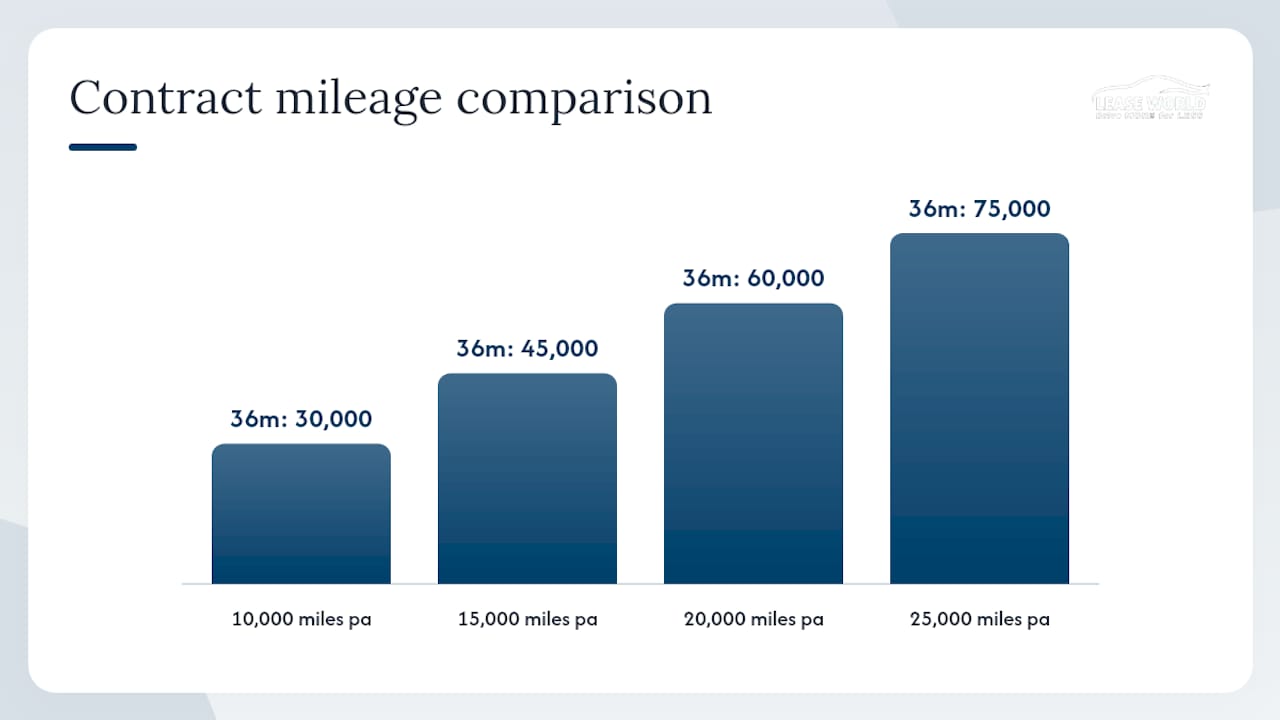
A quick rule of thumb: if your commute, business travel, and leisure driving regularly push you past 15,000 miles in a year, start your search with a high mileage allowance rather than the standard tier.
How agreed mileage changes your monthly payments
Higher agreed mileage directly increases what you pay each month. The reason is residual value: the funder calculates monthly payments by dividing the expected depreciation over the contract term by the number of months. Agreeing to substantially more miles per year increases expected wear and reduces resale value, increasing your monthly payment.
Leasing guides confirm that mileage is a key variable funders use to set monthly costs, alongside the initial payment, contract length, and the car's list price.
A simplified worked example helps make this concrete:
- A mid-range family car has a list price of £30,000.
- At 10,000 miles per year over 36 months, the funder estimates a residual value of £15,000, leaving £15,000 of depreciation to recover.
- At 20,000 miles per year over the same term, the residual value might fall to £12,000, leaving £18,000 to recover.
- That £3,000 difference, spread over 36 months, adds roughly £83 per month before interest and fees.
The numbers vary by make, model, and funder, but the direction is always the same: more miles, lower residual, higher monthly cost.
Pro Tip: Before signing, ask the broker to show you the cost per mile of buying extra allowance upfront versus paying the excess rate at the end. Divide the monthly uplift by the extra miles to get an effective pence-per-mile figure, then compare it to the contract's excess rate. Sometimes paying excess at the end works out cheaper, particularly if you are only marginally over.
How excess mileage charges work and what they cost
Excess mileage charges are a pence-per-mile fee written into your contract. Return the car with more miles than agreed and the funder multiplies the overage by that rate. According to Autotrader, rates commonly span from around 5p to 45p per mile depending on the vehicle segment and funder.
Typical ranges by vehicle segment vary with vehicle type, generally from lower pence-per-mile values for smaller cars up to higher rates for premium models.
These are illustrative market ranges. Your exact rate is in the contract documentation and varies by make, model, and funder.
A worked example: suppose your contract allows 36,000 total miles over three years but you return the car at 39,000 miles, meaning 3,000 miles over.
- At 10p per mile: 3,000 × £0.10 = £300
- At 20p per mile: 3,000 × £0.20 = £600
- At 35p per mile: 3,000 × £0.35 = £1,050
Check your schedule of charges. The excess mileage rate is stated in your order documentation. Find it before you sign, not when you hand the car back.
For more on what happens at the end of a contract, the Lease World guide on exceeding lease mileage covers the process in detail.
How PCH, PCP, and business contract hire treat mileage differently
The short answer: mileage limits apply across all three contract types, but the consequences at the end of the term differ depending on whether you have an ownership option.
- PCH (Personal Contract Hire): You hire the car and hand it back. Exceed the agreed mileage and you pay the excess rate, full stop. There is no option to buy, so the funder's residual value is the only consideration.
- PCP (Personal Contract Purchase): You have a Guaranteed Minimum Future Value (GMFV) set at the start. Exceed your mileage and the car's actual market value at term end may fall below the GMFV, which affects your equity position if you plan to part-exchange. If you exercise the option to buy, you pay the GMFV regardless of actual mileage, but the excess charge still applies on return.
- Business contract hire: Works similarly to PCH but with VAT reclaim implications. Higher mileage allowances can be negotiated, and the monthly cost is often offset against tax. Excess charges apply on handback in the same way.
For a full breakdown of lease terminology including GMFV and residual value, the Lease World leasing glossary is worth bookmarking.
Pro Tip: On a PCP deal, if you plan to sell or part-exchange rather than hand back, mileage still matters for trade value even though you are not paying an excess charge to the funder. A high-mileage PCP car will fetch less at the dealer, so factor that into your total cost of ownership.
How to secure a high mileage lease deal in the UK
Getting the right allowance takes a bit of preparation before you call a broker; exploring options like the Fleet of LAX Sprinter Van Service, Mini Vans & First Class SUVs can give an idea of vehicle choices for high-mileage needs. Work through these steps:
- Estimate your actual annual mileage. Add up your commute, regular long trips, and leisure driving. Then add a buffer of at least 1,000 miles, as dealer guides recommend, to avoid a nasty end-of-term bill.
- Request quotes at multiple allowance levels. Ask the broker to price the same car at 15,000, 20,000, and 25,000 miles per year so you can compare the monthly uplift.
- Calculate the effective cost per mile for each uplift. Divide the extra monthly cost by the extra miles per year, then multiply by the contract length. Compare that figure to the contract's excess rate.
- Ask about mid-term mileage changes. Life changes. Check whether the funder allows you to increase your mileage allowance mid-contract and at what cost.
Questions to ask your broker or funder before signing:
- What is the exact excess mileage rate for this vehicle and funder?
- Can I increase my allowance mid-term, and what is the process?
- Does a higher allowance affect the maintenance package terms?
- Is there a maximum mileage the funder will accept on this model?
- How does the initial payment change if I increase the annual allowance?
Pro Tip: If your mileage is genuinely above 30,000 miles per year, ask specifically for a bespoke quote rather than accepting the highest standard tier. Some funders will negotiate a custom allowance to find the most competitive rate.
Who should consider a high mileage lease?
A high mileage car lease costs more per month than a standard deal, so it only makes financial sense when the alternative is paying large excess charges at handback. The profiles where it typically pays off:
- Long-distance commuters covering 20,000+ miles per year who would breach a standard allowance within the first year.
- Field sales and service workers whose mileage is high but unpredictable month to month.
- Small business owners who use a single vehicle for both business and personal travel and rack up miles quickly.
- Driving instructors whose professional mileage is substantial and consistent.
- Families with multiple regular long trips, such as school runs across counties or frequent motorway journeys.
The decision test is straightforward: multiply your expected excess miles by the contract's pence-per-mile rate, then compare that total to the extra monthly cost of a higher allowance multiplied by the number of months. Whichever is lower is the better financial choice.
One common misjudgement is underestimating occasional long trips. A single holiday drive or a few months of unusually heavy use can push you over the limit faster than expected. Seasonal mileage spikes, particularly in summer, catch drivers out regularly.
How Lease World helps UK drivers find high mileage deals
Lease World specialises in matching UK drivers to lease agreements that fit their actual driving patterns, including higher mileage options that standard comparison sites often bury. As a broker, Lease World approaches multiple funders to find the most competitive rate for your specific allowance requirement.
What Lease World does for high mileage customers:
- Compares funders and presents quotes at multiple mileage tiers side by side.
- Explains the pence-per-mile rate for each deal before you commit.
- Negotiates bespoke allowances for drivers above 30,000 miles per year.
- Offers optional full maintenance packages to cover servicing, tyres, and wear items.
- Arranges free mainland UK delivery on eligible vehicles.
To get an accurate quote, prepare the following before you enquire:
- Your typical annual mileage (honest estimate, not a low guess).
- Any planned long trips or seasonal peaks.
- Preferred contract length (24, 36, or 48 months).
- Whether you want a maintenance package included.
- Your insurance history and whether the vehicle is for personal or business use.
For a broader view of how to choose the right lease mileage, Lease World's dedicated guide walks through the estimation process step by step.
A worked cost example for a higher mileage allowance
Here is a concrete illustration of how an increased allowance changes the numbers. The figures are illustrative and based on realistic market conditions; they are not a quote.
- Base deal: A popular mid-size SUV, 36-month term, 10,000 miles per year, monthly payment of £350.
- Residual value at 10,000 miles per year: approximately £16,000 on a £32,000 car.
- Increase to 20,000 miles per year: residual value drops to approximately £13,500, a reduction of £2,500.
- Monthly payment impact: £2,500 spread over 36 months adds roughly £69 per month, bringing the payment to approximately £419.
- Excess charge comparison: if you stayed on the 10,000-mile deal and drove 20,000 miles per year, you would exceed by 30,000 miles over the term. At 15p per mile, that is £4,500 at handback versus £2,484 extra in monthly payments for the higher allowance.
Please note: funder rates, residual values, and excess charges vary by vehicle, make, model, and funder. This example is illustrative only. Always request a specific quote for your chosen vehicle and mileage requirement.
Three things to remember about high mileage leases
- A high mileage lease sets a higher annual allowance than standard deals, which raises monthly payments because the funder prices in greater depreciation.
- The cost trade-off is monthly uplift versus end-of-term excess charges: calculate both before deciding which allowance to choose.
- The single most important question to ask your broker: "What is the exact pence-per-mile excess rate for this vehicle and funder?" Always check this in the contract's schedule of charges before signing.
The case for erring on the side of more miles
There is a tendency among drivers to pick the lowest mileage allowance that feels plausible, because the monthly payment looks better. It is understandable, but it is usually the wrong call.
The maths rarely favours underestimating. Excess charges at premium rates on a high-end car can run to four figures at handback, and you have no control over the rate once the contract is signed. Buying extra miles upfront, by contrast, locks in a known cost and spreads it across the term.
My recommendation: if you are genuinely unsure whether you will hit 15,000 or 20,000 miles in a year, price both options and compare the total cost over the full term, not just the monthly figure. The difference in monthly payments often looks alarming but the total difference is frequently smaller than one large excess bill. Ask the broker to run that comparison for you in writing before you commit. A good broker will do it without hesitation, and if they will not, that tells you something useful too.
Get a tailored high mileage quote from Lease World
High mileage drivers pay a real penalty for getting the allowance wrong, and the cheapest monthly payment is rarely the cheapest deal overall. Lease World gives you a funder comparison built around your actual mileage, not a standard tier that happens to be available.
Lease World compares funders, explains the pence-per-mile rate for each deal, and can negotiate bespoke allowances for drivers above 30,000 miles per year. Full maintenance packages are available to keep running costs fixed, and free mainland UK delivery applies on eligible vehicles. For drivers who need a vehicle quickly, in-stock van lease deals are also available with shorter lead times.
To get a fast, accurate quote, have your estimated annual mileage, preferred contract length, and maintenance preference ready. Browse the full Lease World leasing guides or request a tailored quotation directly to get started.
Sources
- NTS09: Vehicle mileage and occupancy
- Excess mileage charges on a lease car explained... and how to avoid them | Autotrader
- Are There Mileage Limits on Vehicle Lease Finance?
- High Mileage Car Lease Deals | Carwow
- High Mileage Car Lease Deals | LeaseLoco
- How do I find the excess mileage charge? | Carparison
- High‑Mileage Lease: Everything You Should Know - St. Charles Nissan
Always check your specific contract's schedule of charges for the authoritative pence-per-mile figure. Published market ranges are guides; your contract rate is the only one that counts.
FAQ
What is considered high mileage for a lease in the UK?
Most UK brokers treat 15,000 miles per year or above as high mileage, given that the national average sits at around 7,000 miles per year. Anything above 30,000 miles per year typically requires a bespoke quote.
Is 10,000 miles a lot for a lease?
No. At 10,000 miles per year, you are well within the standard allowance range offered by most UK funders and below the national average for many driver types. A high mileage option is unlikely to be necessary unless your driving increases significantly.
Can you lease a car if you do high mileage?
Yes. Mileage limits are near-universal in UK lease contracts, but funders offer higher allowances up to 30,000 miles per year as standard, and bespoke options above that. The monthly payment rises to reflect the greater depreciation, but high mileage drivers are not excluded from leasing.
Can you change your mileage allowance after signing?
Some funders allow a mid-term mileage increase, though it usually comes with an administration fee and a revised monthly payment. It is not guaranteed, so it is better to set the right allowance at the start. Lease World's guide on changing mileage mid-contract explains the process and what to expect.
Is 200,000 miles considered high mileage on a lease?
That figure refers to total lifetime vehicle mileage, not an annual lease allowance. No standard UK lease contract offers an annual allowance above 30,000 miles per year. Over a 36-month term, a 30,000-miles-per-year deal totals 90,000 miles. A car with high mileage on the clock is typically described as high mileage in the used car market, not in the leasing context.