

TL;DR:
- A vehicle lease agreement is a binding contract that details your rights, costs, and responsibilities during the rental period. Understanding key terms helps you avoid unexpected charges and maintain control over your monthly expenses.
A vehicle lease agreement is a legally binding contract that sets out your rights, costs, and obligations for the duration of a rental period. Getting to grips with the key terms before you sign protects you from unexpected charges and gives you full control over your monthly budget. The British Vehicle Rental and Leasing Association (BVRLA) sets the industry standards that govern fair wear and tear, damage assessments, and end-of-contract procedures across the UK. Understanding lease agreement terms is not optional reading. It is the difference between a predictable monthly cost and a bill that catches you off guard.
What are the key terms in a vehicle lease agreement?
Personal Contract Hire (PCH) is the formal industry term for what most people call vehicle leasing. PCH is a pure rental agreement where monthly payments reflect the vehicle's expected depreciation plus finance costs. You never own the car. That single fact shapes every clause in the contract.
The core terms you will encounter in any UK vehicle lease include the following.
- Initial payment: An upfront sum, typically equivalent to three to nine monthly payments, paid before the vehicle is delivered. Some agreements offer a no-deposit option.
- Monthly rental: The fixed amount paid each month, calculated on depreciation and finance fees.
- Contract length: Typical lease terms run two to four years. Longer contracts reduce monthly payments but reduce your flexibility to change vehicles.
- Annual mileage allowance: The agreed number of miles you can drive each year without penalty.
- Fair wear and tear: The BVRLA publishes a specific guide defining what condition the vehicle must be returned in. Damage beyond those standards triggers repair charges.
- Maintenance package: An optional add-on covering servicing, tyres, and routine upkeep for a fixed monthly fee.
Pro Tip: Read the fair wear and tear guide published by the BVRLA before you sign. It defines exactly what counts as acceptable condition at return, and knowing it upfront saves disputes later.
One term that confuses many lessees is the difference between PCH and Personal Contract Purchase (PCP). PCP includes an option to buy the car via a final balloon payment, while PCH does not. If you have no intention of owning the vehicle, PCH typically offers the cleaner, simpler arrangement.
How do costs and payments work in vehicle leasing?
Monthly payments in leasing are calculated primarily on depreciation. The finance provider estimates how much value the vehicle will lose over your contract term, then divides that figure by the number of months and adds interest and fees. Leasing offers the lowest monthly costs compared to PCP or Hire Purchase (HP) because you are only paying for the portion of the car you use, not working towards ownership.

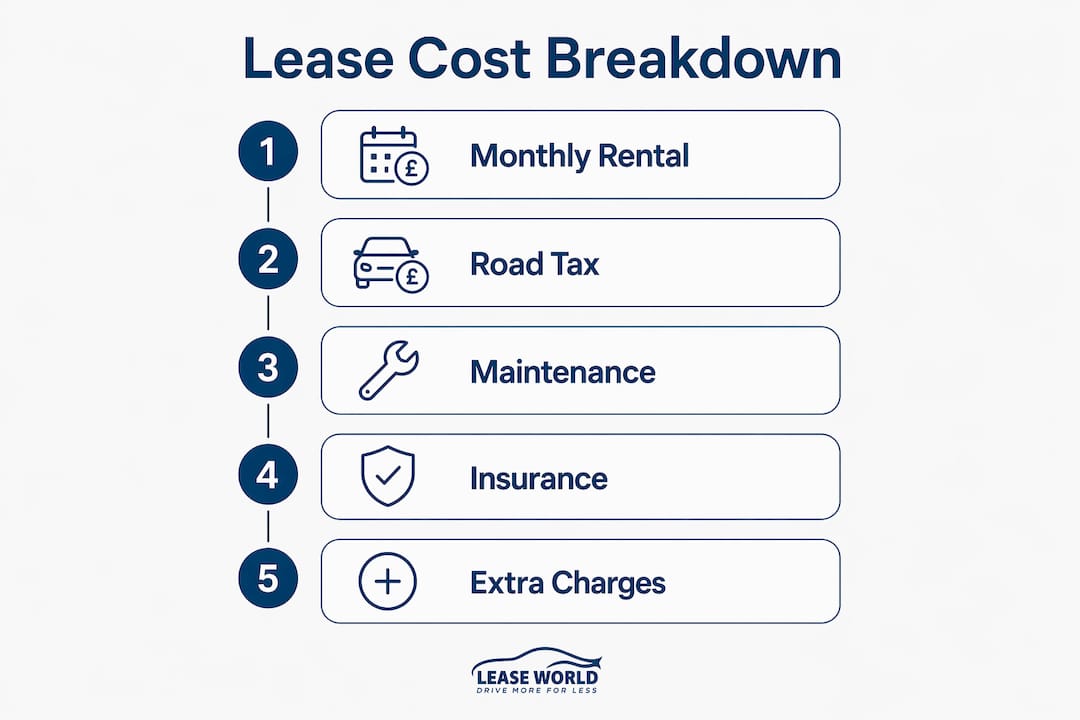
The table below shows the main cost components in a typical UK vehicle lease.
| Cost component | What it covers | Included as standard? |
|---|---|---|
| Monthly rental | Depreciation plus finance fees | Yes |
| Road tax (VED) | Vehicle Excise Duty for the contract period | Usually yes |
| Maintenance package | Servicing, tyres, and routine repairs | Optional add-on |
| Excess mileage charge | Fee per mile over the agreed annual limit | Charged at contract end |
| Damage charges | Repairs beyond BVRLA fair wear and tear | Charged at return |
| Early termination fee | Settlement cost for ending the contract early | Charged if applicable |
Road tax is often included in lease agreements for the full contract duration. That removes one recurring admin task from your plate. Maintenance packages are offered separately and cover servicing and routine upkeep for an additional fixed monthly cost.
Pro Tip: Calculate your true monthly cost by adding the maintenance package fee to your base rental before comparing deals. A lower headline rental with no maintenance cover can cost more overall if your vehicle requires frequent servicing.
Understanding how monthly payments are calculated based on depreciation, mileage, and condition lets you make smarter decisions about contract parameters. Choosing a higher mileage allowance upfront raises your monthly payment slightly but costs far less than paying excess mileage charges at the end.
What are the lessee's obligations during the lease term?
The lessee carries specific responsibilities throughout the contract. Breaching any of them can result in financial penalties or damage to your credit record.
- Mileage compliance: Excess mileage fees run around 10p per mile in the UK. On a contract where you exceed your limit by 5,000 miles, that is £500 added to your final bill. Monitoring your annual mileage usage throughout the contract prevents this.
- Vehicle condition: You must return the vehicle in a condition consistent with BVRLA fair wear and tear standards. Scratches beyond a defined size, damaged alloys, and interior stains that exceed normal use all attract charges.
- Servicing schedule: Lease contracts commonly require adherence to specific servicing schedules. Missing a service can affect the vehicle's condition rating at return and may void warranty cover.
- No modifications: You cannot alter the vehicle in any permanent way. Fitting non-standard accessories, respraying panels, or making mechanical changes all breach the contract.
- Insurance: You must maintain fully comprehensive insurance throughout the lease term. Third-party only cover is not acceptable under standard lease conditions.
The consequences of breaching these obligations range from fixed penalty charges to early termination of the agreement. Knowing them before you sign means you can plan your usage accordingly.
What happens at the end of a vehicle lease agreement?
The end of a lease is where most unexpected costs appear. Preparing for it throughout the contract, rather than in the final weeks, is the most effective way to avoid a large bill.
- Book a pre-return inspection. Many lease providers offer a courtesy check several weeks before the return date. Use it to identify any damage that you can repair yourself at a lower cost than the provider's fixed repair fees.
- Address minor damage yourself. Fixing minor issues before return reduces end-of-lease charges significantly. A small scuff repaired by a local bodywork specialist costs far less than the standardised charge applied by the leasing company.
- Check your mileage. Confirm your total mileage against your contracted allowance before the vehicle is collected. If you are under, you have used your allowance efficiently. If you are over, calculate the excess charge so it does not come as a surprise.
- Understand your options. At contract end, you return the vehicle and either enter a new lease or walk away. PCH does not include a purchase option, so ownership is not on the table. Some providers allow you to extend the contract on a rolling monthly basis if you need more time.
- Confirm the return process. The vehicle is collected or returned to a specified location. A formal inspection is conducted, and any charges are invoiced within a set period. Keep a copy of the inspection report for your records.
Pro Tip: Take dated photographs of the vehicle from every angle on the day of return. If a dispute arises over damage, photographic evidence is your strongest defence.
For a full breakdown of what to expect, the Lease World guide on end-of-lease procedures covers every stage of the return process in detail.
How do you manage and negotiate lease agreement terms?
Reading the contract in full before signing is non-negotiable. Most lessees focus on the monthly payment and overlook clauses that define their obligations. The clauses that matter most are mileage limits, excess mileage rates, damage standards, and early termination conditions.
- Adjust your mileage allowance before signing. Choosing the right mileage allowance upfront and monitoring usage during the contract prevents costly excess charges. If your driving habits change mid-contract, contact your provider to discuss increasing the allowance. It is cheaper to adjust the contract than to pay the per-mile penalty at the end.
- Weigh up maintenance packages carefully. Maintenance packages offer convenience but may not always be cost-effective depending on your expected usage and the vehicle's servicing requirements. Compare the package cost against the manufacturer's recommended service schedule before committing.
- Know your voluntary termination rights. Under the Consumer Credit Act 1974, lessees using certain regulated agreements have the right to voluntarily terminate once they have paid 50% of the total amount payable. Knowing your termination rights and consulting your finance provider early helps manage unexpected circumstances without serious financial detriment.
- Ask every question before you sign. A reputable provider will answer questions about any clause clearly. If a provider is reluctant to explain a term, treat that as a warning sign.
"The most expensive mistake a lessee makes is signing a contract they have not fully read. Every clause exists for a reason, and understanding each one before you commit is the only way to lease with genuine confidence."
If you are unsure about any clause, seek independent advice from a financial adviser or consult the car lease terminology glossary to clarify definitions before proceeding. Reducing vehicle repair costs during the lease term also helps protect your end-of-contract position. Practical guidance on cutting repair costs throughout ownership is worth reading before you take delivery.
Key takeaways
Understanding lease agreement terms fully before signing is the single most effective way to control costs and avoid penalties throughout a UK vehicle lease.
| Point | Details |
|---|---|
| PCH is a rental, not ownership | Monthly payments cover depreciation and fees only; no purchase option exists at contract end. |
| Mileage limits carry real costs | Excess mileage charges run around 10p per mile, making upfront allowance selection critical. |
| BVRLA standards define fair condition | Vehicle condition at return is assessed against BVRLA guidelines, not subjective judgement. |
| Early termination is costly | Ending a lease early typically triggers significant settlement fees; check terms before signing. |
| Pre-return preparation saves money | Fixing minor damage yourself before return costs less than standardised provider repair charges. |
What I have learned from watching UK lessees get it wrong
The most common mistake I see is treating the monthly payment as the only number that matters. Lessees compare headline rentals, pick the lowest figure, and sign without reading the mileage limit or the excess charge rate. Then, twelve months in, they realise they are on course to exceed their allowance by several thousand miles and the per-mile penalty will wipe out any saving they made on the monthly rate.
The second pattern I notice is a reluctance to question contract terms. A lease agreement is a negotiation, not a take-it-or-leave-it document. Mileage allowances, initial payments, and maintenance inclusions are all adjustable before you sign. Providers expect questions. The lessees who ask them consistently get better outcomes.
My honest view is that the contract length decision deserves far more attention than it gets. A two-year contract costs more per month but gives you the flexibility to move to a newer model sooner. A four-year contract reduces your monthly outgoing but locks you in as technology and your circumstances change. Neither is universally better. The right answer depends on your driving habits, your budget, and how quickly the vehicle type you want tends to depreciate.
Lease World's approach of providing transparent terms and no hidden fees reflects what the leasing process should look like for every customer. The complexity is real, but it is manageable when you know what to look for.
— Jason
Lease World: clear leasing support for UK drivers and businesses
Lease World works with individuals and businesses across the UK to make vehicle leasing straightforward from the first enquiry to the day of delivery.
Whether you are leasing a car for personal use or sourcing a fleet of vans for your business, Lease World offers fixed monthly payments, no-deposit options on eligible vehicles, and complimentary UK delivery. The leasing guides cover everything from contract basics to manufacturer lead times, giving you the context to make confident decisions. For a deal built around your mileage, budget, and contract length, request a personalised lease quote directly from the Lease World team. Transparent terms, no hidden fees, and dedicated support throughout your contract.
FAQ
What is Personal Contract Hire (PCH)?
Personal Contract Hire is the formal term for vehicle leasing. Monthly payments cover depreciation and finance fees, and the vehicle is returned at the end of the contract with no option to purchase.
How are monthly lease payments calculated?
Payments are based on the vehicle's expected depreciation over the contract term, adjusted for mileage allowance and finance costs. Higher mileage allowances and shorter contract terms increase the monthly payment.
What happens if I exceed my mileage limit?
Excess mileage is charged at a rate agreed in the contract, typically around 10p per mile in the UK. The charge is applied at the end of the contract based on the total miles driven above the agreed annual limit.
Can I end a vehicle lease early?
Early termination is possible but usually incurs significant settlement fees covering outstanding payments and administrative costs. Check the early termination clause carefully before signing any agreement.
What condition must I return the vehicle in?
The vehicle must meet BVRLA fair wear and tear standards. Damage beyond those standards, such as large scratches, cracked glass, or missing trim, will be charged at the provider's repair rates.