

TL;DR:
- A lease agreement is a legally binding contract that grants exclusive possession of an asset for a set period. It must include specific core components to be enforceable and avoid legal or financial risks.
- Breaking a lease early often incurs penalties unless the contract provides clear termination provisions, and maintaining detailed documentation protects both parties throughout the lease.
A lease agreement is a legally binding contract that grants a lessee exclusive possession of a property or asset for a defined period, in exchange for agreed payments. The lessee gains a legal interest in the asset, not merely permission to use it. Lease terms typically run from six months to several years, making a lease fundamentally different from a short-term hire or a licence. In the UK, lease agreements govern everything from residential tenancies and commercial premises to vehicle contracts, and understanding their structure before signing is the single most effective way to avoid costly disputes.
What is a lease agreement and what must it include?
A lease agreement is defined as a contract between a lessor (the owner) and a lessee (the user), setting out the terms under which the lessee holds exclusive use of an asset. Effective lease agreements contain at least 15 core components to be legally enforceable and practically useful. Missing even one key clause can expose both parties to financial and legal risk.
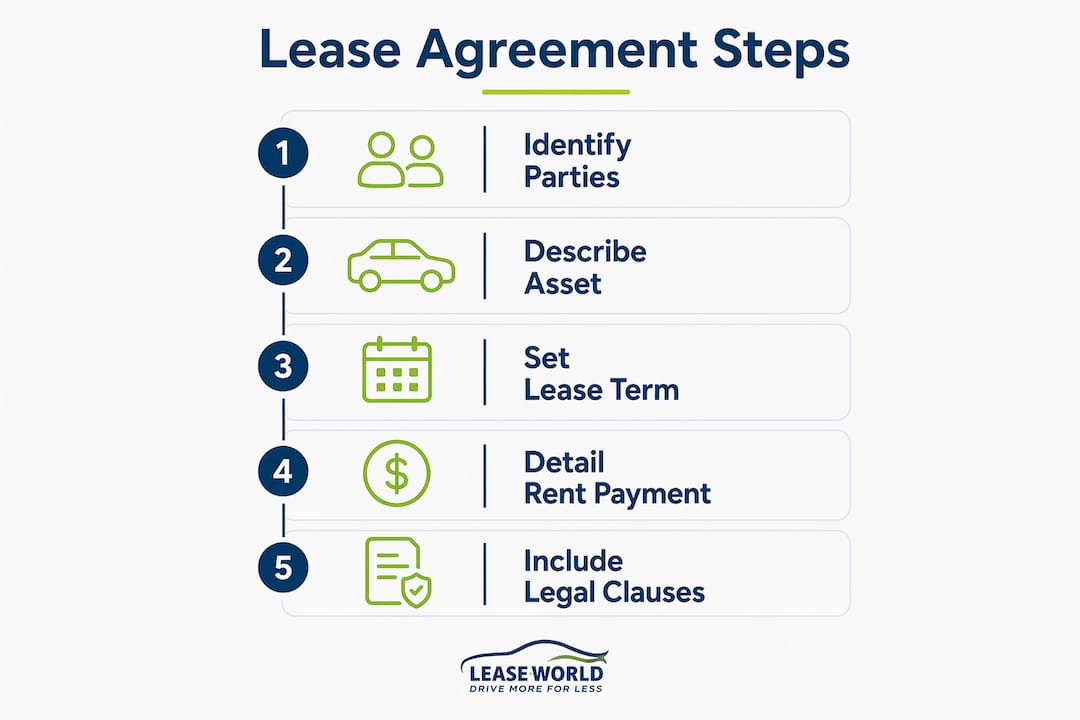
The core components of a well-drafted lease are:
- Names and contact details of all parties (lessor and lessee)
- Full description of the asset, including address or registration details for vehicles
- Lease term, with precise start and end dates
- Rent or payment amount, frequency, and accepted payment methods
- Security deposit amount and the conditions for its return
- Grace periods and late payment fees, stated clearly in writing
- Maintenance responsibilities, specifying who handles routine upkeep versus structural repairs
- Subletting rules, confirming whether the lessee may sublet and under what conditions
- Permitted use, defining how the asset may be used
- Insurance requirements, particularly relevant for vehicle leases
- Early termination conditions, including any fees or notice periods
- Renewal terms, stating whether the lease rolls over automatically
- Governing law, confirming which jurisdiction applies
- Dispute resolution process, such as mediation before litigation
- Signatures of all parties, with dates
Deposit return timelines and late fee structures deserve particular attention. Missing required disclosures can void a lessor's right to retain a deposit, which is a costly oversight that courts take seriously. Grace periods for late payment, typically five to seven days in UK residential leases, should be written into the contract rather than assumed.
Pro Tip: Attach a signed move-in or collection inspection report with timestamped photographs to every lease. This single document resolves the majority of deposit disputes before they escalate.
How do lease agreements work, and how do they differ from licences?
A lease works by transferring a legal interest in the asset to the lessee for the agreed term. A lease grants an estate in property; a licence grants only permission to use premises. That distinction carries significant legal weight. A lessee can exclude others, including the lessor in most circumstances, from the asset during the term. A licensee cannot.

The difference between a lease and a month-to-month rental agreement is equally important. A fixed-term lease locks in the rent and terms for its full duration, giving both parties certainty. A rental agreement, by contrast, typically renews monthly and can be ended by either party with relatively short notice. For businesses planning around a fixed cost base, a lease offers stability that a rolling rental agreement cannot match.
| Feature | Fixed-term lease | Month-to-month rental |
|---|---|---|
| Duration | Six months to several years | Renews monthly |
| Rent certainty | Fixed for the term | Can change with notice |
| Legal interest | Estate in property | Contractual permission |
| Termination | Requires notice or penalty | Short notice by either party |
| Stability | High | Low |
The leasing process step by step for vehicles follows the same legal logic: the lessee holds exclusive use of the vehicle, pays fixed monthly amounts, and returns it at the end of the term.
Pro Tip: Always insist on a written agreement, even for short terms. Verbal lease agreements are difficult to prove in court, and ambiguity almost always works against the party with less documentation.
What happens when you break a lease early?
Breaking a lease before its end date triggers financial penalties and, in some cases, legal action. A lessee may owe the remaining rent unless the contract includes early termination provisions. That liability can be substantial on a multi-year commercial lease or a three-year vehicle contract.
Most well-drafted leases include an early termination clause that sets out a specific fee or notice period. Without one, the lessee's exposure is open-ended. The key steps when seeking to exit a lease early are:
- Review the contract for any early termination clause, break clause, or notice requirements.
- Notify the lessor in writing as soon as possible, preserving a clear record of the date.
- Negotiate a settlement, which may involve paying a fixed penalty rather than the full remaining term.
- Find a replacement lessee if the contract permits assignment or subletting, which can reduce or eliminate the financial penalty.
- Seek legal advice if the lessor refuses to negotiate and the sums involved are significant.
Exceptions to early termination penalties exist for certain protected groups in UK law, including tenants fleeing domestic abuse under the Domestic Abuse Act 2021. For vehicle leases, Lease World's guide on ending a car lease early sets out the specific options and costs involved. Clear written terms at the outset are the most effective way to limit exposure on both sides.
Best practices for managing and updating a lease agreement
A lease agreement is a live document, not a static one. All modifications must be formally documented as addenda to maintain enforceability. Verbal changes, text messages, and informal emails carry no legal weight unless they are incorporated into a signed addendum. This applies to changes in rent, permitted use, subletting arrangements, and pet policies.
The following practices reduce disputes and protect both parties throughout the lease term:
- Use signed addenda for every change. A handshake agreement on a rent reduction or a new clause is unenforceable without a written, signed document.
- Define maintenance terms precisely. Failure to distinguish normal wear and tear from damage causes most security deposit disputes. Specify what each term means in the contract itself.
- Conduct regular inspections. Scheduled inspections with written reports create an ongoing record of the asset's condition. For vehicle leases, understanding who pays for repairs is a common source of confusion that clear contract language resolves.
- Include a governing law clause. Governing law and dispute resolution clauses prevent costly litigation by requiring mediation or arbitration before either party can pursue court action.
- Keep all communication in writing. Emails and letters create a timestamped record that is admissible in dispute proceedings.
The difference between maintenance and repair is a practical distinction that every lessee should understand before signing. Routine maintenance is typically the lessee's responsibility; structural or mechanical failure often falls to the lessor. Getting this in writing prevents the most common source of end-of-lease conflict.
Pro Tip: Create a dedicated folder, physical or digital, for every lease. Store the original contract, all addenda, inspection reports, photographs, and correspondence in one place. If a dispute arises, this folder is your strongest asset.
Key takeaways
A lease agreement grants exclusive legal possession of an asset for a fixed term, and its enforceability depends entirely on how completely and clearly it is written.
| Point | Details |
|---|---|
| Definition matters | A lease grants a legal estate in an asset; a licence grants only permission, with far fewer protections. |
| Completeness is critical | Agreements with at least 15 core components are far less likely to produce costly disputes. |
| Written beats verbal | Verbal agreements are difficult to enforce; all changes must be signed addenda to carry legal weight. |
| Early exit has a cost | Breaking a lease early can mean owing the full remaining term unless a termination clause limits liability. |
| Documentation protects both parties | Timestamped inspection reports and written correspondence resolve most deposit and maintenance disputes. |
What I have learned after years of watching lease disputes unfold
The single biggest mistake I see is treating a lease as a formality rather than a legal instrument. People sign quickly, file the document away, and assume goodwill will cover any gaps. It rarely does.
The confusion between a lease and a licence is more common than most people realise. A client once assumed they had full tenancy rights over a commercial space, only to discover they had signed a licence agreement. The lessor could terminate with minimal notice, and the occupier had no legal recourse. The word "lease" appeared in the document's title, but the substance was a licence. Reading the operative clauses, not just the heading, is non-negotiable.
Deposit disputes are the other area where I see avoidable pain. The argument is almost always the same: the lessor claims damage, the lessee claims wear and tear, and neither party has photographs to prove their position. A five-minute inspection at the start of a lease, documented with a phone camera and a signed report, eliminates this argument entirely.
My strongest advice is to treat the lease as the relationship. If the written terms are vague, the relationship will be vague. If the contract is clear, fair, and complete, both parties know exactly where they stand from day one. That clarity is worth far more than the time it takes to draft it properly.
— Jason
Lease World: vehicle leasing with clear, fair contracts
Understanding a lease agreement is the foundation of any good leasing decision. Lease World applies that same principle to every vehicle contract it offers.
Lease World is a family-run UK leasing specialist with a reputation built on transparent terms, fixed monthly payments, and no hidden fees. Whether you are looking at window van lease deals for a trade business or a personal car contract, Lease World provides detailed contract summaries and dedicated support at every stage. The team walks you through every clause before you sign, so there are no surprises at the end of the term. For tailored advice, contact Lease World directly or browse the full range of leasing guides to find the right contract for your needs.
FAQ
What is the legal definition of a lease agreement?
A lease agreement is a legally binding contract that grants a lessee exclusive possession of a property or asset for a defined term in exchange for agreed payments. It creates a legal interest in the asset, distinguishing it from a licence, which grants only permission to use.
What is the difference between a lease and a rental agreement?
A lease runs for a fixed term, typically six months or longer, with locked-in terms. A rental agreement usually renews monthly and can be ended by either party with short notice, offering less stability for both sides.
What should every lease agreement include?
Every lease should include the names of all parties, a full asset description, the lease term, rent amount and payment method, deposit terms, maintenance responsibilities, subletting rules, and a dispute resolution clause.
Can a verbal lease agreement be enforced in the UK?
A verbal lease agreement can be legally binding but is very difficult to prove in court. Written contracts are strongly recommended because ambiguity in verbal agreements almost always leads to disputes.
What happens if you break a lease early?
Breaking a lease early typically means owing the remaining rent unless the contract contains an early termination clause. Negotiating a settlement or finding a replacement lessee can reduce the financial penalty.