

TL;DR:
- A short-term vehicle lease lasts up to twelve months, offering flexible, predictable rental options for individuals and businesses. It involves fixed monthly payments, mileage caps, and straightforward end-of-contract returns, with higher monthly costs compared to long-term leases but no deposit or early termination penalties. This leasing type provides greater flexibility, reduced administrative burdens, and quicker access to newer vehicles, making it ideal for temporary needs, seasonal demands, or transitional periods.
A short-term lease is a vehicle leasing contract that typically spans one to twelve months, giving individuals and businesses a flexible alternative to committing to a standard two to five year agreement. Short-term vehicle leases are structured around fixed monthly payments, defined mileage allowances, and clear end-of-contract terms, making them predictable and manageable from day one. Lease World and specialist brokers like Flexed offer durations of three, six, and twelve months across cars and vans, covering everything from temporary personal transport to seasonal business fleet needs. The definition of short term lease in a vehicle context is distinct from property short-term lets, a distinction that matters enormously when you are comparing contracts or checking regulatory obligations.
What is a short term lease for vehicles?
A short-term vehicle lease is a formal hire agreement lasting twelve months or less, under which you pay a fixed monthly sum to use a car or van without owning it. The lessee never acquires the asset. At the end of the contract, the vehicle is returned to the leasing company, with no residual value to worry about and no depreciation risk sitting on your balance sheet.

Standard durations in the UK market are three, six, and twelve months. A three-month lease suits a contractor starting a short project. A six-month lease fits a business covering a seasonal peak. A twelve-month lease works well for someone relocating or waiting for a new model to arrive. Each duration carries the same core structure: a monthly payment, a mileage cap, and a wear-and-tear policy.
What short-term leasing means in practice is that you gain access to a vehicle quickly, often within days of approval, without the financial exposure of a long-term contract. UK vehicle lease agreements are structured so that short-term options minimise lock-in time and associated penalties, which is precisely why SMEs use them to cover bridge periods such as temporary roles or seasonal demand.
Pro Tip: If you are unsure which duration suits your situation, use a lease term length guide to compare twelve to sixty month contracts side by side before committing.
Short term lease vs long term lease: what is the difference?
The most visible difference is contract length. Long-term leases run from twenty-four to forty-eight months. Short-term leases run from one to twelve months. That gap in commitment creates a cascade of differences across cost, flexibility, and contract conditions.
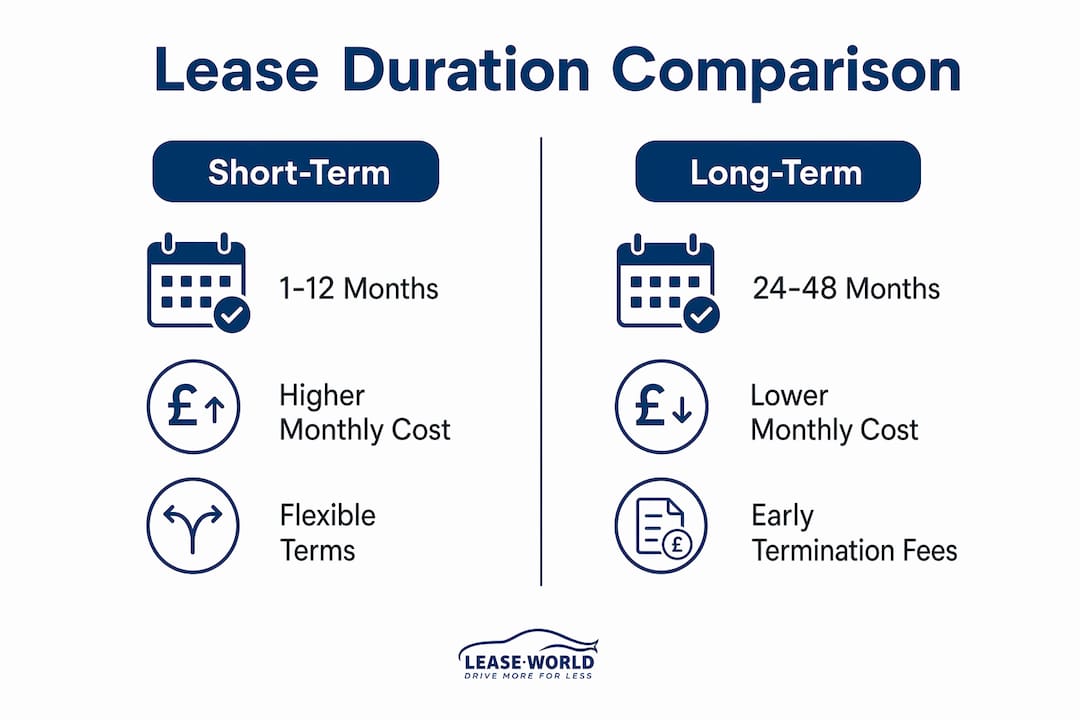
| Feature | Short-term lease | Long-term lease |
|---|---|---|
| Contract duration | 1 to 12 months | 24 to 48 months |
| Monthly cost | Higher per month | Lower per month |
| Flexibility | High, easier exit | Low, penalties apply |
| Mileage cap | Typically lower | Typically higher |
| Deposit requirement | Often none | Usually required |
| Best for | Temporary or uncertain needs | Stable, predictable usage |
The financial trade-off is real. You pay more per month on a short-term contract because the leasing company recovers its costs over a shorter period. A driver paying £350 per month on a twenty-four month lease might pay £480 per month for the same car on a six-month deal. That premium buys you the right to walk away cleanly at the end without a penalty.
Early termination is where long-term leases become costly. Lease term length and early termination charges are the most critical contract elements for businesses needing flexible fleet solutions. With a short-term lease, the contract ends naturally at the agreed date, so there is no early exit fee to absorb.
There is also an accounting advantage worth noting. IFRS 16 grants a short-term lease exemption for leases of twelve months or less without a purchase option, reducing the administrative burden of putting the lease on your balance sheet. For small businesses in particular, that simplification has real value.
What are the benefits and limitations of short-term vehicle leases?
Short-term leasing delivers genuine advantages, but it is not the right choice for every situation. Understanding both sides helps you make a decision grounded in your actual needs rather than marketing copy.
The main benefits include:
- Flexibility. You are not locked in for years. If your circumstances change, a project ends, or a better vehicle becomes available, you are free to move on at contract end.
- No large upfront cost. Many short-term leases require no deposit, which preserves cash flow for individuals and businesses alike.
- Predictable monthly costs. Fixed payments make budgeting straightforward, with no surprise depreciation or resale risk.
- Access to newer vehicles. Short contracts mean you can rotate into newer models more frequently, which matters for businesses projecting a professional image.
- Reduced administrative burden. The short-term lease exemption under accounting standards removes the need to capitalise the lease on your balance sheet.
The benefits of short-term car leasing are particularly strong for contractors, seasonal businesses, and anyone in a transitional period such as relocating for work or waiting for a long-term vehicle order to arrive.
The limitations are equally worth knowing:
- Higher monthly cost compared to an equivalent long-term contract.
- Lower mileage allowances, which can result in excess mileage charges if you underestimate your usage.
- Fewer vehicle customisation options, since the car returns to the fleet at the end.
- Availability can be limited during high-demand periods, particularly for specific models or body types.
Businesses managing fluctuating fleet needs must pay close attention to mileage caps and wear-and-tear conditions to avoid penalties at contract end. These charges are not punitive by design, but they catch lessees who do not read the contract carefully.
Pro Tip: Before signing, calculate your realistic monthly mileage and add a ten per cent buffer. Underestimating mileage is the single most common source of unexpected costs on short-term vehicle contracts.
How to find and secure a short-term lease in the UK
Finding a short-term vehicle lease in the UK is straightforward if you know where to look and what to verify before signing.
-
Start with specialist leasing companies. Lease World offers three, six, and twelve month lease deals across cars and vans, with no deposit options and free UK delivery on eligible vehicles. Specialist providers understand short-term requirements and can turn around agreements faster than generalist dealers.
-
Use broker comparison platforms. Brokers aggregate deals from multiple funders, which can surface lower monthly rates or more suitable mileage packages than going directly to a single provider.
-
Check eligibility requirements before applying. Short-term leases still require a credit check. Reviewing UK car leasing eligibility criteria before applying avoids unnecessary hard searches on your credit file.
-
Verify the key contract terms. Before signing any short-term rental agreement, confirm the exact duration, monthly mileage allowance, maintenance responsibilities, and the conditions for early termination. UK leasing agreements set out predefined mileage caps and maintenance obligations that distinguish them from simple rental arrangements.
-
Negotiate where possible. Short-term lease providers have more flexibility than you might expect, particularly on mileage allowances and delivery timelines. If the standard package does not fit, ask for an adjusted quote rather than accepting the default.
The process from enquiry to delivery typically takes between three and ten working days with an established UK leasing company. That speed is one of the practical advantages that makes short-term leasing genuinely useful in time-sensitive situations.
Vehicle leases vs property short-term lets: understanding the difference
Many people searching for information about short-term leases are actually thinking about two entirely different things, and the distinction matters for both compliance and contract expectations.
A short-term vehicle lease is a private hire agreement between a lessee and a leasing company, governed by consumer credit and contract law. It is not regulated by housing legislation. The vehicle is returned at the end of the agreed term, and no property rights are involved.
A short-term property let is a residential accommodation arrangement, often facilitated through platforms like Airbnb or direct landlord agreements. In Scotland, the Scottish Government defines short-term lets as residential accommodation provided to guests, covering categories including home sharing and secondary letting, each of which requires a licence under the Scottish licensing scheme. These can run from a single night to several months, but they carry regulatory obligations that have no equivalent in vehicle leasing.
| Asset type | Governing framework | Licence required? | Typical duration |
|---|---|---|---|
| Vehicle lease | Contract and consumer credit law | No | 1 to 12 months |
| Property short-term let (Scotland) | Scottish licensing scheme | Yes | 1 night to several months |
| Property short-term let (England) | Planning and tenancy law | Varies by local authority | 1 night to several months |
The practical implication is this: if you are a business or individual looking for a flexible vehicle, you are dealing with a leasing contract. If you are a landlord or host renting out a property for short periods, you are operating under a separate and more complex regulatory framework. Conflating the two leads to misplaced expectations and, in some cases, compliance gaps.
Key takeaways
Short-term vehicle leasing is the most flexible way to access a car or van in the UK without the financial and contractual exposure of a long-term agreement.
| Point | Details |
|---|---|
| Definition is specific | A short-term vehicle lease runs from one to twelve months with fixed payments and a mileage cap. |
| Cost trade-off is real | Monthly payments are higher than long-term leases, but there is no deposit and no early exit penalty. |
| Contract terms decide value | Mileage allowance, wear-and-tear policy, and termination conditions determine whether the deal suits your needs. |
| Vehicle and property leases differ | Short-term vehicle leases and property short-term lets operate under entirely separate legal frameworks. |
| Accounting benefit exists | Leases of twelve months or less qualify for the IFRS 16 short-term exemption, reducing balance sheet complexity. |
Why short-term leasing deserves more credit than it gets
I have seen a lot of UK drivers and business owners dismiss short-term leasing as an expensive stopgap. That view is understandable but incomplete. The higher monthly cost is real, but it is the wrong number to focus on in isolation.
What you are actually buying with a short-term lease is optionality. In 2026, with supply chains still unpredictable and business conditions shifting faster than most planning cycles can accommodate, the ability to commit for six months rather than forty-eight is genuinely valuable. I have spoken with fleet managers at SMEs who locked into long-term contracts in 2022 and spent the following two years paying for vehicles they no longer needed, because their project pipeline changed. A short-term lease would have cost more per month but far less overall.
The other thing I would flag is the mileage trap. Most people underestimate how much they drive, particularly when a vehicle is new and convenient. The excess mileage charges on a short-term contract are not extortionate, but they are avoidable. Build your realistic mileage into the contract from the start, even if it pushes the monthly cost up slightly. You will come out ahead.
Short-term leasing is not a compromise. For the right person in the right situation, it is the most rational vehicle decision available. The key is knowing your timeline, your mileage, and your exit conditions before you sign.
— Jason
Explore short-term vehicle leases with Lease World
Lease World offers a straightforward range of short-term vehicle leasing options built around the needs of UK individuals and businesses. Whether you need a car for three months or a van for twelve, the process is transparent, with fixed monthly payments and no hidden fees.
Browse flexible short-term lease deals across cars and vans, with durations of three, six, and twelve months available. Lease World's family-run approach means you get direct support rather than a call centre, and free UK delivery is included on eligible vehicles. If you are weighing up your options, the leasing guides cover everything from eligibility to contract terms in plain language.
FAQ
What does short term leasing mean for a vehicle?
Short-term vehicle leasing means hiring a car or van under a fixed contract of one to twelve months, with set monthly payments, a mileage allowance, and a clear return date. You use the vehicle without owning it and hand it back at the end of the agreed term.
How does a short-term lease work in practice?
You apply through a leasing company, agree on the duration, mileage cap, and monthly cost, then take delivery of the vehicle. At the end of the contract, you return it. There is no purchase option and no residual value to manage.
Is a short-term lease more expensive than a long-term lease?
Yes, the monthly cost is higher on a short-term lease because the leasing company recovers its costs over fewer months. However, there is typically no deposit required and no early termination penalty, which can make the total cost lower if your needs change.
What is the difference between a short-term vehicle lease and a property short-term let?
A vehicle lease is a contract governed by consumer credit and contract law, requiring no licence. A property short-term let, particularly in Scotland, falls under a separate licensing scheme with regulatory obligations that do not apply to vehicle leasing.
What should I check before signing a short-term lease agreement?
Verify the exact contract duration, monthly mileage allowance, maintenance responsibilities, wear-and-tear policy, and any conditions attached to early termination. These terms determine whether the agreement suits your actual usage and budget.