

TL;DR:
- A car lease monthly payment is based on depreciation, the money factor, and fees, making it usually lower than loan repayments.
- Negotiating the capitalised cost has the greatest impact on reducing monthly payments, while managing mileage and credit scores also influence overall costs.
- Drivers should request full fee breakdowns and use transparency tools to ensure they understand and optimize their lease agreements.
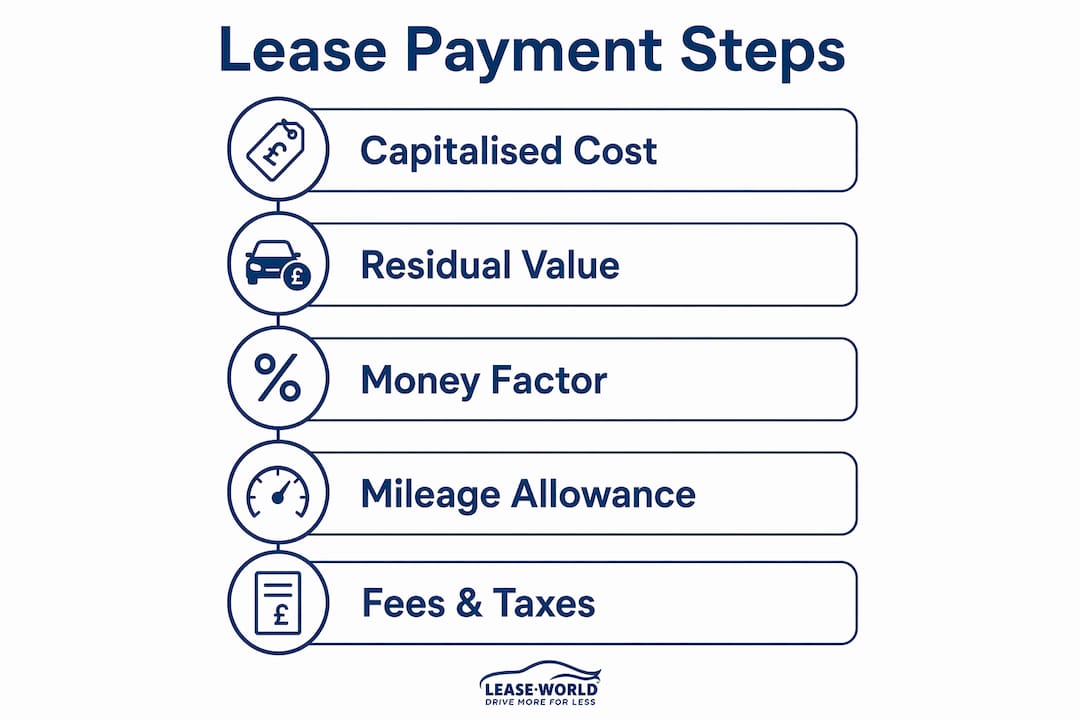
A car lease monthly payment is defined as the cost of the vehicle's depreciation over the lease term, plus a financing charge and any applicable fees. This structure is why lease payments are typically lower than traditional loan repayments for the same car. You are not financing the full purchase price. You are paying only for the portion of the car's value you use. For UK drivers weighing up their options, understanding monthly lease payments means understanding three core figures: the capitalised cost, the residual value, and the money factor. Get those right, and the rest of the monthly car lease breakdown falls into place.
What are the key components that determine your monthly lease payment?

The capitalised cost is the negotiated price of the vehicle, equivalent to the purchase price in a buying transaction. It is the single most negotiable figure in your lease agreement, and reducing it has a direct, proportional effect on every payment you make.
The residual value is the leasing company's prediction of what the car will be worth at the end of the contract. A higher residual value means less depreciation to finance, which lowers your monthly payment. Manufacturers with strong resale reputations, such as BMW, Toyota, and Volkswagen, tend to attract higher residual values and therefore more competitive lease rates.
The money factor is the lease equivalent of an interest rate. Multiplying the money factor by 2,400 gives you an approximate APR. A money factor of 0.00125, for example, equates to roughly 3% APR. This conversion matters because dealers are not always required to present it as a percentage, making it easy to miss an inflated financing charge.
The basic monthly payment formula works as follows: subtract the residual value from the capitalised cost to get the depreciation amount, divide that by the number of months in the lease, then add the money factor multiplied by the sum of the capitalised cost and residual value. The result is your base monthly payment before fees and tax.
Pro Tip: Negotiate the capitalised cost before discussing monthly payments. A reduction of £1,500–£2,000 on the cap cost saves £40–£60 monthly over a 36-month term. That is where the real money is.
| Component | What it is | Effect on monthly payment |
|---|---|---|
| Capitalised cost | Negotiated vehicle price | Lower cap cost = lower payment |
| Residual value | Predicted end-of-lease worth | Higher residual = lower payment |
| Money factor | Lease financing rate | Lower money factor = lower payment |
| Lease term | Contract length in months | Longer term = lower monthly, higher total |
How do mileage limits and credit scores affect your monthly payments?
Annual mileage allowances are a fixed feature of every UK lease contract, and they directly affect the residual value calculation. The more miles you drive, the faster the car depreciates, and the leasing company prices that into your monthly figure.
Moving from a 10,000 to a 12,000 mile annual allowance typically adds £15–£30 per month to your payment. Stepping up to 15,000 miles adds more again. Those increments compound over a 36-month term, so choosing the right allowance from the start matters considerably.
Exceeding your agreed mileage is expensive. Most UK leasing companies charge between 5p and 15p per excess mile, depending on the vehicle and contract. On a car with a 10,000-mile annual limit, driving 15,000 miles a year over three years generates 15,000 excess miles. At 10p per mile, that is £1,500 owed at the end of the contract.
Your credit score affects the money factor offered to you. A lower credit rating signals higher risk to the finance provider, which results in a higher money factor and therefore a higher monthly payment. A drop in credit score tier can add £20–£40 per month to your lease cost. Checking your credit report with Experian, Equifax, or TransUnion before applying gives you a realistic picture of the rate you are likely to receive.
Key factors to review before signing:
- Your average monthly mileage over the past 12 months
- Whether your driving patterns are likely to change during the lease term
- Your current credit score and any outstanding issues on your report
- Whether adjusting your mileage allowance mid-contract is possible if your needs change
Pro Tip: Overestimate your mileage slightly rather than underestimate it. Buying extra miles upfront is almost always cheaper than paying excess mile charges at the end of the contract.
What hidden fees and taxes might add to your advertised monthly payment?
Advertised lease payments are almost never the full story. Advertised payments often exclude fees and VAT, meaning the figure you see on a manufacturer or broker website can be £25–£50 lower than what you will actually pay each month.
The main charges that inflate the real monthly cost include:
- Acquisition fee: The leasing company's charge for arranging the finance, typically £400–£700. This is usually rolled into the monthly payment rather than charged separately, but it still adds to your total cost.
- Administration or documentation fee: A dealer or broker charge for processing the paperwork, ranging from £100 to £300.
- Disposition fee: Charged at the end of the lease if you do not take a new vehicle with the same provider. This typically runs £200–£350 and is often buried in the small print.
- VAT: In the UK, personal lease payments include VAT at 20%. Business lessees can reclaim 50% of the VAT on a car used for mixed purposes, and 100% on a van. The advertised payment on many business-focused deals is shown excluding VAT, which creates a significant gap between the headline figure and the actual cost.
| Payment element | Typical amount | Included in advertised price? |
|---|---|---|
| Base monthly payment | Varies by vehicle | Yes |
| VAT at 20% | 20% of base | Sometimes excluded |
| Acquisition fee (amortised) | £10–£20/month | Rarely |
| Administration fee (amortised) | £3–£8/month | No |
| Disposition fee (amortised) | £6–£10/month | No |
Pro Tip: Always request a fully itemised quote that shows the base payment, VAT, and every fee listed separately. The car lease terminology guide from Lease World explains each charge in plain English, which makes comparing quotes far simpler.
How does leasing compare with buying in terms of monthly costs?
Leasing and buying the same car produce very different monthly commitments. When you buy on finance, your loan repayment covers the full vehicle price plus interest. When you lease, you pay only for the depreciation during your contract period. Lease payments are typically £150–£200 lower per month than loan repayments for the equivalent vehicle.
That gap is real, but it comes with trade-offs. The benefits of leasing a car include lower monthly outgoings, fixed and predictable costs, and the fact that the vehicle remains under manufacturer warranty for most or all of the contract. Leasing shifts mechanical repair risk to the leasing company for the duration of the warranty, which removes the uncertainty of unexpected repair bills.
The drawbacks are equally clear:
- You build no equity. At the end of the contract, you hand the car back with nothing to show for your payments.
- Mileage limits restrict how you use the vehicle.
- You are in a continuous payment cycle. Buying eventually results in owning an asset outright.
- Modifications are not permitted, and the car must be returned in good condition.
Financial analysts recommend calculating the 'true annual cost' of leasing by adding all monthly payments and recurring fees together, then dividing by the number of years. This figure gives you a like-for-like comparison with the annual cost of ownership. For drivers who prioritise access to the latest safety technology and want to avoid uncertain resale values, leasing vs buying often favours leasing on a pure monthly cash flow basis.
How can you negotiate and decode your lease payment quote?
Most drivers focus on the monthly payment figure and accept or reject a deal based on that alone. Industry practitioners confirm that this approach misses the larger savings available through negotiating the capitalised cost. The monthly figure is a result of the underlying numbers. Change those numbers, and the monthly figure follows.
Follow these steps when reviewing a lease quote:
- Request a full breakdown. Ask for the capitalised cost, residual value, money factor, lease term, and all fees listed separately. Any dealer unwilling to provide this should be treated with caution.
- Convert the money factor to APR. Multiply the money factor by 2,400. If the resulting APR seems high relative to current market rates, ask the dealer to justify it or match a lower rate.
- Check for dealer markup. Dealers often mark up the money factor above the standard buy rate, adding £1,200–£2,000 to the total cost of the lease. Ask specifically for the buy rate and compare it to what you have been quoted.
- Negotiate the cap cost first. Treat this like a purchase price negotiation. Manufacturer discounts, dealer contributions, and part-exchange values all reduce the cap cost.
- Calculate your effective monthly cost. Take the total due at signing, add all monthly payments, then divide by the number of months in the contract. High upfront payments increase your overall commitment beyond the stated monthly figure, so this calculation gives you the true cost per month.
- Confirm your mileage allowance. Make sure it reflects your actual driving habits, not an optimistic estimate.
Pro Tip: Use an independent lease payment calculator to verify the numbers a dealer presents. If the figures do not match, ask why. Transparency is non-negotiable when committing to a 24–48 month contract.
Key takeaways
A car lease monthly payment is determined by depreciation, the money factor, and fees. Negotiating the capitalised cost is the single most effective way to reduce what you pay each month.
| Point | Details |
|---|---|
| Capitalised cost is the priority | Reducing the cap cost saves more money than negotiating the monthly figure directly. |
| Money factor converts to APR | Multiply the money factor by 2,400 to check whether the financing rate is competitive. |
| Advertised payments exclude fees | Expect the real monthly cost to be £25–£50 higher once VAT and fees are included. |
| Mileage choice affects total cost | Overestimate your annual mileage to avoid expensive excess mile charges at contract end. |
| True monthly cost includes upfront payments | Divide total lease cost by contract months to find the real monthly commitment. |
Why I think most drivers approach lease quotes the wrong way
Most people I speak to come into a lease negotiation with one question: "What's the monthly payment?" That is understandable. It is the number that fits into a budget. But it is also the number most easily manipulated by a dealer who knows you are focused on it.
The monthly figure is a product of the capitalised cost, the money factor, and the residual value. A dealer can present a low monthly payment by stretching the term, inflating the money factor slightly, or rolling fees into the payment without itemising them. You would never know unless you asked for the full breakdown.
The money factor markup is the detail that surprises people most. A dealer adding 0.00050 to the buy rate on a £30,000 vehicle over 36 months can quietly add over £1,000 to your total lease cost. That is not a rounding error. It is a structural feature of how dealer compensation works in leasing.
My honest advice is to treat a lease negotiation exactly like a purchase negotiation. Start with the cap cost. Get it in writing. Then check the money factor against the buy rate. Only then look at the monthly figure. Drivers who follow this sequence consistently secure better deals than those who lead with the monthly payment question.
Leasing genuinely suits a large number of UK drivers, particularly those who want predictable costs, access to newer vehicles, and no exposure to depreciation risk. But the appeal only holds if you understand what you are agreeing to. Read the fine print on mileage, condition requirements, and end-of-lease fees before you sign anything.
— Jason
How Lease World helps you secure a deal you actually understand
Understanding car lease monthly payments is one thing. Finding a deal that reflects that understanding is another. Lease World works with UK drivers to make the leasing process transparent from the first quote to final delivery.
Lease World provides fully itemised quotes with no hidden fees, fixed monthly payments, and no-deposit options on eligible vehicles. Whether you are leasing your first car or switching from a previous contract, the team explains every figure in plain English before you commit. Explore the leasing guides to build your knowledge, or go straight to a personalised quote tailored to your budget and mileage needs. Lease World's family-run approach means you get a real person, not a call centre, every time you have a question.
FAQ
What is included in a car lease monthly payment?
A car lease monthly payment covers the vehicle's depreciation over the lease term, a financing charge based on the money factor, and any fees rolled into the contract. VAT at 20% is added on top for personal lessees in the UK.
Why are lease payments lower than loan repayments?
Lease payments are lower because you pay only for the portion of the car's value you use, not the full purchase price. This typically results in monthly costs that are £150–£200 less than an equivalent loan repayment.
How does my credit score affect my lease payment?
A lower credit score results in a higher money factor being applied to your lease, which increases the monthly payment. A drop in credit tier can add £20–£40 per month to your lease cost.
What happens if I exceed my mileage allowance?
Excess miles are charged at a rate agreed in your contract, typically between 5p and 15p per mile in the UK. These charges are calculated and billed at the end of the lease term.
Can I negotiate a car lease monthly payment?
Yes, but the most effective approach is to negotiate the capitalised cost rather than the monthly figure itself. A reduction of £1,500–£2,000 on the cap cost saves £40–£60 per month over a standard 36-month lease.