

TL;DR:
- Controlling key variables like capitalized cost, residual value, and money factor helps achieve the lowest monthly lease payments.
- Understanding these factors allows drivers to negotiate better deals and avoid overpaying, especially by focusing on total cost rather than monthly figures.
- Choosing a vehicle with high residual value and a shorter lease term can reduce overall costs, making leasing more affordable.
The lowest monthly lease payment is achieved by controlling three financial variables: capitalised cost, money factor, and residual value. Most UK drivers focus only on the monthly figure a dealer quotes them, which is precisely why they overpay. Leasing can be significantly more affordable than buying outright. Monthly lease payments average lower than equivalent loan repayments, making it a strong option for budget-conscious drivers. Understanding what drives your monthly cost puts you in control from the first conversation with a dealer.
What factors determine your monthly lease payment?
Lease payments are driven by three core components: depreciation, money factor, and residual value. Knowing how each one works lets you spot where a deal is weak and where you have room to negotiate. The leasing jargon that dealers use can obscure these components, but the maths behind them is straightforward once you break it down.
Capitalised cost
Capitalised cost is simply the agreed selling price of the vehicle. It is the single biggest lever you have. A lower capitalised cost means lower depreciation charges across the lease term, which directly reduces your monthly payment. Many drivers skip this negotiation and jump straight to discussing monthly figures. That is a mistake, because dealers can adjust other variables to make a monthly payment look attractive while the overall deal remains expensive.
Money factor
The money factor is the leasing equivalent of an interest rate. It is expressed as a small decimal, such as 0.0015, and you multiply it by 2,400 to convert it to an approximate annual percentage rate. Your credit score has a direct bearing on the money factor a lender will offer you. A strong credit history can unlock a lower money factor, which reduces the finance charge portion of every monthly payment.

Residual value
Residual value is the predicted worth of the vehicle at the end of the lease term. A higher residual value means the car is expected to depreciate less, so you pay for less depreciation each month. Vehicles with high residual values consistently produce lower monthly payments than comparable cars with weaker resale prospects. Brands with strong reliability reputations, such as Toyota, Honda, and certain Volkswagen models, tend to hold value well in the UK market.
Fees and taxes
Acquisition fees, documentation charges, and VAT all add to the total cost of a lease. Some fees are negotiable; others are fixed by the finance company. Always ask for a full breakdown of every charge before signing. VAT at 20% applies to personal lease payments in the UK, so factor this into any monthly figure you see advertised.
Pro Tip: Never evaluate a lease deal on monthly payment alone. Calculate the total amount payable across the full term, including the initial rental and all fees, to make a fair comparison between offers.
How does vehicle choice and lease term affect your payments?
Choosing the right car and the right contract length are two of the most effective ways to find affordable lease options without relying solely on negotiation. These decisions shape the deal before you even speak to a dealer.
Why residual value matters more than sticker price
A car with a high residual value produces a lower monthly payment even if its list price is higher than a rival. Focusing lease shopping on vehicles with strong resale value is one of the most reliable ways to reduce monthly costs. In the UK market for 2026, electric vehicles from manufacturers such as Tesla, Polestar, and MG are attracting competitive residual values as demand for EVs grows, which translates into attractive monthly lease deals.
Short-term vs long-term leases: what the numbers show
Lease term length has a counterintuitive effect on your finances. Shorter leases of 18–24 months often carry higher monthly payments but result in a lower total cash outlay compared to 36-month contracts. That matters if your priority is minimising what you spend overall rather than minimising what leaves your account each month. Understanding term length impact helps you make a decision that fits your actual financial goals.
The table below illustrates how term length affects both monthly cost and total outlay for a representative mid-range vehicle in the UK market.
| Lease Term | Typical Monthly Payment | Estimated Total Outlay | Best For |
|---|---|---|---|
| 18 months | Higher | Lower overall | Minimising total spend |
| 24 months | Moderate | Moderate | Balanced cost and flexibility |
| 36 months | Lower | Higher overall | Lowest monthly figure |
| 48 months | Lowest | Highest overall | Maximum monthly affordability |
A 36-month lease delivers the cheapest monthly figure, but you pay more in total. A short-term lease costs more per month yet gets you out of the contract sooner and often costs less in aggregate. The right choice depends on whether you are managing cash flow or total expenditure.
Pro Tip: If you are comparing two lease offers, always calculate the total cost including the initial rental payment. A lower monthly figure on a longer contract frequently costs more in total than a higher monthly figure on a shorter one.
How to negotiate the lowest monthly lease payment step by step
Negotiation is where the real savings happen. Most drivers leave money on the table because they do not know the order in which to tackle each element of the deal.
-
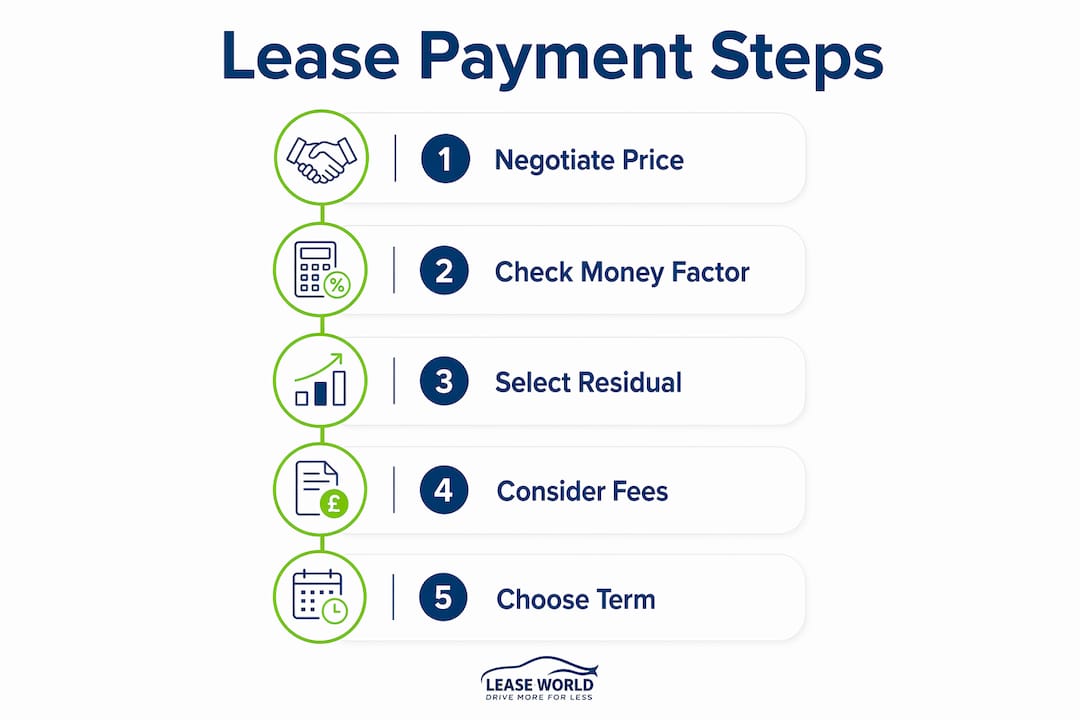
Negotiate the selling price first. Always agree the vehicle price before any discussion of monthly payments. Dealers can manipulate the money factor or add fees to recover margin if you skip this step. Treat the capitalised cost as you would any purchase negotiation.
-
Check the money factor independently. Ask the dealer to state the money factor explicitly. Resources such as Edmunds and LeaseHackr publish benchmark money factors for many vehicles, giving you a reference point. If the dealer's figure is higher than the published rate, push back.
-
Time your approach around manufacturer incentives. Manufacturers and finance houses run lease support programmes that lower the effective money factor or boost residual values on specific models. These programmes typically run on a monthly cycle. Visiting dealers at the end of a month or quarter can also increase their willingness to negotiate.
-
Assess the impact of your initial rental. A larger initial payment reduces your monthly figure, but higher initial payments increase your total out-of-pocket cost and carry a risk: if the vehicle is written off early in the contract, you may not recover that upfront sum. Lease World offers no-deposit options that remove this risk entirely.
-
Get quotes from multiple sources. Comparing offers from several dealers and brokers gives you genuine leverage. A competing quote is the most effective negotiating tool you have. Use a lease payment comparison approach to identify the strongest deal before committing.
-
Ask about one-payment leases. Paying the full lease cost upfront eliminates the monthly finance charge entirely. This works well if you have the capital available and want to minimise total interest paid.
Pro Tip: Watch for dealer markup on the money factor. Dealers are permitted to mark up the money factor above the base rate set by the finance company, and they keep the difference. Always ask whether the quoted money factor is the buy rate or a marked-up figure.
Common mistakes that increase your monthly lease cost
Avoiding errors is as valuable as knowing the right tactics. These are the most frequent mistakes UK drivers make when trying to find the cheapest monthly lease.
- Focusing only on the monthly payment. A low monthly figure can mask a high capitalised cost, a long term, or excessive fees. Always review the full contract cost.
- Underestimating mileage needs. Most UK personal leases set annual mileage limits of 8,000 to 15,000 miles. Excess mileage charges typically run at 5p to 15p per mile. Exceeding your allowance by 5,000 miles can add several hundred pounds to your final bill.
- Ignoring maintenance costs. Standard leases do not include servicing, tyres, or wear-and-tear repairs. A full maintenance lease bundles these costs into the monthly payment, which can make budgeting more predictable even if the headline figure is slightly higher.
- Accepting advertised deals without scrutiny. Leasing specials and incentives can reduce costs, but hidden fees such as drive-off charges and documentation fees may exist. Always request a full cost breakdown before signing.
- Skipping a lease vs buying comparison. Leasing is not always the right choice. If you drive high mileage or want to own the vehicle, the total cost of leasing may exceed that of purchasing over the same period.
Key takeaways
The lowest monthly lease payment comes from negotiating the capitalised cost first, choosing a vehicle with a strong residual value, and selecting a term length that matches your financial priorities rather than simply your monthly budget.
| Point | Details |
|---|---|
| Negotiate capitalised cost first | Agree the selling price before discussing monthly figures to prevent dealer manipulation. |
| Prioritise residual value | Vehicles that hold their value well produce lower monthly payments across any term length. |
| Compare total outlay, not just monthly cost | Shorter terms often cost less overall despite higher monthly payments. |
| Check the money factor | Ask for the base rate and push back on any dealer markup above it. |
| Read every fee in the contract | Acquisition fees, excess mileage charges, and VAT all affect the true cost of a lease. |
What i have learnt after years of watching UK drivers lease cars
Most people walk into a dealership with one number in mind: the monthly payment. Dealers know this, and they use it. I have seen drivers celebrate a £250 per month deal without realising they agreed to a 48-month term with a £3,000 initial rental and a 6,000-mile annual limit. The total cost was higher than a straightforward 24-month deal at £310 per month.
The most effective thing you can do is separate the monthly payment from the total cost in your mind before you start any conversation. Set a total budget for the lease, not a monthly one. Then work backwards to find the term and initial rental combination that fits.
Manufacturer incentive programmes are genuinely worth tracking. Finance houses adjust residual values and money factors on specific models every month. A car that was expensive to lease in march can become one of the best lease rates available by may simply because the manufacturer has injected support into the programme. Signing up to alerts from brokers and leasing specialists keeps you informed without requiring constant research.
One more thing: do not let a low monthly figure distract you from mileage caps. The excess mileage charge is where many UK drivers get caught out at the end of a contract. Be honest about how much you drive and build in a reasonable buffer when setting your annual mileage allowance.
— Jason
Find your best lease deal with lease world
Lease World works with UK drivers to find affordable lease options that match their budget and lifestyle, without the hidden fees or pressure tactics you might encounter elsewhere.
As a family-run business, Lease World offers personal car leasing deals with fixed monthly payments, no-deposit options, and free UK delivery on eligible vehicles. Whether you want to compare models, understand your contract terms, or get a tailored quote, the team provides clear guidance at every stage. Explore the full range of leasing guides and advice on the Lease World website, or request a personalised quote today to see what monthly payments are available for the vehicles you have in mind.
FAQ
What is the cheapest way to lower my monthly lease payment?
Negotiate the capitalised cost (selling price) of the vehicle before discussing monthly figures, and choose a car with a high residual value. These two steps have the greatest direct impact on reducing your monthly payment.
Does a longer lease term always mean a lower monthly payment?
A longer term reduces the monthly figure but increases the total amount you pay across the contract. A 36-month lease costs less per month than an 18-month lease, but the total outlay is typically higher.
How does my credit score affect my lease payment?
Your credit score influences the money factor a finance company offers you. A stronger credit history qualifies you for a lower money factor, which reduces the finance charge portion of each monthly payment.
Should i put down a larger initial rental to lower monthly costs?
A larger initial rental does reduce monthly payments, but it increases your total upfront spend and carries a financial risk if the vehicle is written off early in the contract. Lease World offers no-deposit leasing options that avoid this risk.
Are advertised lease deals always accurate?
Advertised monthly figures are based on specific assumptions about term length, annual mileage, and initial rental. Always request a full breakdown of all fees and charges, as leasing specials can include drive-off fees and other costs not shown in the headline price.