

Securing a new car without a hefty upfront payment is exactly what a low initial rental lease deal promises. In UK car leasing, the "initial rental" is the industry term for what many people loosely call a deposit. It is the first payment you make before your monthly rentals begin, and it is calculated as a multiple of your monthly figure. Getting this amount as low as possible is one of the most popular goals among UK drivers exploring personal contract hire (PCH) today. This guide explains how these deals work, what to watch for, and how to find one that genuinely saves you money rather than simply shifting costs elsewhere.
Table of Contents
- Key takeaways
- What is a low initial rental lease deal?
- Key factors to consider before choosing
- How to find and secure an affordable deal
- Common mistakes that cost drivers money
- Managing your lease once you have signed
- My honest take on low initial rental deals
- Find your next lease deal with Leaseworld
- FAQ
Key takeaways
| Point | Details |
|---|---|
| Initial rental is not a deposit | It is a prepaid multiple of your monthly rental, typically one to three months upfront. |
| Lower upfront means higher monthly | Reducing your initial rental usually increases the monthly payment across the contract. |
| Mileage matching is critical | The mileage allowance you choose affects your total cost far more than the initial rental size. |
| Credit score shapes your options | Lenders use your credit profile to determine which low initial rental deals you can access. |
| Always compare total cost | The cheapest upfront deal is rarely the cheapest overall. Always calculate the full contract cost. |
What is a low initial rental lease deal?
The term "initial rental" refers to the advance payment made at the start of a personal contract hire or business contract hire agreement. Unlike a traditional deposit on a hire purchase or PCP deal, this payment is not refundable and does not contribute to ownership of the vehicle. It is simply a prepayment of rental instalments.
Industry practice tends to set the initial rental at the equivalent of one monthly payment, though some deals offer two or three months upfront in exchange for lower ongoing costs. A low initial rental deal, then, is one where this advance payment is kept to a minimum, sometimes as little as one month's rental.
Here is how the structure compares across common finance types:
| Finance type | Upfront payment | Own the car? | Mileage limit? |
|---|---|---|---|
| PCH (personal lease) | Initial rental (1–3 months) | No | Yes |
| PCP | Deposit (usually 10%) | Optional (balloon payment) | Sometimes |
| Hire purchase | Deposit (usually 10%) | Yes, at end | No |
Pro Tip: If you see a deal advertised as "no deposit," it almost always still requires an initial rental. The two terms are not the same. Read the small print carefully before assuming nothing is owed upfront.
Because PCH monthly payments are generally lower than PCP since you are not financing a balloon payment or residual value, the total outlay on a lease can be competitive even with a slightly higher monthly figure. The trade-off with a low initial rental is straightforward: you pay less today, but your monthly payments will be slightly higher across the term to compensate.

Key factors to consider before choosing
Understanding the structure is one thing. Knowing what actually determines whether a deal suits you is another. Several factors interact to shape the real cost of any affordable lease agreement.
Your mileage allowance matters most. The suitability of a deal depends more on matching your allowed mileage to your actual driving than on the size of the initial rental alone. Payments are calculated based on predicted depreciation, and mileage is the biggest driver of that figure. Choose too low an allowance and you face excess mileage charges. Choose too high and you overpay every month for miles you never use.
- Excess mileage charges can reach around 50p per extra mile, which adds up quickly on a long contract.
- Credit score directly affects which initial rental tiers you qualify for. A stronger credit profile gives you access to the most competitive deals.
- Contract length influences your monthly payment. A 48-month term spreads depreciation further than a 24-month one, which typically lowers the monthly cost but extends your commitment.
- Vehicle choice is significant. Popular models with strong residual values attract lower lease rates because the finance company recovers more of the car's value at the end.
- Additional fees such as documentation charges, delivery fees, or maintenance packages can add hundreds of pounds to the total cost that the headline monthly figure never reveals.
One misconception worth addressing: very low or zero initial rental deals are not automatically the best budget-friendly rental option. They are designed to lower the barrier to entry, but the total contract cost is what you should always evaluate. A deal with a one-month initial rental and £299 per month over 36 months costs the same in total as a three-month initial rental deal at £279 per month. The numbers shift; the overall spend does not change dramatically.
Pro Tip: Before comparing deals, calculate the total contract cost by multiplying the monthly payment by the number of months, then adding the initial rental. This single figure makes genuine comparisons possible.
How to find and secure an affordable deal
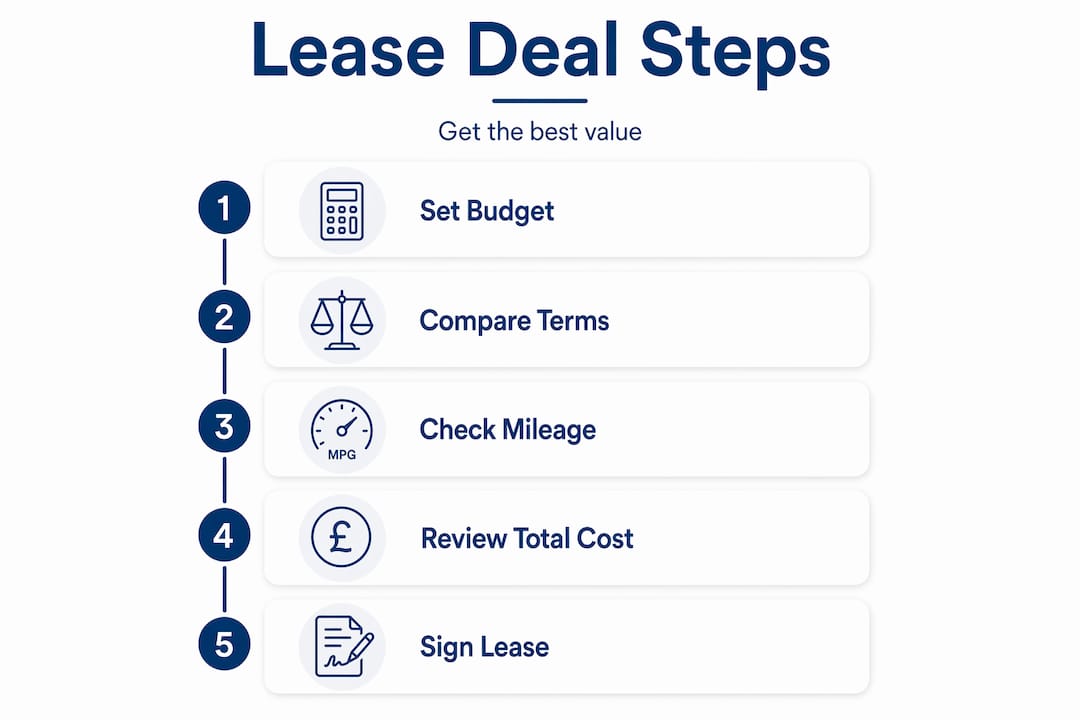
Finding a genuinely good deal takes a structured approach. Here is a practical process that works.
- Establish your monthly budget first. Decide what you can comfortably afford each month, then work backwards to find cars that fit. Do not start with the car and hope the payments align.
- Research multiple providers. Prices for the same vehicle can vary considerably between brokers and direct leasing companies. Comparing across several sources is the single most effective way to find initial lease discounts.
- Look for manufacturer-backed offers. Automaker subsidies can produce unusually low lease payments by reducing the depreciation cost the lease covers. These subvented deals are often the best route to a genuinely low initial rental, and they tend to appear at end of quarter or when manufacturers are clearing stock.
- Negotiate the vehicle price. On some deals, particularly through brokers, negotiating below the list price reduces the finance calculation and can lower both the initial rental and monthly payments.
- Choose your mileage carefully. Use a mileage guide to select an allowance that reflects your genuine annual driving. Padding it for safety costs money; underestimating costs more.
- Clarify business versus personal leasing. If you are self-employed or run a limited company, business contract hire may offer VAT advantages. VAT on rental payments can be partially reclaimed, though recovery is usually limited to 50% where private use is assumed.
- Read the full contract before signing. This sounds obvious, but rushed decisions are a leading cause of unexpected charges. Verify the excess mileage rate, fair wear and tear standards, and any early termination clauses.
| Step | What to check | Why it matters |
|---|---|---|
| Budget first | Monthly affordability | Prevents overcommitting |
| Compare providers | Price variation | Can save hundreds overall |
| Manufacturer deals | Subvented offers | Lowest genuine upfront costs |
| Mileage selection | Annual driving habits | Biggest cost variable |
| Contract review | Excess charges and fees | Avoids nasty surprises |
Pro Tip: End of quarter is often the best time to approach leasing brokers. Finance providers and manufacturers push volume at these points, which can translate into better rental deal offers and lower initial payments.
Common mistakes that cost drivers money
Even drivers who research thoroughly can fall into traps that make a seemingly cheap lease expensive in practice.
- Underestimating mileage. This is the most common and costly mistake. Exceeding your mileage limit can generate charges that dwarf any saving made on the initial rental.
- Focusing only on the initial rental. A low upfront payment is attractive, but total lease cost depends heavily on whether your actual mileage matches the contract allowance and how long the term runs.
- Ignoring fair wear and tear standards. Leasing companies assess the car at return. Damage beyond their published standards results in charges. Know the standards before you sign.
- Assuming approval is guaranteed. Low initial rental deals are often reserved for applicants with strong credit profiles. If your score is lower, the deal you see advertised may not be the one you are offered.
- Overlooking VAT on business leases. VAT applies monthly to contract hire rental payments, and the rules on recovery are specific. Getting this wrong affects your actual cost significantly.
"The best lease deal is not the one with the lowest number on the advert. It is the one where the total cost, the mileage allowance, and the contract terms all fit your actual life."
Lease-end planning is also frequently overlooked. Know your options before the contract expires. Returning the car, renewing into a new deal, or exploring other routes all require some lead time. Leaving it to the last minute often means accepting whatever is available rather than what is best.
Managing your lease once you have signed
Once you are in a lease, the work is not over. Staying on top of a few things protects you from unexpected costs at the end.
- Track your mileage every few months. If you are running ahead of your allowance, contact your provider early. Some will allow you to adjust your mileage mid-contract, which is far cheaper than paying excess charges at the end.
- Keep the car in good condition. Minor scuffs and chips are expected, but panels with significant damage or interior stains will be charged at return.
- Set up a direct debit for monthly payments and keep the account funded. Missed payments affect your credit file and can trigger penalty clauses.
- For business users, keep records of business versus private mileage if you intend to reclaim VAT. The VAT recovery rules require this evidence.
- Start thinking about your next steps around three months before the contract ends. This gives you time to compare new deals without pressure.
My honest take on low initial rental deals
I have seen a lot of drivers get excited about a low upfront figure, sign quickly, and then feel the pinch over the following three years. The appeal is completely understandable. Keeping cash in your pocket at the start of a lease makes sense, especially when you are managing other financial commitments.
But in my experience, the initial rental is the least important number in a lease agreement. The mileage allowance and the monthly payment are what determine whether a deal genuinely works for you. I have seen drivers save £500 on their initial rental only to pay £800 in excess mileage charges at the end of the contract.
My advice for first-time leasers is this: do not let the advertised initial rental be the thing that draws you to a deal. Use it as a filter to shortlist options, then dig into the total cost and the mileage terms. The best affordable lease agreements are the ones where every number fits your situation, not just the first one you see on the page.
One more thing. Manufacturer-backed deals are genuinely worth seeking out. When a carmaker subsidises a lease, the savings are real and the initial rental can be legitimately low without inflating the monthly payments to compensate. These are the deals worth waiting for.
— Jason
Find your next lease deal with Leaseworld
At Leaseworld, we work with a carefully selected panel of finance providers to bring you personal and business car lease deals that suit a range of budgets, including options with low initial rentals. Whether you are after a compact hatchback, a family SUV, or a van for your business, our team is here to help you find a deal where the numbers actually work for you.
We are a family-run business, which means every enquiry gets a personal response. We do not pass you down a call centre queue. If you want to talk through your options, compare deals, or understand exactly what a contract involves before you commit, we are on the phone and email ready to help. Browse our full range of car lease deals and see which options are available with reduced upfront costs right now. If you have questions about deposits, initial rentals, or anything else, our leasing FAQ covers over 100 topics in plain English.
FAQ
What is an initial rental on a car lease?
The initial rental is the advance payment made at the start of a personal or business contract hire agreement. It is calculated as a multiple of the monthly rental, typically one to three months, and is not refundable.
Is a low initial rental deal the same as no deposit?
Not exactly. A no-deposit deal usually still requires an initial rental payment. The difference between the two is that a deposit on a PCP or HP agreement may contribute towards the vehicle's value, whereas an initial rental is simply a prepaid instalment.
Does a lower initial rental mean higher monthly payments?
Yes, in most cases. Reducing the initial rental shifts more of the total lease cost into the monthly payments. The overall contract cost remains broadly the same; only the distribution of payments changes.
How does mileage affect my lease deal?
Mileage is the biggest variable in any lease calculation. Choosing a higher annual allowance increases your monthly payment, while a lower allowance reduces it. Exceeding your limit typically triggers charges of around 50p per extra mile, so accurate mileage selection is critical.
Can I negotiate the terms of a low initial rental lease?
Yes. You can often negotiate the vehicle price, the mileage allowance, and sometimes the contract length. On manufacturer-backed deals, there is less room to move, but a good broker can still identify the most competitive options available at any given time.