
If you work as a contractor, the vehicle is a tool of the trade, and the cleanest way to get one is usually business contract hire: a fixed monthly payment, an agreed mileage and a set term, with no large cash outlay at the start. Which structure suits you depends on whether you trade as a sole trader or through a limited company, whether you need a car or a van, and how much of your driving is private. At Lease World we broker personal and business car and van leases, with no deposit options and fixed monthly payments, and this guide sets out what to weigh before you sign.
TL;DR
- Business contract hire is the usual route for contractors: you pay for the vehicle's expected depreciation plus finance and the lessor's margin, and the leasing company carries the risk on its resale value.
- For a car, HMRC says the VAT you can normally recover on the rental is limited to half, unless it is used for taxi hire or driving instruction. Vans are treated differently.
- A 15% disallowance applies to the rental on cars emitting over 50 g/km of CO2, so emissions change the real cost of a lease.
- Compare the whole contract, not just the monthly figure: initial rental, mileage, maintenance, early termination and return condition.
- Agree the vehicle's condition in writing at hand-back, and keep your charges dispute rights under the BVRLA code.
Table of Contents
- What leasing means for a contractor
- Can you lease as a sole trader or a limited company?
- Contract hire or finance lease?
- VAT on a leased car or van
- Income tax and corporation tax
- Car or van: choosing for the work
- What to compare in a quote
- Ending the lease without surprises
- Getting a lease quote
- FAQ
- Sources
What leasing means for a contractor
Leasing is long-term rental. You choose a vehicle, a term (commonly two to four years) and an annual mileage, then pay a fixed monthly rental. At the end you hand the vehicle back. You never own it, which is exactly why the monthly cost is lower than buying on finance: you pay for the part of the value the vehicle loses, not the whole of it.
For contractors that suits the way the work comes. Cash stays in the business for tools, insurance and the gaps between invoices. The rental is predictable, so it is easy to put into a day rate. And you can match the vehicle to the work: an estate or electric car for travelling between client sites, a panel van for kit and materials.
Our business car leasing and van leasing pages show the ranges available, and our guide to business contract hire covers the basics in more depth.
Can you lease as a sole trader or a limited company?
Contractors in the UK usually trade in one of three ways: as a sole trader, through their own limited company, or via an umbrella arrangement. Leasing is normally arranged in the name of the business, so a sole trader or a limited company can apply. The funder will run a credit check, and for a newer company will often want to see trading evidence such as recent business bank statements. A director's personal guarantee is sometimes requested on a limited company, particularly a young one.
Have these ready before you ask for a quote:
- Your business name, trading address and, for a company, the Companies House number
- Your VAT number, if you are registered
- Recent business bank statements
- Your driving licence details
A good credit record makes approval smoother and gives the funder less reason to ask for extras. If you are comparing a personal lease with a business one, remember that the tax and VAT treatment below only applies to the business route.
Contract hire or finance lease?
These are the two structures contractors meet most often, and they allocate risk differently. HMRC's VAT manual describes the difference.
Under contract hire (an operating lease), the leasing company predicts at the start what the vehicle will be worth when it comes back. You pay for the expected depreciation plus interest and the lessor's profit, and the lessor takes the risk if the vehicle is worth less. That is why contract hire comes with mileage limits and maintenance and condition rules.
Under a finance lease, your payments cover the whole purchase cost of the vehicle plus finance charges and the lessor's profit. Either the lease has a final balloon payment with lower monthly rentals, or it is fully amortised, with the car sold at the end and you receiving a rebate of the proceeds. In both cases you carry the risk on the eventual value.
| Business contract hire | Finance lease | |
|---|---|---|
| What you pay for | Expected depreciation, interest and margin | Full cost, finance and margin |
| Who carries resale risk | The leasing company | You |
| Mileage | Agreed limit, excess charged | Typically more flexible |
| Fits best | Predictable budgeting, new vehicle every few years | Contractors who want to keep or sell the vehicle at the end |
Most contractors who want a predictable cost and no resale worry choose contract hire. If you want to understand finance leases in detail, our finance lease explainer sets them out, and our contract hire page covers the fixed-term route.
VAT on a leased car or van
If you are VAT-registered, VAT is where leasing a car and leasing a van diverge most.
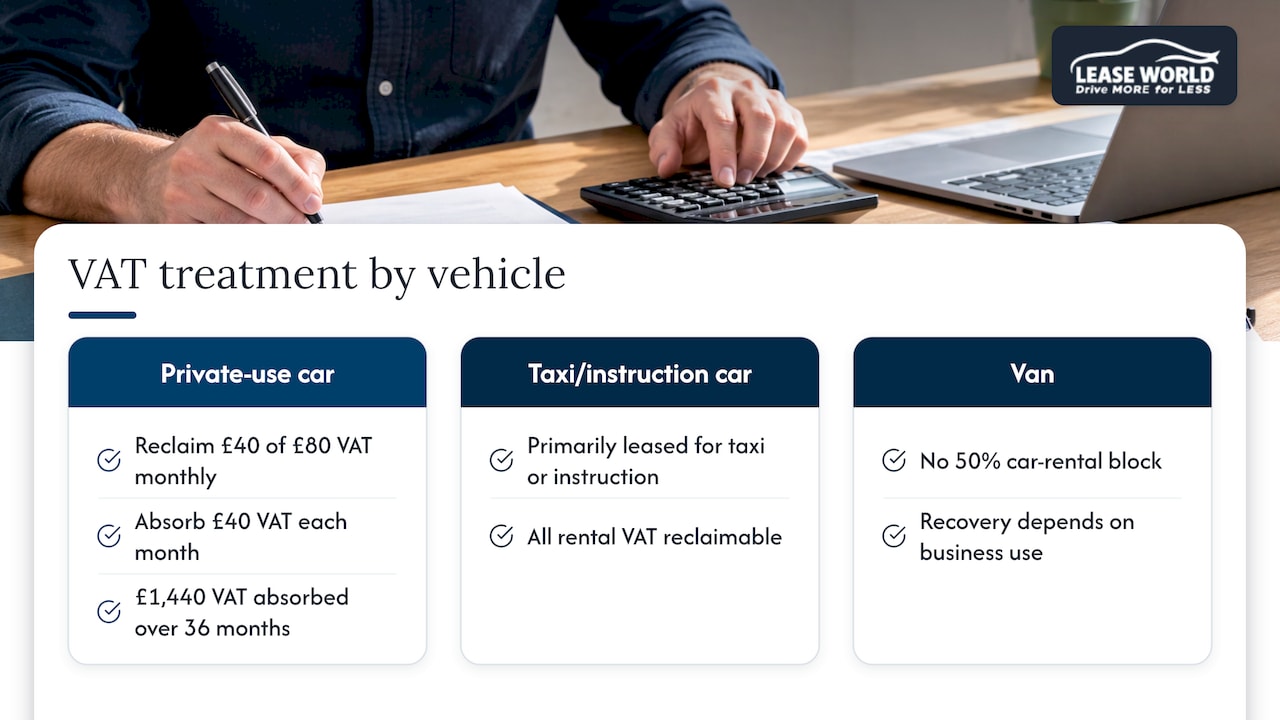
Cars. HMRC's guidance says a business leasing a car it makes available for private use cannot normally recover 50% of the VAT charged on the rental. The other 50% is reclaimable under normal rules. The exception is a car leased primarily for taxi hire or driving instruction, where all the VAT can be reclaimed. The same guidance says that from 1 April 2022 early termination fees on a car lease count as further rental, so the 50% restriction applies to them as well.
Vans. A van is generally treated as a commercial vehicle, and the 50% block on car rentals does not apply to it in the same way. Whether you can reclaim in full still depends on business use, so confirm your position with your accountant before you rely on it.
Worked example. Suppose a car lease has a monthly rental of £400 plus £80 VAT. On a car you can use privately, you would normally recover £40 of that VAT, not £80. Over a 36-month term that is £1,440 of VAT you absorb, which belongs in your cost comparison. Our guide to VAT on lease cars walks through more examples.
If you are not VAT-registered, none of this applies to you, and the VAT on the rental is simply part of what you pay.
Income tax and corporation tax
Lease rentals on contract hire are generally deductible like other running costs, but cars have an extra rule. Mann Judd's business motoring factsheet explains that 15% of the rental is disallowed where the car's CO2 emissions exceed 50 g/km. On a £6,000 annual lease charge for an 86 g/km car, £900 is disallowed and £5,100 is deductible. Deloitte's 2026/27 tax tables confirm the 15% restriction for cars over 50 g/km, applying from 1 April 2021 for corporation tax and 6 April 2021 for income tax.
Three practical consequences for contractors:
- Emissions matter. A car at or under 50 g/km, which includes fully electric models, avoids the 15% disallowance. Our guide to electric car tax benefits for UK companies covers this in detail, and our electric car leasing page shows the range.
- Private use changes the claim. If you are a sole trader, only the business share of the cost is allowable. If your limited company provides the car to you, a benefit-in-kind charge may arise on you personally. Deloitte's tables show the electric car rate rising from 3% in 2025/26 to 4% in 2026/27, then to 5%, 7% and 9% by 2029/30.
- Vans have their own charge. Mann Judd gives the 2026/27 van benefit-in-kind figure as £4,170 a year for unrestricted private use, plus £798 if the company pays for private fuel, with no charge where private use is restricted to a qualifying level. TapTax notes the 15% lease restriction applies only to cars above 50 g/km, not to vans.
Our article on whether a car lease is tax deductible has the current-year rules. Tax outcomes depend on your own circumstances, so your accountant should confirm how they apply to you.
Car or van: choosing for the work
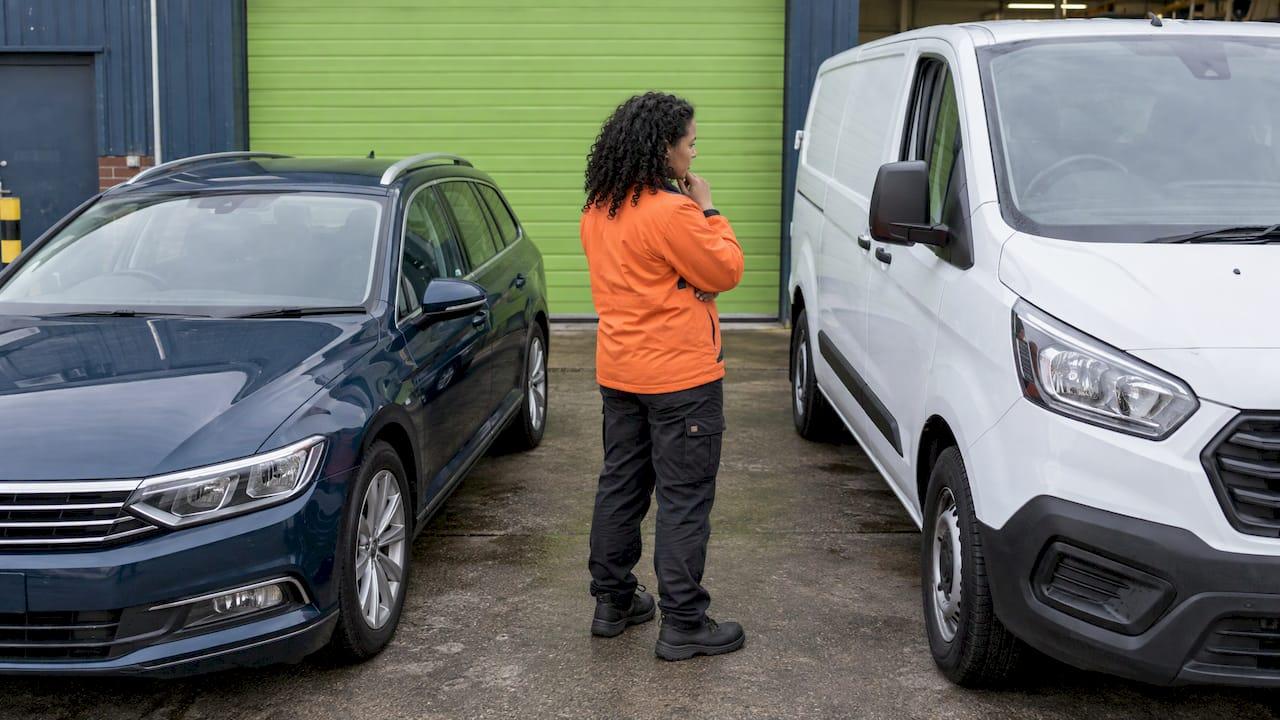
Cars suit contractors who are mainly travelling to clients and carrying a laptop and a few tools. Vans suit trades that carry materials, ladders or equipment. The tax and VAT treatment above is a real part of this decision, because a van's rental sits outside the car 15% restriction and the 50% VAT block.
If you need the van only for a project, a shorter agreement can be better than a three-year commitment. Our short-term vehicle leasing covers 3, 6 and 12 month agreements. For longer needs, panel van leasing and electric van leasing are the pages to start from.
Some contractors are in specific groups with their own routes. Driving instructors can reclaim all the VAT on a car leased primarily for instruction, as HMRC's guidance above confirms, and we have a dedicated driving instructor leasing service. NHS staff, who are often contracting on bank or locum assignments, also have their own offer through us.
What to compare in a quote
Two quotes with the same monthly figure can cost very different amounts. Line them up on these points:
- Initial rental. Many quotes ask for several months' rental up front, often three, six or nine. A no deposit option moves that cost into the monthly payment, so compare total cost over the term, not just the monthly figure.
- Term and annual mileage. Choose a mileage you will really drive. Contractors who move between sites often underestimate it, and excess mileage is charged per mile at hand-back.
- Maintenance. An optional maintenance package adds a higher monthly cost but fixes servicing and tyres. Decide whether you want that certainty.
- Early termination terms. Contracts are fixed-term. If a contract ends early, the funder's policy sets what you owe, and the VAT point above applies to cars.
- Return condition. Ask which fair wear and tear standard applies. A BVRLA member should follow the BVRLA guide.
- Delivery. We offer free mainland UK delivery on eligible new vehicles, which saves a cost that otherwise lands on the first invoice.
- Business and personal use. Confirm in writing whether private use is permitted, since it affects both the VAT and the tax position.
This is where working with a broker helps. We are a family-run business with more than 30 years' experience, and we compare contract hire agreements for you across funders, rather than leaving you to read each set of terms against the others.
Ending the lease without surprises
The cheapest lease can become expensive at hand-back. The BVRLA Leasing Code of Conduct sets out how members must handle the end of a contract:
- At collection, the leasing company and the customer must check the vehicle's condition and agree it, with all readily apparent damage noted and signed for.
- The vehicle is then inspected against the agreed fair wear and tear policy.
- Any charges, including excess mileage, damage, missing equipment and lack of servicing, must be communicated no later than four weeks after collection, with a summary breakdown and photographic evidence.
- For early or voluntary termination, the member must clearly define its policy, which may include charges for unreasonable wear and tear, recovery of loss of value, and adjustments to finance charges.
- A dispute over return condition goes to an independent qualified inspector, whose decision is binding.
In practice: photograph the vehicle at collection, keep the service history, and book repairs for damage beyond fair wear before the return. Our fair wear and tear checklist sets out a timeline for the last 10 to 12 weeks, and our BVRLA code explainer shows how a dispute is resolved.
Our view
Contractors tend to start with the monthly price and discover the rest later: the VAT they cannot recover on a car, the mileage they underestimated, the return charges nobody explained. We would rather you saw all of it before you sign.
We are a family-run broker, FCA authorised and a BVRLA member, and we have been doing this for over 30 years. Our approach is to compare contract hire agreements side by side for you, keep the monthly payments fixed, offer no deposit options where they are available, and stay on hand through the process. For a contractor whose time is billable, handing that comparison to someone who does it every day is a sensible use of the week.
If you are choosing between a car and a van, tell us how you work and how much of your driving is private. That decides far more of the cost than the badge on the bonnet.
Jason
Getting a lease quote
We arrange personal and business car leasing, van leasing, electric vehicles, and short-term leases, across a wide range of car makes and van manufacturers, with optional maintenance packages. Tell us whether you trade as a sole trader or a limited company, your likely mileage and whether you want a car or a van, and we will put together tailored quotations for you through our car leasing enquiry form.
If you are ready to compare vehicles, start with business car leasing or van leasing.
FAQ
Can a self-employed contractor lease a van?
Yes. Sole traders and limited companies can lease vans through business contract hire. The funder will assess credit, and may ask for business bank statements if you are newly trading. The rental is generally allowable for the business share of use, and the 15% car restriction does not apply to vans.
Should a contractor lease through a limited company or as a sole trader?
Both can lease. The difference is in the tax. A company providing a vehicle for your private use may create a benefit-in-kind charge for you, while a sole trader claims only the business share of costs. Your accountant can say which works better for your situation before you sign.
Can I reclaim the VAT on a leased car?
If you are VAT-registered, HMRC says you can normally reclaim half the VAT on rentals for a car available for private use. All of it can be reclaimed on a car leased primarily for taxi hire or driving instruction.
What is the difference between contract hire and a finance lease?
With contract hire the leasing company takes the risk on what the vehicle is worth at the end, and you pay for depreciation plus finance. With a finance lease you pay for the whole cost of the vehicle and carry the resale risk yourself.
What happens if I need to end my lease early?
The funder's early termination policy applies, which can include charges for lost value and adjustments to finance charges. Read it before you sign. For a car, HMRC treats the termination fee as further rental for VAT purposes.
Sources
- HMRC: Motoring expenses (VAT Notice 700/64)
- HMRC VAT Input Tax manual: leasing of cars (VIT53300)
- Deloitte: UK tax rates 2026/27
- Mann Judd: Business motoring, tax aspects
- TapTax: Is van leasing and finance tax deductible?
- BVRLA Leasing Code of Conduct