

HMRC treats the other half as blocked to account for potential private use, and that rule applies whether or not the car is actually driven privately.
A handful of situations change the outcome entirely:
- Hire with driver (cars provided with someone to drive passengers) can qualify for full recovery.
- Driving instruction vehicles used for that specific purpose often escape the block.
- Short-term hire of 10 days or fewer used exclusively for business is exempt from the 50% restriction.
- Exclusive business use, where the car is never available for private journeys, can unlock 100% recovery, though HMRC applies this test strictly.
Maintenance, repairs and tyres are recoverable in full, but only if the lessor invoices them separately from the rental charge. Keep every VAT invoice and lease contract on file. HMRC will ask for them if it queries your claim.
Key Takeaways
| Point | Details |
|---|---|
| Standard recovery rate | Expect to reclaim 50% of VAT on the rental element of most business car leases. |
| Exceptions exist | Hire with driver, driving instruction, short-term hire (≤10 days), and exclusive business use can unlock full recovery. |
| Separate maintenance invoices | Ask lessors to itemise maintenance and repairs separately to recover that VAT in full. |
| Rebates follow the original rule | Only 50% of a termination rebate's VAT needs adjusting if the original rentals were 50% restricted. |
| Get contracts checked early | Lease World reviews lease invoices and contract structure to help businesses secure correct VAT treatment from the start. |
Table of Contents
- Understanding VAT on lease cars and the 50% block
- Which situations allow 100% VAT recovery?
- Which lease charges does the block actually apply to?
- How do you reclaim VAT on lease payments step by step?
- What happens to VAT when a lease is terminated early?
- Worked examples: calculating VAT recovery on a lease
- How Lease World helps with VAT on business leases
- What the rules actually mean for how you should act
- Get your lease invoices checked before VAT becomes a problem
- Sources
- FAQ
Understanding VAT on lease cars and the 50% block
The 50% input tax block exists because HMRC needed a simple way to handle a messy problem: most leased company cars get used for both business and private journeys, and tracking every mile would be a nightmare for businesses and HMRC alike. Rather than asking companies to log private mileage, HMRC picked a flat 50% restriction that applies regardless of how much (or how little) private use actually happens.
That last point trips up a lot of business owners. The block isn't based on actual private mileage. It's based on availability for private use. If an employee can take the car home overnight, has a set of keys, or could technically use it for the school run, HMRC treats that as availability, even if the car never leaves the office car park outside working hours. This "available for private use" test is applied strictly, and simple facts like overnight parking at an employee's home are usually enough to trigger it.
Here's what that means in practice for a typical lease invoice:
- The lessor issues a monthly rental invoice showing the net charge and the VAT.
- Your business identifies the VAT charged specifically on the rental or finance element.
- Half of that VAT is entered as recoverable input tax on your VAT Return.
- The remaining half is simply lost. It cannot be claimed back, carried forward, or offset elsewhere.
This isn't a one-off adjustment either. The block applies from day one of the lease and continues for every single invoice across the contract term, month after month.
Pro Tip: If full VAT recovery matters to your business, look at whether pooling the vehicle on your premises (rather than letting staff take it home) genuinely removes availability for private use. HMRC will look at the practical arrangement, not just what's written in a policy document.
Businesses that lease multiple vehicles across departments often assume each car needs individual assessment. In reality, HMRC applies the same test uniformly. If the arrangement allows private use, the block applies. There is no volume discount or blanket exemption for fleet leases.
Which situations allow 100% VAT recovery?
- Hire with driver. If the lease specifically supplies a car along with a driver for carrying passengers, and this is the actual nature of the supply, the block doesn't apply. This typically covers chauffeur-style arrangements rather than ordinary company cars with a nominated driver.
- Driving instruction. Cars used wholly for giving driving lessons qualify for full recovery, provided that's genuinely the vehicle's function rather than an occasional use case.
- Short-term hire (10 days or fewer). HMRC's internal guidance confirms that a short-term hire used specifically for business purposes, and genuinely temporary, escapes the restriction. This is a legitimate route for covering a staff shortage or a one-off business trip, but it has to be a real short-term need. Rolling short-term hires used as a way to dodge the block will not survive HMRC scrutiny.
- Exclusive business use. This is the hardest test to meet. The vehicle must never be available for private use, which usually means it's kept on business premises, has no private mileage permitted under a written policy that's actually enforced, and often involves pool car arrangements. Simply telling staff "don't use it privately" without physical or contractual controls rarely satisfies HMRC.
There's also a narrow category of Treasury-directed exceptions. Certain public bodies, including some health authorities, are exempt from the standard block under specific Treasury directions. These are rare, HMRC's internal manual treats them as exceptional rather than a general escape route, so don't assume your organisation qualifies without checking directly.
Which lease charges does the block actually apply to?
A single lease invoice can carry several different charges, and they don't all get treated the same way for VAT.
- Rental or finance charge: this is the core amount subject to the 50% block.
- Maintenance, repairs and tyres: fully recoverable, but only when invoiced separately from the rental element.
- Optional services bundled into the rental (breakdown cover, replacement vehicle cover, and similar extras): blocked in full unless the lessor itemises them separately.
- Excess mileage charges: treated as part of the rental supply, so the 50% block applies.
- Early termination payments: usually treated as further consideration for the lease, meaning the block generally follows the same 50% logic as the original rental.
The practical lesson here is worth acting on immediately: ask your leasing company to itemise maintenance separately on every invoice. Practitioner guidance is consistent on this point. Separating it out is a low-friction request, and most lessors will do it without pushback since it costs them nothing to reformat an invoice.
Pro Tip: Review your last three lease invoices right now. If maintenance, servicing, or breakdown cover appears as a single lumped figure alongside the rental charge, call your leasing provider today and ask for a split invoice going forward. You may be overpaying VAT unnecessarily on money you could otherwise reclaim in full.

If you lease through contract hire, check your agreement now. Many contract hire deals bundle maintenance into the monthly figure by default, which is convenient for budgeting but costly for VAT recovery.
How do you reclaim VAT on lease payments step by step?
Getting this right on your VAT Return comes down to documentation and consistent record keeping, not complicated tax planning.
- Check the invoice is valid. A proper VAT invoice from the lessor should show the net rental, the VAT charged, and ideally a statement confirming whether the vehicle is a "qualifying car" for VAT purposes. HMRC's internal guidance sets out what leasing companies are expected to state on these invoices.
- Split the VAT figure. Calculate 50% of the VAT shown on the rental element specifically, separately from any maintenance or service charges.
- Record the recoverable half. Enter this amount as input tax on your VAT Return in the normal way, alongside your other reclaimable VAT.
- Flag the blocked half in your accounting records. Most bookkeeping software allows you to code the irrecoverable VAT to a separate expense line so it's visible for future audits and doesn't get accidentally claimed twice.
- Check partial exemption implications. If your business is partially exempt, the recoverable 50% still needs to run through your normal partial exemption calculation. It doesn't get special treatment just because it's already restricted at source.
- Handle credit notes promptly. If a lessor issues a credit note for a rebate or adjustment, amend your VAT records in the period the credit note is received, not retrospectively, unless your adviser confirms a specific error correction is needed.
Around 50% of VAT on lease rentals is generally recoverable under HMRC's rules, with the remainder permanently blocked rather than deferred. That's a fixed loss on every invoice, not a timing difference, so building it into your monthly cash flow forecasts from the outset avoids nasty surprises at quarter end.
What happens to VAT when a lease is terminated early?
Termination payments and rental rebates are not simply ignored for VAT purposes. HMRC treats them as further consideration connected to the original lease supply, which means the same restriction logic that applied to your monthly rentals carries through to any rebate or termination adjustment.
- If your rentals were subject to the 50% block throughout the contract, only 50% of any VAT credit on a subsequent rebate needs adjusting, matching the original restriction rather than a full 100% correction.
- If the lease qualified for full recovery under one of the exceptions covered earlier, the rebate adjustment should mirror that full recovery treatment instead.
- Request a formal VAT credit note from the leasing company whenever a rebate or termination settlement is issued. Verbal confirmations or account statements alone won't satisfy an HMRC review.
The practical steps are straightforward once you know the rule. When a lease ends early, whether through a company car policy change, vehicle write off, or a straightforward contract exit, ask the lessor for a clear breakdown showing the rebate amount, the VAT element, and confirmation of the treatment applied. Getting this wrong in either direction, over-claiming or under-claiming, creates exactly the kind of discrepancy that draws HMRC attention during a VAT inspection.
Worked examples: calculating VAT recovery on a lease
Numbers make this easier to apply than rules alone. Here are three common scenarios.
Under the standard block, £40 is recoverable and £40 is permanently lost, on every single monthly invoice for the life of the contract.
Example B: Lease plus separately invoiced maintenance. The same £400 rental (£80 VAT) arrives on one invoice, while a separate maintenance invoice of £50 plus VAT (£10 VAT) arrives from the same lessor. The rental VAT is still split 50/50 (£40 recoverable), but the maintenance VAT of £10 is recovered in full because it was invoiced separately, taking total recovery to £50 rather than £40.
| Scenario | VAT charged | VAT recoverable |
|---|---|---|
| Standard rental (Example A) | £80 | £40 |
| Rental + separate maintenance (Example B) | £80 total | £50 total |
| Termination rebate (Example C) | £80 | £40 adjustment |
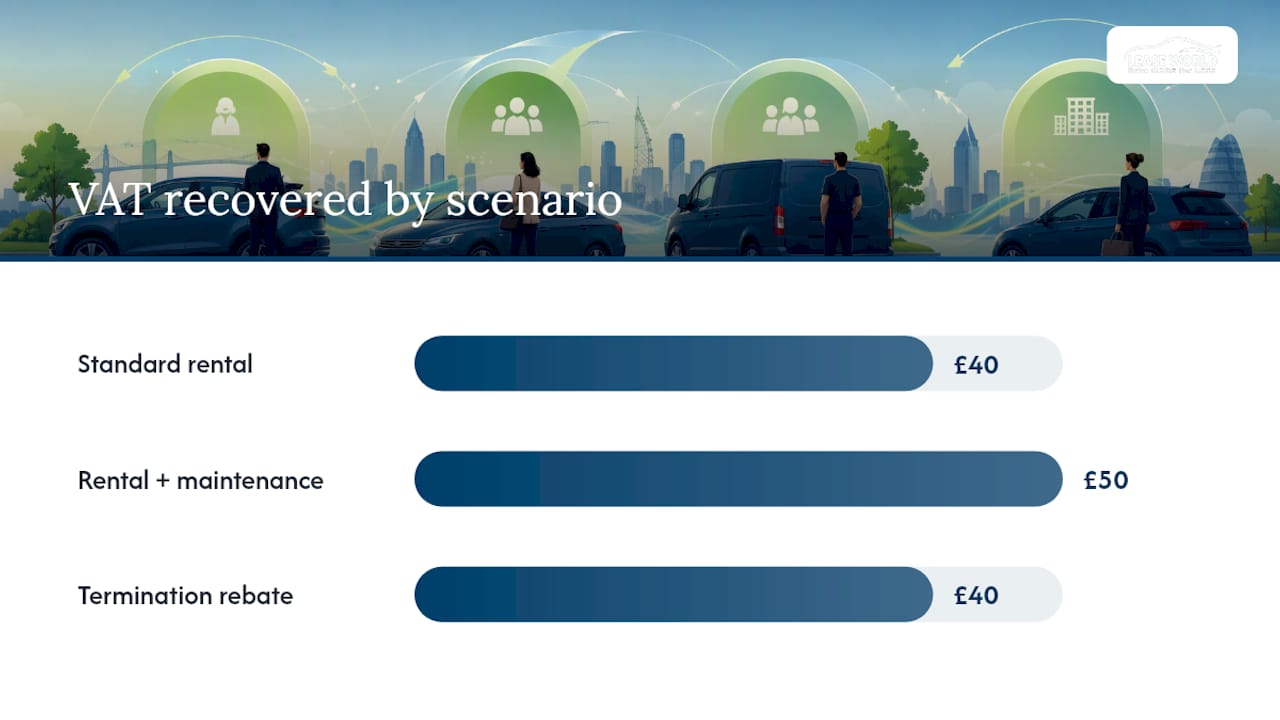
These figures scale directly. Multiply your own monthly rental VAT by the same ratios to estimate your annual recovery position across a fleet.
How Lease World helps with VAT on business leases
Getting VAT treatment right starts before you sign anything, and Lease World builds that check into how it arranges business leases from the outset.
- Contract and invoice review. Lease World checks lease agreements for how charges are itemised, flagging where maintenance or optional extras risk being bundled with the rental in a way that blocks full recovery unnecessarily.
- Guidance on invoice separation. Where a client wants maintenance and repairs invoiced separately to preserve full VAT recovery on that element, Lease World works with funders to structure the agreement accordingly.
- Fixed monthly quotes with no hidden fees, so the VAT and net cost split is clear from the first quotation rather than buried in fine print later.
- Support across business segments, including business car leasing for company fleets, NHS staff arrangements, and driving instructor leases, where different VAT exceptions may genuinely apply.
For businesses running or advising on multiple lease agreements, having someone check the paperwork before signature tends to save far more in reclaimed VAT than it costs in time.
What the rules actually mean for how you should act
It isn't. The real leverage sits in two places most businesses ignore: invoice structure and the availability test.
Too many finance teams accept a bundled lease invoice without ever asking the lessor to split out maintenance. That's money left on the table for no reason, since separating charges costs the lessor nothing and can meaningfully lift your recovery rate.
Treat it as a default that applies only when you haven't structured things any better. Push your leasing provider on invoice detail first. Then look honestly at whether "available for private use" genuinely describes how the car is used, rather than assuming it automatically does.
Get your lease invoices checked before VAT becomes a problem
Sorting VAT treatment out after the fact, once you're mid contract with a bundled invoice and a live HMRC query, is far harder than getting it right at the point of signing. Lease World reviews contract structure and invoice terms as part of arranging business leases, so charges are itemised correctly from the first monthly payment rather than discovered as a costly oversight two years in.
Whether you need a fleet of vans for a growing operation or a single car for a driving instructor, Lease World's team works through the leasing process with you, from quotation to delivery, flagging invoice structure issues before they cost you VAT recovery. Fixed monthly payments, no deposit options on eligible vehicles, and free mainland UK delivery come as standard. If you're ready to see what a properly structured business lease looks like, get a tailored quote and ask specifically about invoice itemisation when you do.
Sources
FAQ
Why can I only claim 50% of VAT on leases?
Is VAT payable on leases?
Is leasing a car 100% tax deductible?
What are three disadvantages of leasing a car?
Common drawbacks include mileage restrictions with charges for exceeding them, limited flexibility to modify or exit the contract early without a termination charge, and the fact that you never own the vehicle outright at the end of the term.