

TL;DR:
- Leasing an electric car through a UK limited company offers significant tax benefits, including full lease deductibility and a 4% benefit in kind rate for 2026/27.
- These advantages, combined with 50% VAT recovery on rentals and exemption from road tax, make electric vehicle leasing highly cost-effective for directors.
Leasing an electric car through your limited company is one of the most tax-efficient decisions available to UK directors right now. The combination of fully deductible lease payments, a 4% Benefit in Kind rate for 2026/27, and 50% VAT recovery on rentals adds up to savings that dwarf anything you get from a petrol or diesel equivalent. Here is exactly how each mechanism works.
Table of Contents
- What are the key tax benefits of leasing an electric car through your company?
- How do electric car lease payments reduce your Corporation Tax bill?
- What BiK rate do directors pay on a company electric car?
- How does VAT work on a leased electric car?
- Are electric cars exempt from road tax, and what grants are available?
- What lease structures work best for company electric cars?
- Financial considerations beyond the headline tax savings
- Lease World: straightforward electric car leasing for UK businesses
- Key takeaways
- FAQ
What are the key tax benefits of leasing an electric car through your company?
Leasing an electric car through your limited company unlocks several overlapping tax advantages that compound across the lease term:
- Full lease payment deductibility: Lease rentals for electric cars with CO2 emissions at or below 50g/km are 100% deductible as a business expense, reducing your taxable profits directly.
- Low Benefit in Kind rate: Electric company cars attract a 4% BiK rate in 2026/27, compared to rates above 30% for high-emission vehicles, cutting the personal tax cost for directors dramatically.
- 50% VAT recovery on lease rentals: HMRC allows businesses to reclaim half the VAT on lease payments by default, with 100% recovery on maintenance costs when paid by the company.
- Road tax exemption: Electric vehicles pay no Vehicle Excise Duty under current UK rules, removing an annual cost entirely.
- Government grants: Schemes such as the Workplace Charging Scheme provide additional financial support for businesses adopting EVs.
- Cash flow preservation: Leasing spreads costs evenly over the lease term rather than requiring a large capital outlay, while delivering steady Corporation Tax deductions throughout.
- Lease World support: Lease World offers tailored electric car leasing arrangements designed to align with these tax advantages from day one.
How do electric car lease payments reduce your Corporation Tax bill?
Lease rental payments for electric cars are treated as an allowable business expense, reducing the company's taxable profits pound for pound. Because electric cars sit at or below the 50g/km CO2 threshold, none of the 15% disallowance that applies to higher-emission vehicles comes into play. Every pound of lease rental paid goes straight against your profits before Corporation Tax is calculated.
The contrast with buying is worth understanding clearly. Purchasing a new electric car outright or via hire purchase qualifies for 100% First Year Allowance, giving immediate full tax relief in year one. Leasing, by contrast, spreads that relief across the lease term through the rental deductions. Neither approach is universally superior; the right choice depends on your cash position and profit forecasts.
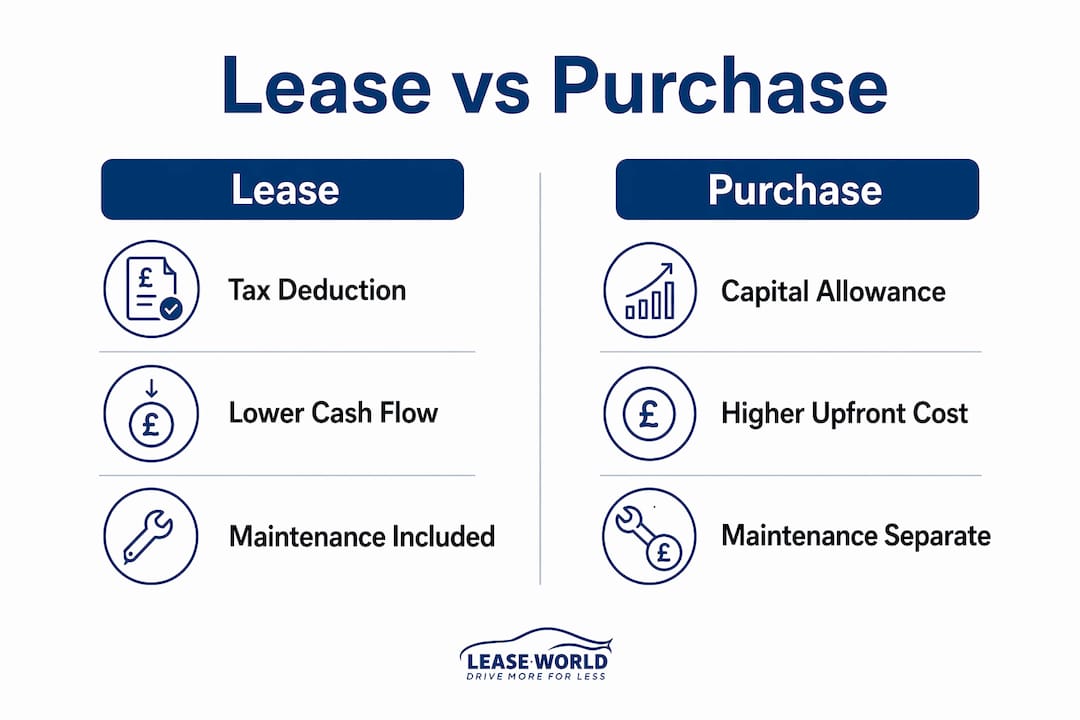
Maintenance costs included within a lease agreement are also deductible as business expenses. For accounting purposes, lease rentals appear on the profit and loss account rather than the balance sheet under an operating lease, keeping the company's asset base clean and the tax treatment straightforward when reported to HMRC.
What BiK rate do directors pay on a company electric car?
The Benefit in Kind rate for zero-emission cars sits at 4% for the 2026/27 tax year. That rate applies to the vehicle's P11D value, which is the manufacturer's list price including options, not the monthly lease payment your company makes.

A practical example illustrates the gap. A popular electric saloon with a P11D value of £45,000 generates a BiK charge of £1,800 per year at the 4% rate. A higher-rate taxpayer director pays 40% income tax on that figure, producing a personal tax cost of £720 annually. The same car with a 30% BiK rate would cost £5,400 in tax each year. That difference is what makes the electric vehicle lease incentive so compelling for directors on higher incomes.
One common misconception is that the P11D value equals the lease cost. It does not. The P11D is based on list price, which can be considerably higher than the monthly rental figure, so directors should model the BiK liability against the actual list price of any vehicle before signing. National Insurance contributions at 13.8% also apply to the employer on the BiK value, adding a modest cost to the company side of the calculation.
Pro Tip: Ask your accountant to run a side-by-side comparison of the BiK cost versus funding the same car through a salary sacrifice scheme. For many directors, the salary sacrifice route reduces both income tax and National Insurance simultaneously, cutting the net cost further.
How does VAT work on a leased electric car?
The default VAT position for a leased car is a 50% input tax block on the rental payments. HMRC applies this block automatically to cover assumed private use, regardless of how many business miles the car actually covers. You do not need mileage logs to claim the 50% you are entitled to; the block is flat and unconditional for qualifying cars.

Maintenance costs sit in a different category. Servicing, repairs, and tyres paid by the business attract 100% VAT recovery, provided the invoices are addressed to the company. Bundling a maintenance package into the lease agreement is therefore a practical way to maximise VAT recovery while keeping costs predictable.
The exception to the 50% block is narrow but worth knowing. If a vehicle is used exclusively for business purposes and private use is prohibited and demonstrably enforced, 100% VAT recovery on the lease rental becomes available. In practice, this is difficult to sustain for a director's company car, so most businesses operate under the standard 50% rule.
Charging costs carry their own VAT rules. VAT on electricity used to charge a company vehicle at the workplace or at a public charging point is recoverable by the business, subject to normal input tax rules. Home charging reimbursed to an employee is treated differently and requires mileage records to apportion business use.
Are electric cars exempt from road tax, and what grants are available?
Electric vehicles are exempt from Vehicle Excise Duty under current UK rules, removing a recurring annual cost that petrol and diesel drivers cannot avoid. For a company running multiple vehicles, that exemption compounds across the fleet.
Beyond VED, the government's Workplace Charging Scheme provides grants for businesses installing EV charge points at their premises, reducing the infrastructure cost of supporting a company electric car. The scheme is administered through the Office for Zero Emission Vehicles and covers a portion of the installation cost per socket. Businesses should check current grant levels directly with the scheme, as figures are subject to periodic review.
The interaction between grants and leasing contracts is straightforward: grants relate to infrastructure rather than the vehicle itself, so they sit alongside the lease rather than affecting its terms. Eligibility for the Workplace Charging Scheme requires the business to have dedicated off-street parking, and the charge points must be installed by an approved installer.
What lease structures work best for company electric cars?
Business Contract Hire is the most common structure for companies leasing electric cars. The company pays fixed monthly rentals over a set term, typically 24–48 months, and returns the vehicle at the end with no ownership obligation. All rental payments are deductible, and the company carries no residual value risk.
Key factors to consider when structuring a lease:
- Lease term: Shorter terms offer flexibility but usually carry higher monthly costs; longer terms reduce monthly outlay and spread deductions over more accounting periods.
- Mileage allowance: Exceeding the contracted mileage triggers excess charges, so set the limit realistically against actual business use.
- Maintenance packages: Including servicing and tyres in the lease agreement simplifies VAT recovery and removes budget uncertainty.
- Residual value: The leasing company absorbs residual value risk under Business Contract Hire, which protects the business from depreciation surprises on a rapidly evolving technology.
- Ownership versus leasing: Buying qualifies for 100% First Year Allowance; leasing does not. If immediate maximum tax relief in year one matters more than cash flow, purchasing outright or via hire purchase may suit better.
Lease World offers flexible terms across a range of electric car lease deals with no hidden fees, fixed monthly payments, and complimentary UK delivery on eligible vehicles, making it straightforward to structure a deal that fits both the business's cash flow and its tax position.
Financial considerations beyond the headline tax savings
Total cost of ownership extends beyond the Corporation Tax deduction. Insurance, employer National Insurance on the BiK value, and any excess mileage charges all feed into the real cost of a company electric car. Accountants consistently recommend modelling these alongside the tax savings rather than treating the lease payment in isolation.
Cash flow is where leasing genuinely wins over buying for most small and medium-sized companies. Spreading payments over 24–48 months preserves working capital that would otherwise be tied up in a depreciating asset. That capital can generate returns elsewhere in the business, which changes the effective cost of the lease when viewed over the full term.
Salary sacrifice schemes add another layer of efficiency for companies with employees who want access to an electric car. Under a salary sacrifice arrangement, the employee gives up gross salary in exchange for the car benefit, reducing both income tax and National Insurance for the employee and employer National Insurance for the company. The BiK charge still applies, but at 4% the net position is usually favourable compared to buying the same car from taxed salary.
The P11D list price, not the lease cost, drives the BiK calculation, so a car with a high list price but an attractive lease deal still generates a proportionally higher BiK charge. Directors should factor this into vehicle selection, not just the monthly rental figure.
Lease World: straightforward electric car leasing for UK businesses
Lease World is a family-run leasing business built around transparency and personal service, which is exactly what company directors need when navigating the tax rules around electric car leasing. There are no hidden fees, no deposit requirements on eligible vehicles, and fixed monthly payments that make budgeting and tax planning clean and predictable.

Where larger brokers push volume, Lease World focuses on matching each business to the right deal. The team compares contracts across the market, explains the tax implications in plain language, and handles delivery across the UK. For directors who want the electric vehicle tax breaks without the complexity of sourcing and negotiating a lease independently, Lease World's leasing guides and dedicated support make the process considerably more straightforward. Get a quote today and see how much your company could save.
Key takeaways
Leasing an electric car through a UK limited company delivers Corporation Tax savings, a 4% BiK rate for 2026/27, and 50% VAT recovery on rentals, making it one of the most tax-efficient vehicle arrangements available to directors.
| Point | Details |
|---|---|
| Lease payments fully deductible | Electric car rentals at or below 50g/km CO2 are 100% deductible, with no 15% disallowance. |
| BiK rate of 4% in 2026/27 | Directors pay income tax on just 4% of the vehicle's P11D list price, not the lease cost. |
| 50% VAT on rentals, 100% on maintenance | HMRC's flat 50% block applies to lease rentals; maintenance VAT is fully reclaimable. |
| Road tax exemption | Electric vehicles pay no Vehicle Excise Duty, removing an annual recurring cost. |
| Lease World | Offers fixed monthly payments, no-deposit options, and transparent terms for business EV leasing. |
FAQ
Is an electric car 100% tax-deductible when leased through a company?
Lease rental payments for electric cars with CO2 emissions at or below 50g/km are 100% deductible as a business expense, reducing taxable profits in full. The 15% disallowance that applies to higher-emission vehicles does not apply to electric cars.
Can a limited company reclaim VAT on a leased electric car?
Yes, but only 50% of the VAT on lease rental payments by default, as HMRC applies a flat block to cover assumed private use. Maintenance costs paid by the company attract 100% VAT recovery.
Do leased electric cars qualify for the 100% First Year Allowance?
No. The 100% First Year Allowance applies only to new, unused electric vehicles purchased outright or via hire purchase. Operating leases and contract hire arrangements do not qualify; tax relief comes instead through the deductible rental payments spread across the lease term.
What BiK rate applies to a company electric car in 2026/27?
The Benefit in Kind rate for zero-emission electric cars is 4% for the 2026/27 tax year, calculated against the vehicle's P11D list price. A higher-rate taxpayer director pays 40% of that 4% charge as income tax annually.