

TL;DR:
- A company car is a taxable benefit provided by an employer, while a personal lease involves a private rental with no tax implications. The financial impact of each depends on VAT treatment, Benefit in Kind tax, and ownership responsibilities, which vary in complexity and cost. Electric company cars offer lower tax rates, making them more cost-effective for higher-rate taxpayers, but total costs should always include taxes and VAT considerations before choosing the best option.
A company car is a taxable employment benefit provided by an employer, while a personal lease is a private contract between an individual and a leasing company with no business tax implications. The choice between a company car vs personal lease shapes your monthly outgoings, tax bill, and day-to-day flexibility in ways that most guides understate. This article breaks down the financial structures, Benefit in Kind tax rates, VAT rules, and ownership conditions that determine which option suits your circumstances in 2026.
How do company car and personal lease financial structures differ?
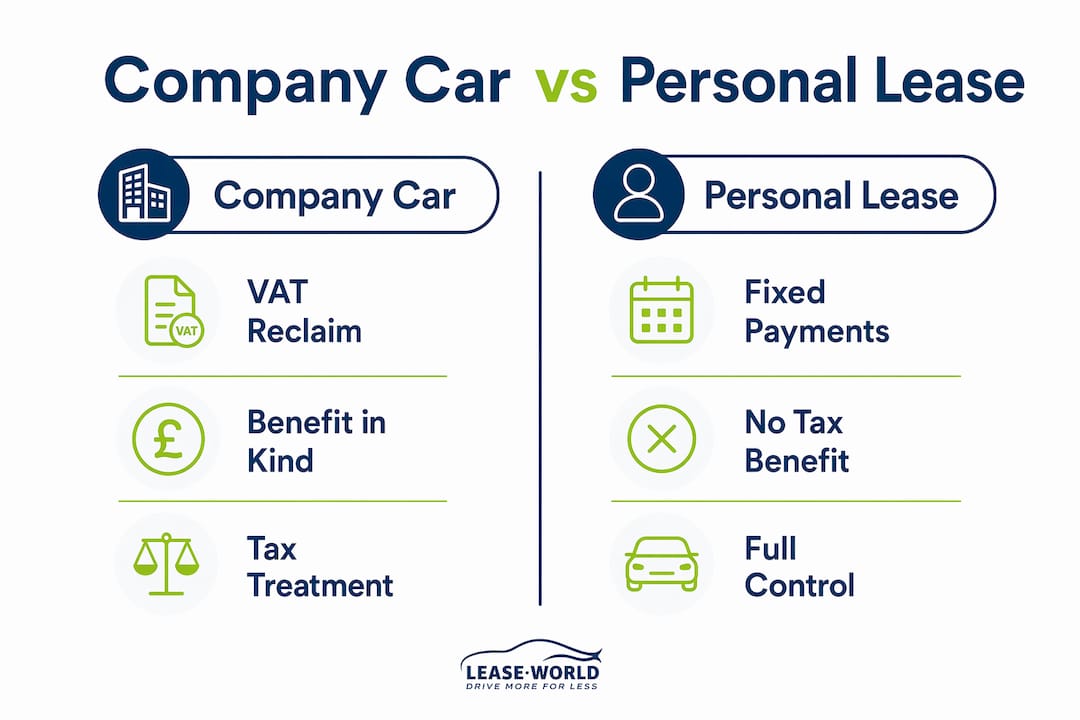
The core financial difference is VAT treatment. Business Contract Hire allows VAT-registered companies to reclaim 50% of VAT on lease rentals where the car is available for personal use, and 100% where the vehicle is used exclusively for business with no private availability. Personal Contract Hire, the standard form of personal leasing, includes VAT in the monthly payment with no option to reclaim it. That difference alone makes business leasing materially cheaper for VAT-registered businesses on a like-for-like vehicle.
Company lease payments also qualify as a business expense, which reduces Corporation Tax liability. Personal lease payments come from post-tax income with no deduction available. For a limited company director, this creates a meaningful gap in the true net cost of each option.
The comparison gets more complex once you factor in Benefit in Kind tax. A company car provided for personal use triggers a tax charge calculated on the vehicle's P11D value multiplied by an appropriate percentage based on CO2 emissions. The employer also pays Class 1A National Insurance contributions on that benefit. These charges sit on top of the lease cost itself and must be included in any honest cost model.
Pro Tip: Never compare a company car and a personal lease using monthly payment figures alone. The true cost model must include BiK tax, employer NICs, and VAT recovery to give you an accurate picture.
| Factor | Company car | Personal lease |
|---|---|---|
| VAT treatment | 50% or 100% reclaimable (business use) | Non-reclaimable, included in monthly cost |
| Tax deductibility | Lease payments reduce Corporation Tax | No deduction available |
| Benefit in Kind | Taxable benefit based on P11D value | No BiK applies |
| Employer NICs | Class 1A NICs payable by employer | Not applicable |
| Monthly cost basis | Pre-tax business expense | Post-tax personal expenditure |
What are the tax implications of a company car vs a personal vehicle?
Benefit in Kind tax is the defining cost of a company car for the employee. HMRC calculates the charge using the vehicle's P11D list price multiplied by an appropriate percentage, which is then taxed at the employee's marginal income tax rate. A higher earner paying 40% income tax faces a substantially larger BiK bill than a basic rate taxpayer on the same vehicle.
The appropriate percentage varies sharply by fuel type and CO2 emissions. For 2026/27, fully electric company cars carry a BiK rate of 4%, rising gradually to 9% by 2029/30. Petrol and diesel cars attract rates up to 37% depending on emissions. That gap makes electric vehicles significantly more tax-efficient as company cars, particularly for higher-rate taxpayers. For context on the best electric options available on lease, Lease World's 2026 electric car lease guide covers current models and rates in detail.
A point that catches many people out: BiK tax applies based on availability, not actual private mileage driven. If a company car is available for personal use, the tax charge applies regardless of whether you use it privately at all. Restricting private use contractually and in practice is the only way to avoid the charge.
Personal leases carry none of these complications. The monthly payment is simply a personal expenditure. HMRC has no interest in a privately leased car beyond normal motoring costs. There is no BiK, no employer NIC, and no P11D submission required.
Key differences in company car tax treatment for 2026/27:
- BiK rate for fully electric cars: 4%, rising to 9% by 2029/30
- BiK rate for petrol/diesel cars: up to 37%, depending on CO2 emissions
- Tax basis: P11D value × appropriate percentage × marginal income tax rate
- Employer cost: Class 1A NICs on the full BiK value
- Personal lease: no BiK, no employer NIC, no HMRC reporting obligation
How do usage and ownership responsibilities differ?
Personal leasing is a fixed-term rental agreement. You pay an initial rental followed by fixed monthly instalments over a contract of typically 24–48 months, then return the vehicle at the end. You never own the car. Mileage limits are set at the outset, and exceeding them triggers per-mile excess charges. The vehicle must be returned in good condition, with fair wear and tear accepted but damage charged separately.

With a company car, the business owns or leases the vehicle and makes it available to you. Running costs including fuel, servicing, insurance, and road tax are often covered by the employer, though arrangements vary. This can represent a significant saving compared to a personal lease, where every running cost falls to you individually. The full maintenance leasing option available through providers like Lease World bundles servicing and tyres into the monthly cost, which reduces that gap for personal lessees.
The practical restrictions differ too. A company car is tied to your employment. If you change jobs or are made redundant, the car goes back. That dependency is a real risk for anyone in a sector with high job mobility. A personal lease, by contrast, sits entirely outside your employment relationship. You keep the car regardless of what happens at work, subject only to the contract terms.
Pro Tip: If you drive fewer than 8,000 miles per year privately, a company car's BiK tax burden may outweigh the running cost savings. Model your actual mileage before deciding.
Here is how ownership and usage responsibilities break down in practice:
- Initial payment. Personal leases require an upfront rental, typically equivalent to three to nine monthly payments. Company cars usually require no personal outlay.
- Running costs. Employers often cover fuel, insurance, and servicing for company cars. Personal lessees pay all running costs from their own pocket.
- Mileage limits. Personal leases set a fixed annual mileage allowance. Company cars may have internal policies but are not subject to the same contractual penalties.
- End of contract. Personal lessees return the car with no ownership option. Company cars revert to the business or are replaced by the employer.
- Employment dependency. Company cars are linked to your role. Leaving the job ends your access to the vehicle immediately.
Which option is financially better: company car or personal lease?
The answer depends on three variables: your income tax rate, the vehicle's emissions, and whether your employer is VAT-registered. A thorough cost comparison must include lease payments, VAT treatment, BiK tax, and employer NICs. Focusing only on the monthly payment produces a misleading result.
For a higher-rate taxpayer driving a petrol or diesel car with high CO2 emissions, a company car can be expensive. A car with a P11D value of £35,000 and a 30% appropriate percentage generates a BiK charge of £10,500. At 40% income tax, that costs the employee £4,200 per year in additional tax. The employer pays Class 1A NICs on top. A personal lease on the same vehicle, funded from post-tax income, may work out cheaper in total once running costs are factored in.
Electric vehicles change the calculation entirely. Electric company cars are a tax-efficient option due to the 4% BiK rate in 2026/27. A £40,000 electric car generates a BiK charge of just £1,600. At 40% tax, the employee pays £640 per year. Combined with VAT recovery and Corporation Tax relief on lease payments, an electric company car can be substantially cheaper than a personal lease on the same model. You can explore current personal lease deals to compare costs directly.
For individuals who are not company directors or employees receiving a company car benefit, the personal lease is the straightforward route. There is no tax complexity, no employer involvement, and no risk of the vehicle being withdrawn. The trade-off is that you carry all running costs and receive no business tax relief.
| Scenario | Better option | Key reason |
|---|---|---|
| Higher-rate taxpayer, electric car | Company car | 4% BiK rate makes tax cost minimal |
| Higher-rate taxpayer, petrol/diesel | Personal lease | High BiK rates erode company car savings |
| VAT-registered business, any car | Company car | VAT reclaim reduces effective monthly cost |
| Employee, no VAT registration | Personal lease | No business tax benefit available |
| Job insecurity or frequent role changes | Personal lease | No employment dependency on the vehicle |
Key takeaways
A company car costs less in tax when it is electric, but a personal lease is simpler, more flexible, and often cheaper for petrol or diesel drivers who pay higher-rate income tax.
| Point | Details |
|---|---|
| BiK tax is the deciding factor | Electric company cars attract only 4% BiK in 2026/27, making them far cheaper than petrol equivalents. |
| VAT recovery favours businesses | VAT-registered companies can reclaim 50% or 100% of lease VAT, reducing the true monthly cost. |
| Personal leases carry no tax complexity | No BiK, no employer NICs, and no HMRC reporting obligations apply to personal leases. |
| Total cost modelling is non-negotiable | Any comparison must include BiK tax, employer NICs, and VAT treatment, not just monthly payments. |
| Employment risk affects company cars | A company car is tied to your job. A personal lease remains yours regardless of employment changes. |
What I have learned from watching people get this decision wrong
People consistently underestimate how much their income tax rate shapes the company car calculation. I have seen higher-rate taxpayers accept a company car on a high-emission diesel, assume it is a perk, and then discover they are paying thousands more per year in BiK tax than a personal lease would have cost them. The monthly payment looked attractive. The tax bill did not.
The electric vehicle opportunity is genuinely significant right now. A 4% BiK rate is historically low, and the window before rates rise toward 9% by 2029/30 is worth acting on. If your employer offers a salary sacrifice or company car scheme on an electric vehicle, the numbers often work in your favour even after accounting for all charges. The small business vehicle selection guide covers this well for those running their own companies.
One trap I see repeatedly involves VAT on maintenance. Companies assume they can reclaim VAT on all lease-related costs, but VAT on separately invoiced maintenance is treated differently from VAT on the lease rental itself. Getting this wrong leads to over-claiming, which creates problems at VAT inspection. Always verify the treatment of each invoice separately.
My honest advice: model the full cost before you decide, not just the headline monthly figure. If you are unsure how BiK tax applies to your specific vehicle and income, speak to a tax adviser before signing anything. The difference between the right and wrong choice here is not marginal. It can run to thousands of pounds per year.
— Jason
Find your next lease with Lease World
Choosing between a company car and a personal lease is easier when you have clear, comparable deals in front of you. Lease World offers a full range of personal and business car leases across electric and conventional vehicles, with fixed monthly payments and no hidden fees.
Whether you are weighing up the tax benefits of a company car or looking for a straightforward personal contract, Lease World's leasing guides cover everything from terminology to payment profiles. You can also request a personalised quote to see current deals matched to your budget and mileage needs. Lease World delivers across the UK on eligible vehicles, with no deposit options available on selected models.
FAQ
What is the difference between a company car and a personal lease?
A company car is a vehicle provided by an employer as a taxable benefit, subject to Benefit in Kind tax and employer NICs. A personal lease is a private contract where you pay fixed monthly instalments and return the car at the end, with no business tax implications.
Is a company car or personal lease cheaper in 2026?
For electric vehicles, a company car is often cheaper due to the 4% BiK rate and VAT recovery available to businesses. For high-emission petrol or diesel cars, a personal lease is frequently the lower-cost option once BiK tax is included in the calculation.
Do you pay tax on a personal car lease?
No. A personal lease is not a taxable benefit. You pay monthly instalments from post-tax income, but HMRC does not apply BiK tax or require any employer reporting on a privately leased vehicle.
Can a business reclaim VAT on a car lease?
Yes, but only partially in most cases. VAT-registered businesses can reclaim 50% of VAT on lease rentals where the car is available for personal use, and 100% where it is used exclusively for business with no private availability.
What happens to a company car if you leave your job?
The vehicle returns to the employer when your employment ends. Unlike a personal lease, a company car is tied to your role, so any change in employment terminates your access to the vehicle immediately.