

TL;DR:
- An electric car lease in the UK is a fixed-term rental agreement where drivers do not own the vehicle. It offers predictable monthly costs, protection against depreciation, and easy upgrades every few years. However, drivers must consider fees, mileage restrictions, and early termination penalties when choosing this option.
An electric car lease is a fixed-term rental agreement, typically lasting 24 to 48 months, where you pay set monthly fees to drive a new electric vehicle without ever owning it. The industry term for this arrangement in the UK is Personal Contract Hire, or PCH. At the end of the contract, you return the car and either walk away or start a new lease on a different model. For UK drivers weighing up electric vehicle lease options in 2026, understanding how PCH works, what it costs, and where it differs from buying is the foundation of every good leasing decision.
What is an electric car lease and how does it work in the UK?
PCH is a long-term hire agreement between you and a leasing company. You agree to a contract length, an annual mileage allowance, and a fixed monthly payment. The leasing company retains ownership of the vehicle throughout.
The process follows a clear sequence.
- Choose your vehicle and contract terms. You select the make, model, trim level, contract length (typically 24, 36, or 48 months), and annual mileage. Each variable directly affects your monthly payment.
- Pay an initial rental. Most leases require an upfront payment equivalent to 1 to 9 months of your monthly fee. A higher initial rental lowers subsequent monthly costs.
- Drive within your agreed mileage. UK lease mileage limits typically run from 5,000 to 30,000 miles per year. Exceeding them triggers penalty charges of 3 to 30 pence per extra mile. That range is wide, so always confirm the exact rate in your contract.
- Return the vehicle in good condition. At contract end, you hand the car back. PCH includes no option to purchase, which distinguishes it clearly from Personal Contract Purchase (PCP).
- Start a new lease if you wish. Many drivers use this moment to upgrade to a newer EV model.
Maintenance, insurance, and road tax are not automatically included in a standard PCH agreement. Some deals bundle servicing and breakdown cover, particularly through full maintenance leasing packages. Battery leasing is now rare on newer EVs, as most manufacturers include the battery within the vehicle price.
Pro Tip: Always check whether your quoted monthly payment includes VAT. Business leases are typically quoted excluding VAT, while personal leases include it. Comparing the two without adjusting for VAT produces a misleading cost difference.

What are the costs involved in an electric car lease?
The monthly cost of an electric car lease is calculated primarily on depreciation. The leasing company estimates how much the car will lose in value over your contract term, then divides that figure by the number of months, adding interest and fees.
Key costs to understand before signing:
- Monthly payment. Covers the vehicle's depreciation over the contract period, plus the finance company's margin.
- Initial rental. A lump sum paid upfront, usually 1 to 9 months' worth of payments. It is not a deposit and is non-refundable.
- Acquisition and disposition fees. These fees are frequently overlooked but can total several hundred pounds, particularly on shorter 24-month contracts. They represent a meaningful share of total contract cost.
- Excess mileage charges. Charged per mile above your agreed annual limit, at rates between 3 and 30 pence per mile.
- Early termination penalties. Ending a lease before the contract finishes can cost the full remaining balance. This is one of the most significant financial risks in leasing.
- Wear and tear charges. Damage beyond fair wear and tear is charged at vehicle return. Familiarise yourself with the BVRLA's fair wear and tear guidelines before returning any leased vehicle.
Advertised lease deals are almost always based on the lowest trim level. Choosing upgraded paint, alloy wheels, or a higher specification raises your monthly payment. This happens because residual value calculations vary by exact vehicle configuration, and options affect how much the car is worth at contract end.
| Cost type | Leasing (PCH) | Buying outright | PCP finance |
|---|---|---|---|
| Upfront cost | Initial rental (1–9 months) | Full purchase price | Deposit (typically 10%) |
| Monthly payments | Fixed, lower than PCP | None | Higher than PCH |
| Ownership at end | No | Yes | Optional (balloon payment) |
| Depreciation risk | Borne by leasing company | Borne by owner | Borne by owner |
| Flexibility to change | High (new lease at term end) | Low (must sell) | Medium (PCP balloon) |
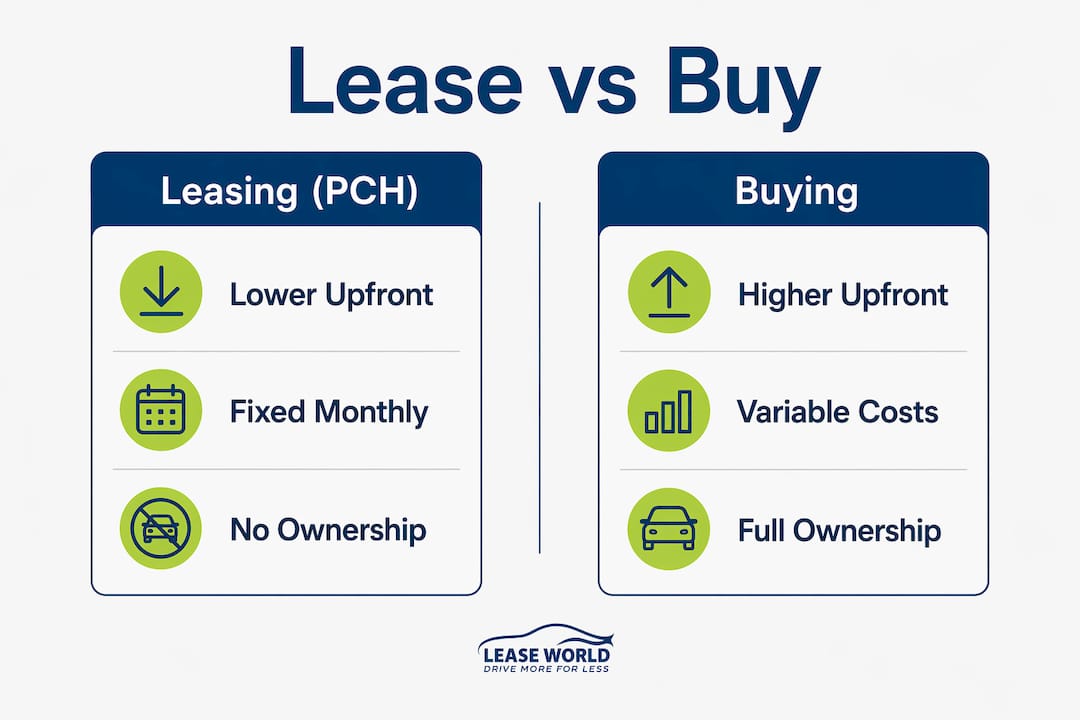
Understanding this table is the fastest way to answer whether an electric car lease is worth it for your situation. If low monthly outlay and freedom from depreciation matter most, PCH wins. If building equity matters, buying wins.
What are the benefits and drawbacks of leasing an electric car?
Leasing an EV carries genuine advantages that buying cannot replicate, but it also carries constraints that suit some drivers poorly.
Benefits of electric car leasing:
- No depreciation risk. The leasing company absorbs any drop in the car's residual value. Residual value is contractually locked in, so a sudden market price fall does not affect you.
- Technology currency. EV battery and charging technology is advancing rapidly. Leasing lets you upgrade every 2 to 3 years to a model with better range and faster charging, rather than being locked into ageing hardware.
- Lower monthly payments. PCH monthly costs are typically lower than PCP finance on the same car, because you are only paying for the vehicle's depreciation, not its full value.
- Predictable budgeting. Fixed monthly payments make financial planning straightforward. You know your motoring cost for the entire contract term.
- Salary sacrifice savings. Salary sacrifice EV leasing deducts payments from gross pay before Income Tax and National Insurance. For employed UK drivers, this can reduce the effective cost substantially, and many schemes bundle maintenance and breakdown cover.
Drawbacks to consider:
- No ownership equity. Every payment builds zero equity. At contract end, you have nothing to sell or trade.
- Mileage restrictions. Drivers who regularly exceed 20,000 miles per year face steep penalty charges. High-mileage drivers should model the excess mileage cost carefully before committing.
- Early exit is expensive. Terminating early can equal the full remaining balance. Life changes such as redundancy or relocation make this a real risk.
- Condition obligations. You must return the car in acceptable condition. Scratches, kerbed alloys, and interior damage attract charges.
Pro Tip: Before signing, use a mileage tracker app for one month to establish your true average annual mileage. Most drivers underestimate their mileage, which leads to costly excess charges at contract end.
How does leasing an electric car compare to buying or financing?
The core difference between leasing and buying is ownership. When you buy, you own the asset and bear all associated risks, including depreciation. When you lease, the finance company owns the car and bears the depreciation risk.
| Factor | PCH lease | PCP finance | Outright purchase |
|---|---|---|---|
| Monthly cost | Lowest | Medium | None (after purchase) |
| Ownership | Never | Optional at end | Immediate |
| Depreciation exposure | None | Full | Full |
| Flexibility | High | Medium | Low |
| Tax efficiency (employed) | High (salary sacrifice) | Low | Low |
| Modification rights | None | Limited | Full |
PCP finance sits between leasing and buying. You pay monthly instalments and can choose to pay a final balloon payment to own the car, hand it back, or use any equity as a deposit on a new deal. The monthly payments are higher than PCH because PCP finance includes the option to own. For drivers who want ownership flexibility, PCP is worth considering. For drivers who simply want the newest EV at the lowest monthly cost, PCH is the stronger choice.
Salary sacrifice schemes deserve particular attention for employed UK drivers. Payments come from gross salary, reducing taxable income. This makes EV salary sacrifice one of the most tax-efficient ways to drive a new electric car in the UK. Employers benefit too, as they save on National Insurance contributions. The 2026 UK guide to available EV leases covers which models qualify and how to access these schemes.
For those researching electric vehicle setup at home, leasing also removes the concern of owning a car whose charging technology becomes outdated as home charger standards evolve.
Key takeaways
An electric car lease (PCH) is the most cost-effective way for UK drivers to access a new EV with fixed monthly payments, no depreciation risk, and the freedom to upgrade every two to three years.
| Point | Details |
|---|---|
| PCH means no ownership | You return the car at contract end; there is no option to buy under a standard lease. |
| Mileage limits matter | UK leases allow 5,000–30,000 miles per year; exceeding this costs 3–30 pence per mile. |
| Hidden fees add up | Acquisition and disposition fees can total several hundred pounds, especially on 24-month contracts. |
| Salary sacrifice cuts costs | Employed drivers can reduce effective lease costs by paying from gross salary before tax and NI. |
| Early exit is costly | Terminating a lease early can require paying the full remaining contract balance. |
Why I think most UK drivers underestimate leasing's real value
The most common mistake I see is drivers treating a lease purely as a monthly payment decision. They compare the PCH figure to a PCP figure and stop there. That misses the bigger picture entirely.
The real value of leasing an EV in 2026 is protection against technology risk. EV battery chemistry, range, and charging speed are improving faster than almost any other consumer technology. A car you buy today could feel genuinely outdated in three years. A lease removes that problem entirely. You hand it back and move on.
The second thing most drivers miss is the fine print on fees. Acquisition and disposition fees are rarely mentioned in advertised deals, yet they can add hundreds of pounds to the total cost of a short lease. Always request the full cost breakdown, not just the monthly figure. The car lease terminology glossary is a good starting point for understanding every line item before you sign.
My honest advice: plan your mileage conservatively, read every clause on early termination, and treat the salary sacrifice option as the first thing to investigate if you are employed. For most UK drivers who want a new EV without the ownership headaches, leasing is the right call.
— Jason
Electric car leasing deals from Lease World
Lease World offers a wide range of electric car lease deals for both personal and business customers across the UK, with contract lengths and mileage allowances tailored to individual needs.
As a family-run business, Lease World provides fixed monthly payments, no-deposit options on eligible vehicles, and complimentary UK delivery. Every deal is presented transparently, with no hidden fees. Whether you are looking for a short-term arrangement or a standard 36-month PCH contract, Lease World's team offers dedicated support to help you compare terms and find the right fit. You can also request a personalised lease quote directly, or browse the full UK leasing guides to build your knowledge before committing.
FAQ
What is the difference between PCH and PCP?
PCH (Personal Contract Hire) is a pure lease with no option to buy the car at the end. PCP (Personal Contract Purchase) includes a final balloon payment that lets you purchase the vehicle if you choose.
How much does an electric car lease cost per month in the UK?
Monthly costs vary by model, contract length, and mileage allowance. Advertised deals are based on the lowest trim; upgrading options or choosing a shorter contract raises the monthly payment.
Can I end an electric car lease early?
Early termination is possible but expensive. Penalties can equal the full remaining balance of the contract, so exiting early should be treated as a last resort.
Is leasing an electric car worth it for high-mileage drivers?
Leasing suits high-mileage drivers well because the residual value is locked in contractually, transferring depreciation risk to the finance company. However, drivers must stay within their agreed annual mileage to avoid penalty charges.
What happens at the end of an electric car lease?
You return the vehicle to the leasing company in the agreed condition. There is no obligation to buy, and you are free to start a new lease on a different model immediately.