

TL;DR:
- Electric vehicle leasing in the UK primarily involves Personal Contract Hire agreements, where drivers pay fixed monthly fees for a set period without ownership rights. Monthly payments cover depreciation, VED, warranty, and breakdown costs, while insurance, charging, and tyres are paid separately; upfront rentals should be affordable and non-refundable. At lease end, drivers can return, extend, or negotiate to buy the vehicle, with accurate mileage and condition management preventing unexpected charges.
Electric vehicle leasing is defined as a fixed-term rental agreement, most commonly a Personal Contract Hire (PCH), where you pay a set monthly amount to drive a new EV and return it at the end of the contract. PCH is the dominant method for private EV leasing in the UK, with typical lease terms running from 24 to 48 months and an agreed annual mileage cap set from the outset. You never own the vehicle. You pay purely for the use of it, which means the leasing company absorbs the depreciation risk that would otherwise fall on you as a buyer. For UK drivers weighing up how EV leasing works, that single distinction changes the entire financial calculation.
How does EV leasing work in the UK?
Understanding how EV leasing works starts with one core principle: you are paying for depreciation, not for ownership. The leasing company buys the car, calculates how much value it will lose over your contract term, and charges you that loss plus a financing fee, spread across monthly payments. This is why a car that depreciates slowly, such as a Tesla Model 3 or a Volkswagen ID.4, often produces lower monthly lease costs than a less popular model with steeper value loss.
The leasing mindset requires a genuine shift from ownership thinking. You are not building equity. You are buying access to a car for a defined period, after which you hand it back and either walk away or start a new agreement. For many UK drivers, this is actually the point. EV technology is advancing quickly, and a 36-month lease means you can move to a newer, longer-range model without the headache of selling a depreciating asset.
PCH agreements are arranged either directly through a manufacturer's finance arm, such as Volkswagen Financial Services or Tesla Finance, or through a leasing broker. Brokers compare deals across multiple funders and often secure lower monthly rates than going direct. Lease World operates as exactly this kind of broker, giving you access to a range of deals with transparent pricing and no hidden fees.
What costs are included in an EV lease payment?
Monthly lease payments cover a specific set of costs, and knowing what sits inside and outside that figure prevents budget surprises.
What is typically included:
- Depreciation and financing fees (the core of every payment)
- Road tax (Vehicle Excise Duty), though this has changed since April 2025
- Manufacturer warranty for the duration of the lease
- Breakdown cover in most standard agreements
What you must budget for separately:
- Car insurance (a legal requirement you arrange independently)
- Electricity costs for home or public charging
- Home charger installation, which can cost several hundred pounds
- Tyres, unless covered by an optional maintenance package
The monthly cost is primarily driven by the vehicle's expected value loss over the contract term, which is why initial rental size matters. A higher upfront payment, typically three, six, or nine months' worth of rentals paid at the start, reduces your monthly figure. However, initial rentals are non-refundable if the contract ends early, so paying a large sum upfront carries real financial risk if your circumstances change.
Optional maintenance packages are worth examining carefully. They generally cover scheduled servicing, MOT tests, and routine parts such as brake pads and wiper blades. What they rarely cover is tyre replacement, cosmetic repairs, or charging equipment. Maintenance packages in EV leases are limited in scope by design, so read the terms before assuming full coverage.

Pro Tip: Only pay an initial rental amount you could afford to lose entirely. If your contract ends early due to redundancy or a change in circumstances, that upfront sum will not be returned to you.
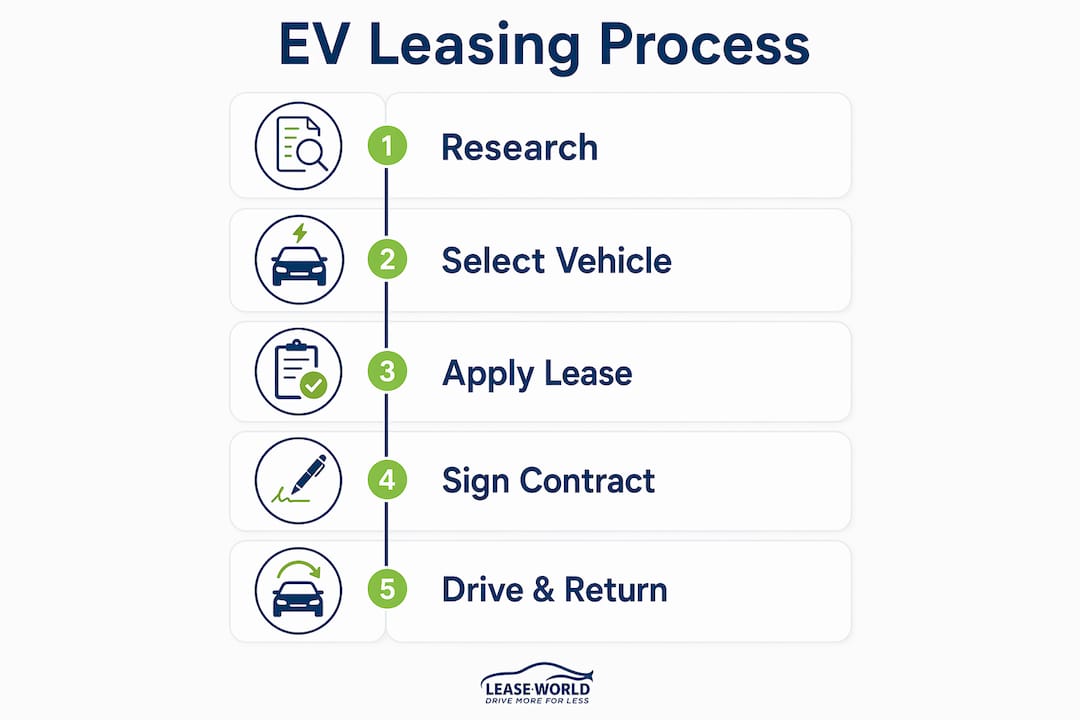
What is the step-by-step leasing process for UK drivers?
The leasing process follows a clear sequence from choosing a car to taking delivery. Here is exactly what to expect:
-
Choose your vehicle, term, and mileage. Select the EV model, contract length (typically 24, 36, or 48 months), and your realistic annual mileage. Underestimating mileage to lower the monthly cost is one of the most common and expensive mistakes lessees make.
-
Submit your application and documents. You will need proof of identity, proof of address, and evidence of income. The funder runs a credit check at this stage. A poor credit history does not automatically disqualify you, but it may affect the rate offered or require a larger initial rental.
-
Pay the initial rental. Once approved, you pay the agreed upfront amount, usually by bank transfer or direct debit. This triggers the order being placed with the manufacturer or dealer.
-
Set up your monthly direct debit. Payments begin one month after delivery and continue for the full contract term. The amount is fixed and will not change unless you modify the agreement.
-
Take delivery and inspect the vehicle. The car is delivered to your home or a chosen address. Conduct a thorough inspection at handover and note any pre-existing marks or damage in writing. This protects you from being charged for damage you did not cause at the end of the lease.
-
Read your contract in full before signing. The small print on mileage caps and servicing obligations can make or break whether the lease ends with unexpected charges. Pay particular attention to the excess mileage rate, which is charged per mile over your agreed limit.
For a more detailed walkthrough of each stage, the leasing process guide at Lease World covers every step with practical UK-specific advice.
What happens at the end of an electric vehicle lease?
End-of-lease planning is where many drivers are caught off guard. You have three main options when your contract concludes:
- Return the vehicle and walk away. This is the most straightforward outcome. You hand the car back, and the leasing company assesses its condition and mileage.
- Extend the lease. Most funders allow extensions of 3 to 12 months on a rolling basis, which is useful if you are not yet ready to commit to a new agreement.
- Negotiate a purchase. In some PCH contracts, buying the vehicle at the end is possible, though it is not guaranteed and the price offered is not always competitive against the open market.
The condition assessment at return is governed by BVRLA Fair Wear and Tear Guidelines, which define what counts as acceptable use-related deterioration versus chargeable damage. A small stone chip on the bonnet is generally acceptable. A scuffed alloy wheel or a tear in the upholstery is not.
| Scenario | Likely outcome |
|---|---|
| Mileage within agreed limit, condition acceptable | No additional charges; straightforward return |
| Mileage exceeded by 2,000 miles | Per-mile excess charge applied, typically 5p to 15p per mile |
| Minor damage beyond fair wear and tear | Repair cost invoiced after independent assessment |
| Lease extended for 6 months | Monthly payments continue; no new credit check required |
Excess mileage charges and damage fees are the two most common sources of unexpected costs at lease end. Both are avoidable with accurate mileage planning and routine vehicle care throughout the contract.
How do VED changes and maintenance affect your EV lease costs?
The tax position for electric vehicles shifted materially in April 2025. EVs are now subject to Vehicle Excise Duty for the first time, with a first-year rate of £10 and a standard annual rate of £195 applying to newer cars thereafter. This matters for leasing because VED is typically built into the monthly payment by the leasing company, meaning any rate changes on new registrations will be reflected in quotes going forward.
| VED category | Rate from April 2025 |
|---|---|
| Zero-emission EV, first year | £10 |
| Zero-emission EV, standard rate | £195 per year |
| PHEV (plug-in hybrid) | Standard rate applies |
EVs are increasingly subject to normal road taxation, and lessees should expect costs to evolve further as government policy continues to adjust. The practical implication is straightforward: always request a fully itemised quote that confirms whether VED is included, rather than assuming it is.
On maintenance, EVs have fewer moving parts than petrol or diesel vehicles, which reduces servicing frequency and cost. However, tyres on electric cars wear faster due to the additional weight of battery packs and the instant torque delivery. Tyre replacement is almost never included in a standard maintenance package, so budget for this separately. A set of tyres for a Tesla Model Y or a Hyundai IONIQ 5 can cost between £400 and £700 fitted, depending on the specification.
Pro Tip: When comparing lease quotes, always ask whether VED is included in the monthly figure. Some brokers quote excluding road tax to make the headline number look lower.
Key takeaways
EV leasing in the UK works through Personal Contract Hire, where fixed monthly payments cover depreciation and included costs, while mileage, condition, and evolving VED rules determine the true total cost.
| Point | Details |
|---|---|
| PCH is the standard method | Most UK private EV leasing uses Personal Contract Hire with 24 to 48 month terms. |
| Monthly payments cover specific costs | Depreciation, VED, warranty, and breakdown are included; insurance and charging are not. |
| Initial rental is non-refundable | Only pay upfront what you can afford to lose if the contract ends early. |
| End-of-lease charges are avoidable | Accurate mileage planning and BVRLA-compliant condition management prevent surprise fees. |
| VED now applies to EVs | Since April 2025, zero-emission cars pay £10 in year one and £195 annually thereafter. |
What I have learned from watching drivers approach EV leasing
Most people who regret their lease made the same mistake: they optimised for the lowest monthly payment rather than the most accurate contract. They underestimated their annual mileage by 3,000 or 4,000 miles to shave £20 off the monthly figure, then paid £300 to £600 in excess mileage charges at the end. The maths never works in their favour.
The other pattern I see regularly is misplaced confidence in maintenance packages. Drivers assume "full maintenance" means they will never pay for anything mechanical during the lease. Then a set of tyres needs replacing at 18 months, and they are surprised to find it is not covered. Read the maintenance schedule line by line before you sign, not after.
On the question of initial rental size, my honest view is that a lower upfront payment is almost always the wiser choice for most people, even if it raises the monthly cost slightly. The non-refundable nature of initial rentals means you are taking a real financial risk by paying six or nine months upfront. Life changes. Jobs change. A modest initial rental keeps your exposure manageable.
The VED changes since April 2025 have also shifted the conversation. EVs are no longer tax-free to run, and the evolving cost picture means you should always request a fully itemised quote. A good broker will show you exactly what is included. If they cannot or will not, that tells you something important about how they operate.
Use a regulated leasing broker, compare at least three quotes, and check the leasing terminology before you sign anything. The drivers who do this rarely have complaints at the end of their contract.
— Jason
Find your next EV lease with Lease World

Lease World specialises in personal electric vehicle leasing for UK drivers, offering transparent pricing, no hidden fees, and complimentary delivery on eligible vehicles. Whether you are leasing an EV for the first time or moving on from a previous contract, the team provides personalised support at every stage, from comparing quotes to taking delivery. Browse the full range of electric car leasing deals or explore the UK leasing guides to deepen your understanding before you commit. As a family-run business, Lease World puts straightforward advice ahead of sales pressure.
FAQ
What is PCH and how does it differ from buying an EV?
PCH (Personal Contract Hire) is a fixed-term rental agreement where you pay monthly to use an EV and return it at the end. Unlike buying, you never own the vehicle and do not take on depreciation risk.
How is the monthly lease payment calculated?
The monthly payment is based primarily on the vehicle's expected depreciation over the contract term, plus a financing fee. Road tax, warranty, and breakdown cover are typically included in the figure.
Can I buy the EV at the end of a PCH lease?
PCH contracts are not designed for purchase at the end, though some funders will negotiate a sale price. This option is not guaranteed and the price offered may not reflect open-market value.
What happens if I exceed my mileage allowance?
Excess mileage is charged at a per-mile rate agreed in your contract, typically between 5p and 15p per mile. This charge is applied after the vehicle is returned and assessed.
Is insurance included in an EV lease?
Insurance is not included in a standard PCH agreement. You are legally required to arrange your own fully comprehensive car insurance separately before taking delivery of the vehicle.