

TL;DR:
- Leasing is a long-term fixed contract that offers lower monthly payments compared to short-term rental, which is more flexible but costlier. Leasing suits stable drivers with predictable mileage, while rental is ideal for unpredictable, short-term needs. Businesses can reclaim VAT on leases, making them more tax-efficient, but early termination often incurs high costs.
Leasing is defined as a long-term fixed contract that gives you use of a vehicle in exchange for set monthly payments, while rental provides short-term access with far greater flexibility and typically higher costs over time. The difference between lease and rental comes down to three things: contract length, financial commitment, and how predictable your driving needs are. Personal Contract Hire (PCH) is the standard leasing product for private drivers in the UK, covering terms of 24 to 48 months with fixed monthly fees. Rental agreements, by contrast, run from a single day to a few months and require no long-term commitment. Choosing the wrong option costs money. Understanding the distinction upfront protects you from that.
What are the key contract differences between lease and rental?

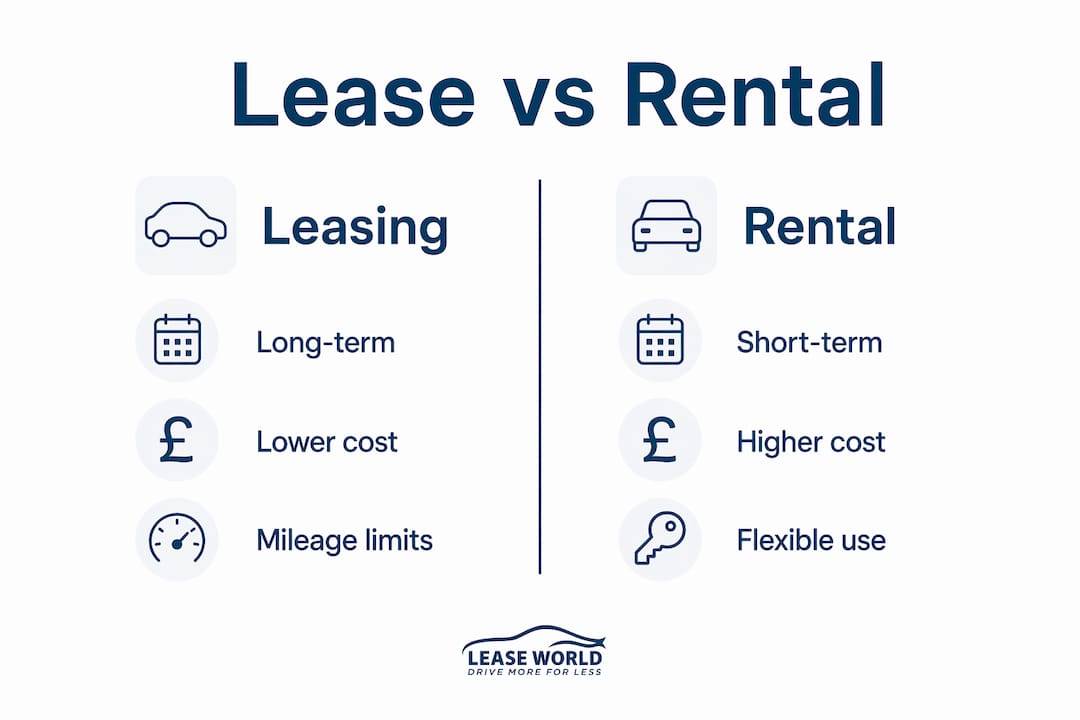
The most visible difference between lease and rental agreements is the contract length. Leasing contracts typically run for 2 to 4 years, while rental agreements cover periods from a single day to around 3 months. That gap in duration shapes everything else about how each product works.
Upfront costs and deposits
Leasing usually requires an initial rental payment at the start of the contract. This is typically equivalent to 3, 6, or 9 monthly payments and is paid before you take delivery of the vehicle. Short-term rental, by contrast, rarely demands a large upfront sum. You may pay a security deposit, but the barrier to entry is much lower.
Mileage limits
Leases carry a fixed annual mileage allowance agreed at the start of the contract. Exceeding that limit triggers excess mileage charges at a set pence-per-mile rate. Rental agreements are generally more flexible on mileage, though unlimited mileage terms vary by provider. If your annual driving distance fluctuates significantly, that distinction matters a great deal.
Flexibility and termination
Rental agreements can be ended with short notice, often just a few days. Lease contracts bind you for the full term. Early termination penalties on a lease are typically substantial, often requiring you to pay a large portion of the remaining monthly payments. That contractual rigidity is the price you pay for lower monthly costs.
- Contract length: Leasing runs 24–48 months; rental runs days to 3 months.
- Upfront cost: Leasing requires an initial rental payment; rental requires little or none.
- Mileage: Leasing has fixed caps with penalties; rental is generally more flexible.
- Exit: Rental ends with short notice; leasing carries heavy early termination fees.
- Ownership: Neither option gives you ownership of the vehicle at the end.
Pro Tip: Before signing a lease, calculate your realistic annual mileage and add 10% as a buffer. Underestimating mileage is one of the most common and avoidable sources of end-of-contract charges.
How do the financials and VAT implications differ?
Leasing offers lower monthly payments than rental because the cost is based on the vehicle's depreciation over the contract term, not its full value. Rental pricing reflects higher daily administration, insurance overhead, and the cost of maintaining a flexible fleet. Over a 12-month period, a leased vehicle almost always costs less per month than an equivalent rental.
VAT reclaim for businesses
The financial gap widens significantly for VAT-registered businesses. Businesses using Business Contract Hire can reclaim 50% of the VAT on monthly lease payments and 100% of the VAT on any maintenance package. That reclaim is not available on short-term rental costs in the same way. For a business running multiple vehicles, the difference in net cost is material.
Leasing a vehicle through a limited company also allows the business to deduct lease payments against Corporation Tax. That makes leasing a structurally more tax-efficient choice for most businesses compared to rental. Private individuals do not benefit from VAT reclaim, but they still gain from the lower monthly rate that leasing provides.
Cost comparison at a glance
| Factor | Leasing | Short-term rental |
|---|---|---|
| Monthly cost | Lower, depreciation-based | Higher, includes admin and insurance |
| VAT reclaim (business) | 50% on payments, 100% on maintenance | Not applicable in the same way |
| Upfront payment | Initial rental required | Minimal or none |
| Maintenance option | Often available as add-on | Usually included in daily rate |
| End-of-contract charges | Possible (mileage, damage) | Minimal |
Pro Tip: If you run a VAT-registered business, always compare the net monthly cost of leasing after VAT reclaim, not the gross figure. The gross-to-net difference often makes leasing the clear winner even when the headline rental rate looks competitive.
Who should choose leasing versus rental?
Leasing suits drivers and businesses with predictable mileage and stable needs. If you drive a consistent number of miles each year and need a vehicle for the foreseeable future, a lease delivers the best value per month. Fleet managers running company vehicles on fixed routes are a textbook case for leasing.
Rental suits situations where your vehicle need is temporary or uncertain. Consider these scenarios where rental is the stronger choice:
- Relocation periods. You have moved to a new city and need a car while you settle in, but you are not yet sure how long you will stay or what your commute will look like.
- Short-term project work. A contractor working on a 3-month site placement needs transport for that period only. A lease would bind them for far longer than the project lasts.
- Between vehicles. You have sold your car and are waiting for a new one to arrive. A short-term rental fills the gap without a long-term commitment.
- Unpredictable mileage. If your driving needs swing wildly from month to month, the mileage caps in a lease become a financial risk.
For businesses, the decision also depends on company structure. Leasing through a limited company limits personal liability if the business encounters difficulties, whereas a personal lease ties the financial obligation to the individual. The difference between leasing and buying is a separate question, but it is worth understanding all three options before committing.
Short-term leasing sits between the two. Products covering 3, 6, or 12 months offer more flexibility than a standard lease while costing less than daily rental. For transitional needs that last longer than a few weeks, this middle ground is worth exploring.
What are the common pitfalls when leasing or renting?
The biggest financial surprises in leasing come not from the monthly payment but from end-of-contract charges. Excess mileage fees and damage reconditioning costs frequently exceed what drivers anticipated when they signed the contract. These charges are often more impactful on total lease cost than the monthly payment itself, yet they receive far less attention at the point of sale.
- Excess mileage: Charges are set at a fixed pence-per-mile rate. On a 3-year lease, even a modest daily overage compounds into a significant bill.
- Damage beyond fair wear and tear: Scratches, kerbed alloys, and interior stains that fall outside the British Vehicle Rental and Leasing Association (BVRLA) fair wear and tear guidelines will be charged at reconditioning rates.
- Early termination: Exiting a lease early is expensive. Early termination fees typically require payment of a substantial portion of the remaining contract value.
- Ownership misconceptions: PCH leasing does not include any option to purchase the vehicle at the end of the contract. This differs from Personal Contract Purchase (PCP) or Hire Purchase. Many drivers confuse the two and are surprised when the car goes back.
- Maintenance responsibility: Unless you add a maintenance package, servicing, tyres, and MOT costs fall on you during a lease. Rental agreements usually include these in the daily rate.
Pro Tip: Read the BVRLA fair wear and tear guide before returning a leased vehicle. It defines exactly what condition is acceptable and what will be charged. Knowing the standard in advance lets you address minor issues before the vehicle inspection.
Key takeaways
Leasing delivers lower monthly costs and tax advantages for predictable, long-term vehicle use, while rental provides flexibility at a higher price for short-term or uncertain needs.
| Point | Details |
|---|---|
| Contract length | Leases run 24–48 months; rentals cover days to a few months. |
| Monthly cost | Leasing is cheaper per month due to depreciation-based pricing. |
| VAT advantage | VAT-registered businesses reclaim 50% VAT on lease payments; rental does not offer the same benefit. |
| Flexibility | Rental exits with short notice; lease exits carry heavy termination penalties. |
| Ownership | Neither PCH leasing nor rental gives you ownership of the vehicle at contract end. |
Why I think most people get this decision wrong
Most drivers I speak with approach the lease versus rental question as a cost comparison. They look at the monthly figure and choose the lower number. That framing misses the point entirely.
The real question is whether your life or business is stable enough to commit. A lease is a contract, not a subscription. If your circumstances change, such as a job move, a change in commute, or a business pivot, you are still bound to that agreement. Short-term rental costs more per month, but it buys you the right to change your mind. That optionality has genuine financial value that rarely appears in a simple monthly cost comparison.
The other mistake I see regularly is businesses choosing to lease through a company purely for the tax benefit. The VAT reclaim and Corporation Tax deduction are real advantages, but they do not justify a lease that does not fit the business's actual vehicle needs. Tax efficiency should follow the right decision, not drive it. If the vehicle use is genuinely short-term or unpredictable, the tax saving will not offset the early termination cost if you need to exit.
My honest view is that leasing is the right choice for the majority of UK drivers who have a stable commute and consistent mileage. But "majority" is not "everyone." Take the time to map your actual driving patterns over the past 12 months before you sign anything. The car finance versus leasing question is worth working through too, because for some buyers, ownership still makes more financial sense. The worst outcome is committing to a 3-year lease and realising 6 months in that your needs have changed.
— Jason
How Lease World can help you find the right vehicle deal
Lease World works with individuals and businesses across the UK to match them with leasing agreements that fit their actual needs, not just the lowest headline rate. Whether you are looking at personal car leasing or a business fleet solution, the team at Lease World provides transparent quotes with fixed monthly payments and no hidden fees.
Lease World also offers short-term leasing options for drivers who need flexibility without the cost of daily rental. If you are still working through the terminology, the leasing guides cover everything from contract types to delivery timelines in plain English. Get in touch with Lease World for a personalised quote and find a deal that works for your situation.
FAQ
What is the main difference between a lease and a rental?
A lease is a long-term fixed contract, typically 24–48 months, with lower monthly payments and set mileage limits. A rental is a short-term arrangement covering days to a few months, offering greater flexibility at a higher monthly cost.
Can a business reclaim VAT on vehicle leasing?
Yes. VAT-registered businesses using Business Contract Hire can reclaim 50% of the VAT on monthly lease payments and 100% of the VAT on any maintenance package, an advantage not available on standard short-term rental.
Does leasing a car mean you own it at the end?
No. Personal Contract Hire (PCH) is a pure rental agreement with no option to purchase the vehicle at the end of the contract. This differs from PCP or Hire Purchase, both of which include a potential ownership pathway.
What happens if I need to end a lease early?
Early termination fees on a lease are typically substantial, often requiring payment of a significant portion of the remaining contract value. Rental agreements can usually be ended with short notice and minimal penalty.
Is short-term leasing a good alternative to rental?
Short-term leasing covering 3, 6, or 12 months offers a middle ground between standard leasing and daily rental. It costs less per month than rental while providing more flexibility than a full 24–48 month lease contract.