

A short-term business lease, often running for a defined project period that is generally a few months to a few years, suits any business that needs exclusive control of a space for a defined project. If you only need flexible access to a desk or shared kitchen, a licence to occupy is usually cheaper and simpler. The moment you need to exclude the landlord and shape the space yourself, you need a lease, and that decision changes your legal protections, your costs, and how easily you can walk away.
TL;DR:
- Short-term leases usually last from a few months to around five years and require exclusive possession, giving control over access and modifications.
- A licence to occupy is a flexible, low-protection arrangement suitable for shared or seasonal spaces, but a promise of sole use indicates a lease may be in place regardless of the contract's title.
- Most short leases are deliberately contracted out of security of tenure, meaning tenants generally cannot request renewal after the term ends.
- Landlords charge a rental premium for short leases to cover higher turnover risks, additional marketing costs, and lower income certainty, which can increase overall costs beyond rent.
- When negotiating, tenants should focus on clear break clauses, capped reinstatement costs, broad permitted use, symmetrical notice periods, and service charge caps to minimize future liabilities.
Table of Contents
- What counts as a short-term commercial lease?
- Licence to occupy vs lease: which one are you actually signing?
- Security of tenure, registration and tax: the legal checklist
- Why short-term deals sometimes cost more than you'd expect
- How to decide, and what to negotiate before you sign
- What Lease World sees when businesses take on short-term space
- Where Lease World fits while you sort out your premises
- A publisher's take: why "flexible" doesn't mean "risk-free"
- Sources
- FAQ
What counts as a short-term commercial lease?
The defining feature of any lease, short or long, is exclusive possession. You control who comes in and out, you can change the locks, and the landlord can't just wander in to check on things. That's what separates a genuine lease from a licence, regardless of what the paperwork calls it.
In practice, "short-term" in the UK commercial market usually means anywhere from a few months up to a few years, sometimes up to around five years. For very short occupations under six months, landlords often prefer a licence or a tenancy at will instead of a full lease, since the legal overhead barely pays for itself on such a short deal.
Typical obligations still apply even on a short lease:
- The tenant covers repairs, insurance, and often service charges, depending on how the lease is drafted.
- The landlord must provide the property in the condition promised at the start and honour any break rights agreed.
- Both parties usually document permitted use, meaning what the space can actually be used for.
- Rent is normally paid monthly or quarterly in advance, sometimes with a rent deposit held against damage or arrears.
This structure works well for pop-up retail testing a new location, a project team needing a satellite office for a fixed contract, or a growing business that wants a foothold in a city before committing to something bigger, especially when considering minibus hire with driver for event or project transport.
Licence to occupy vs lease: which one are you actually signing?
The legal test that decides this isn't the title on the document. It's whether you have exclusive possession, a principle that comes from the case of Street v Mountford and gets applied constantly in UK property disputes. If you can lock the landlord out and control access, courts will likely call it a lease, whatever the contract says.
A licence to occupy is a lighter, more flexible arrangement. It grants permission to use space without creating a formal landlord and tenant relationship, and it doesn't attract security of tenure. Licences suit:
- Serviced offices where you share reception, meeting rooms, and cleaning with other businesses.
- Shared kitchen or workshop space where several tenants use the same equipment on a rota.
- Very short occupations, such as a market stall or seasonal retail unit.
Pro Tip: If your landlord promises you sole use of a specific room with your own key, that's a strong sign you actually have a lease, no matter what the agreement is titled. Get it checked before you sign.
Watch for this trap: a "licence" that hands you a dedicated space, restricts the landlord's access, and runs for a fixed term at a fixed rent can be reclassified as a lease by a court, importing rights and duties neither side planned for.
Security of tenure, registration and tax: the legal checklist
Most business tenants in England and Wales get security of tenure under the Landlord and Tenant Act 1954, meaning you can usually ask for a new lease when your term ends. Landlords who don't want that obligation can "contract out" using a formal notice and declaration procedure before the lease starts. Most short-term leases are contracted out deliberately, since landlords want the property back at the end of the term without a renewal dispute.
Three things matter here in practice:
- Registration: leases granted for more than seven years must be registered with HM Land Registry. Most short-term leases fall well under that threshold and don't need registering, which keeps administration light.
- Stamp Duty Land Tax: SDLT can apply to commercial leases depending on rent and premium levels, so check your position against current thresholds via Gov or a tax adviser before signing anything with an unusual rent structure.
- Holding over: if you stay in occupation after your lease ends and keep paying rent, you may unintentionally acquire continuation rights under the 1954 Act, a frequent source of dispute between landlords and tenants who assumed the arrangement had simply lapsed.
A tenancy at will can bridge the gap while a longer lease is negotiated, but it offers very little security and either side can end it on short notice.
Why short-term deals sometimes cost more than you'd expect
Short leases often carry a rental premium. Landlords take on more turnover risk with a short tenant, more marketing cost when the space comes back empty, and less certainty over their own income, so they price that risk into the rent. Market advisers have noted that short-term leasing has grown as businesses test locations before committing, which gives landlords in prime spots more leverage to charge for the flexibility.
Budget for more than just rent:
- Base rent, usually quoted per square foot per year even on a short deal.
- Service charge, covering shared building costs like cleaning, security, and utilities in communal areas.
- Business rates, which apply regardless of lease length and are separate from rent entirely.
- Insurance, often split between buildings cover (landlord) and contents or liability cover (tenant).
- Fit-out and reinstatement costs, since you'll usually need to return the space to its original condition when you leave.
- Professional fees, covering your solicitor's time reviewing the lease and any surveyor input on condition.
Ask for a written, itemised breakdown before you agree anything, and push for a cap on service charge increases during the term. A landlord unwilling to itemise costs upfront is rarely one who'll be transparent about increases later.
How to decide, and what to negotiate before you sign
Start with five questions: do you need exclusivity, what fit-out are you planning, how long do you realistically need the space, does the location matter to customers, and how fast might you outgrow it? Answering these honestly points you towards a lease or a licence far more reliably than price alone.
Once you know you need a lease, prioritise these points in negotiation:
- Break clause wording should use objective, dateable conditions rather than anything the landlord can dispute subjectively.
- Reinstatement obligations need a clear cap, so you're not liable for undoing every improvement you made.
- Permitted use should be broad enough to cover pivots in your business model, not just your day-one plan.
- Notice periods for both renewal and termination should be symmetrical, not one-sided in the landlord's favour.
- Assignment and underletting rights matter if you might need to exit early by passing the lease to another business.
- Service charge caps protect you from surprise increases mid-term.
Ask the landlord or agent directly: is this lease contracted out of the 1954 Act, what's the true break date, who pays for dilapidations, is the rent quoted exclusive of VAT and rates, what's included in the service charge, and can the lease be assigned. Negotiation guides for short-term commercial leases consistently flag narrow, objective break conditions as the single most valuable clause to get right.
Pro Tip: Before signing anything longer than six months, ask a solicitor for a focused Commercial Lease Review rather than a full conveyancing service. It's faster, cheaper, and catches the clauses that actually bite.
What Lease World sees when businesses take on short-term space
Businesses signing a short-term commercial lease almost always need something to move around in while they're setting up, whether that's a pop-up launch, a satellite office fit-out, or a project team covering a temporary site. Lease World deals with exactly this kind of short-notice, flexible need every week, matching businesses with short-term vehicle leases that don't tie them into a multi-year commitment before they even know if the location will work out.
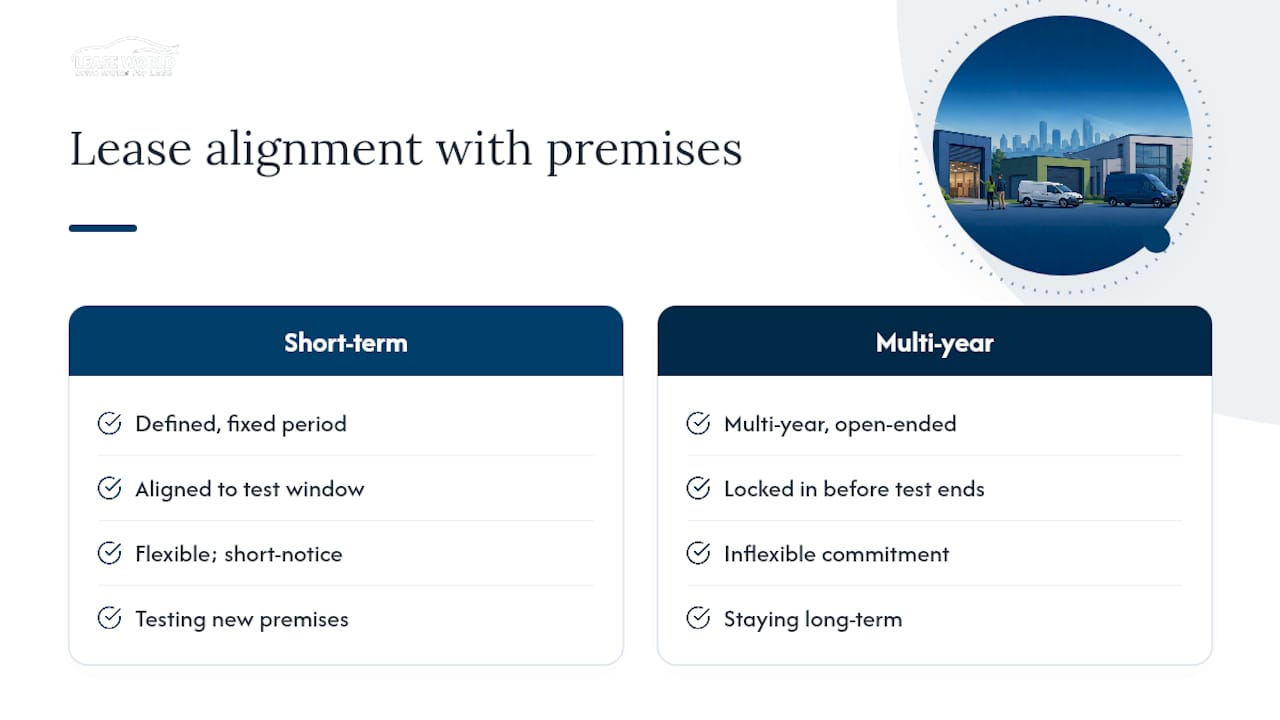
If your business is testing a new premises for a defined period, matching your vehicle commitment to that same window makes far more sense than locking into a standard long-term contract. It's not the right call for a business that already knows it's staying put for years, but for anyone still finding their feet in a new lease, it's worth a look.
Where Lease World fits while you sort out your premises
Sorting out a short-term lease is only half the logistics problem. If your business needs a van or car to match a temporary site, whether for deliveries, staff transport, or moving stock between locations, Lease World runs alongside your property timeline instead of against it.

Flexible payment options and suitable delivery services on eligible vehicles mean you're not tying up capital you'll need for fit-out costs or rent deposits. Lease World's short-term vehicle leasing options run on 3, 6, and 12 month terms, so your transport commitment can match your lease length rather than outlasting it. For businesses needing a van for stock or deliveries around a new site, the in-stock van leasing range offers quick delivery without a long wait on manufacturer lead times. If you're weighing up which vehicle type fits your project, the leasing guides cover payments and delivery timelines in plain terms. Ready to see what fits your budget? Get a quote and find out what's available before your new lease even starts.
A publisher's take: why "flexible" doesn't mean "risk-free"
The received wisdom around short-term leasing treats flexibility as an unambiguous win for small businesses, and mostly, it is. But there's a blind spot worth naming: flexibility for you is usually priced by the landlord as risk for them, and that price shows up in the rent, not in the headline term length. A business that fixates on getting the shortest possible lease can end up paying more per year than one that negotiated a slightly longer term with a well-drafted break clause instead.
The other pattern worth flagging is how often businesses get the licence versus lease decision backwards. They assume a licence is always the "safe" cheap option, then discover too late they've been granted something closer to exclusive possession without any of the statutory protections a proper lease would have given them. Read the substance, not the title, before you sign.
Where short-term thinking genuinely pays off is in matching every commitment, premises and vehicles alike, to the actual length of the project rather than to habit or convenience. That's the practical overlap between property decisions and fleet decisions: both should be sized to the work, not to what's easiest to arrange.
— Jason
Sources
- Licence to Occupy in the UK | Sprintlaw UK
- Leases v licences in property legal agreements — the importance of exclusive possession
- Understanding Commercial Property Occupation: Leases, Contracted-Out Tenancies and Licences - Herrington Carmichael
- Negotiation guide—short term commercial leases | LexisNexis
- Gov
FAQ
Can you get a six-month lease in the UK?
Yes. Six-month commercial leases are common, though landlords often prefer a licence or tenancy at will for occupations under six months since the legal setup costs barely justify a full lease for that length.
Does a seven-year commercial lease need to be registered?
Leases longer than seven years must be registered with HM Land Registry; most short-term leases fall under this threshold and don't require registration.
Can a sole trader have a business lease?
Yes, sole traders can and regularly do sign commercial leases in their own name, though landlords may ask for personal guarantees or a rent deposit given the lack of a separate corporate entity.
Is there a minimum term for a commercial lease?
There's no statutory minimum term for a commercial lease in England and Wales; terms are agreed between landlord and tenant, though very short occupations are often handled through a licence to occupy instead.
What's the difference between a lease and a licence for a business?
A lease grants exclusive possession and, in most cases, security of tenure under the 1954 Act, while a licence grants permission to use space without excluding the landlord or creating those statutory protections.