

Signing a lease for your business premises feels like a straightforward task until you read the small print. A small business lease, known in commercial property circles as a commercial tenancy agreement, is a legally binding contract that grants you the right to use and occupy a property in exchange for rent, while ownership stays with the landlord. What catches many business owners off guard is how different these agreements are from residential tenancies. There are far fewer legal protections, far more room for costly mistakes, and far more money at stake than most people expect.
Table of Contents
- Key takeaways
- What a small business lease really means
- Types of business leases and what they cost you
- Negotiating a lease that works for your business
- Practical steps and support for lease obligations
- My honest take on lease due diligence
- Leasing a vehicle for your small business
- FAQ
Key takeaways
| Point | Details |
|---|---|
| Leases are legal contracts | A commercial tenancy agreement grants usage rights only; ownership always stays with the landlord. |
| Lease type affects your total cost | Gross, net, and percentage leases allocate expenses differently, changing what you actually pay each month. |
| Negotiation is expected | Most commercial lease terms favour the landlord and can be negotiated before you sign. |
| Personal guarantees carry real risk | Landlords commonly require personal guarantees, which can put your personal assets on the line. |
| Professional review is worth the cost | A solicitor or chartered surveyor can spot costly clauses that are easy to miss on a first read. |
What a small business lease really means
The small business lease definition that most people carry around is too simple. They picture a document that says "you pay X per month, you get the space." The reality is considerably more layered.
A commercial lease is largely unregulated compared to residential tenancies. Commercial leases have few mandatory tenant protections and commonly run for five to ten years. That means whatever you agree to at the start, you are typically locked in for a long time with very little legal recourse if the terms turn out to be unfavourable.
The lease will define the exact premises you are renting, including measurements and boundaries. It will set out the term length, the rent amount, what that rent includes, and how it can increase over time. It will also specify what you are permitted to do in the space, under what conditions you can leave early, and whether you are personally liable if the business cannot pay.

Understanding these components before you sign is not optional. It is the difference between a lease that supports your business and one that quietly drains it.
What the lease actually covers
A well-drafted commercial tenancy agreement will address several key areas. The important provisions to verify include the precise description of the leased premises, the full term length, rent details with any escalation clauses, and termination conditions.
Pay particular attention to the permitted use clause. This defines what activities you are allowed to carry out on the premises. A narrow permitted use clause can prevent you from adapting your business model later. If you open as a café but later want to add a small retail section, a restrictive clause could block you entirely. Broad permitted use terms are worth pushing for, and you should also check whether the landlord has granted exclusivity to any competitors in the same building or development.
Key components to review in any commercial lease:
- Rent and escalation clauses: How much you pay now and how increases are calculated, whether by fixed percentage, RPI, or open market review.
- Service charges and operating expenses: What costs beyond base rent you are responsible for.
- Repair and maintenance obligations: Whether you are liable for structural repairs or just internal maintenance.
- Break clauses: Whether either party can end the lease early and under what conditions.
- Termination rights: The circumstances under which the landlord can end the agreement.
- Personal guarantees: Whether you are personally liable for rent if the business fails.
Pro Tip: Ask the landlord for a schedule of service charges from the past three years before signing. This gives you a realistic picture of what you will actually pay beyond the headline rent figure.
Types of business leases and what they cost you
Not all commercial leases work the same way. The lease type determines how operating expenses are split between landlord and tenant, which has a direct impact on your monthly outgoings and your ability to budget accurately.
| Lease type | Who pays operating expenses | Typical term | Predictability for tenant |
|---|---|---|---|
| Gross lease | Landlord | 1–3 years | High: fixed monthly cost |
| Single net lease | Tenant pays property tax | 3–5 years | Moderate |
| Double net lease | Tenant pays tax and insurance | 5–10 years | Moderate |
| Triple net (NNN) lease | Tenant pays tax, insurance, and maintenance | 10–25 years | Low: variable costs |
| Modified gross lease | Shared, negotiated split | 3–7 years | Moderate to high |
| Percentage lease | Base rent plus percentage of turnover | 5–10 years | Variable |
| Ground lease | Tenant owns building, pays land rent | 25–99 years | Very low |
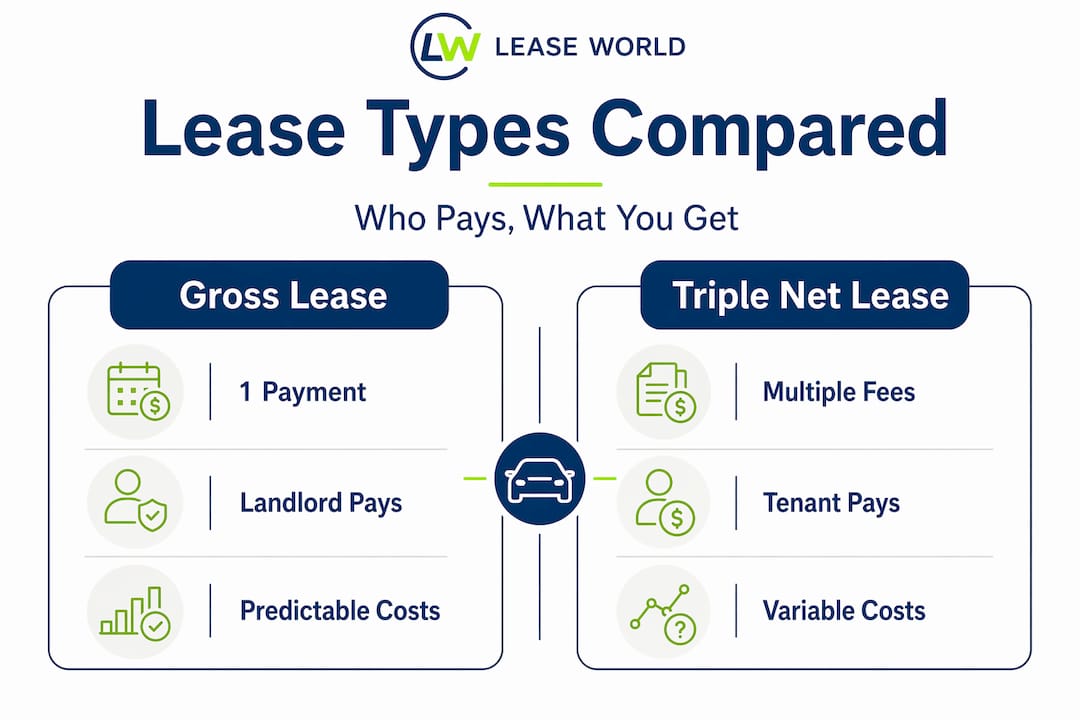
A gross lease is the simplest arrangement. You pay one monthly figure and the landlord covers the building's running costs. It is easier to budget but often comes with a higher base rent to compensate.
A triple net lease (often written as NNN) shifts almost all costs onto you: property taxes, building insurance, and maintenance. Your base rent looks attractively low, but base rent alone is misleading once you factor in what else you are paying. NNN leases are common in retail and can produce significant cost surprises in years when maintenance bills spike.
A percentage lease is frequently used in shopping centres. You pay a base rent plus a percentage of your monthly turnover above a certain threshold. This can work in your favour during slow periods but exposes you during strong trading months.
Pro Tip: When comparing lease options, always calculate your total occupancy cost, not just the base rent. Add service charges, insurance contributions, business rates, and estimated repair costs to get a true monthly figure.
Negotiating a lease that works for your business
Here is something most landlords will not advertise: almost everything in a commercial lease is negotiable. The document you receive first is written to favour the landlord. That is not cynicism. It is simply how the process works.
Commercial leases are largely unregulated, which means there is no standard form that protects you by default. Your protection comes from negotiation.
Follow these steps before you commit to any commercial tenancy agreement:
- Get the heads of terms in writing. Before a formal lease is drafted, agree the key commercial points in a heads of terms document. This is not legally binding but sets expectations clearly.
- Negotiate the rent-free period. Many landlords will offer a rent-free period at the start of the lease to help you fit out the premises. Push for this, especially in a slow market.
- Push for a break clause. A break clause lets you exit the lease at a specified point, typically at year three or five of a ten-year term. Without one, you are committed for the full duration.
- Limit the personal guarantee. Personal guarantees are common and carry real personal liability risk. Negotiate a cap on the guarantee, a sunset clause that ends it after a set period, or a deed of guarantee from the company only.
- Clarify repair obligations. Make sure the lease specifies exactly what state the premises must be returned in at the end of the term. A schedule of condition at the start protects you from being held responsible for pre-existing damage.
- Review assignment and exit rights. Assignment restrictions and renewal conditions can seriously limit your options if you want to sell the business or relocate. Negotiate these early, not when you are already under pressure to move.
- Instruct a solicitor. A commercial property solicitor will identify clauses you would likely miss and can negotiate amendments on your behalf. The cost is modest compared to the financial exposure of signing a bad lease.
Pro Tip: Never sign a lease under time pressure. If a landlord is pushing you to sign quickly, that urgency is almost always in their interest, not yours.
Practical steps and support for lease obligations
Once you understand the lease you are entering, the next challenge is managing it as your business grows. Lease costs are fixed obligations. They do not flex when your revenue dips, which makes forward planning critical.
Start by building your full annual lease cost into your cash flow forecast before you sign. Include rent, service charges, business rates, and an allowance for repairs. Review this figure against your projected revenue and make sure you have a buffer.
Some financial support is available for small businesses facing lease costs. For example, New Jersey's Small Business Lease Grant Programme covers up to 20% of lease payments for two years for eligible businesses. While this is a US example, similar local authority and government grant schemes exist in the UK and are worth researching through your local enterprise partnership or the British Business Bank.
Useful resources and contacts for small business lease support:
- Local Enterprise Partnerships (LEPs): Offer guidance and sometimes grant funding for small businesses taking on commercial premises.
- The British Business Bank: Provides information on finance options and support schemes.
- Citizens Advice Business Debt Line: Useful if lease payments become unmanageable.
- Royal Institution of Chartered Surveyors (RICS): Can help you find a qualified surveyor to review lease terms and property condition.
- A commercial property solicitor: Non-negotiable for any lease over two years or with significant financial exposure.
As your business evolves, revisit your lease regularly. If you are approaching a break clause date, plan well in advance whether to exercise it or negotiate a renewal. Leases that made sense at launch can become restrictive as the business changes direction.
My honest take on lease due diligence
I have spoken to a lot of small business owners over the years, and the pattern I see most often is this: they spend weeks researching their product, their pricing, their marketing. Then they spend two hours on a lease that will commit them to tens of thousands of pounds over the next five years.
In my experience, the lease is the single most underestimated financial commitment a small business takes on. It is not just a cost. It is a constraint on how you operate, where you can go, and what you can do with the business if your plans change. I have seen businesses trapped in premises they outgrew, unable to assign the lease when they found a buyer, and personally liable for rent after the company folded. Every one of those situations started with a lease that was not read carefully enough.
My advice is simple: treat the lease negotiation with the same seriousness you would give to taking on a business partner. Get professional advice. Push back on terms that do not suit you. And never assume that because something is printed in the document, it cannot be changed.
The businesses that come out well are the ones that go in with their eyes open.
— Jason
Leasing a vehicle for your small business
If your business also needs reliable transport, vehicle leasing is a separate but equally practical option worth considering. Unlike a property lease, a business car lease gives you access to a new vehicle for a fixed monthly payment without the large upfront cost of buying outright. It is a straightforward way to manage transport costs and keep your fleet looking professional.
At Leaseworld, we work with small businesses across the UK to find competitive car and van lease deals that fit real budgets. Whether you need a single company car or a small fleet of vans, we handle the process from quote to delivery. If you are self-employed or running a limited company, you can explore your van leasing options and see what monthly figures look like for your situation. We are a family-run business, and every enquiry gets personal attention rather than a call centre queue.
FAQ
What is a small business lease in simple terms?
A small business lease, formally known as a commercial tenancy agreement, is a legally binding contract granting you the right to use a property for business purposes in exchange for regular rent payments. Ownership of the property remains with the landlord throughout.
How long does a typical small business lease last?
Lease terms vary by lease type and negotiation. Commercial leases commonly span several years, with shorter gross leases running one to three years and triple net leases often extending to ten years or more.
Can I negotiate the terms of a commercial lease?
Yes. Most terms in a commercial lease are negotiable, including rent, break clauses, repair obligations, and personal guarantees. Because commercial leases carry few mandatory tenant protections, negotiation is your primary tool for securing fair terms.
What is a personal guarantee on a business lease?
A personal guarantee means you are personally liable for rent payments if your business cannot pay. Personal guarantees are common in commercial leases but can sometimes be capped or limited through negotiation.
What is the difference between a gross lease and a triple net lease?
In a gross lease, the landlord covers operating expenses and you pay a single monthly figure. In a triple net lease, you pay base rent plus property taxes, building insurance, and maintenance costs, making your total monthly outgoings harder to predict.