

Yes, you can claim business mileage on a personally leased car. Use HMRC's approved mileage rates (55p per mile for the first 10,000 business miles, 25p thereafter for 2026/27) or claim a proportion of actual running costs instead. You cannot mix both methods for the same vehicle, and the route that suits you depends on your mileage, lease cost, and whether the car is leased personally or through your employer.
TL;DR:
- Claiming mileage on a leased car can be done through HMRC's approved rates or by deducting actual running costs, but not both for the same vehicle.
- High-mileage drivers with lower lease costs benefit more from the flat rate, while low-mileage, expensive leases favor claiming actual costs after proper apportionment.
- Maintaining detailed, dated logs with trip purposes and supporting invoices is essential for a legitimate claim, especially when using actual costs.
- For company-leased cars, mileage claims are replaced by Benefit-in-Kind taxation, and fuel reimbursements follow separate rules, complicating personal mileage claims.
- Always clarify and document the rental versus maintenance split in writing before claiming to avoid disallowed expenses or miscalculations during HMRC reviews.
Table of Contents
- How do you claim mileage on a leased car?
- How do you calculate your mileage claim on a lease?
- What records does HMRC expect for a mileage claim?
- Are company-leased cars treated the same as personal leases?
- What are the common pitfalls when claiming mileage on a lease?
- How does Lease World help with lease paperwork for tax claims?
- What UK drivers get wrong about leased-car mileage claims
- How Lease World can help you sort your lease paperwork
- Sources
- FAQ
How do you claim mileage on a leased car?
Two routes exist, and picking the wrong one costs you money.
Approved Mileage Allowance Payments (AMAPs), often called simplified expenses, pay you a flat rate per business mile. That rate is designed to cover everything: fuel, insurance, servicing, depreciation, and yes, your lease rental. You don't submit lease invoices or fuel receipts to support an AMAPs claim; you just log the miles. Sole traders can check their eligibility using HMRC's simplified expenses checker, and the rules on simplified vehicle expenses confirm this method suits most personally leased cars used for business.
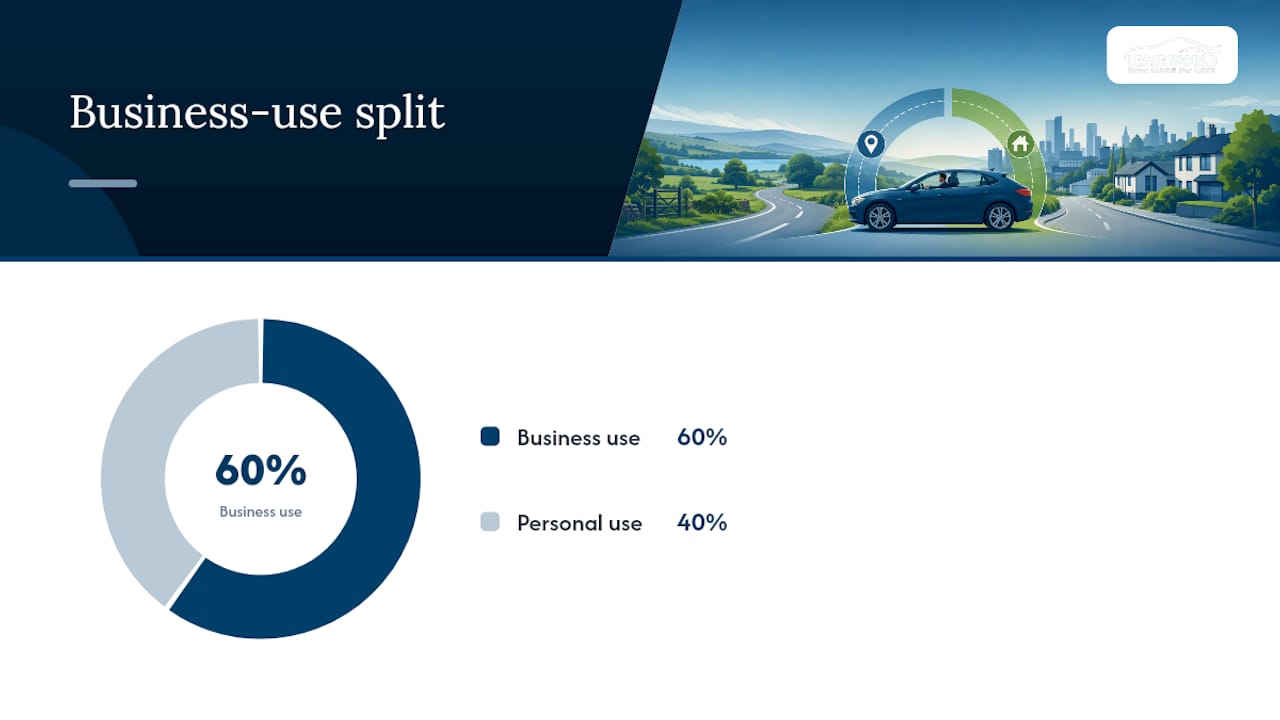
The actual costs method works differently. You total your genuine running costs, lease rentals, fuel, insurance, servicing and apportion them by business-use percentage. If you drive 60% of your annual mileage for work, you claim 60% of those costs. This method demands proper invoices and a defensible mileage log, but it can produce a bigger claim if your lease is expensive relative to your mileage.
You cannot switch between the two for the same vehicle without good reason. HMRC expects consistency once you've chosen a method, and mixing approaches on a single car is a red flag during any enquiry.
- AMAPs: no receipts needed, flat rate, simplest for most drivers
- Actual costs: receipts required, apportioned by business use, better for high-cost leases with lower mileage
Pro Tip: If you've claimed capital allowances on the car, you're barred from using simplified mileage for that vehicle. Check this before you commit to a method, because capital allowances and mileage claims are mutually exclusive.
How do you calculate your mileage claim on a lease?
Numbers settle this faster than any explanation. Here's how each method plays out for a typical personally leased car used partly for business.
AMAPs worked example:
- You drive a substantial amount of business miles in the year on your leased hatchback.
- Using HMRC's approved mileage rate of 55p per mile for the first 10,000 miles, you calculate your mileage relief accordingly.
- If your employer already reimbursed you a lower mileage rate, you deduct that amount and claim tax relief on the remaining eligible sum.
Actual costs worked example:
- Your lease costs £4,800 a year, and business use is 60% of total mileage, giving a starting claim of £2,880.
- If the car's CO2 emissions exceed 50g/km, HMRC's lease rental restriction rules require a statutory disallowance on the rental element, so you reduce that £2,880 before claiming.
- Add apportioned fuel, insurance, and servicing at the same 60% business-use rate, then total everything for your final claim.
Here's the pattern worth noting: low-mileage drivers with expensive leases often do better under actual costs, once the disallowance is applied, because the rental cost dwarfs what a flat 55p rate would return. High-mileage drivers with modest leases almost always do better under AMAPs, since the per-mile rate scales with distance rather than being capped by lease cost. Run both calculations before you file. It takes twenty minutes and can shift your claim by hundreds of pounds either way.
What records does HMRC expect for a mileage claim?
A mileage log without dates and purposes is worth very little in an enquiry. HMRC wants specifics, not estimates.
For every journey, record the date, the reason for travel, start and end points (postcodes or odometer readings), and total miles. If you're claiming actual costs, keep every lease invoice, fuel receipt, insurance schedule, and service record, ideally showing the rental and maintenance elements separately.
- Date, purpose, and route for every business journey
- Odometer readings or postcode-to-postcode mileage for each trip
- Lease invoices and receipts if using actual costs, retained for the current tax year plus four prior years
Pro Tip: Use a simple spreadsheet or a mileage-tracking app rather than relying on memory at year-end. Digital logs with timestamps hold up far better under HMRC scrutiny than a handwritten diary reconstructed in March.
Are company-leased cars treated the same as personal leases?
No, and this trips up more drivers than any other part of the process. A company-leased car provided by your employer is a Benefit-in-Kind (BIK), taxed through your tax code based on the car's list price and CO2 emissions, not through mileage claims. Fuel reimbursement for a company car follows separate Advisory Fuel Rates, not AMAPs.
If you personally lease your car, and simply use it for work, you claim under AMAPs or actual costs as covered above, minus whatever your employer already pays you.
- Company-leased car: taxed as BIK, fuel reimbursed via Advisory Fuel Rates, no AMAPs claim
- Personally leased car: AMAPs or actual costs available, subject to employer mileage payments already received
Always check what your employer calls its mileage payments. HMRC guidance on taxing mileage payments only treats a lump sum plus low mileage rate as tax-free MAPs if the lump sum genuinely covers standing costs; otherwise it's a taxable benefit, and you may still be owed relief on the shortfall. If you're unsure which side of that line your car falls on, our company car versus personal lease guide breaks down the practical differences.
What are the common pitfalls when claiming mileage on a lease?
It applies when your leased car's CO2 emissions exceed 50g/km, and it hits only the rental or hire element of your contract under the actual costs method, not maintenance packages billed separately.
- Confirm your car's CO2 figure before assuming the disallowance applies; sub 50g/km leases (mostly EVs and plug-in hybrids) escape it entirely.
- Request an invoice breakdown separating rental from maintenance, since only the rental portion is restricted.
- Calculate both AMAPs and actual costs before filing, and keep evidence for whichever you choose.
- Never blend the two methods on one vehicle within the same tax year.
Our CO2 emissions and car leasing guide covers which bands trigger the disallowance in more detail.
How does Lease World help with lease paperwork for tax claims?
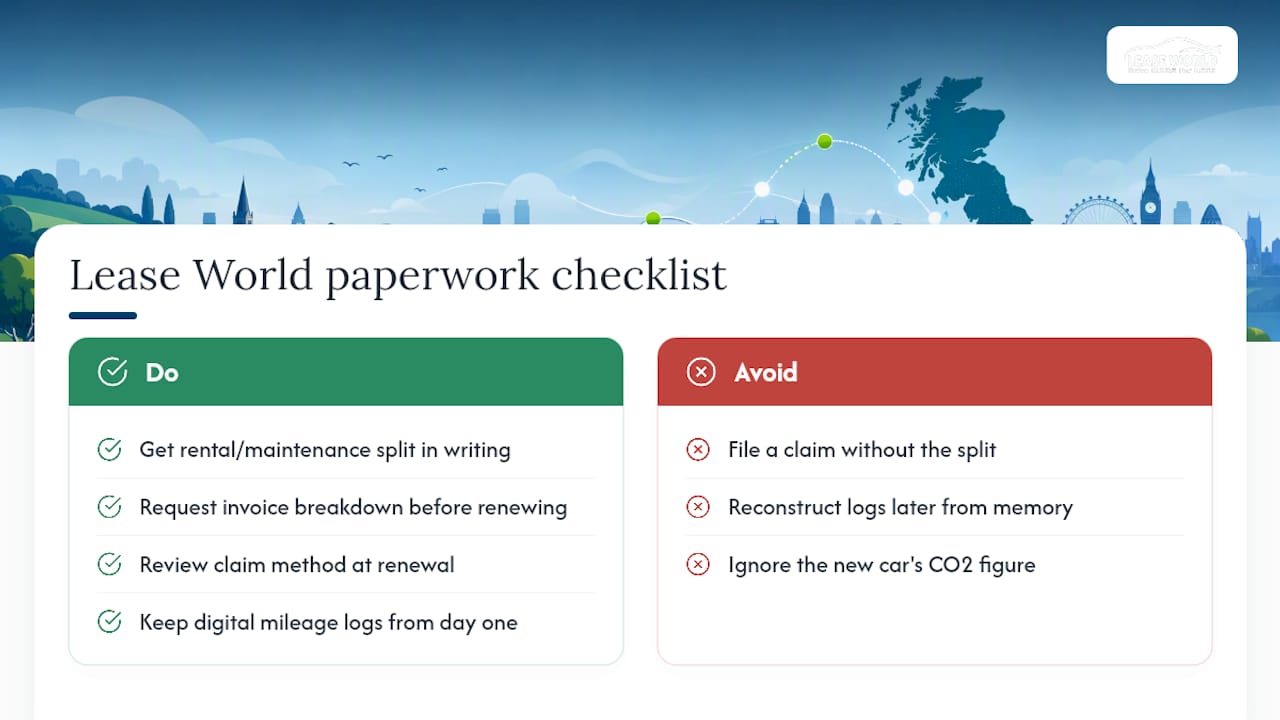
Getting the rental/maintenance split in writing is the single most useful thing you can do before filing. Ask your funder or broker for an invoice breakdown that separates the hire charge from any servicing or maintenance package included in your monthly payment. Without that split, HMRC (and you) can't apply the disallowance correctly, and you risk over-claiming or under-claiming.
Lease World generally advises reviewing your claim method at renewal, when a vehicle change or a shift in your business mileage pattern often flips which method suits you best. Before renewing, check the new car's CO2 figure, request the invoice breakdown in advance, and keep digital mileage logs from day one rather than reconstructing them later.
If you manage a small fleet, a partner resource on apportioning maintenance versus rental costs for fleet vehicles covers similar ground for multiple vehicles.
What UK drivers get wrong about leased-car mileage claims
Most guidance treats mileage claims as a generic self-employment topic, glossing over the fact that a lease contract has its own quirks.
The bigger error, though, is picking a method once and never revisiting it. Business mileage patterns shift, lease costs change at renewal, and a method that worked brilliantly on your last car can be the wrong choice on your next one. Treat the AMAPs-versus-actual-costs decision as an annual or per-vehicle check, not a one-time setup task.
If there's one thing worth prioritising above all else, it's getting the rental/maintenance split from your funder in writing before you file anything. Everything else, the mileage rate, the disallowance, the record-keeping, is straightforward once that split is in front of you. Without it, you're guessing at figures HMRC expects you to know precisely.
— Jason
How Lease World can help you sort your lease paperwork
Lease World is the practical route to sorting the contract detail your tax claim depends on, before you're staring down a filing deadline wondering what percentage of your monthly payment counts as rental. Every quote comes with clear terms, no hidden fees, and support from a family-run team that will talk you through the rental and maintenance split on request.
If you're weighing up a new personal lease against your current one, our personal car leasing deals page shows fixed monthly payments with no deposit options, and free UK delivery on eligible vehicles. Considering an electric vehicle to sidestep the CO2 disallowance entirely? Our guide to lease electric car tax benefits explains what changes. And if your current contract is coming up for renewal, browse our full range of leasing guides or request a tailored quote and we'll walk you through the invoice breakdown before you sign anything.
This article is general information, not a substitute for advice from a qualified financial advisor. Consult a qualified financial professional about your own circumstances before acting on anything here.
FAQ
Do you get reimbursed for unused miles on a lease?
No. Mileage allowances relate to tax relief on business travel, not to your lease contract's mileage limit. Unused contracted miles on a lease agreement aren't refunded by your leasing company; they're simply unused, unlike a tax claim, which only pays out for miles actually driven.
Can you claim tax back on lease cars?
Yes, if you use a personally leased car for business travel, you can claim tax relief via HMRC's approved mileage rates or the actual costs method, minus anything your employer has already reimbursed you.
What happens if you go over your mileage limit on a UK lease?
Exceeding your contracted annual mileage triggers excess mileage charges from your leasing company, calculated per mile over the agreed limit, entirely separate from any HMRC tax treatment of your business mileage.
What evidence does HMRC need for a mileage claim?
HMRC expects a detailed log showing the date, purpose, and mileage of each business journey, plus lease invoices and receipts if you're using the actual costs method rather than approved mileage rates.
Can I claim both AMAPs and actual costs on the same leased car?
No. You must choose one method per vehicle and stick with it for that car's life in your business; switching methods without good reason invites HMRC to question your claim.