

TL;DR:
- Choosing the right car lease depends on accurately estimating mileage, total contract costs, and understanding lease terms. Leasing involves fixed durations, mileage allowances, and potential fees, so thorough research and comparison saving drivers from costly surprises. Lease World offers tailored, transparent quotes with no hidden fees, ensuring drivers find deals matching their needs without unnecessary risk.
The right lease matches your driving profile, budget and contract terms — not simply the lowest monthly payment. Before you sign anything, run through these checks:
- How many miles do you realistically drive each year? Underestimating is the single costliest mistake.
- What is your true monthly budget? Include insurance, fuel or charging, and any maintenance package.
- Which contract length suits your life? A 24-month deal costs more per month; a 48-month deal locks you in longer.
- PCH or BCH? Private drivers use Personal Contract Hire; VAT-registered businesses should consider Business Contract Hire.
- Is road tax included? Not all deals bundle Vehicle Excise Duty — check before comparing prices.
- Have you calculated the total contract cost? Add up every payment, the initial rental, and likely excess-mileage charges.
Next steps: (1) Calculate your realistic annual mileage using last year's odometer readings. (2) Add up the full contract cost across at least three providers. (3) If you run a business, confirm your VAT reclaim position before choosing PCH over BCH.
Table of Contents
- How car leasing works in the UK — from quote to handback
- PCH vs BCH: which lease type suits you?
- Matching the vehicle style to your lifestyle
- Setting your budget: monthly payment vs total cost of ownership
- How to tailor your contract: duration, mileage and maintenance
- Reading the fine print: fees, wear and tear, and early exit
- What happens at the end of the lease?
- How Lease World helps UK drivers find the right lease
- Key takeaways
- The leasing decision most people get wrong
- Get a tailored lease quote from Lease World
- Useful sources and further reading
- FAQ
How car leasing works in the UK — from quote to handback
Car leasing, formally known as Personal Contract Hire (PCH) for private drivers, is essentially a long-term rental. You pay an initial rental (a multiple of the monthly payment, typically one to nine months' worth upfront), then fixed monthly payments for the agreed term. At the end, you hand the car back. You never own it, and there is no option to buy unless the contract specifically provides one.
The process follows a clear sequence:
| Stage | What happens | Typical timeframe |
|---|---|---|
| Choose vehicle and spec | Select make, model, trim, mileage and contract length | 1–3 days |
| Get quotes and compare | Request quotes from at least three providers | 1–3 days |
| Credit check and application | Funder assesses creditworthiness; you supply proof of address and income | 1–5 days |
| Sign contract and pay initial rental | Contract issued; initial payment taken on signing | 1–2 days |
| Vehicle ordered and built | Manufacturer builds or allocates the vehicle | 2–20 weeks (varies by model) |
| Delivery | Vehicle delivered to your door or collected from dealer | 1 day |
| Contract period | You drive, maintain within terms, stay within mileage | 24–48 months |
| End-of-lease inspection and handback | Vehicle inspected against BVRLA fair wear and tear standards | 1 day |
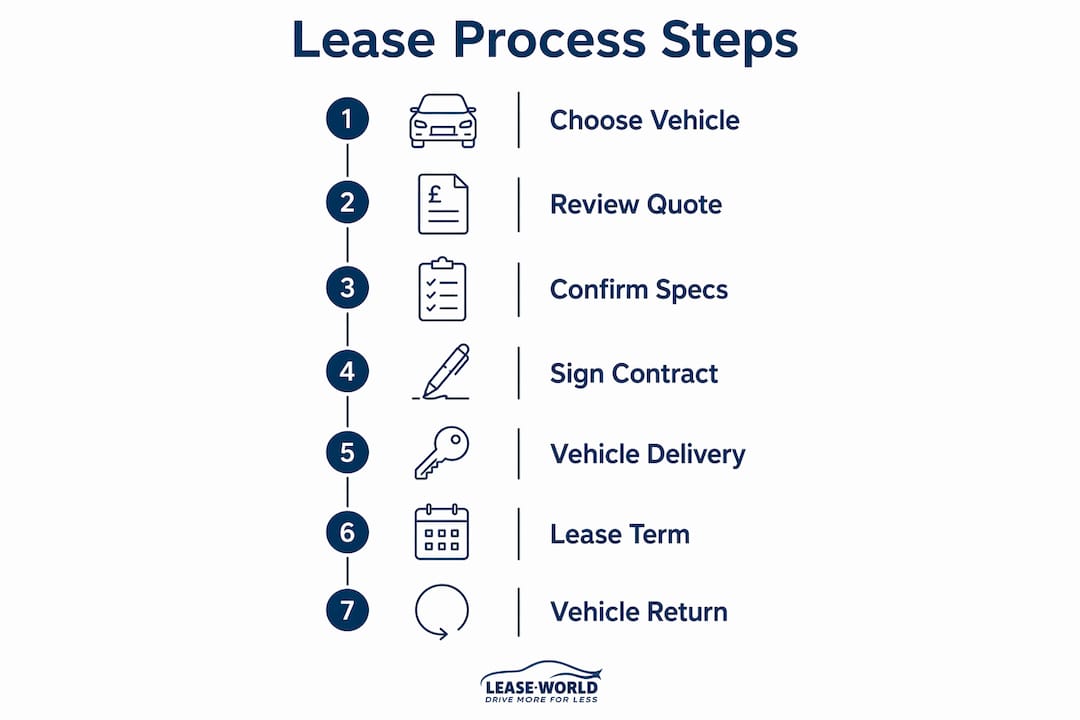
Delivery lead times vary considerably by manufacturer and model. Popular electric vehicles and newly launched models can run to 20 weeks or more; in-stock deals can cut that to a matter of days. Leasing eligibility depends on your credit history, address history and income — the funder, not the broker, makes the final decision.
Most leases run between 24 and 48 months, with 36 months being the most common choice. Shorter terms cost more per month; longer terms reduce the monthly figure but commit you for longer.
PCH vs BCH: which lease type suits you?
The UK market draws a clear line between two main contract types, and choosing the wrong one costs money.
Personal Contract Hire (PCH) is for private individuals. Payments include VAT at 20%, which you cannot reclaim. Road tax is usually included for the contract duration. There is no option to purchase at the end.
Business Contract Hire (BCH) is for VAT-registered businesses. The headline advantage: BCH allows businesses to reclaim 50% of VAT on rental payments where there is some private use of the vehicle. Where a maintenance package is added, the VAT on that element is often 100% reclaimable. For a business paying £400 per month including VAT, the effective net cost after reclaim can be meaningfully lower. Sole traders and partnerships can use BCH, but the reclaim rules are the same — you must be VAT-registered.
A few other options worth knowing:
- Short-term leases run from a few months up to around two years. They cost more per month than a standard lease but suit drivers who need flexibility, are between contracts, or want to try an EV without a long commitment. For a fuller comparison of short-term options, the lease vs rental guide explains where each product fits.
- Fleet leasing (BCH at scale) applies when a business leases multiple vehicles. Volume can improve terms, and a fleet manager handles renewals centrally.
Pro Tip: If you are a sole trader who is VAT-registered, always request BCH quotes alongside PCH quotes and compare the net-of-VAT monthly cost. The saving is often £50–£80 per month on a mid-range car.
Matching the vehicle style to your lifestyle
Choosing the right body style is not just about preference — it affects your monthly payment, insurance group, fuel costs, and how practical the car is for your actual daily use.

City commuters cover short distances, park in tight spaces, and rarely need more than five seats. A compact hatchback (think Volkswagen Polo, MINI, or a small EV such as the BYD Dolphin Surf) keeps insurance and fuel costs low and suits urban parking. If your commute is mostly urban and you have home charging, an EV lease is worth serious consideration: competitive EV lease deals are increasingly available due to manufacturer support and policy pressure, and home charging makes the running cost case compelling.
Families need boot space, rear legroom, and ideally ISOFIX points on multiple seats. An estate, MPV, or mid-size SUV covers most needs. MPVs such as the Ford Galaxy or Volkswagen Touran offer the most passenger space per pound of monthly payment; SUVs cost more to lease and insure but suit families who also need light off-road capability or tow a caravan. Lease World's MPV lease deals are worth comparing if passenger space is the priority.
High-mileage business drivers covering 20,000+ miles per year should focus on diesel or hybrid powertrains for fuel economy, and on vehicles with low Benefit-in-Kind (BIK) tax rates if the car is a company benefit. A fully electric car attracts a 3% BIK rate in 2026, which is a significant saving for higher-rate taxpayers.
Rural and towing drivers need ground clearance, four-wheel drive, or a towing capacity that matches their trailer. Not all SUVs are rated for towing — check the manufacturer's braked towing figure before committing to a spec.
One practical note: road tax on a leased vehicle is typically included in the contract for private leases, but it is worth confirming this in writing. The road tax guide for leased cars explains what is and is not covered across different deal types.
Setting your budget: monthly payment vs total cost of ownership
The monthly payment is the worst number to use when comparing lease deals. Two deals at £299 per month can have total contract costs that differ by thousands of pounds once you account for the initial rental, mileage allowance, maintenance, and likely excess charges.
Total cost of ownership (TCO) for a lease includes:
- Initial rental (e.g. three months upfront = three times the monthly payment)
- All monthly payments across the full term
- Road tax (if not included)
- Insurance
- Fuel or charging costs
- Maintenance (servicing, tyres, MOT if applicable)
- Gap insurance (recommended — see below)
- Any excess-mileage charges at handback
The 1% and 1.5% rules are quick sanity checks, not substitutes for a full TCO calculation. The 1% rule states that a monthly payment of roughly 1% of the vehicle's list price represents a good deal; 1.25% is acceptable; 1.5% is the upper limit of a fair deal. So on a car with a £30,000 list price, a monthly payment of £300 passes the 1% test, £375 is borderline, and anything above £450 warrants scrutiny. The rule assumes a standard 36-month term and a typical mileage allowance — it breaks down on short terms, high-mileage contracts, or heavily discounted EVs.
Worked example: A 36-month lease with a three-month initial rental and £299 per month.
Gap insurance is commonly recommended for leased vehicles: if the car is written off or stolen and the insurer's payout falls short of the outstanding lease balance, gap insurance covers the shortfall and prevents you from owing money on a car you no longer have.
The same car and specification can vary by £50–£100 per month between brokers on identical terms.
Pro Tip: Always compare the total contract cost — not just the monthly figure — across at least three providers before signing. A £50 per month difference on a 36-month deal is £1,800 over the term.
How to tailor your contract: duration, mileage and maintenance
Getting the contract terms right is where most drivers either save money or create problems for themselves. The three levers are duration, mileage, and maintenance inclusion.
| Term | Monthly cost | Flexibility | Risk |
|---|---|---|---|
| 24 months | Higher | Return sooner; easier to adapt to life changes | Less time to spread initial rental cost |
| 36 months | Mid-range | Most common; balances cost and commitment | Moderate lock-in |
| 48 months | Lower | Lowest monthly payment | Longest commitment; technology changes faster than the contract |
Mileage is the most consequential number in the contract. Excess-mileage charges typically run from 6p to 18p per mile depending on the vehicle and funder. On a 36-month contract, exceeding your allowance by 5,000 miles at 12p per mile costs £600 at handback — money you could have spent on a slightly higher mileage allowance upfront, usually at a lower effective rate. Check your last two years of odometer readings and add 10–15% as a buffer.
Maintenance packages bundle servicing, tyres, and sometimes MOT cover into a fixed monthly addition. They make the most sense for high-mileage drivers, those who want budget certainty, or anyone leasing a premium vehicle where servicing costs are high. For a low-mileage city driver on a standard hatchback, a maintenance package may cost more than paying for services individually. Lease World's full maintenance leasing page sets out what a typical package covers and how to assess whether it is worth adding.
Early termination is the risk that catches drivers out most often. Unlike PCP or HP agreements, leasing rarely carries a statutory right to exit early without steep charges. Expect to pay the remaining rentals or a significant proportion of them. If your circumstances might change — a new job, a growing family, a move abroad — a shorter term is worth the higher monthly cost.
Reading the fine print: fees, wear and tear, and early exit
Most lease surprises are not hidden — they are in the contract, unread. These are the clauses that generate the most end-of-lease disputes.
Excess-mileage charges are stated in pence per mile in the contract. The range across the market runs from 6p to 18p per mile. On a 10,000-mile-per-year contract, driving 13,000 miles in year one and making it up in year two does not help — most funders calculate excess on the total contract mileage at handback, so the buffer approach works, but only if you stay within the total.
Fair wear and tear is assessed against BVRLA (British Vehicle Rental and Leasing Association) standards. Scratches longer than 25mm, dents larger than 10mm, cracked glass, and missing trim are typically chargeable. Stone chips on the bonnet below a certain size are usually acceptable. The BVRLA publishes its fair wear and tear guide for both cars and vans — reading it before handback is time well spent.
Watch for these fees before signing:
- Administration fee on application (typically £100–£300, sometimes waived)
- Collection fee at end of lease if the vehicle is collected rather than returned to a depot
- Damage charges above fair wear and tear thresholds
- Early termination fee — often the outstanding rentals or a fixed percentage
Understanding the lease agreement terms before signing is the single most effective way to avoid end-of-lease charges. Pay particular attention to the mileage calculation method, the wear and tear standard referenced, and the early-termination clause.
Gap insurance deserves a mention here too. It is an often-overlooked add-on that prevents significant liability if the car is written off early in the contract when the gap between insurer payout and outstanding lease balance is at its widest.
What happens at the end of the lease?
The end-of-lease process is straightforward if you have prepared. If you have not, it is where unexpected bills arrive.
The inspection is carried out by the funder or a third-party inspection company, usually at your home or workplace. The inspector photographs the vehicle and records any damage against the BVRLA standard. You should be present if possible — you can note any disagreements on the inspection report at the time.
Handback checklist:
- Clean the car thoroughly inside and out before inspection
- Check all four tyres for tread depth (minimum 1.6mm legally; many funders require more)
- Repair minor stone chips and small scratches where the cost of repair is less than the likely charge
- Locate all keys, the service book, locking wheel nut key, and any accessories supplied with the car
- Check that all infotainment and connectivity settings are reset to factory defaults
- Photograph the car yourself before handback, with timestamps
Options at end of term: For most PCH contracts, the only option is to hand back and walk away. Some funders offer a short extension (typically month-by-month) if you need more time to arrange a replacement. Purchasing the vehicle is not usually available on a standard PCH contract. If you want the option to buy, a PCP agreement is the more appropriate product — the car finance vs car leasing guide explains the difference clearly.
Disputing charges: If you believe a charge is unfair, raise it in writing with the funder within the timeframe stated in your contract. The BVRLA offers a conciliation service for disputes between consumers and its members. Keep your own photographic evidence from throughout the contract, not just at handback.
For guidance on repair responsibilities during the lease period, including what counts as fair wear and what you are expected to fix yourself, the linked resource covers the typical clauses in plain language.
How Lease World helps UK drivers find the right lease
Lease World is a family-run UK leasing broker that takes a different approach to the process: transparent pricing, no hidden fees, and personalised comparisons rather than a one-size-fits-all deal sheet.
- Tailored comparisons: Lease World compares contracts across funders to match your mileage, term, and budget — not just the lowest headline monthly figure.
- No-deposit options: Eligible vehicles are available with no initial rental, which suits drivers who prefer to keep cash available.
- Free UK delivery: On eligible vehicles, Lease World delivers to your door at no extra charge.
- Maintenance package guidance: The team explains what a maintenance package covers and whether it makes financial sense for your usage profile.
- Transparent pricing: Lease World's fair price policy and price match guarantee mean you are not paying over the odds for the same deal available elsewhere.
- Contract support: Before you sign, Lease World walks through the key clauses — mileage calculation, wear and tear standard, and early-termination exposure — so there are no surprises at handback.
For business drivers, the team can clarify BCH VAT reclaim rules and help sole traders understand which contract type gives the better net cost. For private drivers, the leasing guides hub covers everything from eligibility to end-of-lease preparation in plain language.
Key takeaways
Choosing the right lease vehicle comes down to three questions answered honestly: how you will use the car, what the full contract actually costs, and whether the terms match your risk tolerance.
| Point | Details |
|---|---|
| Match mileage to reality | Excess charges run 6–18p per mile; overestimate rather than underestimate your annual distance. |
| Compare total contract cost | The same spec can vary by £50–£100 per month between brokers — always compare at least three quotes. |
| PCH vs BCH matters for businesses | VAT-registered businesses can reclaim 50% of BCH rental VAT, meaningfully reducing net cost. |
| Read the early-exit clause | Leasing lacks PCP/HP voluntary-termination protections; early exit is usually expensive. |
| Lease World | Offers personalised comparisons, no hidden fees, no-deposit options, and free UK delivery on eligible vehicles. |
The leasing decision most people get wrong
There is a tendency to treat a lease like a subscription — pick the lowest monthly number, sign, and move on. The problem is that leasing is not a subscription. It is a fixed-term financial commitment with real penalties for getting the mileage wrong, real costs for damage above a defined standard, and no easy exit if your circumstances change.
The drivers who come out of a lease without a surprise bill are the ones who did two things before signing: they calculated their mileage honestly (using actual odometer data, not a rough guess), and they read the early-termination clause. Not the summary — the actual clause. Those two steps take about 30 minutes and can save hundreds of pounds.
There is also a widespread misconception that the cheapest monthly payment represents the best lease deal. It rarely does. A lower monthly payment often comes with a higher initial rental, a shorter mileage allowance, or a longer term that locks you in when you might want to change. The total contract cost is the only number that tells the truth.
One more thing: gap insurance is genuinely underused. Most drivers assume their comprehensive motor insurance covers the full lease balance if the car is written off. It covers the market value of the car at the time of the loss — which, in the first 18 months of a lease, can be several thousand pounds less than what you still owe. A gap policy costs relatively little and removes that exposure entirely.
Get a tailored lease quote from Lease World
Knowing what you need from a lease is one thing. Finding the deal that actually delivers it — right mileage, right term, right monthly cost, no nasty surprises — is where most drivers spend unnecessary time and energy.
Lease World does the comparison work for you. As a family-run broker with transparent pricing and a price match guarantee, the team matches your driving profile to the contracts that genuinely fit — not just the ones with the most attractive headline figure. No-deposit options are available on eligible vehicles, and free UK delivery means the car comes to you. Whether you are a private driver weighing up PCH or a sole trader trying to work out your BCH VAT position, the process starts with a single conversation.
Browse the leasing guides to go deeper on any aspect of the decision, or go straight to the quote page to get a personalised comparison based on your actual mileage, budget and vehicle preferences.
Useful sources and further reading
These are the primary sources used in this article, selected for their authority and UK relevance:
- Parkers — Car leasing explained: Covers how PCH works, what affects monthly payments, and why total cost matters more than the headline figure. Good starting point for private drivers new to leasing.
- AutoHit — Car leasing in the UK: Detailed breakdown of PCH vs BCH, VAT reclaim rules, excess-mileage charges, and EV lease considerations. Particularly useful for business drivers.
- What Car? — Everything you need to know about car leasing: Explains early-termination exposure, gap insurance, and the differences between leasing and PCP/HP. Read before signing any contract.
- LeaseGuide — The one percent rule: Clear explanation of the 1% and 1.5% benchmarks for evaluating whether a monthly payment represents fair value relative to the vehicle's list price.
- BVRLA fair wear and tear standards: The industry standard used by funders to assess vehicles at handback. Reading this before your inspection is the most practical preparation you can do.
FAQ
What is the 1.5% rule when leasing a car?
The 1.5% rule is a quick benchmark: if your monthly lease payment is below 1.5% of the vehicle's list price, the deal is broadly acceptable. A monthly payment at or below 1% of the list price is considered a strong deal; 1.25% is good; 1.5% is the upper limit of fair value. The rule works best on standard 36-month contracts and loses accuracy on short terms or heavily subsidised EV deals.
Is it better to lease a car for 24 or 36 months?
A 36-month lease is the most common choice because it balances monthly cost and commitment. A 24-month lease costs more per month but returns you to the market sooner, which suits drivers whose needs may change or who want to upgrade to newer technology more frequently. The right answer depends on how stable your mileage and lifestyle are likely to be.
What are the best vehicle leasing options for UK drivers right now?
The best lease depends on your usage, not a single model. EV leases are particularly competitive at present due to manufacturer support and low BIK tax rates for business drivers. For families, estate cars and MPVs offer the best space-per-pound. For city drivers, compact hatchbacks and small EVs keep running costs low. Compare total contract cost across at least three providers rather than relying on a single monthly figure.
What happens if I go over my mileage on a lease?
Excess mileage is charged at a rate stated in your contract, typically 6p to 18p per mile. The charge is calculated on the total mileage at handback against the total allowance for the full contract. There is no way to offset excess miles from one year against a shortfall in another — the final odometer reading is what counts.
Can I end a car lease early in the UK?
Early termination on a lease is usually expensive. Unlike PCP or HP agreements, leasing does not carry a statutory voluntary-termination right once a set proportion of payments has been made. Expect to pay the remaining rentals or a significant percentage of them. If flexibility matters, choose a shorter contract term or consider a short-term lease product instead.