

An excess mileage charge is a pence‑per‑mile fee your finance company bills you for every mile you drive beyond the total agreed at the start of your lease or PCP contract. Most leasing and personal contract purchase agreements include one. Before you sign anything, find the exact per‑mile rate in your paperwork, check whether VAT gets added on top, and build a buffer into your mileage estimate so the figure never catches you out.
TL;DR:
- Most lease agreements include a per-mile fee that can range from 3p to 50p, depending on the vehicle and provider, often excluding VAT.
- Excess miles are billed at handback based on the final odometer reading, with early termination and partial use affecting the calculation.
- Adding a 10% buffer to your estimated annual mileage at sign-up can prevent costly charges and should be recalculated if circumstances change.
- Requesting a mileage allowance amendment or extension early is usually cheaper than paying the excess fee at the end of the contract.
- Always verify the exact wording of your mileage limit and keep records, such as odometer photos and mileage logs, to avoid disputes.
Table of Contents
- What are excess mileage charges and which agreements include them
- How excess mileage is calculated, with worked examples
- When charges are applied, and what happens to unused miles
- Practical options if you expect to exceed your allowance
- How to choose the right mileage at sign-up
- Lease World checklist: what to check now in your contract
- Why I round mileage estimates up, not down
- Get a mileage-aware lease quote from a vehicle leasing broker
- Sources
- FAQ
What are excess mileage charges and which agreements include them
Funders set mileage limits because the number of miles on the clock directly affects what a car is worth when it comes back. A vehicle with 60,000 miles on it sells for considerably less at auction than one with 30,000, so the finance company prices that risk into your monthly payment upfront. Agree a lower annual mileage and your payments drop; agree a higher one and they rise, because the funder is betting on a lower resale value from day one.
This mechanism only applies to certain products:
- Personal Contract Purchase (PCP) and Personal Contract Hire (PCH) almost always carry a mileage limit, because the funder retains an interest in the car's future value.
- Hire Purchase (HP) and standard personal loans usually have no mileage cap at all, since you are working towards outright ownership regardless of the odometer reading.
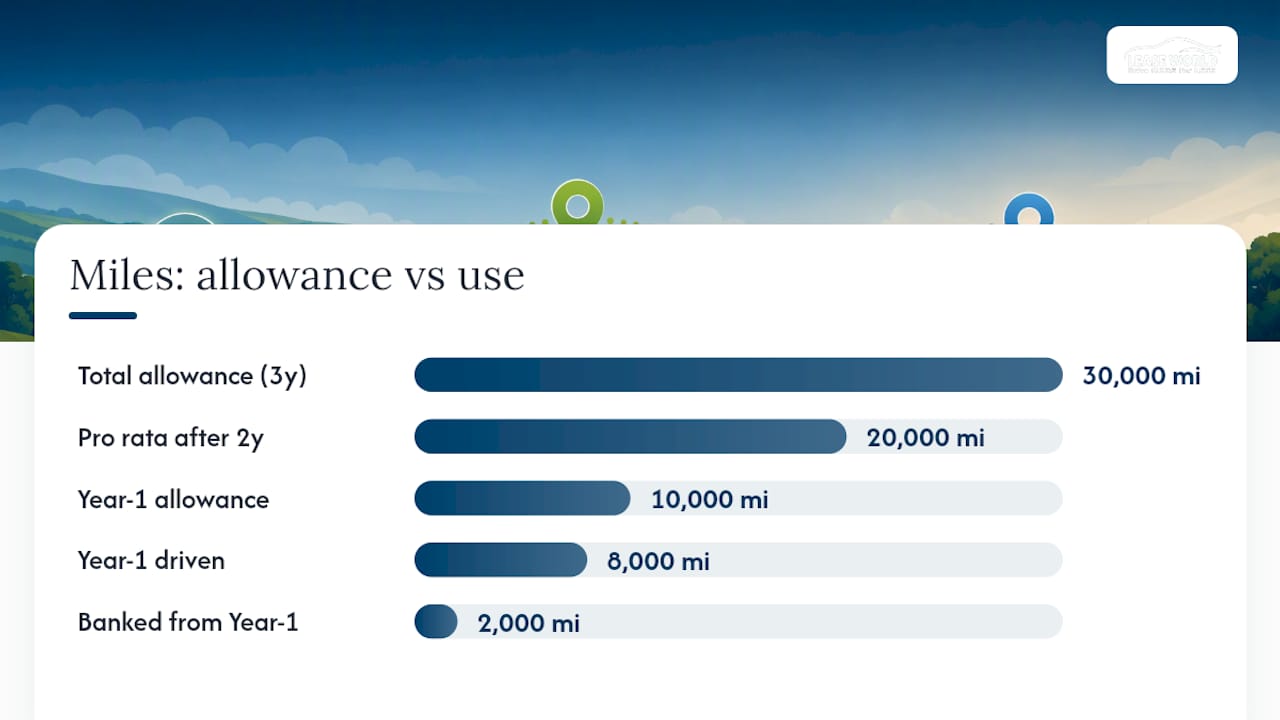
- Your annual allowance multiplies across the whole term, so a 3-year lease at 10,000 miles a year gives you a 30,000-mile total budget, not a yearly reset.
That last point trips up more drivers than anything else in this article. Running low mileage in year one does not automatically protect you if you drive hard in year three.
How excess mileage is calculated, with worked examples
The formula funders use is simple: excess miles × the per-mile rate in your contract. The complication is that rates vary hugely between funders and vehicles, and the quoted figure sometimes excludes VAT.
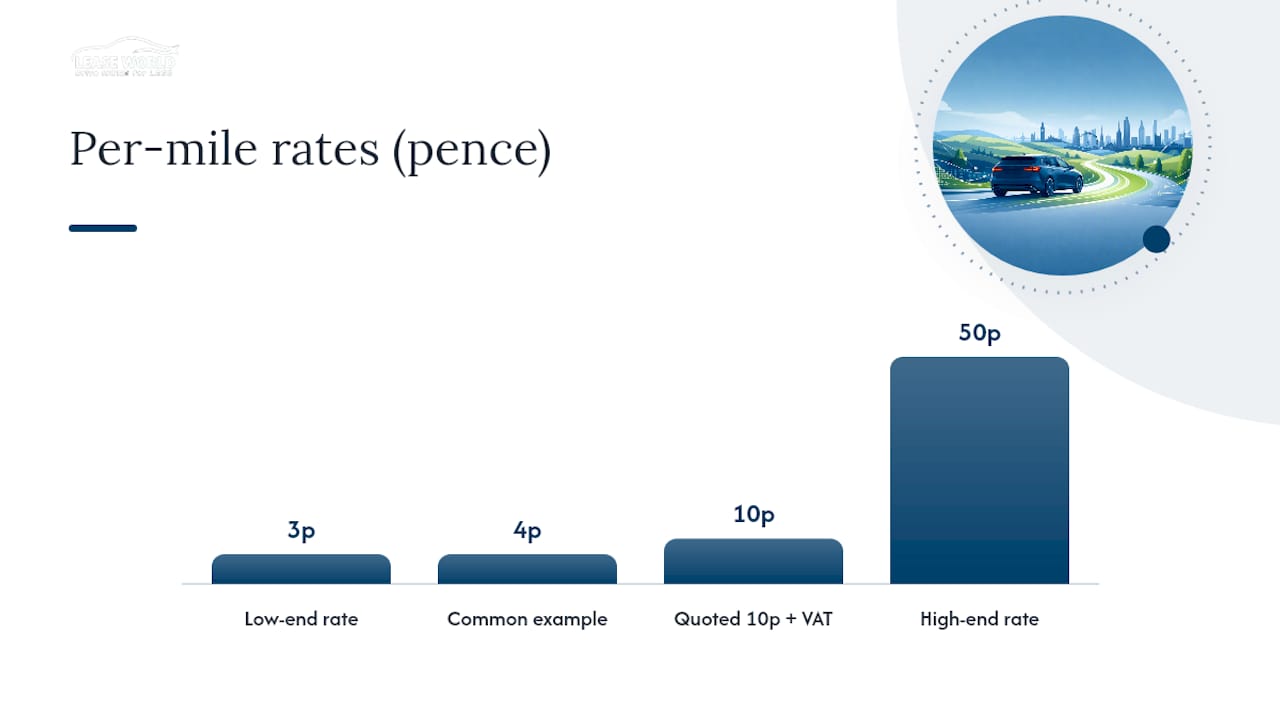
Published ranges across UK guides run from roughly 3p to 50p per mile depending on the provider and the car in question. Premium or low-volume models often carry higher per-mile rates because their residual values are more sensitive to condition and mileage.
Here's how the sum plays out in practice:
- Basic example: drive 8,000 miles over your allowance at a common rate of 4p per mile and you owe £320.
- Add VAT: if your funder quotes the rate as "10p per mile plus VAT", the real cost per mile is 12p, because some lenders quote rates excluding VAT and you must add 20% yourself.
- Check the wording: always work out both figures, ex VAT and inc VAT, when comparing offers or estimating a potential bill.
If you end the contract early rather than running it to term, the excess mileage calculation is usually applied pro rata against the miles you were entitled to up to that point, not the full contract allowance.
When charges are applied, and what happens to unused miles
Excess mileage is normally worked out and billed at handback, when the funder inspects the car and reads the final odometer figure. It is not something they chase you for mid-contract in the ordinary run of things.
There are exceptions worth knowing about:
- Early termination changes the maths. If you hand the car back before the contract ends, the funder recalculates your allowance pro rata for the time you actually held the car, which can shrink your buffer considerably.
- Carry-forward works across the whole term, not year by year. Driving 8,000 miles in year one against a 10,000-mile allowance leaves you 2,000 miles "banked" for later, and this is confirmed in how funders apply the charge at handback rather than annually.
- A driver who terminates two years into a three-year, 30,000-mile deal has effectively used only two-thirds of their total allowance, roughly 20,000 miles, and any overage gets measured against that reduced figure, not the full 30,000.
Practical options if you expect to exceed your allowance
Realising you'll go over mid-contract is not a crisis, but it does need action rather than hoping the final bill will somehow be smaller than it looks. There are four realistic routes, roughly in order of what tends to work out cheapest.
- Ask for a mileage amendment. Contact your funder and request a revised allowance. Guides consistently advise asking for a written quote before you commit to a higher mileage, since your monthly payment will rise but often by less than the equivalent excess fee would cost.
- Extend the lease. Some funders let you extend the term at the existing rate, effectively buying yourself more miles within the same monthly cost structure. Worth comparing directly against option one.
- Buy the car via the PCP balloon payment, or trade it in. If you're already close to the end of the agreement, settling the balloon and keeping the car sidesteps the mileage penalty altogether. A part-exchange against your next vehicle can absorb the difference too.
- Simply pay the excess-mile bill. If you're only a few hundred miles over, working out the actual cost using the contract's per-mile rate often shows it's cheaper than renegotiating anything.
Pro Tip: Run the maths on a mileage amendment as soon as you suspect you'll go over, not in the final month. Funders are far more flexible with three months' notice than with three weeks.
How to choose the right mileage at sign-up
Getting this right at the start saves you from ever needing the options above. The method is straightforward and takes about ten minutes with a calculator.
- Map your regular journeys. Add up your commute, school runs, and any weekly fixed trips, then multiply by roughly 46 working weeks to get an annual base figure.
- Add occasional trips. Factor in holidays, visits to family, and anything seasonal you know is coming. Also think ahead: a new job, a house move, or a partner starting to use the car changes the sum significantly.
- Apply a buffer. Industry guidance recommends adding around 10% to your final estimate to cover unforeseen journeys, and that small addition to your monthly payment is minor insurance against paying per-mile fees at the end of the contract.
So if your regular and occasional journeys total 9,000 miles a year, round up to 9,900 with the buffer, then round again to the nearest sensible band, likely 10,000 miles. It costs you slightly more monthly. It costs a lot less than a final bill.
Lease World checklist: what to check now in your contract
Before your next handback date arrives, or ideally the day your contract starts, run through this short list.
- Find the exact wording. Locate "agreed total mileage" and the per-mile rate in your paperwork, and check specifically whether it says "plus VAT" or "including VAT". Failing to add VAT can understate your final bill by 20%.
- Keep evidence as you go. Dated odometer photos taken every few months and a simple mileage log are recommended best practice if a funder ever disputes the recorded figure at handback.
- Hold onto servicing receipts. They often show mileage at each visit, giving you an independent trail that backs up your own log.
- Contact the funder early. As soon as you suspect you'll overrun, ask for a written quote to increase your allowance and compare that cost directly against the expected excess-mile fee.
Pro Tip: Photograph the odometer alongside a dated newspaper or your phone's lock screen showing the date. It's a small habit that removes any ambiguity if a dispute ever reaches the Financial Ombudsman Service.
Why I round mileage estimates up, not down
Every time I've seen someone walk through their annual mileage sum, they land on a precise, sensible-sounding number, then talk themselves out of the buffer because it feels like paying for miles they won't use. That's backwards. The buffer isn't a tax on cautious drivers, it's the cheapest insurance in the entire contract, because the gap between a slightly higher monthly payment and a lump-sum bill at handback is never close.
My rule: whatever your honest estimate comes out to, round it up to the nearest 1,000 miles, then write down the reason why in one sentence. Job change likely next year, new baby, elderly parent needing more visits, whatever it is. That sentence is what stops you talking yourself back down to the cheaper, riskier figure six months later.
— Jason
Get a mileage-aware lease quote from a vehicle leasing broker
Getting the mileage figure right at sign-up matters more than almost any other number in your contract, and it's exactly where a broker earns its keep. A reputable leasing broker works through your likely annual mileage as part of every tailored quote, comparing contracts across multiple funders so you're not stuck with one lender's rigid bands or hidden VAT wording on excess charges.

A family-run brokerage rather than a call-centre operation typically offers fixed monthly payments agreed upfront, with no deposit options and free mainland UK delivery on eligible vehicles, so there's no surprise cost stacked on top of the mileage conversation. If you're weighing up your options, start with a personal car leasing quote and talk through your expected annual mileage before you commit to a figure, or head to the enquiry page if you'd rather discuss a business contract hire deal directly with the team.
This article is general information, not a substitute for advice from a qualified financial advisor. Consult a qualified financial professional about your own circumstances before acting on anything here.
Sources
- Excess mileage charges on car finance deals: what are they and how do you avoid them? | Auto Express
- When are excess mileage charges applied? | Santander Consumer
- What are yearly mileages and excess mileage charges? | WhatCar
- Excess mileage charges on a lease car explained... and how to avoid them | Auto Trader
FAQ
What is a reasonable excess mileage charge?
Rates vary widely across the market, from roughly 3p to 50p per mile depending on the funder and vehicle, so always check your own contract rather than relying on a market average.
How do I calculate the excess mileage charge in the UK?
Multiply the number of miles you've driven over your agreed total by the per-mile rate in your contract, remembering to add 20% VAT if the rate is quoted "plus VAT" or "ex VAT," as some lenders state it that way.
Is an excess mileage charge enforceable?
Yes, it's a standard contractual term in most PCP and lease agreements, and funders are entitled to bill it at handback; if you believe a charge has been miscalculated, the Financial Ombudsman Service handles disputes between drivers and finance companies.
How do I avoid paying excess mileage charges?
Estimate your annual mileage carefully, add a roughly 10% safety buffer, and contact your funder for a written quote to amend your allowance the moment you suspect you'll go over rather than waiting until handback.