
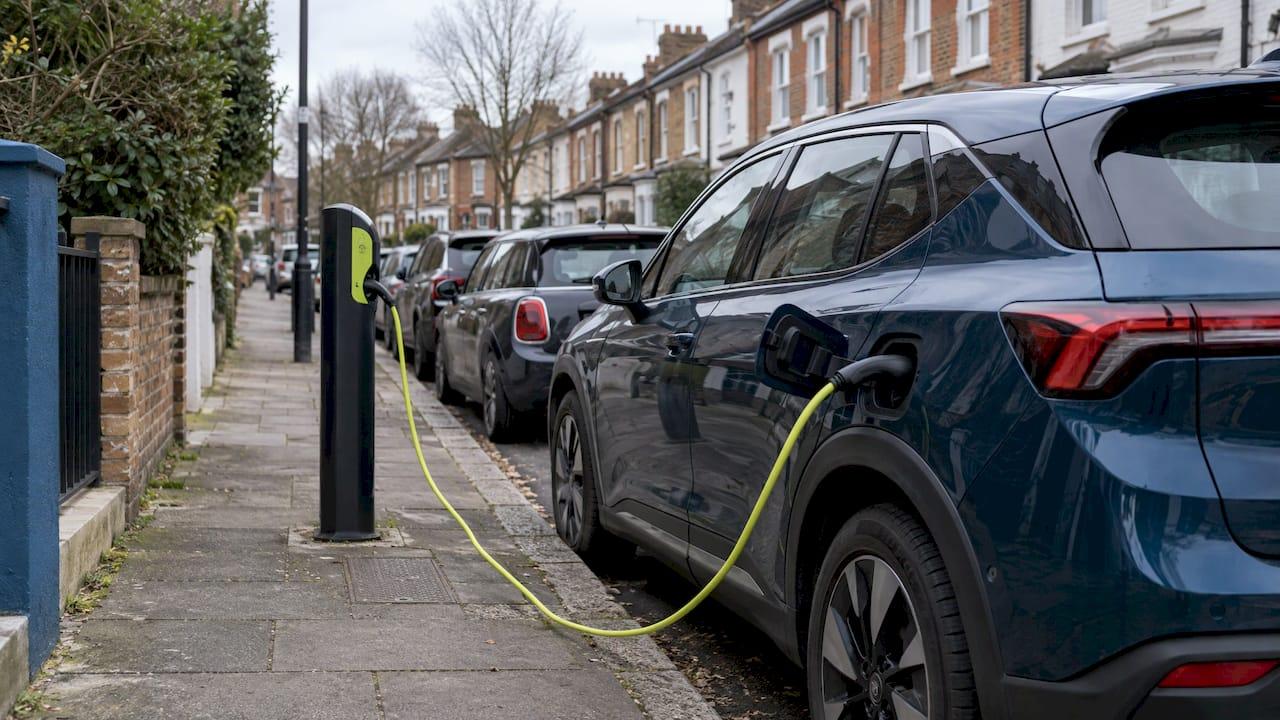
Yes, you can lease an electric car without a home charger, and plenty of UK drivers do. A lease has no rule that says you must own a wallbox. What decides whether it works is your week: where the car is parked, where you can plug in, and how many miles you cover. At Lease World we arrange electric car leases on fixed monthly payments, and we start every no-driveway conversation with that routine before we talk about models.
This guide shows where drivers without a home charger actually charge, what it costs per mile, and how to check that a lease suits your routine before you sign.
TL;DR
- You do not need a home charger to lease an EV. You need two or three reliable places to charge in a normal week, such as work, a supermarket or an on-street charger near home.
- Public charging costs more than home charging. Rapid chargers averaged about 77p per kWh in Zapmap's August 2026 index, against a home rate near 26p per kWh on the Ofgem cap.
- Many drivers still come out ahead. An industry report found drivers relying only on public charging saved in 58% of scenarios, and salary-sacrifice lessees did better still.
- Match the lease length and the car's range to your charging routine. A short-term lease is one way to test it.
Table of Contents
- Can you lease an electric car with nowhere to charge at home?
- Where drivers without a home charger charge
- What it costs: the honest per-mile picture
- Is it still worth it? What the evidence says
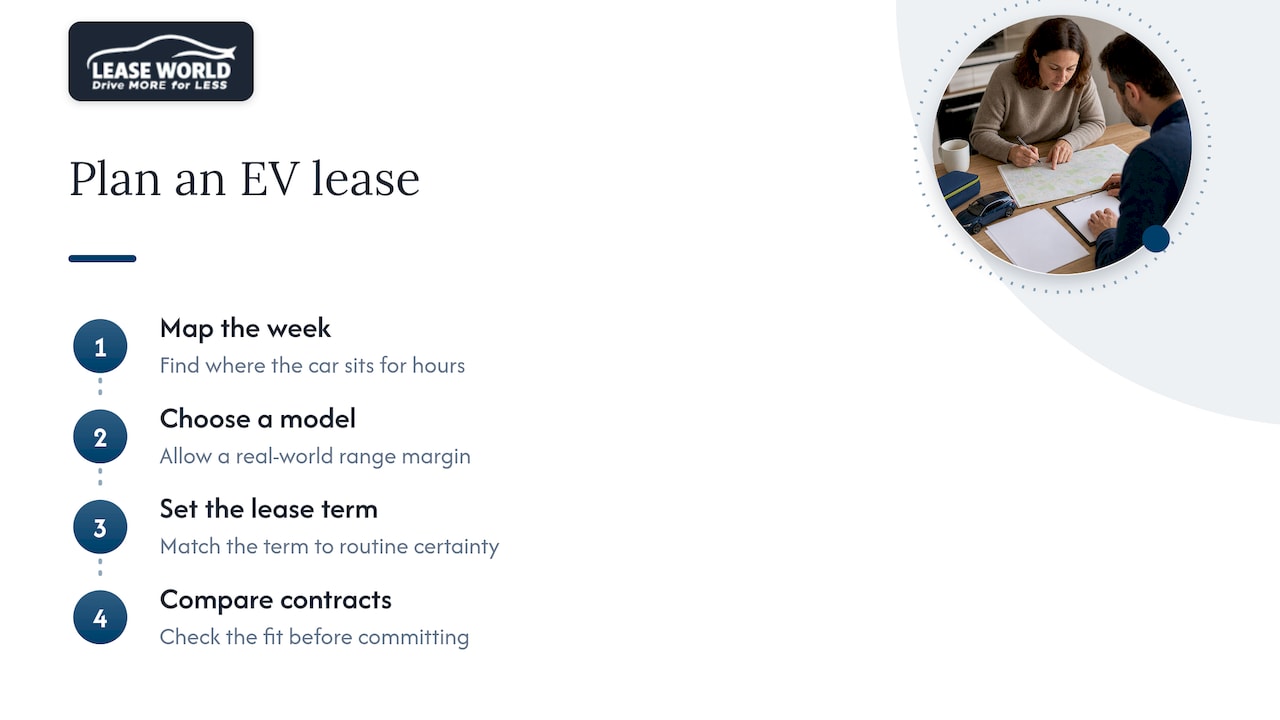
- Check your routine before you choose a car
- Getting the lease right when you charge in public
- Why a broker helps when you have no home charger
- Ready to compare EV leases?
- FAQ
- Sources
Can you lease an electric car with nowhere to charge at home?
Yes. Leasing is a contract hire agreement: you pay a fixed monthly amount to use the car for an agreed term and mileage. The agreement covers the car, not your driveway. Nothing in it depends on a home chargepoint.
The government's own infrastructure strategy treats drivers without driveways as a core group. It says on-street charging is crucial for people without off-street parking and expects around 300,000 public chargepoints at minimum by 2030. Zest, quoting Zapmap data, puts the UK total at 116,729 public chargepoints in January 2026, so the network is already large, though it grows month by month.
The practical question is not "can I?" but "how will I charge, and what will it cost?" The rest of this article answers both.
Where drivers without a home charger charge
The main options, as Uswitch sets them out, are these:
- Workplace charging. A car parked for eight or nine hours can take a useful top-up while you work.
- Destination charging. Chargers at supermarkets, gyms, shops and cafes let you add range while you do something you were doing anyway.
- Long-stay charging. Stations, airports and some hotel car parks suit cars that sit for hours or days.
- On-street residential chargers. Often converted lampposts or bollards rated at 3 to 7kW, they typically take 6 to 12 hours for a full charge, so they suit overnight use.
- Rapid chargers. For long journeys, or when everything else is full, a rapid stop is the fast route.
What is the network made of? DfT statistics cited by Expertsure show 54% of UK public chargers are at destination locations and 32% are on-street residential units. That fits the pattern above: most public charging is built around places where cars sit for a while.
Zapmap's beginner's guide adds a useful rule from an EV driver: match charger speed to the time you stay. An hour-long stop suits a rapid charger, common at supermarkets and gyms. A few hours means a slower destination charger is enough.
Standard connectors mean any public charger will do
Public chargers use standardised connectors, so almost any EV works with almost any public charger of the speed and connector type you want. You are not tied to one network for the car you lease, though you may need a few apps or cards to pay.
What it costs: the honest per-mile picture
Public charging is priced per kWh (kilowatt hour, the unit of electricity), and the price depends on charger speed. Prices move with the market and each network sets its own, so treat any figure as a snapshot of its period.
- Rapid and ultra-rapid: Prepared Britain, using Zapmap's August 2026 price index, reports a weighted-average pay-as-you-go price of 77p per kWh on 50kW+ chargers, about 24.2p per mile at 3.18 miles per kWh. The ten biggest rapid networks ranged from 59p to 92p.
- Slower public chargers (3 to 49kW): the same index averaged 54p per kWh, about 17p per mile.
- Home on the Ofgem price cap: about 8.3p per mile, according to the same analysis, with an overnight EV tariff far lower.
To make it concrete, the RAC's Charge Watch works through a rapid charge from 10% to 80% of a 64.8kWh battery. At an example price of 78.12p per kWh, that costs around £40 for roughly 168 miles.
A worked example
Take 8,000 miles a year at 3.5 miles per kWh, which is the efficiency the RAC assumes. That needs about 2,286 kWh of electricity.
| Where you charge | Price per kWh | Approx. yearly cost |
|---|---|---|
| Mostly slower public chargers | 54p | about £1,234 |
| Mostly rapid chargers | 77p | about £1,760 |
The prices come from the Zapmap-based figures above. The yearly totals are our own arithmetic from them, so your result will differ with your car, your driving and the networks you use. Most drivers mix the two, which is why we suggest planning around your own pattern. Our guide to electric car charging costs goes through home and public rates in more detail.
Where electric still beats petrol
Prepared Britain's analysis puts the crossover point at roughly 53p per kWh against petrol and 55p against diesel, at 3.18 miles per kWh. Slower public chargers at 54p sit right around that line, and workplace or destination charging is often cheaper than rapid. The sensible plan for a driver without a home charger is to make rapid charging the exception and slower, longer-stay charging the habit.
Is it still worth it? What the evidence says
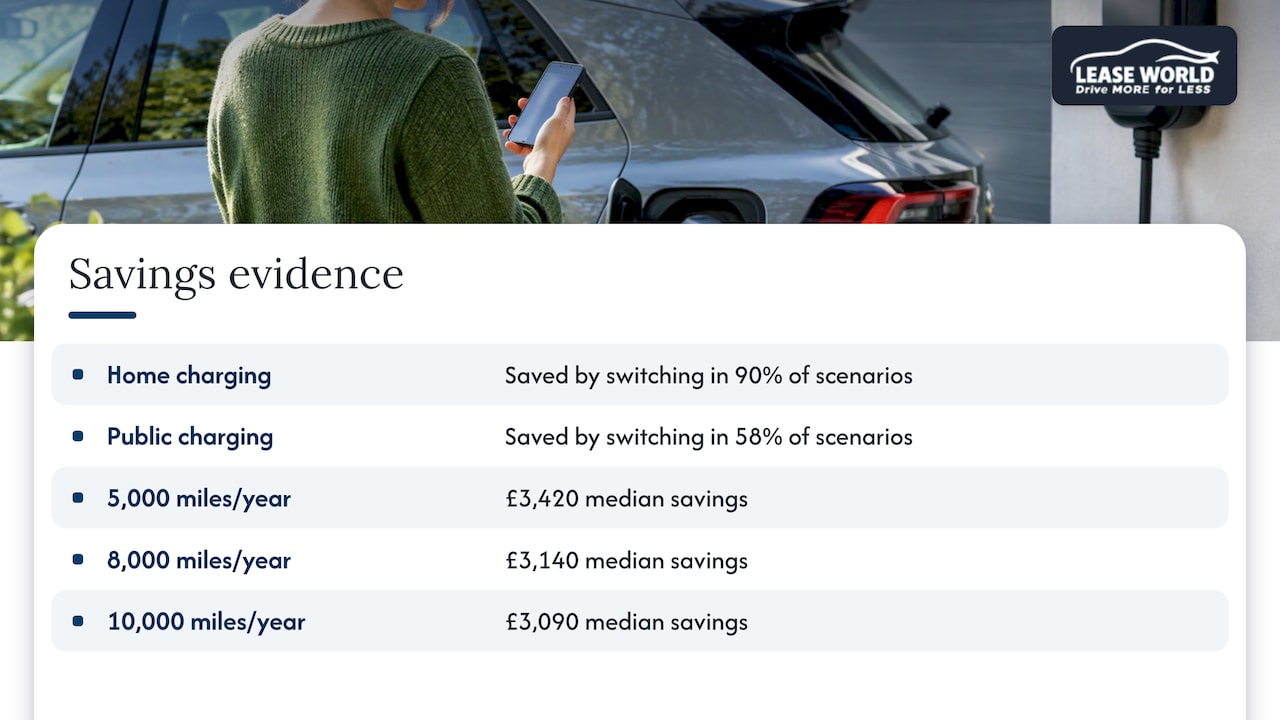
An Electric Vehicles UK industry report from February 2025 modelled a range of drivers. Those with home charging saved by switching in 90% of scenarios. Those relying entirely on public charging still saved in 58%.
For salary-sacrifice lessees the picture was stronger. The report found higher-rate taxpayers benefited whatever their charging method, with median savings of £3,420, £3,140 and £3,090 at 5,000, 8,000 and 10,000 miles a year. Salary sacrifice is an employer scheme where the lease payment comes out of your gross pay. If you work for the NHS or another employer that offers it, ask your payroll team whether it covers electric cars.
The lesson is not that public charging is free of effort. It is that the sums often still work, provided you plan your charging rather than improvise it.
Check your routine before you choose a car
Before you pick a model or a term, run through this short list. It follows the logic that Zapmap's driver advice gives about mapping your routine first.
- Name two or three places you can charge in a normal week. Work, the supermarket, the gym, a street charger near your front door. If you can only name one, ask what happens when it is busy or out of order.
- Count your weekly miles. A driver doing a short commute and the school run needs far less from public chargers than a driver covering 400 miles a week.
- Match charger speed to dwell time. Overnight on-street suits slower chargers. A quick shop suits a rapid one.
- Price it at public rates. Use 54p to 77p per kWh in your sums, not the home rate.
- Choose real-world range with a margin. A car with comfortable range between charges means fewer stops and less stress when a charger is occupied.
- Pick the term to suit your confidence. If you are unsure how your routine will hold up, a shorter agreement keeps your commitment smaller.
Driving instructors and high-mileage drivers
If you teach for a living, your car sits at lessons rather than at a desk, so you may charge between pupils or at a depot. High mileage pushes you toward rapid charging, so work out your weekly cost at the higher rates before you commit. We have a dedicated driving instructor leasing service, and it is worth telling us your typical day when you ask for quotes.
Renters and flat owners
Drivers in rented homes or flats can sometimes get help with installing a socket, but the grant rules change and depend on your parking. Our guide to leasing with an EV charger and the 75% grant explains the wording that matters, and the official government page has the current terms. Many drivers never need one at all.
Getting the lease right when you charge in public
A fixed monthly payment covers the car, not the electricity, so the lease is only half your monthly cost. Our article on what electric car leasing really costs covers the lease side. For the running-cost side, see what UK drivers pay to charge in 2026 and our electric car charging guide.
When you compare contracts, put these side by side:
- Monthly rental and initial payment (some deals have no deposit)
- Contract length and annual mileage allowance
- Whether a maintenance package is included
- Real-world range of each car
- Delivery terms
The range and mileage lines matter most for a public charger user, because they set how often you need to plug in.
Why a broker helps when you have no home charger
Two drivers with the same salary and the same budget can need very different cars. One has a workplace charger and a 12-mile commute. The other lives on a terraced street and covers 15,000 miles a year. Comparing contracts across funders for each of those situations takes time, and the cheapest monthly price is not always the best fit for the second driver.
As a broker, we compare contract hire agreements across funders and build tailored quotations, with a wide choice of makes and models on fixed monthly payments. We are a family-run business with more than 30 years of experience, FCA authorised and a member of the BVRLA. Our electric deals include no deposit options and free mainland UK delivery on eligible new vehicles.
Our view on leasing an EV without a home charger
We would not tell anyone to wait for a driveway before going electric. Plenty of the drivers we talk to are in flats, rented houses or terraces, and the question they ask is the right one: where will I plug in?
Our answer is to start with the week, not the car. Work out where the car sits for hours, because that is where cheap, slow charging happens. Then choose a model whose real-world range gives you a margin, and a term that suits how sure you are of your routine.
A lease helps here because the monthly payment is fixed and the contract is compared for you before you commit. We would rather spend ten minutes on your charging pattern than send you a quote that looks good on paper and fails on a wet Tuesday.
Jason
Ready to compare EV leases?
Tell us where you park and where you can charge, and we will compare electric lease deals that fit. Our electric car leasing page shows the range, and you can also look at personal car leasing, business car leasing or electric van leasing. We also offer short-term leases, and specialist deals for driving instructors and NHS staff, which you can find from our home page.
When you are ready, send us a car leasing enquiry with your usual weekly mileage and charging options.
FAQ
Can you lease an electric car without a home charger?
Yes. A lease covers the car, and you can charge at work, at destinations, on the street or at rapid chargers. Check that you have two or three realistic places to charge in a normal week before you choose a model.
How much does it cost to charge an EV without a home charger?
It depends on the charger. Zapmap's August 2026 index averaged 54p per kWh on slower public chargers and 77p per kWh on rapid ones, against a much lower home rate. Slower, longer-stay charging usually works out cheaper per mile than rapid.
Can I charge a leased EV at work?
Often, if your employer has chargepoints. A car parked for eight or nine hours can add a meaningful top-up. Ask your employer or facilities team whether staff can use the chargers and how they are billed.
Is a short-term lease a good way to try an EV with no home charging?
It can be. A shorter agreement lets you see how your charging routine holds up over real weeks of driving. We offer short-term vehicle leasing, so ask us which cars and terms are available.
Sources
- Charging an EV without a home charger, Uswitch
- Charging an electric vehicle: a beginner's guide, Zapmap
- Is an electric car cheaper to run than diesel?, Prepared Britain
- EV public charging costs, RAC Charge Watch
- Electric Vehicles UK code report, February 2025
- Taking charge: the electric vehicle infrastructure strategy
- UK EV Charging Statistics 2026, Expertsure
- Can you run an EV without a home charger?, bp pulse
- EV charger grants for UK businesses, Zest