
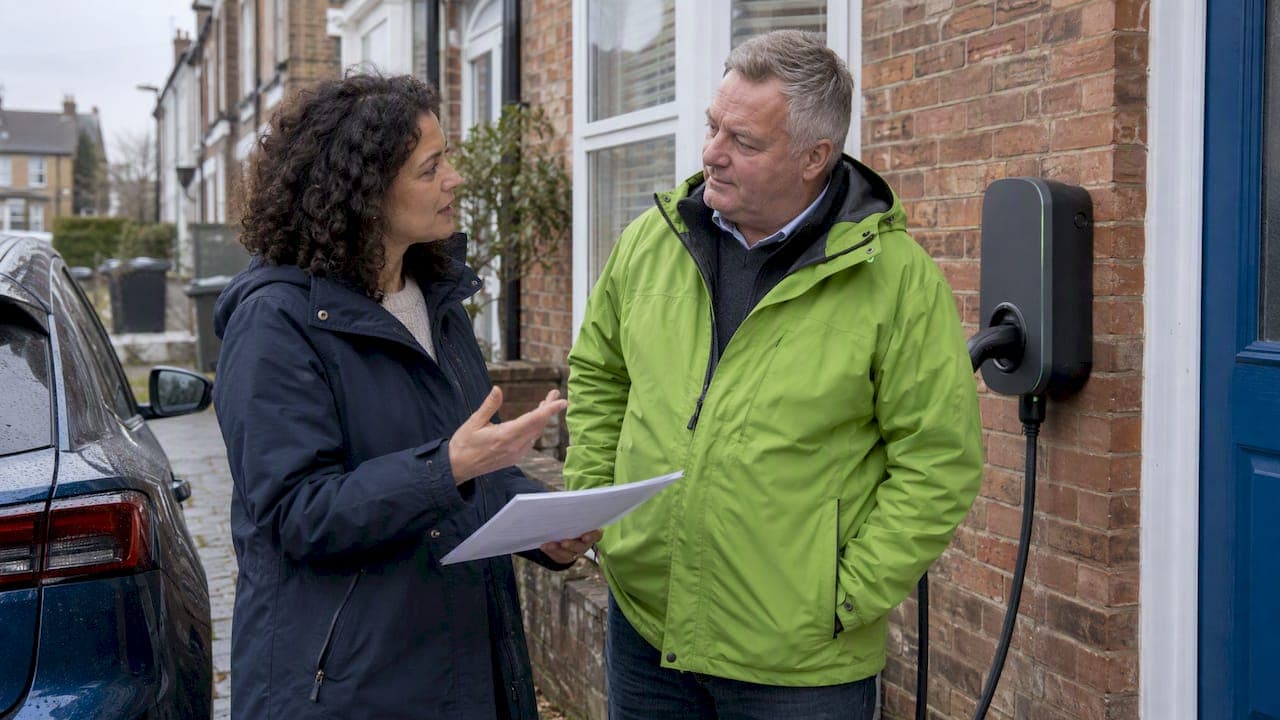
You can get an EV charger through a lease, but only if the contract itemises the charger and installation as separate costs, confirms you'll own the hardware once payments finish, and runs for at least six months. Get that wording wrong and you lose access to the renters' and flat owners' grant, which covers 75% of costs up to a capped amount per socket. You'll also need landlord consent and an OZEV-authorised installer.
TL;DR:
- Eligible renters, flat owners, and landlords can claim 75% of purchase and installation costs, up to the per socket cap, through March 31, 2027.
- A charger lease qualifies only when the agreement separately lists hardware and installation costs, including VAT, transfers ownership after final payment, and lasts six months.
- Tenants and flat owners need written consent from a landlord or freeholder, an eligible EV held or leased for six months, and an OZEV approved installer.
- Leasing counts as a sale under smart chargepoint rules, so obtain the compliance statement, technical file, and software version details before installation ends.
- Businesses may claim full expensing or the Annual Investment Allowance, while dedicated chargepoints may qualify for 100% business rates relief through 2036.
Table of Contents
- The three ways to get a charger: bundles, rentals and leases
- Grant eligibility: who can claim, how much and what you need
- What your lease contract needs to say
- Permission, leasehold rights and getting the installation done
- [Costs and tax: when leasing makes financial sense in 2026 — including how to budget for additional protection like ceramic coating cost UK options to maintain your vehicle's finish after switching to an EV](#costs-and-tax-when-leasing-makes-financial-sense-in-2026-including-how-to-budget-for-additional-protection-like-ceramic-coating-cost-ukhttpsdiamondbritecoukceramic-coating-cost-uk-options-to-maintain-your-vehicles-finish-after-switching-to-an-ev)
- What to check for compliance before you sign anything
- Your step-by-step checklist for leasing and claiming the grant
- Does a leased charger affect your property's value or tenancy?
- Why contract wording matters more than the charger itself
- How we can help with your EV leasing questions
- FAQ
- Sources
The three ways to get a charger: bundles, rentals and leases
Most people meet one of three models when they start looking at EV chargers outside a straight cash purchase.
- Bundled vehicle lease: the charger and installation sit inside your car lease agreement, often as an add-on line.
- Standalone charger rental or subscription: you pay monthly for the hardware alone, usually with the supplier retaining ownership throughout.
- Operating or finance lease for a charger: structured like equipment leasing, with different accounting treatment depending on which type you sign.
The distinction matters because ownership timing drives grant eligibility. A subscription where the charger never transfers to you typically fails the grant's ownership test. A bundled lease that itemises the charger and states it becomes yours after the final payment usually passes. Checking your paperwork against these three categories before you apply saves a wasted application.
Grant eligibility: who can claim, how much and what you need
As of April 2026, renters, flat owners and eligible landlords can claim 75% of EV chargepoint purchase and installation costs, up to a capped amount per socket, with funding confirmed until 31 March 2027.
The grant covers 75% of costs up to a capped amount per socket, a significant uplift from the previous £350 cap, making leased installations far more affordable for tenants and leaseholders who don't own their property outright.
To claim, you'll generally need:
- Proof you own or lease an eligible electric vehicle for at least six months, under Gov.
- Written landlord or management company consent, if you rent or hold a leasehold flat.
- A quote and installation from an OZEV-authorised installer, who applies the grant on your behalf.
A leased charger qualifies only when the agreement itemises the hardware and installation cost (including VAT) separately from any vehicle finance, and states clearly that ownership passes to you once the payments are complete.
What your lease contract needs to say
Before signing anything, read the contract for these specific clauses, not just the headline monthly price.
- Itemised cost line: the charger and installation must appear as a distinct cost including VAT, not folded into a single vehicle lease figure.
- Ownership-on-completion wording: the contract should state you own the hardware once the agreed payments are made, not that it remains the supplier's property indefinitely.
- Minimum term: bundled vehicle leases need to run at least six months to satisfy grant eligibility rules.
- Maintenance and insurance responsibility: subscription models often leave software updates and fault cover with the supplier, which can affect who signs the compliance statement later.
Ask directly who holds the technical file and who signs the statement of compliance. If neither party can answer clearly, that's a sign the paperwork isn't ready for a grant application.
Pro Tip: Ask for the ownership and itemisation clauses in writing before you sign, not as a verbal assurance from a salesperson.
Permission, leasehold rights and getting the installation done
If you rent or hold a leasehold flat, you'll almost always need written consent from your landlord or freeholder before any charger goes on the wall or in a parking bay. Lease covenants commonly require this, and disputes tend to centre on whether consent was unreasonably withheld, as tribunal material on leasehold charger disputes shows.
- Permitted development rules can simplify many domestic installations, but they don't remove the need for landlord consent.
- Cross-pavement charging solutions may still need separate highway or local authority permission, even where permitted development applies.
- An OZEV-authorised installer, combined with documented written consent, substantially reduces the risk of a dispute later.
Pro Tip: Keep copies of every consent email, quote and compliance statement together; they're the first thing a tribunal or grant auditor will ask for.
Costs and tax: when leasing makes financial sense in 2026 — including how to budget for additional protection like ceramic coating cost UK options to maintain your vehicle's finish after switching to an EV
For businesses, 2026/27 brings two main routes to full tax relief on charger costs: full expensing for limited companies, or the Annual Investment Allowance for unincorporated businesses.
Dedicated EV chargepoints may also qualify for 100% business rates relief until 2036, a relief confirmed in the November 2025 Budget, which strengthens the case for workplace and landlord installations.
- An operating lease generally keeps payments as a tax-deductible revenue expense, with no capital allowance claim available.
- A finance lease may let you claim capital allowances on the capital element, depending on how the agreement is structured.
- Landlords offering chargers across multiple units should check the commercial landlord chargepoint grant, which can cover up to 100 sockets a year for properties paying business rates.
Because the right treatment depends on your specific accounting position, it's worth checking the detail with an accountant before committing to either structure.
What to check for compliance before you sign anything
The Electric Vehicles (Smart Charge Points) Regulations 2021 require most domestic chargepoints sold in Great Britain to include smart functionality, supplied with a statement of compliance and a technical file.
- Leasing or hiring a chargepoint counts as a 'sale' under these regulations, so the same paperwork obligations apply to leased units as to outright purchases.
- Ask for the statement of compliance, the technical file and confirmation of the installed software version, in writing, before the installer leaves.
- Confirming compliance matters for safety first, but it also underpins your eligibility for both the household grant and any business tax relief you plan to claim.
Your step-by-step checklist for leasing and claiming the grant
- Decide which model fits you (bundle, subscription or standalone lease) and check the ownership wording carefully.
- Get written consent from your landlord or freeholder if you rent or hold a leasehold flat.
- Request a quote from an OZEV-authorised installer and ask for the statement of compliance upfront.
- Apply for the grant with your eligibility documents, lease agreement and installer quote, then keep every record.
| Step | What you need | Who provides it |
|---|---|---|
| Choose model | Itemised cost and ownership clause | Lease provider |
| Get consent | Written landlord or freeholder approval | Landlord or management company |
| Book installation | Quote and compliance statement | OZEV-authorised installer |
| Apply for grant | Eligibility proof and paperwork | You, via the installer |
Does a leased charger affect your property's value or tenancy?
A well-documented, consented charger installation tends to support rather than undermine a property's position on the market, since EV charging access is increasingly something buyers and tenants look for. The key word is documented: an installation done without landlord consent or without a retained compliance statement can create problems at the point of sale or renewal, not because the charger itself is unwanted, but because the paperwork trail is missing.
For leaseholders, a charger installed under a leased or subscription agreement raises a separate question at the end of the lease: does the hardware stay with the property, or does it belong to the lessee and get removed? This should be settled in writing before installation, not worked out retrospectively when you come to sell or move out. A tenancy agreement that's silent on this point leaves both landlord and tenant exposed if the charger needs removing or if a new tenant wants to use it.

For landlords letting to tenants with EVs, a charger funded partly through the commercial landlord chargepoint grant is generally treated as a fixture benefiting the property, which can be a point worth noting in future tenancy agreements or at renewal. Future tenants inheriting a compliant, well-documented charger inherit a benefit; those inheriting an undocumented one inherit a dispute waiting to happen. Settling ownership, maintenance responsibility and removal rights in writing at the outset avoids both outcomes.
Why contract wording matters more than the charger itself

The charger hardware is rarely the problem. What causes grant rejections, leasehold disputes and tenancy headaches is contract wording that nobody checked closely enough before signing. Suppliers and landlords aren't always deliberately vague, but a subscription agreement written for simplicity often omits the ownership and itemisation detail that a grant application or a future sale will need.
The conventional advice, pick a reputable installer and get a good price, misses the part that actually determines whether you get your money back from the government or end up in a leasehold dispute two years later. That's the clause about who owns the hardware and when. Readers who treat the paperwork as seriously as the installation quote tend to avoid the problems that surface later, whether that's a rejected grant claim or a tenancy dispute over who removes the unit.
— Jason
How we can help with your EV leasing questions
Vehicle leasing and charger paperwork often arrive at the same time, and getting one wrong can complicate the other. As a family-run leasing broker, we compare contract terms across providers and talk through what each clause actually means before you sign anything, including how an electric car lease might interact with a bundled charger agreement.

We offer options on eligible vehicles, so there are no hidden costs sitting behind the headline price. If you're weighing up an EV lease alongside a charger decision, get a quote and we'll talk you through the options that fit your situation.
FAQ
Do any EV leases come with free charging?
Some EV lease providers include home charger installation or public charging credit as part of a bundled package, though this varies by provider and specific deal. Always check whether "free charging" refers to the hardware, the electricity itself, or a limited-time credit, since contract wording differs widely.
What is the cheapest EV to lease in the UK?
The cheapest EV to lease changes regularly with manufacturer offers, residual values and funder pricing, so there's no fixed answer that holds over time. The most reliable way to find current pricing is to compare live quotes across models rather than relying on a figure that may already be out of date.
Can I get a government grant for an EV charger?
Yes, renters, flat owners and eligible landlords can claim 75% of the purchase and installation cost, up to a capped amount per socket, with the scheme funded until 31 March 2027. You'll need an eligible electric vehicle, landlord consent where applicable, and an OZEV-authorised installer to process the claim.
Is it cheaper to buy or lease an EV?
Leasing an EV typically spreads cost into fixed monthly payments with no large upfront outlay, while buying means paying the full price (or finance costs) but owning the asset outright from the start. Which is cheaper overall depends on how long you keep the vehicle, its residual value, and whether you need the flexibility a lease offers; comparing personal car leasing deals against purchase quotes for the same model is the only reliable way to tell.
Sources
- Electric Vehicle Chargepoint Grant for Renters and Flat Owners
- Gov
- The Electric Vehicles (Smart Charge Points) Regulations 2021