
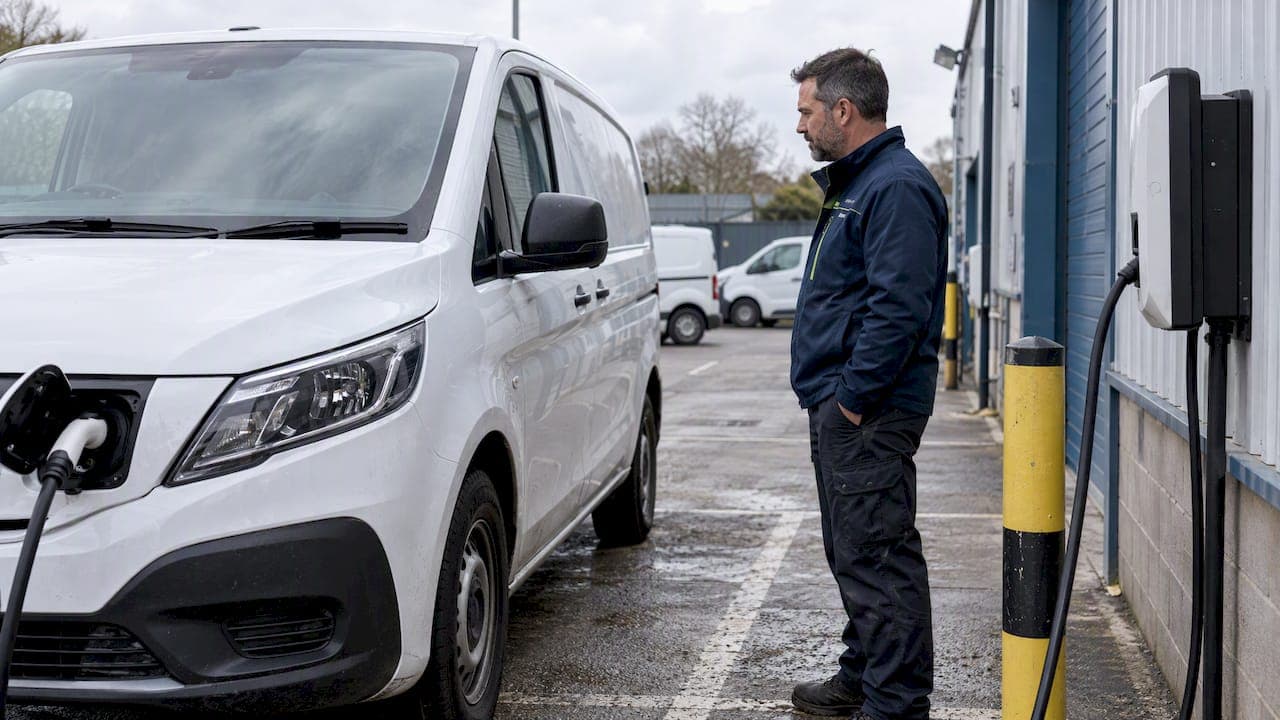
Leasing an electric van makes financial sense for most UK businesses that run predictable routes, have or can install depot charging, and want to swap vehicles every three to four years rather than own them. The main trade-off is higher monthly rentals set by residual value risk, offset by lower running costs and grant support. Before signing anything, get the costs and incentives, charging setup and lease terms right first.
TL;DR:
- Electric van leasing offers lower monthly rentals when residual values are higher, but they are generally set more cautiously due to market uncertainty.
- Government grants and incentives, like the zero-emission van grant and tax benefits, can significantly reduce the total cost of ownership for electric vans.
- Accurate duty cycle audits are essential to match EV models with real route requirements, especially payload and range, to avoid impractical choices.
- Depot charging planning should start early with site surveys, grid upgrades, and grant applications, as infrastructure delays can extend project timelines significantly.
- Residual value uncertainty and remarketing risks cause electric van leases to appear more expensive, especially over shorter contracts, requiring careful total cost analysis.
Table of Contents
- How electric van leasing works: contracts, inclusions and quotes
- Costs, tax and UK incentives that change the whole-life calculation
- Will an electric van actually suit your operations?
- Planning depot charging: grants, grid delays and installation
- Negotiating lease terms and reading the small print
- Residual values and the remarketing risk behind higher rentals
- Lease World perspective: supporting UK fleet electrification decisions
- Get a tailored electric van leasing quote
- FAQ
- Sources
How electric van leasing works: contracts, inclusions and quotes
Most businesses lease electric vans through Business Contract Hire, a fixed-term rental agreement where you pay a monthly amount to use the van and hand it back at the end, with no ownership and no resale hassle. Contracts typically run from 24 to 48 months, with mileage bands agreed upfront, usually anywhere from 8,000 to 20,000 miles a year, because going over your allowance triggers excess mileage charges at the end.
Maintenance can be bundled in or kept separate. A maintained contract adds a fixed monthly cost covering servicing, tyres and routine repairs, which suits businesses that want one predictable bill rather than variable garage invoices.
What is typically included or excluded:
- Road tax and the manufacturer warranty are standard on nearly all leases.
- Maintenance, tyres and breakdown cover are optional extras, priced separately unless you choose a maintained package.
- Insurance is usually arranged separately through your own business policy or a broker, not bundled into the lease.
- Battery degradation cover varies by manufacturer, so check the specific warranty terms before signing.
Dealers apply the Zero Emission Van Grant directly to the vehicle's price before the lease company calculates your rental, which lowers the capital cost that rentals are built on. From there, the monthly figure comes down to how much the vehicle is expected to be worth at the end of the term: a higher residual value means a lower rental, and a lower one pushes the rental up. For a broader introduction to how these agreements are structured, our guide to van leasing covers the basics in more depth.
Costs, tax and UK incentives that change the whole-life calculation
Whole-life cost comparisons between electric and diesel vans hinge on a handful of UK-specific figures that most businesses overlook when they only compare monthly rentals.
One of the clearest incentives: zero-emission vans attract a nil rate for van benefit charge purposes in the 2026 to 2027 tax year, while the standard flat-rate van benefit charge sits at £4,170 for that year, with the van fuel benefit charge at £798. For a business running several vans with private use, that nil rate alone can be worth thousands a year in avoided tax.
The Zero Emission Van Grant knocks up to £5,000 off the price of an eligible new electric van, applied by the dealer at the point of purchase or lease rather than claimed separately. On top of that, a £1 billion government package announced in March 2026 continues this van grant support alongside depot charging funding, though it does not remove the complexity of grid connections for larger sites.

For the energy side of the sum, HMRC's advisory electric rates set reimbursement at 7p per mile for home charging and 15p per mile for public charging, figures worth comparing against your current diesel fuel costs per mile.
To build a simple total cost of ownership comparison, collect:
- The van's price after the Zero Emission Van Grant is applied.
- Estimated annual energy cost based on your typical charging mix (depot versus public).
- A realistic residual value estimate from the leasing company, not a manufacturer's optimistic figure.
- Maintenance costs, whether bundled into the lease or quoted separately.
Our article on electric vehicle tax benefits goes further into how these figures interact for different company structures.
Will an electric van actually suit your operations?
The van benefit charge nil rate and grant money mean nothing if the vehicle cannot do the job. Start by auditing your actual duty cycles rather than assuming.
Work out, per route or per driver:
- Average daily mileage and the worst-case peak day, not just the typical round.
- Payload requirements, including tools, stock or equipment carried permanently.
- Dwell time at depot overnight, which determines whether standard charging is enough or you need faster charging.
- Any auxiliary equipment (tail lifts, refrigeration units, racking) that draws power and affects range.
Smaller electric vans generally handle payload well because their batteries are lighter, but mid-size and large panel vans often carry a payload penalty compared with diesel equivalents, since battery weight eats into the gross vehicle weight allowance. This matters most for businesses already running close to their payload limit.
Real-world evidence backs electric vans strongly for last-mile delivery: a trial run by Gnewt Cargo in London found vehicles covering average weekly distances of around 174 km while using materially less energy than diesel comparators and returning to depot with charge to spare. Tradespeople with moderate daily mileage and predictable routes tend to do well too. Refrigerated and long-distance distribution work is harder to justify electrically today, given the added power draw and range needs, and diesel or hybrid can remain the pragmatic choice until range and payload improve for those specific jobs.
Pro Tip: Run your duty cycle audit before requesting quotes, not after, so you compare models against your real mileage and payload rather than a brochure range figure.
Planning depot charging: grants, grid delays and installation
Underestimating charging infrastructure is the single biggest way fleet electrification projects go over budget and miss deadlines. Treat it as its own project with its own timeline.
- Confirm eligibility and apply for the Workplace Charging Scheme, which offers vouchers of up to £500 per socket, capped at 40 sockets per applicant, claimed through the scheme's portal.
- Commission a site survey to assess existing electrical capacity, cabling routes and how many vans need to charge simultaneously overnight.
- Contact your distribution network operator early. Grid connection lead times for depot upgrades have been reported at up to 15 years in the worst-affected locations, so this step should start well before vehicles are due to arrive.
- Use an authorised installer for any voucher-funded chargepoints, since the Workplace Charging Scheme requires this for the claim to be valid.
- Gather documentation for the grant claim, including proof of eligibility, installer quotes and site ownership or lease details.
Where grid capacity is tight, staged installations and smart charging software that spreads the load across the night can keep a fleet moving while permanent upgrades are negotiated. Managed energy contracts that shift charging to off-peak hours also reduce both cost and strain on the connection. A commercial EPC assessment can clarify how your depot's existing energy setup affects what charging capacity is realistically available, something our partner's commercial EPC guide explains in more detail.
Negotiating lease terms and reading the small print
The headline monthly figure on a quote is built from several variables, and understanding each one gives you room to negotiate rather than just accepting the first number.
- Capital cost after any grant is the biggest lever, so always confirm the Zero Emission Van Grant has been applied before comparing quotes.
- Mileage banding affects price directly: a lower annual allowance cuts the rental but risks excess mileage charges if you underestimate usage.
- Maintenance packages add a fixed cost but protect against unpredictable repair bills, worth weighing against your in-house servicing capability.
- Battery warranty terms vary by manufacturer and should be read in full, not assumed to match the vehicle warranty.
- Residual value assumptions set by the finance company directly drive the rental, so ask how that figure was calculated.
Before signing, get end-of-lease condition standards and damage charges in writing, along with exactly what counts as fair wear and tear versus chargeable damage. Our leasing guides hub covers contract comparison in more depth if you want to see how different providers structure these terms.
Residual values and the remarketing risk behind higher rentals
Residual value uncertainty is the quiet force behind why electric van rentals can look steep compared with diesel. The BVRLA leasing outlook report flags pessimistic forecasts for used electric van values as a significant barrier, and leasing companies build that uncertainty straight into their rentals to protect their margins when vehicles come back at the end of the contract.
In practice, this means two vans with identical list prices can carry different monthly rentals purely because one finance provider is more cautious about second-hand demand. Shorter contract lengths can reduce your exposure to this uncertainty, since the vehicle is newer and more predictable when it is handed back. Where available, balloon payment structures shift some residual risk onto the business rather than the lender, which can lower the monthly rental but adds exposure if the van is worth less than expected at the end.
When comparing total cost of ownership across providers, ask for the residual value assumption behind each quote and model an optimistic, base and pessimistic scenario rather than taking one number at face value, since remarketing demand for electric vans remains genuinely unsettled.

Lease World perspective: supporting UK fleet electrification decisions
Fleet managers rarely have time to track every grant update or grid delay story, which is where a broker earns its place. Comparing contracts across providers to find terms that fit a business's actual duty cycle, not just its budget, with options that include no deposit and delivery on eligible vehicles.
When modeling total cost of ownership, grant eligibility, realistic residual assumptions and maintenance costs are considered together rather than quoting a bare monthly figure and leaving the rest to guesswork. Customers are also pointed towards authorised chargepoint installers when depot charging is part of the decision.
A useful quote starts with clear figures: typical daily mileage, payload needs and current charging infrastructure at the depot. The more of that you can share upfront, the faster a genuinely comparable set of options comes back.
— Jason
Get a tailored electric van leasing quote
Working out whether electric vans fit your fleet takes less guesswork when someone else is running the numbers alongside you. Fixed monthly quotes across a range of electric vans are put together, with no deposit required and delivery on eligible vehicles, so the figures compared are ones that can be acted on.

To get a quote that reflects your operation rather than a generic estimate, share a few details when you enquire:
- Typical daily and peak mileage for the routes the van will cover.
- Payload and any equipment that needs to fit alongside cargo.
- Whether depot charging is already installed or still being planned.
Browse current options on our electric van leasing page, or look through the wider van leasing range if you are still deciding between electric and conventional models. We can also help you think through grant eligibility and point you towards authorised chargepoint installers if depot charging is part of the plan. Start a quote through our enquiry page and a member of the team will work through the figures with you.
FAQ
Is leasing an electric van cheaper than buying outright?
Leasing avoids the upfront capital outlay and shields the business from residual value risk, since the leasing company carries that exposure rather than you. Buying outright can work out cheaper over a long holding period, but ties up capital and leaves you exposed to resale uncertainty in a market where used electric van values remain unsettled.
How much is the Zero Emission Van Grant worth?
The Zero Emission Van Grant is worth up to £5,000 off the price of an eligible new electric van, applied by the dealer at the point of purchase or lease. The discount reduces the capital cost before the leasing company calculates your monthly rental.
Do electric vans attract a lower benefit in kind charge?
Yes, zero-emission vans attract a nil rate for van benefit charge purposes for the 2026 to 2027 tax year, compared with the standard flat-rate charge of £4,170 for other vans. This is a significant saving for businesses with drivers who use the van for private journeys too.
How long does it take to get a workplace charger installed?
Installation itself can often be completed within a few weeks once a survey and quote are in place, but grid connection upgrades at busier sites can take considerably longer, so it pays to start the process well ahead of your planned fleet changeover. Applying for the Workplace Charging Scheme voucher early helps keep the project on schedule.
Can Lease World help with grant and charging questions?
Yes, Lease World works through grant eligibility and realistic cost comparisons as part of putting a quote together, and can point customers towards authorised chargepoint installers. Enquiries can be made through the electric van leasing page.