

TL;DR:
- Van leasing allows users to pay fixed monthly fees for the use of a van without ownership, offering financial flexibility and simplicity. Contract hire transfers residual value risk to the leasing company and keeps vehicles off the balance sheet, while finance lease involves ownership-like arrangements with the van recorded as an asset and liability. For most small businesses, contract hire provides clear advantages by preserving cash flow and reducing accounting complexity.
Van leasing is a fixed monthly payment arrangement that gives you full use of a van for an agreed term without ever owning it. The industry term for the most common form is contract hire, though finance lease is a widely used alternative with different financial implications. Both sit under the broader umbrella of van leasing, and understanding the difference between them is the single most important decision you will make before signing any agreement. Lease World works with UK businesses and private customers to match the right lease type to the right situation, cutting through the confusion that catches most first-time lessees off guard.
What is van leasing and how does it work?
Van leasing is a long-term rental agreement. You pay a fixed monthly fee to use a brand-new van for a set period, typically 24–48 months, then return it at the end of the term. You never own the vehicle. The leasing company retains ownership throughout, which is precisely what creates the financial advantages that make van leasing attractive to so many UK businesses.

The process works in a straightforward sequence. You choose a van, agree a contract length and annual mileage limit, then make monthly payments for the duration. At the end, you hand the van back, subject to a condition and mileage check. Some agreements include an initial rental payment upfront, though Lease World offers no-deposit options on eligible vehicles.
Leasing lowers upfront costs and spreads payments over time, which protects working capital. That matters enormously for small businesses that need their cash in the business, not tied up in a depreciating asset sitting on the drive.
Pro Tip: Set your annual mileage estimate slightly higher than you expect to need. Excess mileage charges at the end of a contract are almost always more expensive than paying a marginally higher monthly rate from the start.
What are the main types of van leases?
Two lease types dominate the UK market: contract hire and finance lease. They look similar on the surface but behave very differently in practice.
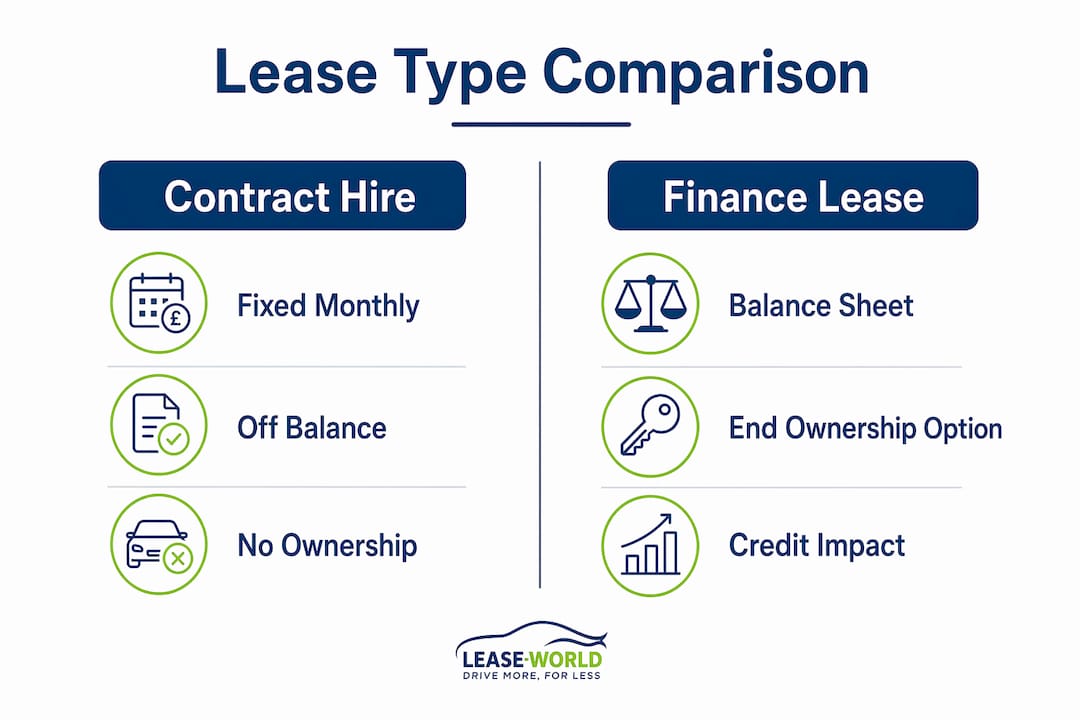
Contract hire
Contract hire is the most common form of van leasing for UK businesses. You pay a fixed monthly fee, use the van, and return it at the end of the term. The leasing company carries all the residual value risk. That means if the van is worth less than expected when you hand it back, that loss falls on them, not you. Residual value risk transfers to the leasing company in contract hire, which stabilises your monthly payments and removes end-of-term value uncertainty entirely.
Contract hire keeps vehicles off the balance sheet and treats monthly payments as fully deductible operating expenses. For most SMEs, this is the cleaner accounting outcome.
Finance lease
Finance lease gives you use of the van without ownership, but the arrangement works differently at the end of the term. The van is sold to a third party, and lessees typically receive 95–99% of the resale proceeds after that sale. You benefit from the residual value without ever holding the title. This suits businesses that want some exposure to the asset's end value, or those whose accountants have a specific reason to treat the van differently.
Finance lease requires the van and lease liability to appear on the balance sheet, which affects credit scoring and loan eligibility. That is a meaningful distinction for any business planning to borrow in the near future.
Lease type comparison
| Feature | Contract hire | Finance lease |
|---|---|---|
| Ownership | Leasing company | Leasing company |
| Balance sheet treatment | Off balance sheet | On balance sheet |
| Residual value risk | Leasing company | Lessee (via sale proceeds) |
| End-of-term options | Return van | Sell van, receive proceeds |
| Maintenance packages | Often included | Lessee typically responsible |
| Best suited to | SMEs, fleets, straightforward budgeting | Businesses wanting residual value benefit |
How does van leasing compare to buying?
Buying a van outright means paying the full purchase price upfront, or taking on a finance agreement that shows as debt on your balance sheet. Leasing avoids both of those outcomes. The table below shows the practical differences across the areas that matter most to UK businesses.
| Factor | Leasing | Buying outright |
|---|---|---|
| Upfront cost | Low or none | Full purchase price |
| Monthly cash flow | Fixed, predictable | No ongoing payment (if bought outright) |
| Ownership | No | Yes |
| Depreciation risk | Leasing company | Owner |
| VAT reclaim | Usually full reclaim on business use | Partial reclaim on purchase price |
| End-of-term flexibility | Return and upgrade | Sell or keep |
| Balance sheet impact | Minimal (contract hire) | Asset recorded |
The core advantage of leasing over buying is cash flow. Van leasing suits businesses wanting access to new vans with minimal upfront cost, which preserves operating capital for stock, staff, or growth. Buying ties up capital in an asset that depreciates the moment it leaves the forecourt.
Leasing also removes the hassle of selling the van when you are done with it. You simply return it, choose your next vehicle, and carry on. For businesses running multiple vans, that administrative simplicity compounds quickly across a fleet. Explore how leasing compares to finance in more detail if you are weighing up both routes.
What are the financial and accounting impacts for UK businesses?
The accounting treatment of a van lease directly affects your balance sheet, your tax position, and your ability to borrow. Getting this wrong costs businesses money and borrowing capacity.
Under contract hire, monthly payments are operating expenses. They reduce taxable profit in the period they are paid, with no asset or liability recorded on the balance sheet. Financial experts emphasise that contract hire suits those wanting to keep vehicles off the balance sheet and preserve borrowing capacity. If your business is planning to apply for a loan or mortgage on commercial property, this matters.
Under finance lease, the van appears as an asset and the lease obligation appears as a liability. Finance lease inclusion on the balance sheet can complicate credit scoring and limit other borrowing opportunities for SMEs. That does not make finance lease a bad choice, but it does mean you need to go in with your eyes open.
VAT treatment is one of the clearest financial wins in van leasing. VAT on leasing payments is usually fully reclaimable for VAT-registered businesses when the van is used exclusively for business purposes. That effectively reduces your real monthly cost by 20%, which is a significant saving over a 36-month or 48-month contract.
Key accounting considerations at a glance:
- Contract hire payments are fully deductible operating expenses
- Finance lease creates an asset and corresponding liability on the balance sheet
- VAT-registered businesses can reclaim VAT on monthly payments for business-use vans
- Finance lease on the balance sheet may reduce available credit for other borrowing
- Choosing between the two depends on tax strategy and balance sheet goals
Pro Tip: Before signing any lease agreement, ask your accountant to confirm which lease type aligns with your current balance sheet position and any planned borrowing in the next two years. The monthly payment difference between contract hire and finance lease is often small; the accounting difference is not.
What are the benefits and drawbacks of van leasing?
Van leasing delivers clear advantages, but it also carries limitations that catch lessees off guard when they have not read the small print carefully.
The benefits
- No large upfront payment. Most leases require only an initial rental or no deposit at all, keeping cash in the business.
- Fixed monthly costs. Budgeting is straightforward because your payment does not change over the term.
- Access to new vehicles. You drive a current model with a full manufacturer warranty, reducing unexpected repair costs.
- VAT recovery. VAT-registered businesses reclaim VAT on monthly payments for business-use vans.
- No depreciation risk. The leasing company absorbs the loss if the van's value drops sharply.
- Maintenance packages. Maintenance is often included in contract hire packages, covering servicing and tyres for a single monthly fee.
The drawbacks
- No ownership. You build no equity and cannot sell the van.
- Mileage limits. Exceeding your agreed annual mileage triggers per-mile charges at the end of the contract.
- Condition requirements. The van must be returned in good condition. Fair wear and tear is accepted, but damage is charged.
- Early termination costs. Ending a lease before the agreed term is expensive. Most contracts charge a significant proportion of the remaining payments.
- Maintenance responsibility in finance lease. Under a finance lease, you cover all servicing and repairs yourself.
Understanding what happens at the end of a lease before you sign is the single best way to avoid a costly surprise. End-of-term charges for excess mileage and damage are the two most common complaints from lessees who did not plan ahead.
Pro Tip: If your business mileage varies significantly month to month, consider a contract hire package that includes a maintenance plan. Bundling servicing into a single monthly payment removes the risk of a large, unexpected repair bill mid-contract.
Key takeaways
Van leasing is the most cost-effective way for UK businesses and private customers to access new vans with predictable costs, no depreciation risk, and full VAT recovery on business use.
| Point | Details |
|---|---|
| Contract hire is off balance sheet | Monthly payments are operating expenses, preserving borrowing capacity for SMEs. |
| Finance lease returns residual value | Lessees receive 95–99% of resale proceeds, offering partial asset benefit without ownership. |
| VAT reclaim reduces real cost | VAT-registered businesses reclaim VAT on payments, cutting the effective monthly cost by 20%. |
| Mileage limits need careful planning | Set mileage slightly above your expected use to avoid costly per-mile charges at contract end. |
| Lease type choice affects credit | Finance lease appears on the balance sheet and can limit other borrowing opportunities. |
My view on choosing the right van lease in the UK
My view on choosing the right van lease in the UK
The most common mistake I see is businesses picking a lease type based on the monthly payment alone. The monthly figure is the least important number in the contract. What matters is how that agreement interacts with your balance sheet, your VAT position, and your plans for the next three years.
Contract hire is the right default for the vast majority of UK SMEs. It is clean, predictable, and keeps your books simple. Finance lease makes sense in specific situations, usually when an accountant has identified a tax or balance sheet reason to treat the van as an asset. Without that specific reason, the added complexity of finance lease rarely pays off.
The other thing I would push back on is the idea that leasing is complicated. It is not. The terminology can feel dense at first, but the core concept is simple: you pay to use a van, you return it, you move on. The leasing guides at Lease World break down every term clearly, which removes the anxiety that stops people from getting a good deal.
My honest advice: align your lease term with your actual usage pattern, get your accountant involved before you sign, and do not underestimate your mileage. Those three steps resolve the majority of problems I have seen businesses encounter with van leasing.
— Jason
Van leasing deals from Lease World
Lease World offers a wide range of van lease deals for both business and personal customers across the UK, with fixed monthly payments, no hidden fees, and complimentary delivery on eligible vehicles.
Whether you need a compact panel van for a sole trader operation or a larger commercial vehicle for a growing fleet, Lease World's team compares contract types and finds the deal that fits your usage and budget. Browse current window van lease options or request a personalised quote to see exactly what your monthly payment looks like before you commit to anything.
FAQ
What is the difference between contract hire and finance lease?
Contract hire is a straightforward rental with no ownership and no balance sheet impact. Finance lease keeps the van off your ownership but records it as an asset and liability, and returns most of the resale proceeds to you at the end.
Can I reclaim VAT on van leasing payments?
VAT-registered businesses can reclaim VAT on monthly leasing payments in full when the van is used exclusively for business purposes, effectively reducing the real monthly cost by 20%.
What happens if I exceed my mileage limit?
Exceeding your agreed annual mileage triggers a per-mile excess charge at the end of the contract. Setting your mileage allowance slightly above your expected use at the start avoids this cost.
Is van leasing better than buying for a small business?
For most small businesses, leasing is the better option. It preserves cash flow, removes depreciation risk, and keeps the vehicle off the balance sheet under contract hire, which protects borrowing capacity.
What are my options at the end of a van lease?
Under contract hire, you return the van and can start a new agreement. Under finance lease, the van is sold and you receive 95–99% of the resale proceeds. Full details on end-of-lease options are available from Lease World.