
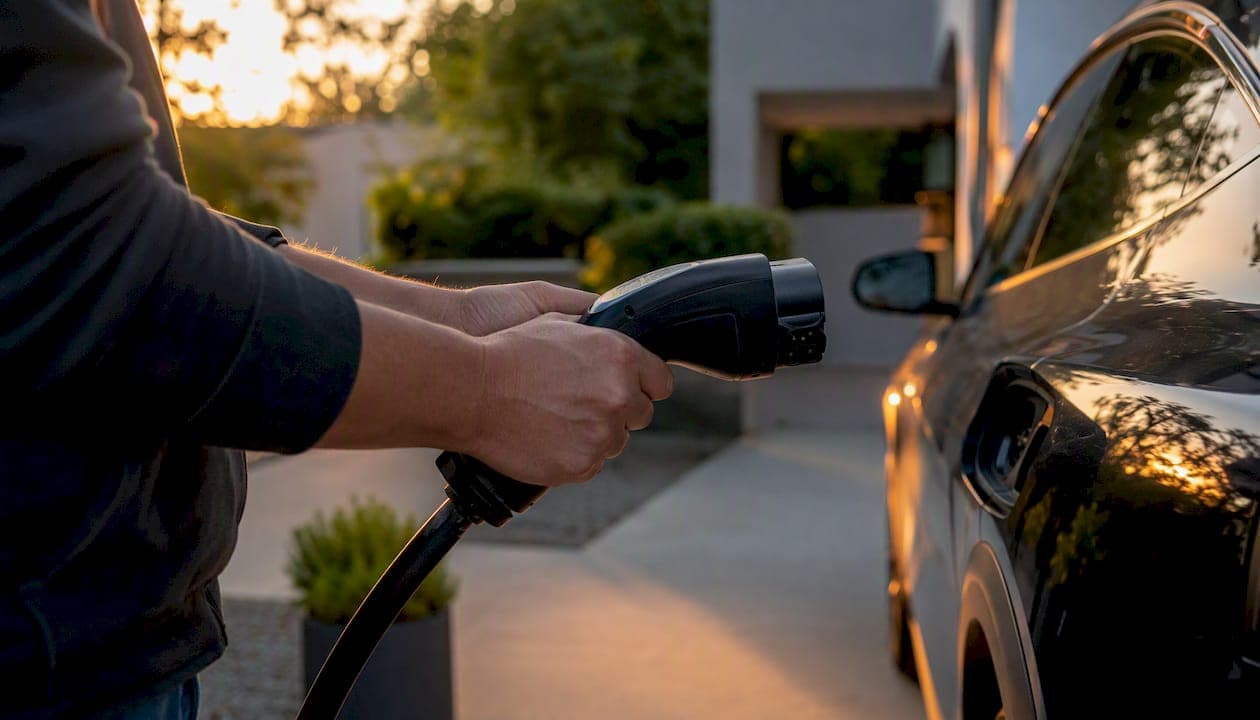
Charging at home costs most drivers between 8p and 25p per kWh, while public charging runs from roughly 54p per kWh on standard units to 79p or 80p per kWh on rapid and ultra-rapid chargers, according to Zapmap's price index. Put another way: a 100 mile top-up at home on a cheap overnight tariff might cost around £2.50, while the same 100 miles from a rapid charger could cost closer to £16.
That gap is the single most important fact in this whole topic. A car that's cheap to run at home can be expensive to run on the road, and the difference isn't marginal.
- Home, standard tariff: roughly 20p to 25p/kWh (based on the Ofgem default cap average of about 24.67p/kWh)
- Home, EV overnight tariff: roughly 7p to 9p/kWh
- Public, standard/fast charger: around 54p/kWh (Zapmap weighted average)
- Public, rapid/ultra-rapid: around 79p to 80p/kWh (Zapmap weighted average)
These are live, moving figures. Public prices change often enough that checking Zapmap or your charging app before a long trip is worth the thirty seconds it takes.
Key Takeaways
Home charging on an off-peak EV tariff costs roughly a sixth of public rapid charging per mile, making tariff choice the biggest lever on total EV running costs.
| Point | Details |
|---|---|
| Home beats public by miles | Off-peak home tariffs (~8.7p/kWh) cost far less than public rapid charging (~79 to 80p/kWh). |
| Check pricing model, not just rate | p/kWh, p/minute and session fees can make the same charger cost very differently depending on your car. |
| Installation costs vary by property | A 7 kW install runs £900 to £1,400 for simple jobs, £1,800 to £2,800+ where consumer unit or groundworks are needed. |
| Rapid charging is for topping up, not daily use | Manufacturers recommend 10% to 80% rapid sessions occasionally, not as a routine, for cost and battery health. |
| Factor charging into lease budgets | Lease World's fixed monthly payments make it easier to add realistic charging spend to your total EV cost. |
This article is general information, not a substitute for advice from a qualified financial advisor. Consult a qualified financial professional about your own circumstances before acting on anything here.
Table of Contents
- How much does it cost to charge an electric car? Understanding the pricing models
- How much does home charging actually cost?
- What does public charging cost by charger type?
- Worked examples: what a real charge actually costs you
- How can you cut your EV charging bill?
- Why does charging speed change what you pay?
- Sources
- FAQ
How much does it cost to charge an electric car? Understanding the pricing models
Every charge point bills you one of three ways, and knowing which one you're looking at stops nasty surprises on your statement.
Pence per kWh (p/kWh) is the simplest and most common model. You pay for the energy delivered, full stop. A 60 kWh battery charged from empty at 54p/kWh costs £32.40.
Pence per minute (p/minute) charges for time connected, regardless of how much energy actually goes in. This model rewards fast chargers and penalises slow ones. Plug a car limited to 40 kW into a per-minute tariff and you'll pay more per kWh than someone using the same charger with a car that can pull 100 kW.
Flat session or connection fees add a fixed charge on top of the energy cost, sometimes bundled with parking. A £1 connection fee barely matters on a 40 kWh top-up. It matters a lot if you're just adding 5 kWh to get home.
- p/kWh: kWh added × rate = cost
- p/minute: minutes connected × rate = cost
- Session fee: flat charge + (kWh × rate), sometimes plus parking
VAT differs too. Domestic electricity, and most home charging, is taxed at 5%. Public charging has historically sat at the standard 20% rate, which is part of why public prices look so much steeper than home ones even before you account for infrastructure costs.
Pro Tip: Always check the connector's maximum kW alongside the pricing model. A slow charger on a per-minute tariff can quietly cost more than a rapid charger on a per-kWh one.
How much does home charging actually cost?
The single biggest lever on your annual EV spend is which electricity tariff you're on, not which car you drive.
On a standard variable tariff, you're paying somewhere close to the Ofgem default cap average of 24.67p/kWh (Q2 2026 figure). Switch to a dedicated EV tariff with a cheap overnight window and that same electricity can cost around 8.7p/kWh, according to Selectra's analysis of EV tariffs. That's roughly a two-thirds reduction for doing nothing except changing supplier or tariff and plugging in after midnight.
What installation actually costs
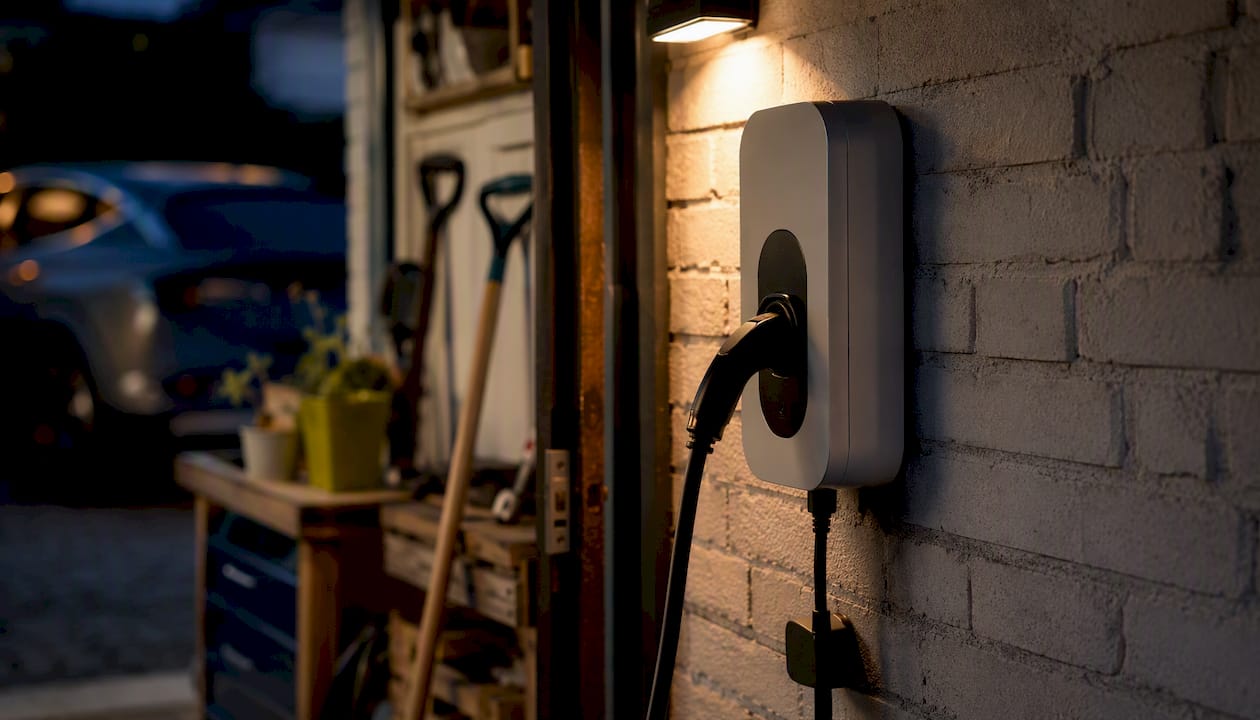
A straightforward 7 kW home charger installation typically runs £900 to £1,400, but that figure assumes a clean job: modern consumer unit, short cable run, easy access to your meter. BookaBuilderUK's 2026 cost data shows that once you add real-world complications, total costs commonly climb to £1,800 to £2,800 or more.
What pushes the price up:
- An ageing consumer unit needing replacement (typically adds £400 to £900)
- A long cable run from the consumer unit to the parking space, especially if it needs trenching through a driveway or garden
- Load-balancing hardware to stop the charger tripping your main supply, usually £100 to £250
- Any groundworks requiring your Distribution Network Operator (DNO) to get involved, which can add weeks and pounds
Installers repeatedly flag the same issue: quotes vary wildly not because of the charger brand but because of what's already in the wall. A pre-installation site survey, rather than a generic online estimate, is the only reliable way to know your real number before committing. If your house is older or you've never had electrical work checked, budget for a consumer unit upgrade as a real possibility, not a worst-case scenario.
Pro Tip: Ask your installer directly about consumer unit condition, certification, and post-install testing before you sign anything. A cheap quote that skips these steps usually isn't cheap for long.
What does public charging cost by charger type?
Public charging splits into four broad speed categories, and the pricing model shifts as the speed goes up.
Slow chargers (3 to 7 kW) are typically found on lamp posts or at destinations where you'll be parked for hours. Fast chargers (7 to 22 kW) suit supermarkets, car parks, and workplaces. Rapid chargers (around 50 kW) are built for motorway services and quick top-ups. Ultra-rapid chargers (150 kW and above) are the newest infrastructure, aimed at adding hundreds of miles in the time it takes to grab a coffee.
| Charger type | Typical power | Common pricing metric | Typical UK price range | Best use case |
|---|---|---|---|---|
| Slow | 3–7 kW | p/kWh | Often free to ~40p/kWh | Destination/on street, long dwell |
| Fast | 7–22 kW | p/kWh | ~40–54p/kWh | Supermarkets, retail, workplace |
| Rapid | ~50 kW | p/kWh or p/min | ~54–79p/kWh | Motorway services, quick top-ups |
| Ultra-rapid | 150 kW+ | p/kWh | ~79–80p/kWh | Long journeys, minimal dwell time |
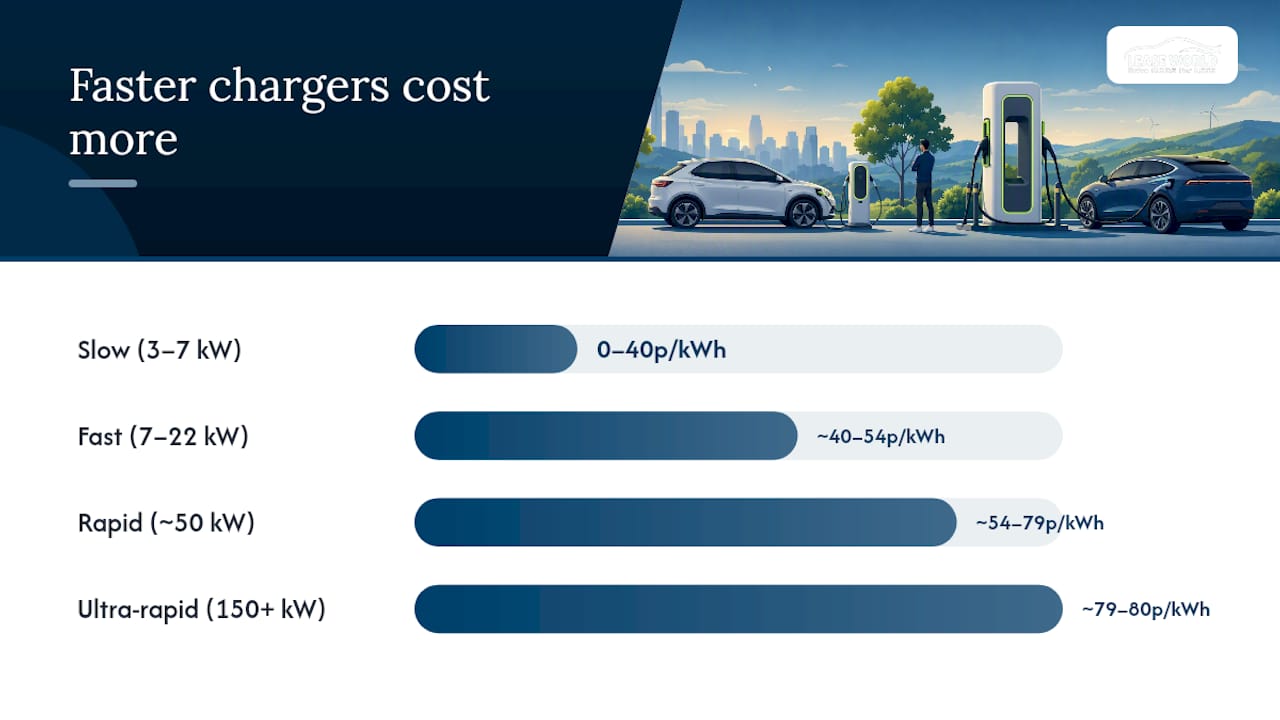
Zapmap's weighted average puts standard and fast charging (up to 49 kW) at around 54p/kWh, and rapid/ultra-rapid (50 kW and above) at 79p to 80p/kWh.
Operator pricing varies more than most drivers expect. Some supermarket car parks, in retail partnerships similar to what Tesco and Lidl offer, provide free or heavily discounted charging while you shop. Independent network comparisons show this spread clearly: destination chargers at retail sites are sometimes free, while motorway rapid hubs are consistently the most expensive option on the network.
Rapid and ultra-rapid charging costs more for reasons that make sense once you see the infrastructure behind them. High-power connections need heavier grid capacity, more expensive hardware, and often dedicated substation work. Add standard-rate VAT, ongoing maintenance, and land or lease costs at prime motorway locations, and the premium isn't just profit margin. It's the price of speed.
Worked examples: what a real charge actually costs you
These three calculations use a 3.5 mile per kWh efficiency benchmark, roughly typical for a mid-size family EV.
- Home, off-peak tariff, 100 miles: 100 miles ÷ 3.5 mi/kWh = 28.6 kWh. At 8.7p/kWh, that's £2.49.
- Public, standard charger, 100 miles: 28.6 kWh at Zapmap's 54p/kWh average comes to £15.44, over six times the home off-peak cost.
- Rapid charger, 10% to 80% top-up: for a 70 kWh battery, that's 49 kWh added, roughly adding around 170 miles of real-world range. At 79p/kWh that's £38.71, though the actual figure depends on charging speed taper as the battery fills.
Real-world charging never hits these numbers exactly. Use these formulas as a solid planning baseline, then adjust once you know your own car's real-world efficiency.
How can you cut your EV charging bill?
Home charging first, road charging second, is the cheapest possible routine, and it's not close.
- Switch to an EV-specific overnight tariff. This is the single biggest lever available, cutting your rate from around 24.67p/kWh to roughly 8.7p/kWh.
- Use smart scheduling on your charger or car app so charging automatically happens in the cheapest overnight window.
- If you have solar panels, pair your charger with generation where the system supports it. Pairing a charger with solar generation can offset daytime charging entirely on sunny days.
- Plan longer journeys to minimise the number of rapid charging sessions rather than topping up little and often.
- Use workplace or destination chargers when they're free or cheap, even if they're slower.
- Compare roaming apps and subscriptions rather than defaulting to whatever app the charger prompts you to download.
A network subscription only pays for itself if you charge on that network regularly enough that the monthly fee is offset by the discounted per-kWh rate. If you charge publicly once a month, stick with pay-as-you-go.
Pro Tip: Compare total session cost, not just the headline p/kWh rate. A cheaper rate with a hefty connection fee can lose to a slightly pricier tariff with none, especially on smaller top-ups.
Keeping your charging cable and connector in good condition also matters more than people assume. A poor connection or worn cable increases resistance and losses, meaning you pay for energy that never actually reaches the battery.
Why does charging speed change what you pay?
A 50 kW rapid charger typically adds around 30 to 40 kWh in 20 to 30 minutes, though the rate slows as the battery approaches full. That taper is the main reason fast charging costs more per kWh than it looks on paper.
Three things push the price up as speed increases:
- Charging taper means the last 20% of a rapid session delivers energy much more slowly, so you pay session or time-based fees for less actual charge
- Higher currents create more heat and more energy loss during transfer
- Rapid and ultra-rapid sites carry higher standing charges and infrastructure overheads, which operators pass on through the per-kWh rate
That guidance exists partly for battery health and partly because the economics simply don't favour rapid charging as a routine.
Where to check live prices and the assumptions behind these figures
The figures above lean on a handful of live tools worth bookmarking: Zapmap's price index for current public averages, operator apps for site-specific rates, the Ofgem default cap for domestic benchmarks, and Gov for grants and infrastructure schemes.
- Efficiency assumption: 3.5 mi/kWh
- Off-peak home tariff: 8.7p/kWh
- Public averages: Zapmap's 54p/kWh (standard) and 79 to 80p/kWh (rapid)
- Rapid top-up benchmark: 10% to 80% state of charge
Public prices shift regularly enough that checking Zapmap or your charging app before setting off is worth the habit.
Practical perspective: plan around home-first charging
If you have any access to off-street parking, prioritise it. An off-peak EV tariff turns charging into one of the cheapest parts of running a car, whereas relying on public rapid charging can erode most of that advantage.
If you're budgeting for a leased EV, don't stop at the monthly payment. Add your realistic charging spend, mostly home-based if you can manage it, to get an honest total cost picture before you sign anything.
Include charging costs when comparing your next EV
There are other ways to get behind the wheel of an EV, from outright purchase to PCP finance, and charging costs matter whichever route you take. Where leasing pulls ahead for a lot of drivers is predictability: one fixed monthly payment, no depreciation risk, and no surprise repair bills eating into the savings you've just worked out on your electricity tariff.
Lease World builds fixed monthly payments with no deposit required on eligible deals and free mainland UK delivery, so the only variable left to budget for is your charging spend, and now you know roughly what that looks like. Browse personal electric car leasing options to see current EV deals, or head straight to get a personalised quote and factor your expected charging costs into the total monthly figure before you commit.
Sources
FAQ
How much is EV charging at Tesco?
Tesco's charging bays, run through Pod Point, often include free or low-cost charging for shoppers on slower units, though rapid chargers on site typically charge standard public rates. Check the app on site, as pricing varies by location and charger speed.
How much does it cost to charge an electric car for 200 miles?
At home on an off-peak tariff (8.7p/kWh) and 3.5 mi/kWh efficiency, charging costs scale with distance. On public rapid charging at Zapmap's average of roughly 79p/kWh, the cost is substantially higher for the same mileage.
How much does it cost to charge an electric car at Sainsbury's?
Sainsbury's car parks host various operators, and pricing follows standard public rates for that charger type rather than a Sainsbury's-specific tariff. Fast chargers typically fall near the 54p/kWh average Zapmap reports for units up to 49 kW.
Where can I charge my EV for free in the UK?
Some retail car parks, workplaces with charging schemes, and select hotels offer free charging as a customer perk, though availability varies constantly by location. Checking Zapmap's filters for free chargers before you travel is the most reliable way to find current options.
Is charging an electric car cheaper than filling up with petrol?
Home charging on an EV tariff is substantially cheaper per mile than petrol, but relying mainly on public rapid charging can bring costs close to, or above, petrol equivalents. The savings depend heavily on how much of your charging happens at home versus on the road.