

Compare lease quotes by normalising every offer to the same figure: add the initial rental divided by the number of months to the monthly payment, then rank the results using the Lease Value Ratio. Never trust the headline monthly price on its own, since a low figure often hides a bigger upfront rental or a shorter term. Once you have full quotes, from a broker such as Lease World or elsewhere, this two-step method takes minutes and stops you overpaying.
TL;DR:
- Comparing lease quotes requires normalizing upfront rental costs across the contract duration to find the true monthly expense.
- It's essential to gather all details, including initial rental, fees, maintenance, and stock status, to avoid inaccurate comparisons.
- The Lease Value Ratio helps evaluate value by comparing the true monthly cost to the car's retail price, with below 0.8% indicating excellent value.
- Watch for red flags such as unclear excess-mileage charges, undefined wear-and-tear standards, or missing stock details before signing a lease.
- Requesting multiple fixed-amount quotes and calculating the true total cost allows for fairer, more informed negotiations.
Table of Contents
- What details to collect from every lease quote
- How to normalise quotes and find the true monthly cost
- What is the Lease Value Ratio and how does it rank deals?
- Contract checks and red flags to watch for
- A step-by-step workflow for comparing multiple quotes
- Lease World: proof points and how we support fair comparisons
- Understanding different types of lease agreements
- Do credit scores affect lease quotes and negotiation leverage?
- Tax implications and incentives for commercial vehicle leases
- What are your options at the end of a lease?
- How to negotiate lease terms effectively
- What conventional lease advice gets wrong
- Get comparable quotes from Lease World
- Sources
- FAQ
What details to collect from every lease quote
A lease quote is only comparable once you have every figure that feeds into the monthly price. Missing even one field, and you're comparing guesswork rather than actual cost.
Before you calculate anything, pull these details from each quote:
- Initial rental (sometimes called the deposit or advance payment) as a cash figure, not a "months' worth" description
- Monthly payment including VAT for personal contracts
- Contract length in months
- Annual mileage allowance
- Excess-mileage rate in pence per mile
- Maintenance inclusion (yes or no, and what it covers)
- Admin, delivery, or collection fees
- Vehicle spec and stock status (in production, on order, or in stock and ready for delivery)
Each field carries its own risk if left out. A quote without a confirmed stock or delivery slot is provisional. Pricing on a car still to be built can shift before it reaches your driveway, so treat any figure attached to a vague delivery window with caution. Copy each quote into one row of a spreadsheet, using the same column order every time. That single habit prevents the most common comparison error: reading two quotes side by side and unconsciously comparing different things.
How to normalise quotes and find the true monthly cost
Two quotes with identical monthly payments can cost wildly different amounts once you factor in what's paid upfront. The fix is a formula that spreads the initial rental evenly across the contract term, giving you one true monthly figure to compare instead of two separate numbers that don't mean much on their own.
The formula:
(Initial rental ÷ contract months) + monthly payment = true monthly cost
Multiply that true monthly figure by the contract length to get the total contract cost, then add any admin or delivery fees. That total is the number that actually matters, because it captures everything you'll pay from signature to handback.
Here's a worked example with two 36 month quotes for the same model:
- Quote A: £3,000 initial rental, £299 monthly payment. £3,000 ÷ 36 = £83.33. True monthly cost = £382.33. Total contract cost = £13,764, plus a £150 admin fee = £13,914.
- Quote B: £1,500 initial rental, £329 monthly payment. £1,500 ÷ 36 = £41.67. True monthly cost = £370.67. Total contract cost = £13,344, plus no admin fee = £13,344.
Quote B looks worse on the forecourt, since £329 a month sounds higher than £299. Run the maths, and it's actually £570 cheaper over the full term.
Quote A undercuts on the headline monthly price by £30, yet costs £570 more overall once the upfront rental and fees are spread across the contract.
Maintenance status changes this picture further. If Quote A includes servicing and Quote B doesn't, you need to price in roughly three years of tyres, brakes, and services on top of Quote B's total before the comparison is fair. No-deposit deals follow the same logic in reverse: a zero upfront payment usually means a higher monthly rental or a longer term, so always check the total before assuming £0 down is the cheaper route.
What is the Lease Value Ratio and how does it rank deals?
The Lease Value Ratio (LVR) tells you how much a lease costs relative to the car's actual value, which matters because a £400 monthly cost is excellent on a £45,000 executive saloon and poor on a £16,000 city car.
The formula:
True monthly cost ÷ car retail price × 100 = LVR (%)
As a rough guide:
- Below 0.8% typically signals excellent value for money
- 0.8% to 1.5% sits in reasonable, market-standard territory
- Above 1.5% suggests you're overpaying relative to the car's worth
The Lease Value Ratio becomes especially useful when you're comparing cars in different price brackets, where monthly cost alone tells you nothing about relative value.
The hatchback is the worse deal even though it's cheaper in cash terms. That's the entire point of using LVR: it strips out the effect of car price and shows which lease genuinely represents value.
Contract checks and red flags to watch for
A clean-looking quote can still contain traps that only surface at handback or halfway through the term. Run through these checks before you sign anything.
Watch for these warning signs:
- No initial rental figure stated, or it's bundled vaguely into "low monthly payments"
- Excess-mileage calculation method left unclear or absent entirely
- Wear-and-tear standard not defined, or referencing a document you haven't seen
- Admin, collection, or early-termination fees higher than industry norm
- No confirmed delivery slot or stock status on the vehicle you're quoted
Excess mileage is the trap that catches people out most often, because it's invisible until the lease ends. Rates typically run between 3p and 15p per mile, and going 2,000 miles over your annual allowance across a three year lease can add several hundred pounds to your final bill. If you suspect you'll exceed your mileage, it's often cheaper to pay slightly more each month for a higher allowance upfront than to settle the excess at handback.
Ask the broker these questions directly: What's included in the initial rental? How is excess mileage calculated and charged? Is the wear-and-tear standard the BVRLA fair wear and tear guide? Is this vehicle in stock, or on order?
The Financial Conduct Authority requires that lease adverts show the initial rental, term, and mileage alongside the monthly price. Treat any advert missing these as a transparency warning sign, not just an oversight.
Pro Tip: Keep your car in good condition through the contract, since wear-and-tear charges at handback are assessed against BVRLA standards. A decent pre-wash treatment before your return inspection can help avoid disputed marks that weren't there when you collected the car.
A step-by-step workflow for comparing multiple quotes
Comparing three to six quotes properly takes structure, not just patience. Follow this sequence every time and you'll cut hours off the process while catching more of the errors above.
- Fix your mileage and term first. Decide your realistic annual mileage, add a buffer of a few thousand miles if your driving varies, and pick a preferred contract length before requesting any quotes.
- Gather full quotes into one spreadsheet, giving each quote its own row using the fields listed earlier: initial rental, monthly payment, term, mileage, fees, and maintenance status.
- Calculate true monthly cost and total contract cost for every row using the formula above.
- Compute LVR for each quote and rank them. Shortlist the top one or two rather than trying to hold six numbers in your head.
- Request the full written quote on your shortlisted deals and confirm stock and delivery timing before you sign anything.
This mirrors the standard comparison workflow used across the leasing industry: define parameters, gather data, calculate, rank, then confirm. Skipping straight to "which is cheapest per month" is where most comparisons go wrong.
Lease World: proof points and how we support fair comparisons
Lease World is a family-run brokerage built around one idea: readers should be able to compare offers on equal terms, not guess which broker is hiding a fee. That means quoting a fixed monthly payment, offering no-deposit options where suitable, and providing free mainland UK delivery on eligible vehicles rather than folding a delivery charge into the small print.
Every quote from Lease World includes the fields covered earlier: initial rental, monthly payment, term, mileage allowance, and maintenance status, so you can run the true monthly cost formula immediately without chasing missing numbers. The full breakdown of how lease pricing and LVR work is published on the Lease World blog for anyone who wants to see the maths behind a specific quote before committing.
Positive Google reviews and repeat customer feedback reflect a broker that treats comparison as something to make easier, not harder. If you're ready to see how a real quote stacks up, the process starts with providing your mileage, term preference, and vehicle interest, and Lease World returns figures built to be compared like for like.
Understanding different types of lease agreements
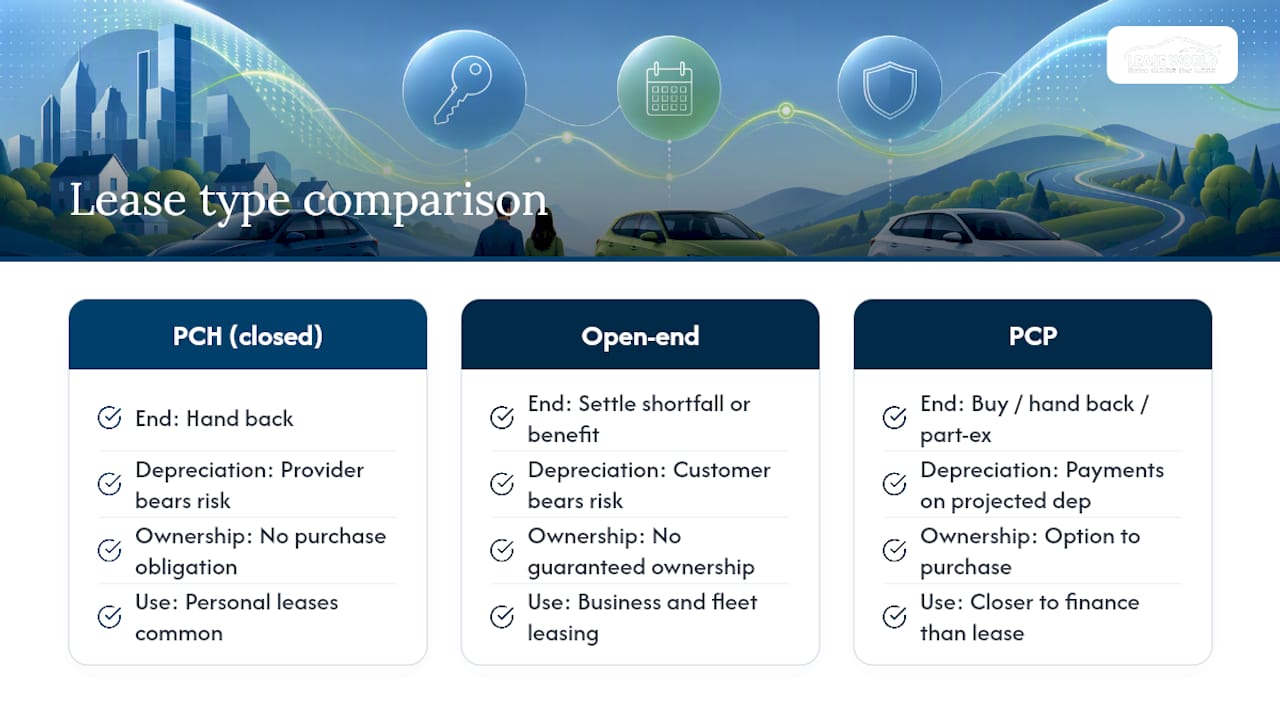
Most personal car leases in the UK are closed-end agreements, meaning you hand the car back at the end of the term with no obligation to buy it, provided you've stayed within the agreed mileage and condition standard. Personal Contract Hire works this way: you pay to use the car, not to own it, and the finance provider absorbs the risk on its resale value.
Open-end leases work differently and are far more common in business and fleet leasing. Here, the customer takes on the depreciation risk. If the car is worth less than projected at the end of the term, you cover the shortfall; if it's worth more, you can sometimes benefit. This structure suits businesses that want flexibility on mileage and usage but comes with genuine financial exposure that most private drivers would rather avoid.
There's also Personal Contract Purchase, which sits closer to finance than leasing. You have the option to buy the car at a pre-agreed price at the end of the term, alongside the option to hand it back or part-exchange. PCP differs from PCH in that monthly payments are calculated against the car's projected depreciation rather than pure usage cost, which is exactly why comparing a PCP monthly figure against a PCH monthly figure without adjustment is meaningless. Always confirm which structure you're being quoted before you run any comparison, because the same monthly number can represent a completely different financial commitment depending on the agreement type.
Do credit scores affect lease quotes and negotiation leverage?
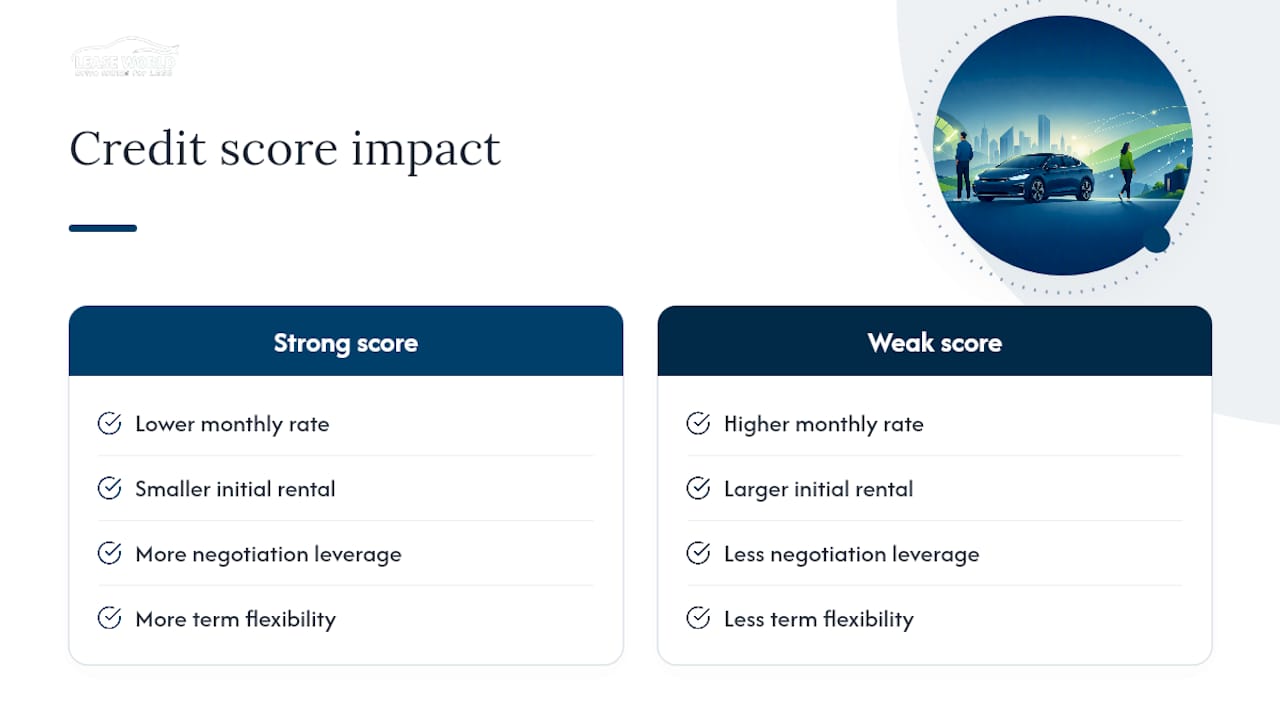
Your credit score directly shapes both the monthly rate you're offered and how much room you have to negotiate. Lease pricing is underwritten by finance providers who assess default risk before setting terms, and a stronger score typically unlocks lower rates, smaller initial rentals, and more flexibility on term length.
A weaker credit history doesn't automatically rule out leasing, but it usually means a higher monthly payment for the same car, a larger initial rental requested upfront, or both. Some providers will still lease to applicants with imperfect credit, just at a materially different price point. This is worth knowing before you request quotes, since two brokers running the same application through different funders can return noticeably different figures purely based on how each funder weighs your file.
Negotiation leverage tends to follow the same pattern. Applicants with strong, clean credit histories are in a better position to push back on initial rental size or ask for a fee to be waived, because the funder has less risk to price in. If your score sits in a stronger band, it's worth explicitly asking whether the initial rental can be reduced or the admin fee dropped, since brokers have more discretion to move on these than on the base monthly rate itself. Checking your credit file before applying, and correcting any errors, is a cheap step that can materially change the numbers you're quoted.
Tax implications and incentives for commercial vehicle leases
Business leasing carries a different tax treatment to personal leasing, and it's often the deciding factor in whether a company chooses to lease rather than buy outright.
Monthly lease payments on vehicles used for business can also usually be offset against taxable profits as an allowable expense, which is a meaningful advantage over outright purchase for many limited companies and sole traders. The exact treatment depends on the vehicle's CO2 emissions and its classification as a car versus a commercial vehicle, so the numbers differ meaningfully between, say, a low-emission electric car and a diesel panel van.
Electric and low-emission vehicles attract further incentives through lower Benefit-in-Kind rates for company car drivers, which has pushed a large share of business leasing demand toward EVs in recent years. If you're comparing quotes for a business vehicle, factor in the VAT recovery position and expected Benefit-in-Kind cost alongside the true monthly cost calculated earlier, because the after-tax cost can shift the ranking of your shortlisted deals. It's worth getting a specific figure from an accountant rather than relying on general guidance, since thresholds and rates depend on your company structure and the vehicle's emissions banding.
What are your options at the end of a lease?
Most personal leases end with a straightforward return: hand the car back, pass the condition and mileage check, and walk away with no further obligation. This is the default and, for the majority of Personal Contract Hire customers, the intended outcome from day one.
A renewal or new lease on a different vehicle is the most common next step for drivers who've enjoyed the process, and it gives you the chance to reapply everything covered above: request fresh quotes, recalculate true monthly cost, and rank by LVR again rather than assuming your existing provider will automatically offer the best deal a second time.
Buyout applies mainly to Personal Contract Purchase agreements, where a final "balloon" payment lets you keep the car outright. Whether that's worthwhile depends entirely on whether the pre-agreed buyout figure sits below the car's actual market value at that point, something worth checking against current used values before committing.
Whichever route you're heading toward, the condition standard applied at return is where disputes happen most. Confirm in advance which fair wear-and-tear guide your contract references, and keep photographic evidence of the car's condition at both collection and return.
How to negotiate lease terms effectively
Negotiation on a lease quote rarely happens on the headline monthly figure, because that number is usually calculated tightly against the funder's rate. The real room to move sits in the initial rental, admin fees, and sometimes the mileage allowance included at no extra cost.
Getting multiple quotes before you negotiate anything is the single biggest lever available. Once you've calculated the true monthly cost and LVR across three or four offers, you have concrete numbers to put to a broker: "this deal comes out £15 a month cheaper once I account for the initial rental, can you match that?" is a far stronger position than negotiating on gut feeling.
Timing matters too. Brokers and funders sometimes have stock they need to move before month or quarter end, and asking about current stock offers rather than build-to-order pricing can surface deals with better terms attached. Asking directly whether the admin fee can be waived, or whether the initial rental can be reduced in exchange for a slightly longer term, costs nothing and often works, particularly with independent brokers who have more flexibility than dealership finance desks tied to a single funder.
Don't negotiate away transparency to get a lower number. A broker who drops the price but becomes vague about mileage terms or fees has moved the cost somewhere you can't see it, not removed it.
What conventional lease advice gets wrong
Both habits fall apart under scrutiny. Quick percentage rules were built for a market with more stable pricing and fewer manufacturer incentives; EV grants, changing residual values, and aggressive end-of-quarter stock deals have made those thumb rules unreliable as a final answer, even if they're still fine as a rough first filter.
The bigger failure is treating the monthly payment as the whole story. It never is. A quote is three or four numbers dressed up as one, and the initial rental is doing more work than most buyers realise. I'd argue the LVR calculation matters more than most articles admit, because it's the only metric that adjusts for car price and stops you comparing a bargain city car against an overpriced premium saloon as if they're on the same scale.
What should you prioritise first? Fix your mileage honestly before you request a single quote. Every other number, the monthly payment, the true monthly cost, the LVR, means nothing if the mileage band underneath it doesn't match how you actually drive.
— Jason
Get comparable quotes from Lease World
Lease World is built for exactly the comparison method covered above: request a quote and you get a fixed monthly payment, a clear initial rental figure, and no hidden delivery or admin surprises buried in the small print. That's the whole point of normalising quotes in the first place. It only works if the broker gives you every number upfront.
To get a quote that's ready to run through the true monthly cost formula, tell Lease World your preferred mileage, contract length, and the vehicle or category you're interested in, whether that's a family car, an electric vehicle, or a window van for business use. Lease World returns full figures matching every field covered in this article: initial rental, monthly payment, term, mileage allowance, and maintenance status, so you can drop the numbers straight into your spreadsheet and calculate LVR against any other quote you're holding. No deposit options are available on eligible vehicles, and free mainland UK delivery applies where the vehicle qualifies.
Start your comparison by requesting a quote directly, and you'll have the full data set needed to rank it against anything else on your shortlist within the day.
Sources
- Best websites for leasing a new car in the UK in 2026
- Which?
- How to compare car leasing deals in the UK market
FAQ
What is the best website to compare car lease deals?
There's no single definitive site, but a reliable broker that supplies full quote details, initial rental, monthly payment, term, mileage, and fees, lets you run the true monthly cost and LVR calculations yourself. Lease World structures its quotes to include every one of these fields for exactly that reason.
What is the 1.5% rule when leasing a car?
It's a useful quick filter, but Which? and other industry voices warn that it's increasingly unreliable given manufacturer incentives and EV pricing, so treat it as a first screen rather than a final answer.
Who is offering the best lease deals right now?
The "best" deal depends entirely on your mileage, budget, and vehicle preference rather than any single provider being cheapest across the board. Running true monthly cost and LVR across several quotes, including one from Lease World, is the only reliable way to identify the strongest offer for your specific situation.
How do I calculate the true monthly cost of a lease?
Divide the initial rental by the number of months in the contract, then add that figure to the monthly payment. This spreads the upfront cost evenly across the term, giving you one comparable figure instead of two separate numbers that can mislead on their own.