
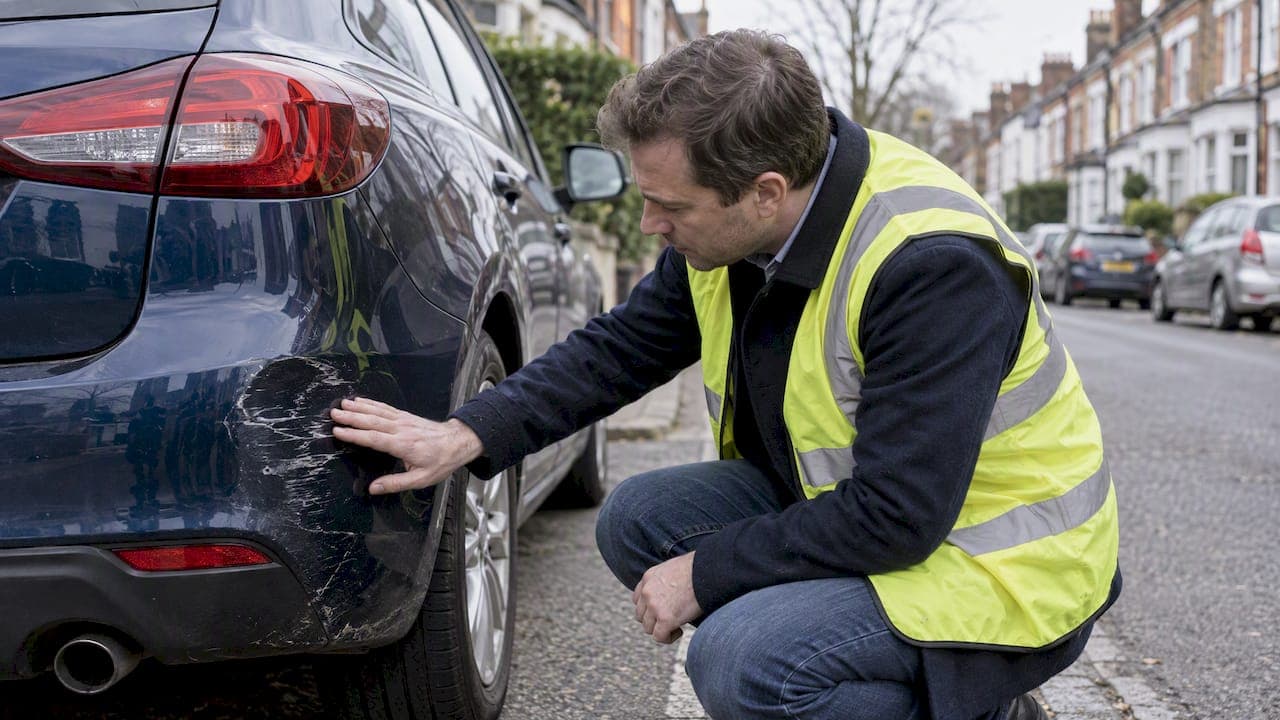
If you have had an accident in a lease car, the steps are the same as for any car at the scene, with one extra phone call: you must tell your leasing company as well as your insurer. The funder owns the car, so repairs usually go through its approved process, and you stay responsible for the contract, even if the car is badly damaged or written off.
This guide walks through the first hour, the first week and the long tail: repairs, courtesy cars, write-offs, the shortfall risk and what it means when you hand the car back.
TL;DR
- Stop, exchange details, and report to the police within 24 hours if you could not exchange details or someone was injured.
- Tell your insurer straight away, then your leasing company. Do not authorise repairs until the funder has agreed who will do them.
- Standard insurance pays the car's market value, not your outstanding lease balance. If the car is written off, there can be a gap, which is what Lease GAP cover is for.
- Repairs done properly now save you from damage charges when the car goes back.
- Keep every document: photos, claim reference, repair invoice and written approval from the funder.
Table of Contents
- At the scene: the legal basics
- Who to tell, and in what order
- Who is responsible for the car?
- Who pays for repairs?
- Courtesy cars and getting around
- Small marks, glass and cosmetic damage
- When the car is a write-off
- Accident near the end of your lease
- Our view: what we tell customers after a crash
- Planning your next lease with accidents in mind
- Your checklist after an accident in a lease car
- FAQ
- Sources
At the scene: the legal basics
Your first duties are the same whether the car is leased, financed or owned. GOV.UK says that if an accident causes damage or injury, you must give your name and address and the vehicle registration number to anyone with reasonable grounds to ask for them. You must report the accident to the police within 24 hours if you did not exchange details at the scene, or if another person was injured. The same page says you should tell your insurer, whether or not you plan to claim.
In practice, that means:
- Make everyone safe. Switch on hazard lights, move people away from traffic, and call 999 if anyone is hurt or the road is blocked.
- Exchange details. Names, addresses, registration numbers and insurers. Note the make and colour of any other vehicle.
- Take photos. The damage, the positions of the cars, road markings, skid marks, weather and any signs. Photograph the other driver's number plate.
- Get witness details where you can, even just a name and phone number.
- Do not admit fault. State the facts and leave liability to the insurers.
The car being leased changes none of this. It changes what happens next.
Who to tell, and in what order
On a lease, three parties have an interest in the car: you, your insurer and the funder that owns it. Many people only call the insurer and forget the rest.
Your insurer first. Your policy will say how quickly you must report an incident. Reporting late can put a claim at risk, so do it the same day if you can. If you are not sure how cover on a leased car works, our guide to why insurance differs for leased cars explains the basics, and the day one insurance rule explains why you need cover before you drive away.
Then the leasing company. Your contract will state that you must report accidents and damage. The funder may have its own claims or accident management process, and it may want the repair done by an approved repairer. Check your agreement for the exact wording.
Your broker. If you leased through us, call us too. We can point you to the right contact at the funder and explain what your agreement says. We cannot replace the insurer's claim handling, but we know where lease customers usually get stuck.
Your employer, if it is a company car. Under a business lease, your fleet manager or employer may need to be told first. Our page on leasing a car for business use covers how the responsibilities split.

Who is responsible for the car?
The funder owns the car, but you are the registered keeper and the hirer. In most situations the leasing company is not liable for an accident. You carry the contract obligations: to insure the car, keep it in good order, and pay every month whether or not it is driveable.
If someone else was driving, check that they were a named driver with the funder's consent. Our guide to adding a named driver to a lease car explains why written consent matters. An unapproved driver can cause problems with both the insurer and the funder.
Who pays for repairs?
It depends on fault, your policy and your contract.
| Situation | Who normally pays | What to watch |
|---|---|---|
| Accident was your fault, comprehensive cover | Your insurer, less your excess | Excess comes out of your pocket. A claim may raise your premium at renewal |
| Accident was not your fault | The at-fault driver's insurer, via your insurer or a credit hire route | Recovery can take time. Keep paying your lease |
| Damage with no third party (a pole, a wall) | Your insurer, less excess | Report it, even if you think it is minor |
| Third party only cover | You pay for your own car's damage | Lease agreements normally require fully comprehensive cover, so check yours |
| Small scuffs you choose not to claim for | You, at your own cost or at return | The funder may still charge at the end |
Our page on who pays for repairs on a leased car goes deeper into maintenance versus damage.
A comprehensive policy typically covers damage to your own vehicle, including collisions, fire and theft. That is the usual route for a leased car.
Do not authorise repairs on your own
This is the mistake we see most often. A local garage offers a quick fix, you say yes, and later the funder says the work was not approved. Leasing companies often specify approved repairers or procedures, and unauthorised work can breach your contract terms, leading to extra charges or arguments when you return the car.
Before any work starts:
- Ask your insurer and the funder who will carry out the repair.
- Get approval in writing, an email is fine.
- Ask whether genuine or equivalent parts will be used, as your agreement may set a standard.
- Keep the invoice and the repair report for the end of the lease.
If the accident was not your fault
You may be offered a credit hire company to arrange replacement transport and repairs. Citizens Advice explains that these firms take over the claim to recover costs from the other driver's insurer, and that you can remain legally liable for the hire contract if recovery fails. On a lease, add a second question: will the funder accept the credit hire firm's chosen repairer? Ask before you sign anything.
Courtesy cars and getting around
Many drivers assume a courtesy car is automatic. The Financial Ombudsman Service has seen disputes where that assumption was wrong: in one decision about a hire car, the issue was what the policy actually promised. Typically a courtesy car lasts while the car is being repaired and does not apply when the car is a total loss. If an insurer refers you to a separate hire firm, the hire contract may be legally separate from your policy, so read its terms.
Your lease payments carry on while the car is in the garage. A courtesy car does not change that.
Small marks, glass and cosmetic damage
Not every incident is a crash. Light scuffs, hazing on glass or a stone chip can follow a minor run-in. Light surface marks on glass may be tackled at home, and a guide on how to polish car glass safely is a useful place to start. Cracks, deep chips and anything in the driver's line of sight are different: report them and have them repaired as your policy and funder require, rather than experimenting.
At the end of the lease, the car is assessed against the fair wear and tear standard in your contract. Our guide to returning a leased car correctly explains how the inspection works and how to avoid surprise charges. Documented, approved repairs make that conversation far easier than a patched-up panel with no paperwork.
When the car is a write-off
If repairs would cost too much compared with the car's value, your insurer may declare it a total loss. GOV.UK explains that when a vehicle is written off, your insurer tells you that and how much it will pay. The wreck is categorised under the Salvage Code of Practice: A and B cars are crushed or broken, while S (structural) and N (non-structural) cars can return to the road once repaired.
There is an economic pressure behind this. The Department for Transport's Motor Insurance Taskforce reports that insurers paid around £3 billion in claims in Q3 2025, £1.9 billion of it for vehicle repairs. Insurers weigh repair costs closely, so do not be surprised if a car you thought was fixable is written off.
The shortfall problem
Here is where leasing differs from owning. Standard motor insurance pays the market value of the car at the time of loss. It does not pay your remaining lease balance. When a leased car is written off, the funder will usually ask for an early termination charge to settle the contract, and that figure can exceed the insurance payout. The Financial Ombudsman Service's decision shows how this mismatch can be described, and the gap is yours to cover unless you have protection.
That protection is GAP insurance. The ABI describes GAP insurance as cover for the difference between a vehicle's value and what you owe, because a vehicle's value starts to fall the moment you buy it. We explain the numbers in avoiding a £4,000 shortfall with GAP insurance. Check whether your lease already includes it. Many do not.
If you have GAP cover, contact the GAP provider before you accept your motor insurer's offer. The ABI guide notes that the two insurers can disagree on market value, and GAP insurers often reserve the right to challenge a low settlement. Accepting too fast can cause trouble later.
Our page on what happens if a leased car is written off sets out the steps in order. Theft works similarly, and we cover it in what happens if a leased car is stolen.

Accident near the end of your lease
A crash in the final weeks is stressful because the return inspection is close. The principles hold:
- Report it and repair it through the approved route, rather than hoping nobody notices.
- Ask the funder whether the repair can be finished before collection or whether the car should go back as is with the claim in progress.
- Keep proof that the repair was carried out by an approved repairer, with the invoice.
- Do not assume that returning the car early ends your payments. Ending a lease early usually triggers a termination charge, so ask for a quote in writing.
If the damage is serious and the insurer pays out as a total loss close to the end of the term, the shortfall is usually small, because the balance is low. Even so, check the figures.
Our view: what we tell customers after a crash
We are a family-run broker with more than 30 years of experience, FCA authorised and a BVRLA member. Customers ring us after accidents more often than you might expect, and the pattern is consistent.
The pain rarely comes from the crash itself. It comes from three avoidable things: a garage instructed before the funder agreed, a write-off with no GAP cover, and a lease-end inspection with no repair paperwork. All three are fixed by a phone call and a saved email.
When we compare contracts for a customer, we look at more than the monthly figure. We check what insurance and GAP arrangements the customer will need, whether maintenance is included, and what the funder's damage and return rules say. A cheaper-looking deal with unclear terms can cost more after one bad day on the road.
My advice if you have just had an accident: breathe, photograph everything, call your insurer, and then call us or your funder before you say yes to anyone's repair offer.
— Jason
Planning your next lease with accidents in mind
If this has made you think harder about protection, build it into your next deal. We arrange personal, business, van, electric and short-term leases, with fixed monthly payments and no deposit options on eligible deals. Free mainland UK delivery applies on eligible new vehicles. We compare contracts from different funders, so you can see how damage terms, insurance requirements and maintenance options differ before you sign.
Start with personal car leasing, look at business car leasing or van leasing, or send us your requirements through our quote page. NHS staff and driving instructors can also find tailored options through our homepage.
Your checklist after an accident in a lease car
- Make the scene safe and call 999 if anyone is hurt.
- Exchange details and take photos.
- Report to the police within 24 hours if required.
- Tell your insurer the same day.
- Tell your leasing company or broker.
- Wait for written approval before any repair starts.
- If the car is a write-off, call your GAP provider before accepting an offer.
- Keep paying your lease unless the funder confirms otherwise in writing.
- File every email, invoice and report for the return inspection.
Some context on why this matters: the Department for Transport recorded 127,883 road casualties of all severities in Great Britain in 2025, including 1,538 fatalities. Most collisions are far less serious, but any of them can leave you with a damaged car you do not own.
FAQ
Do I still pay my lease if the car is being repaired?
Yes. Your monthly payments continue while the car is in the garage, because the contract is separate from the car's condition. Ask your insurer about a courtesy car, and remember it usually applies only during repairs.
Can I use my own garage to fix a leased car?
Only with the funder's agreement. Many leasing companies specify approved repairers, and unapproved work can breach your contract and lead to extra charges. Get approval in writing before any work begins.
What happens if my leased car is written off?
Your insurer pays the market value, which may be less than you still owe. The funder will usually ask for an early termination charge, so any difference falls to you unless you have GAP insurance. Contact your GAP provider before accepting the insurer's offer.
Will an accident affect my lease at the end of the term?
It can. The car is inspected against the fair wear and tear standard in your contract, and poorly repaired or undocumented damage can be charged for. Approved repairs with invoices are your best protection.
Do I have to tell my leasing company about a minor accident?
Your agreement will almost certainly require it. Telling the funder early avoids disputes, and your insurer needs to know about any incident whether or not you claim.
Sources
- Vehicle insurance: If you're in an accident, GOV.UK
- Insurance write-offs, GOV.UK
- Reported road casualties Great Britain, final results: 2025, GOV.UK
- Motor insurance, ABI
- Making Sense of GAP Insurance, ABI
- Decision DRN-3238207, Financial Ombudsman Service
- If the accident wasn't your fault, Citizens Advice
- Motor Insurance Taskforce final report, Department for Transport