

What is vehicle finance?
Vehicle finance is an umbrella term for financial products that let you spread the cost of a car over time, rather than paying the full price upfront. Instead of paying the full price of the car upfront, you pay an initial deposit followed by fixed monthly instalments, usually with interest added. The lender typically retains ownership of the vehicle until the final payment is made or, in some cases, until you exercise an option to buy.
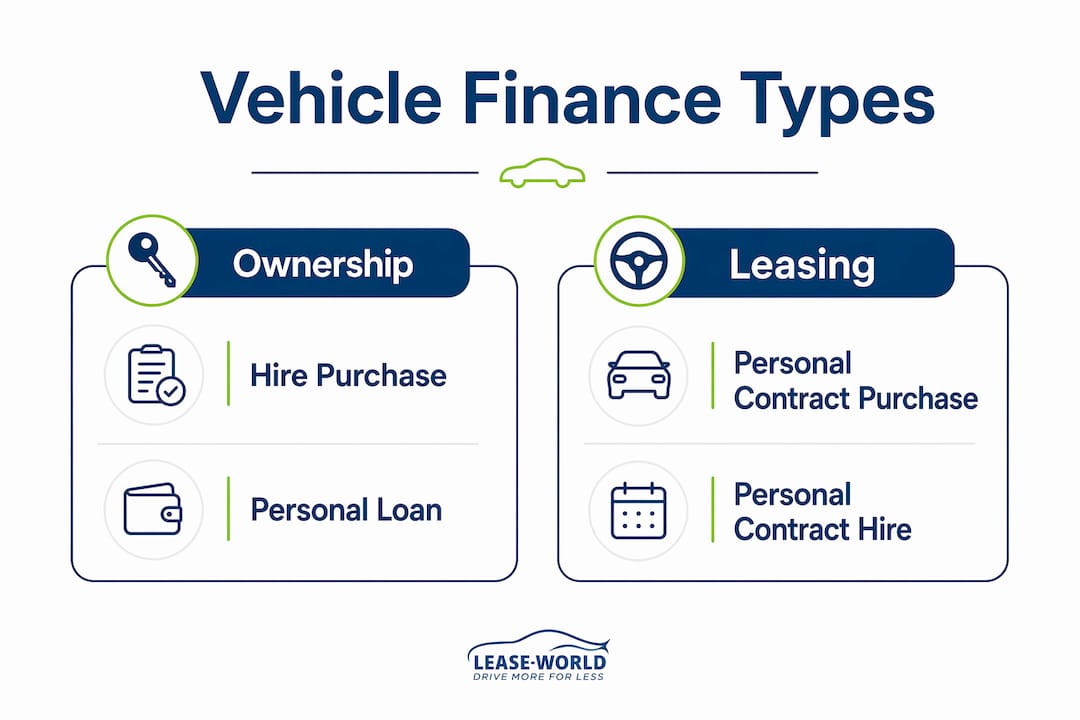
Typical deposits for car finance run to around 10% of the vehicle's value, while leasing arrangements usually ask for the equivalent of 3–6 months' payments upfront. The four main products you'll encounter are:
- Hire Purchase (HP): you pay fixed monthly instalments and own the car outright at the end.
- Personal Contract Purchase (PCP): lower monthly payments, with an optional lump sum at the end if you want to keep the car.
- Personal Loan: an unsecured loan from a bank or building society; you own the car from day one.
- Personal Contract Hire (PCH): a long-term rental with no option to own; you hand the car back when the contract ends.
Each product suits a different set of priorities, and the right choice depends on whether you want to own the car, keep monthly costs low, or simply use a vehicle for a fixed period.

How does a vehicle finance agreement actually work?
Understanding the mechanics before you sign anything saves a lot of headaches later. Here is the process, step by step.
-
Choose your vehicle and finance product. Decide whether HP, PCP, PCH, or a personal loan fits your budget and ownership goals. Dealers often offer finance in-house, but you can also arrange it independently through a bank or broker.
-
Submit an application. You provide proof of identity, address, income, and employment. The lender runs a hard credit check at this stage, which leaves a footprint on your credit file.
-
Credit assessment and approval. The lender reviews your creditworthiness and sets your interest rate accordingly. A stronger credit profile typically unlocks a lower rate; a thinner or patchy history may mean a higher one or a declined application.
-
Sign the finance contract. Most UK motor finance operates through a tripartite structure linking you, the dealer, and the finance provider. This arrangement creates specific consumer protections that a straightforward personal loan does not carry.
-
Pay your deposit and take delivery. Once the contract is signed and the deposit cleared, the dealer releases the vehicle.
-
Make monthly repayments. Each payment covers a portion of the principal (the amount borrowed) plus interest. On a PCP deal, your payments cover the car's depreciation over the contract period rather than its full value.
-
Reach the end of the agreement. Your options depend on the product. HP ends with ownership transferring to you automatically. PCP gives you three choices: pay the optional final balloon payment and keep the car, hand it back, or use any equity as a deposit on a new deal. PCH simply ends with the car returned.
Contract terms typically include annual mileage limits and a requirement to keep the vehicle in reasonable condition. Exceeding either can trigger penalty charges, so read those clauses carefully before signing.

The main types of vehicle finance available in the UK
Hire Purchase (HP)
Hire Purchase is the most straightforward finance product. You put down a deposit, then pay fixed monthly instalments over an agreed term. Ownership transfers to you automatically once the final payment clears. There is no balloon payment, no mileage anxiety about equity, and no end-of-term decision to make. HP suits buyers who want certainty and plan to keep the car for several years.
Personal Contract Purchase (PCP)
PCP agreements work differently. Your monthly payments cover only the depreciation of the car during the contract, not its full value. At the end, a Guaranteed Minimum Future Value (GMFV) is set at the outset: this is the balloon payment you'd pay to own the car outright. Because you're not paying off the whole vehicle, monthly costs are lower than HP for the same car. The trade-off is that you don't automatically own it at the end.
Pro Tip: PCP deposits and payment structures vary considerably between deals. A lower deposit often means higher monthly payments, so model both scenarios before committing.
Personal loan
A personal loan from a bank or building society is unsecured, meaning the lender has no claim on the vehicle itself. You own the car from the moment you drive away. That flexibility comes at a price: unsecured lending typically requires a stronger credit profile, and interest rates can be higher than those on secured finance products.
Personal Contract Hire (PCH)
Personal Contract Hire is essentially a long-term rental. You pay a fixed monthly amount for the use of the vehicle, hand it back at the end, and never own it. Road tax is usually included, and many contracts bundle in maintenance. PCH suits drivers who want predictable costs and a new car every few years without the hassle of selling.
Quick comparison
| Feature | HP | PCP | Personal Loan | PCH |
|---|---|---|---|---|
| Own the car at end? | Yes (automatic) | Optional (balloon payment) | Yes (immediate) | No |
| Monthly cost | Medium | Lower | Varies | Fixed and low |
| Deposit required | ~10% | ~10% | None (lender dependent) | 3–6 months' payments |
| Mileage limits | No | Yes | No | Yes |
| Credit check required | Yes | Yes | Yes | Yes |
| Consumer Credit Act protections | Yes | Yes | Yes | No |
Eligibility across all four products generally requires you to be at least 18 years old, a UK resident, and able to demonstrate a regular income. Lenders also assess your credit history, existing debt levels, and employment status. A County Court Judgement (CCJ) or recent missed payments will reduce your options, though some specialist lenders cater to non-standard credit profiles.
What does vehicle finance actually cost?
The headline monthly payment is rarely the whole story. Here is a breakdown of the main cost components.
| Cost element | Typical detail |
|---|---|
| Initial deposit | Usually around 10% of vehicle value for HP/PCP; most leasing contracts (PCH) require an upfront payment equivalent to 3-6 months' instalments |
| Monthly repayments | Cover principal and interest (HP/PCP/loan) or rental cost (PCH) |
| Interest rate (APR) | Varies by creditworthiness and product type |
| Optional balloon payment | PCP only; set at the outset as the GMFV |
| Excess mileage charges | Applies to PCP and PCH; charged per mile over the agreed limit |
| Damage charges | End-of-term inspection on PCP/PCH; fair wear and tear is acceptable |
| Early settlement fee | May apply if you repay a loan or HP agreement ahead of schedule |
The total amount repayable on any finance agreement is always higher than the car's purchase price, because interest accrues across the contract term. On a PCP deal, if you choose not to pay the balloon payment and simply return the car, you will have paid for the use of the vehicle during that period rather than building equity in it. Neither outcome is wrong; they just serve different goals.
If you ever find yourself struggling with payments, the Financial Ombudsman Service and the FCA advise contacting your lender immediately. Lenders can offer payment holidays or contract restructuring, and proactive communication is far less damaging to your credit file than a missed payment.
How to apply for vehicle finance in the UK
Getting approved is largely a matter of preparation. Lenders want to see that you can afford the repayments and that you have a history of managing credit responsibly.
-
Check your credit report first. Use a service such as Experian, Equifax, or TransUnion to review your file before any lender does. Correct errors, and if your score is lower than you'd like, spend a few months reducing existing balances before applying.
-
Set a realistic budget. Work out the maximum monthly payment you can genuinely afford, factoring in insurance, fuel, servicing, and any mileage overage charges. A common rule of thumb is to keep total motoring costs below 15% of your take-home pay, though this varies by circumstance.
-
Choose the right product. If ownership matters to you, HP or a personal loan makes sense. If you want lower monthly costs and flexibility, PCP is worth modelling. If you simply want to drive a new car every few years without the admin of selling, PCH is the cleaner option.
-
Gather your documents. Lenders typically ask for proof of identity (passport or driving licence), proof of address (utility bill or bank statement dated within three months), and proof of income (payslips or bank statements for the last three months, or two years of accounts if self-employed).
-
Apply and await the credit decision. The lender runs its affordability assessment and credit check. The Financial Conduct Authority requires lenders to conduct these checks and provide clear, transparent contract terms, protecting you from agreements you cannot realistically sustain.
-
Review the finance agreement carefully. Before signing, confirm the APR, total amount payable, contract length, mileage allowance, and any early settlement terms. If anything is unclear, ask.
-
Consider a pre-approved decision before visiting a dealer. Some lenders offer a soft-search pre-approval that does not affect your credit score. Knowing your budget ceiling before you walk into a showroom puts you in a stronger negotiating position.
Pro Tip: Applying to multiple lenders in quick succession leaves multiple hard searches on your credit file. Use a broker or a comparison tool that runs a single soft search across several lenders before committing to a full application.
Vehicle finance vs personal loans: what's the real difference?
The core distinction is security. HP and PCP agreements are secured against the vehicle, meaning the lender retains a legal interest in the car until the agreement ends. A personal loan is unsecured; the lender has no claim on the vehicle, and ownership passes to you immediately.
That security arrangement has practical consequences beyond just who holds the logbook:
- Consumer protections. The tripartite finance structure links the lender to the dealer's obligations. If the car is faulty, you can pursue the finance company as well as the dealer under the Consumer Credit Act. With a personal loan, your dispute is solely with the seller.
- Voluntary termination rights. Under the Consumer Credit Act, once you have paid at least 50% of the total amount payable on an HP or PCP agreement, you can return the vehicle and walk away with no further liability. Personal loans carry no equivalent right.
- PCP compensation claims. If you took out a PCP agreement and believe the commission arrangement was not disclosed to you, you may have grounds to claim compensation under FCA rules.
- Ownership timeline. With a personal loan, you own the car from day one and can sell it whenever you choose. With HP or PCP, selling before the agreement ends requires settling the outstanding finance first.
- Interest rates. Secured finance products can sometimes offer competitive rates for buyers with average credit, because the vehicle itself reduces the lender's risk. Personal loans tend to reward only those with strong credit profiles.
The right choice depends on what you value most. If immediate ownership and flexibility matter, a personal loan is cleaner. If lower monthly payments and built-in consumer protections are the priority, HP or PCP has the edge.
Key takeaways
Vehicle finance lets UK buyers spread the cost of a car through deposits and monthly repayments, with HP, PCP, personal loans, and PCH each offering a different balance of ownership, cost, and flexibility.
| Point | Details |
|---|---|
| Four main products | HP, PCP, personal loans, and PCH cover the vast majority of UK car finance arrangements. |
| Deposit expectations | Finance agreements typically require around 10% upfront; leasing contracts usually ask for the equivalent of 3–6 months' payments upfront. |
| Secured vs unsecured | HP and PCP are secured against the vehicle; personal loans are not, and ownership transfers immediately. |
| Consumer Credit Act rights | HP and PCP borrowers can voluntarily terminate after paying 50% of the total amount payable. |
| Credit impact | Missing payments damages your credit rating; contact your lender early if you are struggling. |
FAQ
What does vehicle finance mean?
Vehicle finance is an umbrella term for financial products that let you spread the cost of a car over time through a deposit and monthly repayments, rather than paying the full price upfront.
How does finance on a car work?
You agree a deposit, contract length, and monthly payment with a lender; the lender pays the dealer, and you repay the lender in instalments with interest until the agreement ends.
Is a personal loan better than vehicle finance?
It depends on your priorities. A personal loan gives you immediate ownership and no mileage restrictions, but typically requires a stronger credit profile. HP and PCP offer built-in consumer protections and can be accessible across a wider range of credit histories.
Is car finance the same as a loan?
Not exactly. A personal car loan is one type of car finance, but HP and PCP agreements are secured products with different ownership rules and consumer protections that unsecured personal loans do not carry.
What happens if you miss a car finance payment?
Missing a payment harms your credit rating. Contact your lender as soon as possible; many will offer a payment holiday or restructured terms to avoid a formal default.