

TL;DR:
- Hire purchase is a regulated credit agreement that allows buyers to use assets immediately and own them after the final payment, with legal ownership staying with the lender until then. It involves fixed monthly payments over 12 to 60 months, with ownership transferring at the end and legal protections under the Consumer Credit Act 1974. This option suits buyers who want long-term ownership and predictable costs but carries higher overall interest and repossession risks if payments are missed.
A hire purchase agreement is a consumer credit arrangement where you pay an initial deposit, then fixed monthly instalments, gaining immediate use of an asset and full ownership once the final payment clears. Regulated under the Consumer Credit Act 1974, hire purchase is one of the most widely used financing methods for vehicles and high-value items in the UK. The legal title stays with the finance provider throughout the contract. You own nothing until that last payment lands. Understanding this distinction is the single most important thing you can take from this article.
How does hire purchase work in practice?
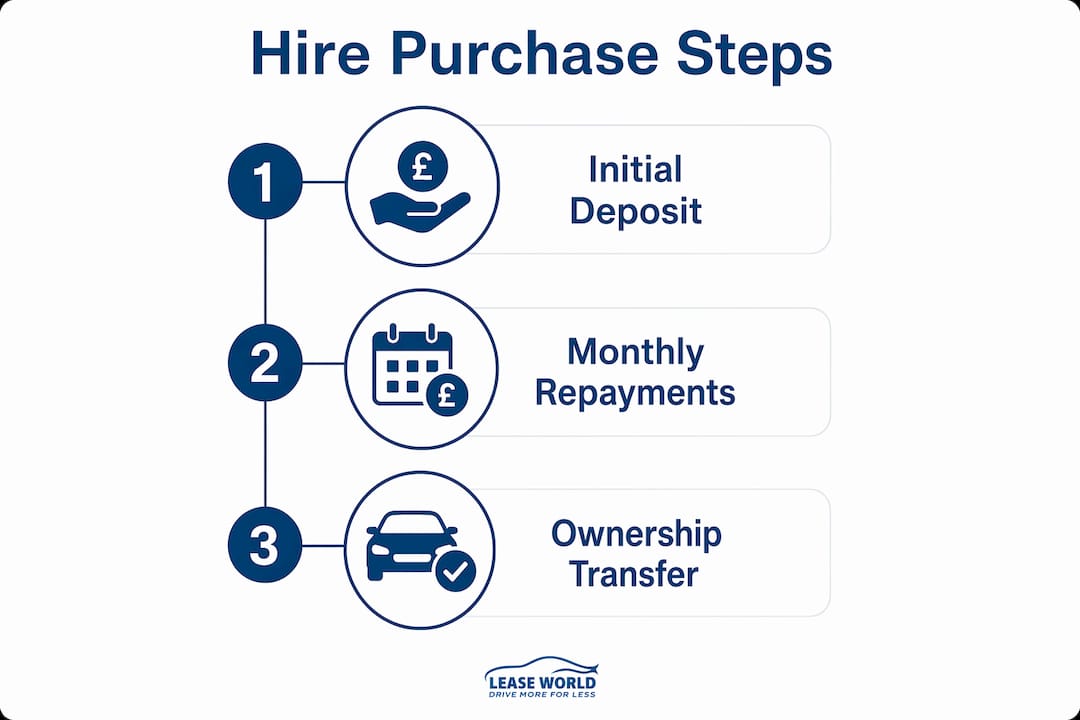
Hire purchase agreements follow a clear three-stage structure: deposit, monthly repayments, and ownership transfer. Deposits typically run 10–20% of the asset's purchase price, with repayment terms spanning 12–60 months. That range matters because a 12-month term means higher monthly payments but less total interest, while a 60-month term reduces monthly outgoings but increases the overall cost significantly.

Each monthly payment covers a portion of the asset's principal cost plus interest. The interest rate is fixed at the start, so your payments never change mid-contract. This predictability is one of the main reasons hire purchase suits buyers who need to budget carefully over several years.
Once you complete all instalments, ownership transfers to you automatically or for a small option-to-purchase fee. Unlike a personal contract purchase (PCP), there is no large balloon payment waiting at the end. You pay the agreed amount, and the asset is yours.
During the agreement, your responsibilities are significant. You must maintain the asset, keep it insured, and cannot sell, modify, or dispose of it without the finance provider's consent. The provider holds legal title, so any attempt to sell the asset before completing payments is a breach of contract and potentially a criminal offence.
Pro Tip: Use a hire purchase calculator before signing. Input the deposit, interest rate, and term length to see the total amount repayable. The difference between a 24-month and 48-month term on a £20,000 car can add thousands in interest.
What are the key benefits and risks of hire purchase?
Hire purchase suits buyers who want ownership without a large upfront payment. The benefits are real, but so are the risks.
Benefits:
- You gain immediate use of the asset from day one, even before ownership transfers.
- Monthly payments are fixed for the entire contract, making budgeting straightforward.
- Approval is often more accessible for buyers with weaker credit because the asset itself acts as collateral for the lender.
- Ownership transfers at the end, unlike leasing where you hand the asset back.
- There is no large balloon payment at contract end, unlike PCP agreements.
Risks:
- The total cost is higher than paying cash upfront because interest accumulates across the full term.
- Missing payments puts you at risk of repossession. The finance provider can reclaim the asset if you fall behind.
- You are exposed to depreciation. Once you own the asset, any drop in its value is your financial loss.
- You cannot sell or modify the asset during the contract, which limits your flexibility.
Fixed payments and eventual ownership make hire purchase predictable, but the higher overall cost compared to a cash purchase is a genuine trade-off. For most buyers, the ability to spread the cost outweighs the interest charge, provided they can sustain the payments throughout the term.
Pro Tip: Before committing, calculate your debt-to-income ratio. If your monthly hire purchase payment would take your total debt repayments above 40% of your take-home pay, the agreement may put you under real financial pressure.
How does hire purchase compare with leasing and PCP?
Hire purchase, leasing, and personal contract purchase each serve different needs. Choosing the wrong product costs money and causes frustration.
The clearest difference is ownership. With hire purchase, you own the asset at the end. With a personal contract hire arrangement, you never own it. You pay to use the vehicle for a set period, then return it. This suits buyers who want a new car every few years without the hassle of selling or the risk of depreciation.
A finance lease sits between the two. The asset appears on the lessee's balance sheet, but ownership typically remains with the finance company. For businesses, this creates different accounting and tax outcomes compared to hire purchase.
| Feature | Hire purchase | Personal contract hire | Personal contract purchase |
|---|---|---|---|
| Ownership at end | Yes, automatic or nominal fee | No, asset returned | Optional, large balloon payment |
| Monthly payments | Fixed, covers principal and interest | Fixed, covers depreciation only | Lower, deferred cost at end |
| Balloon payment | None | None | Yes, significant |
| Asset on balance sheet | Yes | No | No |
| Modification restrictions | Yes, during contract | Yes, during contract | Yes, during contract |
For businesses, the balance sheet impact of hire purchase is a genuine advantage. Assets acquired via hire purchase appear on the balance sheet from day one, enabling capital allowance claims and interest deductions. Operating leases keep the asset off the balance sheet entirely, which changes how the business reports its finances. Tax relief on hire purchase makes it preferable to leasing for businesses that want to claim capital allowances against taxable profit.
For private buyers, the choice between hire purchase and PCP often comes down to mileage and flexibility. PCP suits drivers who want lower monthly payments and the option to upgrade. Hire purchase suits drivers who want to own the car outright without a large final payment.
Pro Tip: If you are unsure about the terminology across these products, the leasing glossary at Lease World explains key terms clearly, including APR, option-to-purchase, and residual value.
What legal rights do UK buyers have under hire purchase?
UK consumers have strong legal protections under hire purchase agreements. Knowing them before you sign is not optional.
The Consumer Credit Act 1974 is the primary legislation. It requires lenders to provide clear written disclosures before you sign, including the total amount payable, the APR, and all fees. Any agreement that omits these disclosures is potentially unenforceable.
Your key rights include:
- Cancellation rights. You have a 14-day cooling-off period after signing. You can withdraw from the agreement without penalty within this window.
- Repossession limits. Once you have paid more than one third of the total amount payable, the lender cannot repossess the asset without a court order. This is known as the "protected goods" rule under the Consumer Credit Act 1974.
- Voluntary termination. Once you have paid 50% of the total amount payable, you can return the asset and walk away from the agreement with no further liability, provided the asset is in reasonable condition.
- FCA authorisation. Contracts lasting over three months require the lender to be authorised by the Financial Conduct Authority. Always verify your lender's FCA registration before signing.
The legal distinction between possession and ownership is central to all of these rights. You possess and use the asset throughout the contract, but the finance provider owns it. Selling the asset before completing payments is a criminal offence under the Theft Act 1968, not just a civil breach. This is a detail many buyers overlook, and it has serious consequences.
If you believe a lender has acted unfairly or breached the terms of your agreement, you can escalate a complaint to the Financial Ombudsman Service. The FCA's consumer credit rules give you a clear route to redress.
Key takeaways
Hire purchase is a regulated credit agreement that gives you immediate use of an asset, fixed monthly payments, and full ownership at the end, but legal title stays with the lender until the final instalment clears.
| Point | Details |
|---|---|
| Ownership transfers at the end | You own the asset after all payments, unlike leasing where you return it. |
| Deposits and terms are standardised | Expect a 10–20% deposit and repayment terms of 12–60 months. |
| Legal protections are strong | The Consumer Credit Act 1974 gives you cancellation rights, repossession limits, and voluntary termination rights. |
| Business users gain tax advantages | Capital allowances and interest deductions apply, unlike with operating leases. |
| Missing payments risks repossession | The lender retains legal title and can reclaim the asset if you default. |
My honest view on when hire purchase actually makes sense
I have spoken with a lot of people who signed hire purchase agreements without fully understanding what they were committing to. The most common mistake is treating it like a straightforward loan. It is not. You do not own the asset until the final payment. That distinction has real consequences if your circumstances change mid-contract.
Hire purchase makes genuine sense in a specific set of situations. If you want to own the vehicle outright at the end, cannot pay cash upfront, and need predictable monthly payments, it is a solid product. The fixed rate and no balloon payment make it easier to plan than PCP. For buyers who have been turned down for unsecured loans, the asset-as-collateral structure means credit approval is often more accessible than with a personal loan.
Where I see buyers go wrong is underestimating the total cost. The interest over a 48 or 60-month term adds up to a meaningful sum. If you can afford a larger deposit, do it. Reducing the amount financed cuts the total interest paid more than most people realise.
For businesses, hire purchase is often the better choice over leasing when the asset has long-term value and the business wants to claim capital allowances. The balance sheet treatment and tax deductibility of interest make it a financially efficient route to ownership. But this only works if the business has the cash flow to sustain payments reliably.
My advice is simple. Read the full agreement before signing. Understand the voluntary termination threshold. Know your repossession rights. And never commit to a monthly payment that stretches your budget to its limit, because life rarely stays predictable for three to five years.
— Jason
Thinking about leasing instead? Lease World can help
Hire purchase is one route to getting behind the wheel of a new vehicle. Leasing is another, and for many UK drivers it offers lower monthly payments, no depreciation risk, and the freedom to upgrade regularly.
Lease World is a family-run leasing specialist with a reputation built on transparent pricing, no hidden fees, and complimentary UK delivery on eligible vehicles. Whether you are looking for personal car leasing deals or want to compare your options before deciding, Lease World's team provides straightforward advice without the pressure. Browse the leasing guides to understand every financing option available to you, or request a personalised quote to see what monthly payments look like on the vehicle you want.
FAQ
What is the difference between hire purchase and leasing?
Hire purchase transfers ownership to you after all payments are complete. Leasing means you use the vehicle for a fixed period and return it at the end, with no option to own it.
Is hire purchase classed as a loan?
Hire purchase is a form of consumer credit, not a standard personal loan. The key difference is that the lender retains legal ownership of the asset until the final payment, whereas a loan gives you ownership immediately.
Can I end a hire purchase agreement early?
Yes. Once you have paid 50% of the total amount payable, you can voluntarily terminate the agreement and return the asset under the Consumer Credit Act 1974, with no further payments required provided the asset is undamaged.
Does hire purchase affect my credit score?
Yes. Hire purchase agreements are recorded on your credit file. Making payments on time improves your credit profile. Missing payments damages it and can trigger repossession proceedings.
Can a business use hire purchase for tax purposes?
Yes. Business users can claim capital allowances on assets acquired through hire purchase and deduct interest charges from taxable profit, which is an advantage over operating leases where the asset stays off the balance sheet.