

TL;DR:
- A subsidised lease is a vehicle agreement where manufacturers directly lower monthly payments using financial supports like interest rate cuts or residual value boosts. It offers significant cost savings compared to regular leasing or loans, especially for drivers with top-tier credit, by reducing interest, depreciation, or capital costs. These deals are fixed in terms of mileage, model, and contract length, and verifying genuine manufacturer backing is essential before committing.
A subsidised lease deal is a vehicle lease where the manufacturer directly reduces your monthly payments through financial support mechanisms such as lower interest rates, inflated residual values, or cash contributions. The industry term for this arrangement is a subvented lease, and understanding the distinction matters because not every "special offer" qualifies. These deals are centrally managed by captive finance arms, not negotiated at dealership level. For UK drivers seeking affordable leasing options, a genuine subsidised deal can be the most cost-effective route to a new vehicle available.
How does a subsidised lease deal work?
A subsidised lease works by having the manufacturer's captive finance company alter one or more of the three core variables that determine your monthly payment: the money factor, the residual value, and any direct price contribution.
The money factor is the interest rate equivalent in a lease. Manufacturer subsidies can halve the money factor, cutting finance charges significantly. A reduction from 0.0025 to 0.0015, for example, translates directly into a lower monthly figure without any change to the vehicle's list price.

Residual value is the predicted worth of the car at the end of the lease. When a manufacturer inflates this figure, the depreciation portion of your monthly payment falls. You are effectively paying for less depreciation over the contract term, which is where a large portion of the savings comes from.
Direct contributions work differently. The manufacturer applies a cash sum to reduce the capitalised cost of the vehicle before the lease calculation runs. This lowers the base amount you are financing, which reduces every monthly payment across the full contract.
- Money factor reduction: Lowers the finance charge element of each payment.
- Residual value inflation: Reduces the depreciation element, often the largest cost component.
- Direct cash contribution: Cuts the vehicle's starting cost before calculations begin.
- Combined approach: Some programmes apply two or all three mechanisms simultaneously for maximum savings.
Pro Tip: Ask the broker or dealer to confirm in writing which subsidy mechanism applies to your deal. This tells you whether the saving is front-loaded or spread across the contract.
Manufacturers use these programmes to move specific models, clear stock, or accelerate adoption of new technology. Understanding how automotive direct marketing drives these incentives helps you recognise when a deal is genuinely manufacturer-backed rather than a dealer promotion dressed up as one.
What are the key benefits of subsidised lease deals?
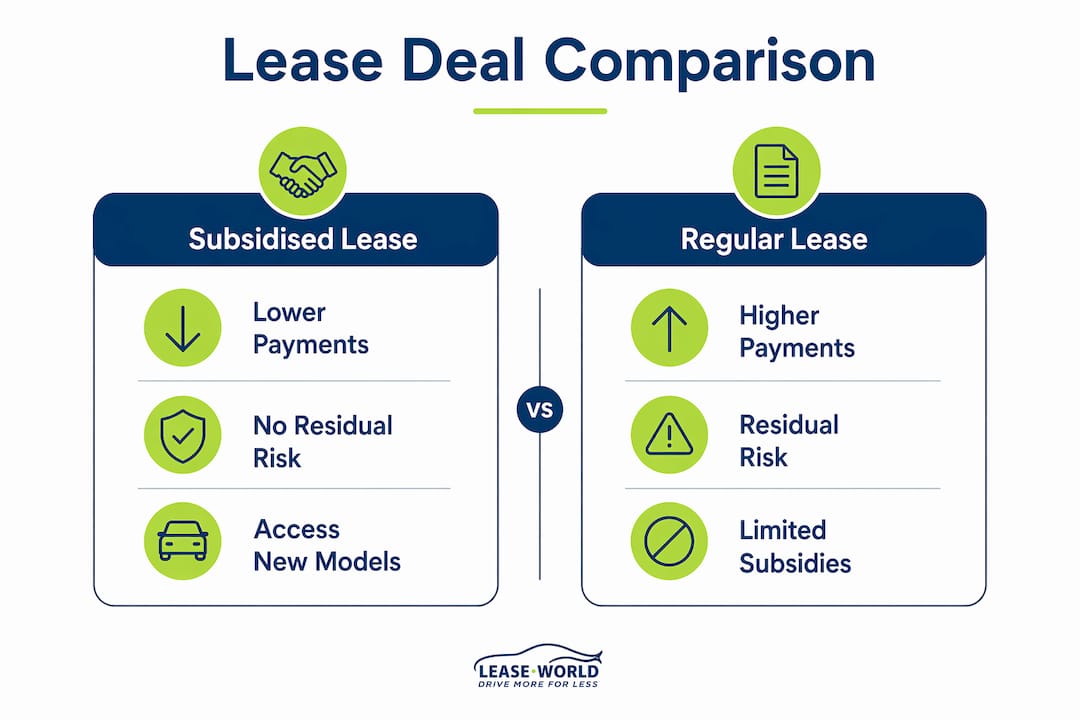
Subsidised leases offer lower total cost of ownership compared with regular leases or personal finance loans, particularly for drivers with strong credit histories. They beat typical personal loans by reducing both the interest and the depreciation components simultaneously. That double saving is what makes subvented deals genuinely different from standard contract hire.
The table below compares subsidised leases against common alternatives on the factors that matter most to UK drivers.
| Factor | Subsidised lease | Regular lease | PCP or HP finance |
|---|---|---|---|
| Monthly payment | Lower, manufacturer-supported | Market rate | Typically higher |
| Interest rate | Reduced by manufacturer | Standard lender rate | Standard lender rate |
| Residual value risk | Carried by finance company | Carried by finance company | Carried by you (PCP) |
| Equity build-up | None | None | Possible with HP |
| Flexibility | Low, fixed terms | Moderate | Moderate to high |
| Credit requirement | High (top tier) | Standard | Standard to high |
For business drivers, the advantages extend further. Electric vehicle subsidised leases benefit from the UK's Benefit in Kind tax incentives, which reduce the taxable value of the vehicle significantly. Business users leasing electric vehicles via company contracts gain tax and VAT advantages that personal lessees do not receive. That gap in tax treatment makes a subsidised EV lease one of the most cost-effective company car arrangements available in 2026.
Access to the newest models is another practical benefit. Manufacturers typically apply subsidies to current or recently launched vehicles to stimulate demand. You get a new car with a full warranty, the latest safety technology, and no concerns about depreciation, because the finance company absorbs that risk entirely.
Compared with car finance vs car leasing on a standard basis, a subsidised lease removes the financing cost burden that makes PCP or HP agreements expensive over a full term. The saving is real, not cosmetic.
What are the typical terms and conditions?
Subsidised lease deals come with strict eligibility criteria and fixed contract parameters. Top-tier credit is usually required, equivalent to a FICO score of 750 or above in the US system. In the UK context, this means a clean credit file with no missed payments, low credit utilisation, and a stable income history. Drivers with lower scores may still qualify for a lease but will face standard market rates, erasing the subsidy benefit entirely.
The contract terms themselves are rigid. Fixed mileage caps, set contract lengths, and limited model choices are standard features of subvented deals. You cannot usually negotiate the annual mileage allowance upward without losing the subsidised rate, and the contract length is typically fixed at 24 or 36 months.
- Model and trim restrictions: Subsidies apply to specific variants, often base or mid-spec trims on factory-allocated stock.
- Colour and options limits: Deals are tied to specific factory stock, which may mean accepting a colour or specification you would not have chosen.
- No equity: You build no ownership stake. At the end of the contract, you return the vehicle.
- End-of-lease obligations: Fair wear and tear standards apply. Damage beyond those standards results in charges.
- No dealer negotiation on rate: Finance terms are preset by the manufacturer, so dealers cannot alter the interest rate or residual value.
Pro Tip: Check the mileage cap carefully before signing. Exceeding it typically costs between 5p and 30p per mile depending on the manufacturer, and that cost is not covered by the subsidy.
The lack of flexibility is the trade-off for the lower cost. If your circumstances change mid-contract, exiting early is expensive. Treat a subsidised lease as a fixed financial commitment, not a flexible arrangement.
How to identify a genuine subsidised lease deal in the UK
Spotting a real subvented deal requires looking beyond the headline monthly payment. Many advertised "special offers" rely on dealer pricing adjustments rather than true manufacturer subsidy, and the difference matters to your wallet.
- Verify the source of the subsidy. Ask whether the rate comes from the manufacturer's captive finance company or from a third-party lender. Captive finance involvement confirms the deal is manufacturer-backed.
- Compare the money factor to the standard rate. Request the standard money factor for the same vehicle on a non-promotional lease. A genuine subsidy produces a noticeably lower figure.
- Check the residual value assumption. Ask what residual value percentage the deal uses. An inflated residual reduces your monthly cost but is not always disclosed upfront.
- Calculate total cost, not just monthly payments. Low monthly payments can be offset by a high initial rental. Add the initial payment to the total of monthly payments to get the true cost of the deal.
- Read the qualifying criteria. Confirm your credit profile meets the top-tier requirement before applying. A hard credit search that results in a declined application at the subsidised rate harms your credit file.
- Scrutinise the contract fine print. Look for excess mileage charges, damage liability thresholds, and early termination fees. These costs can erode the savings from the subsidised rate.
Financial advisors recommend comparing total cost of ownership, including the initial payment and all monthly rentals, rather than focusing on the monthly figure alone. A deal with a £199 per month headline and a £1,500 initial rental may cost more over 36 months than a deal at £229 per month with a £500 initial rental. The maths matters more than the marketing.
Key takeaways
A subsidised lease deal delivers genuine savings only when the manufacturer's captive finance arm reduces the money factor, inflates the residual value, or applies a direct contribution, and when the driver meets top-tier credit requirements.
| Point | Details |
|---|---|
| Subsidy source | Savings come from the manufacturer's captive finance arm, not dealer discounts. |
| Credit requirement | Top-tier credit is required; lower scores face standard rates and lose the saving. |
| Key cost levers | Money factor reduction and residual value inflation are the two primary saving mechanisms. |
| Total cost check | Always add the initial rental to monthly payments to calculate the true deal cost. |
| Contract rigidity | Fixed mileage, trim, and term conditions are the trade-off for lower monthly payments. |
My honest view on subsidised leases
I have seen a lot of drivers get excited about a headline monthly payment, sign the contract, and then feel short-changed six months in. Not because the deal was dishonest, but because they did not read the conditions carefully enough.
The truth is that a genuine subsidised lease is one of the best-value financing arrangements available in the UK, full stop. When a manufacturer cuts the money factor and inflates the residual simultaneously, the monthly saving over a standard lease can be substantial. For electric vehicles in particular, the combination of a subvented rate and Benefit in Kind tax relief makes the business car leasing case almost unanswerable for company drivers.
The pitfall is not the deal itself. The pitfall is misidentifying a dealer promotion as a manufacturer subsidy, or accepting a mileage cap that does not fit your actual driving habits. I have spoken to drivers who paid hundreds in excess mileage charges on a deal they thought was saving them money. The subsidy was real. The mileage planning was not.
My advice is straightforward. Confirm the captive finance involvement in writing. Calculate the total contract cost before you compare deals. And if your credit profile is not at the top tier, ask what rate you will actually receive before a hard search goes on your file. A subsidised lease is worth pursuing. Just pursue it with your eyes open.
— Jason
Lease World can help you find the right deal
Finding a genuine subsidised lease deal in the UK takes more than browsing a manufacturer's website. Lease World works with a wide range of manufacturer-backed offers, giving you access to subvented rates across personal and business contracts without the guesswork.
Lease World's team compares initial rentals, monthly payments, and total contract costs so you see the real value of each deal, not just the headline figure. Whether you are looking for a personal car lease or a company vehicle with tax advantages, the leasing guides on the Lease World website walk you through every step. Get a personalised leasing quote today and see which manufacturer-subsidised deals you qualify for right now.
FAQ
What does subsidised lease mean?
A subsidised lease, also called a subvented lease, is a vehicle lease where the manufacturer reduces monthly payments by lowering the interest rate, inflating the residual value, or applying a direct cash contribution through its captive finance company.
Who qualifies for a subsidised lease deal?
Qualifying typically requires top-tier credit, equivalent to a FICO score of 750 or above. Drivers with lower credit scores may still lease a vehicle but will receive standard market rates rather than the subsidised terms.
Is a subsidised lease worth it compared to PCP or HP?
A subsidised lease generally offers lower monthly payments and no residual value risk compared with PCP or HP finance, making it cost-effective for drivers who do not need to own the vehicle at the end of the contract.
Can I negotiate the terms on a subsidised lease?
The interest rate and residual value on a subsidised lease are set by the manufacturer's captive finance arm and cannot be altered by the dealer. Mileage allowance and contract length are also typically fixed with little room for adjustment.
Are electric car leases subsidised in the UK?
Many electric vehicle leases carry manufacturer subsidies alongside UK government tax incentives such as Benefit in Kind relief, making them particularly cost-effective for business users compared with petrol or diesel alternatives.