

TL;DR:
- A pickup lease is a contract that allows you to use a vehicle for a set period with fixed monthly payments and no ownership involved.
- It suits private drivers, small businesses, and fleets seeking predictable costs, but recent tax changes in April 2025 now treat most double cab pickups as cars for tax purposes.
A pick up lease is a finance contract that lets you use a pickup truck for a fixed term, paying a set monthly amount, without ever owning the vehicle. At the end of the agreement, you hand it back. That's it. No depreciation headache, no resale negotiation, no large capital outlay up front.
Who does this suit? Broadly, three groups:
- Private drivers who want predictable monthly motoring costs and the practicality of a pickup for towing, camping, or rural use.
- Sole traders and small businesses that need genuine load or tow capacity and want to keep cash in the business rather than tied up in a depreciating asset.
- Small fleets managing multiple commercial vehicles where fixed costs and regular replacement cycles matter.
One immediate flag: the tax treatment of double cab pickups changed significantly in April 2025. If you're leasing for business, that affects your benefit-in-kind and capital allowances position. The full picture is in the tax update section below, and an accountant conversation is strongly recommended before you sign.
Table of Contents
- How does a pickup lease work in the UK?
- What lease types apply to pickups?
- What do leasing costs and contract terms actually mean?
- Pickup-specific checks: payload, towing, insurance, and classification
- Advantages and disadvantages of leasing a pickup
- Should you lease or buy a pickup?
- How long does a pickup lease take from quote to delivery?
- What to check in a pickup lease contract before you sign
- UK tax and VAT update: what changed for pickups in April 2026
- Key takeaways
- Is leasing a pickup always the right call?
- Lease World can help you find the right pickup lease deal
- Useful sources and further reading
- FAQ
How does a pickup lease work in the UK?
Most pickup leases structure the relationship between three parties: you (the lessee), a finance funder, and the supplying dealer or broker. You pay the funder; the broker arranges the deal; the dealer delivers the vehicle.
Here's the typical flow:
- Get a quote. Choose your pickup model, specification, contract length, typically ranging from a few years, and annual mileage. The broker provides a monthly figure and an initial rental amount.
- Credit check and finance approval. The funder runs a credit assessment. Leasing a pickup requires a full UK driving licence and satisfactory credit history.
- Sign the agreement. You receive the contract hire agreement, funder details, and terms and conditions. Read them before signing.
- Vehicle ordered. The broker places the order with the manufacturer or sources from dealer stock. Lead times vary considerably.
- Delivery. The vehicle arrives, usually with a pre-delivery inspection. Check it against the order confirmation before accepting.
- In-term responsibilities. You cover insurance, fuel, and any servicing not included in a maintenance package. Keep the vehicle in good condition.
- End of term. Return the vehicle. It's inspected against the BVRLA fair wear and tear standard. Excess mileage or damage charges may apply.
A common scenario: a sole trader takes a 3-year contract hire on a double cab pickup with a maintenance package included. Monthly payments are fixed; the maintenance package covers scheduled servicing and tyres. At 36 months, they hand it back and start a new agreement on a newer model.
Pro Tip: Document the vehicle's condition and mileage at delivery with dated photographs. Do the same at return. This protects you if there's a dispute over wear and tear or mileage charges.

What lease types apply to pickups?
Several contract types exist in the UK, and they are not interchangeable. Here's what you'll encounter:
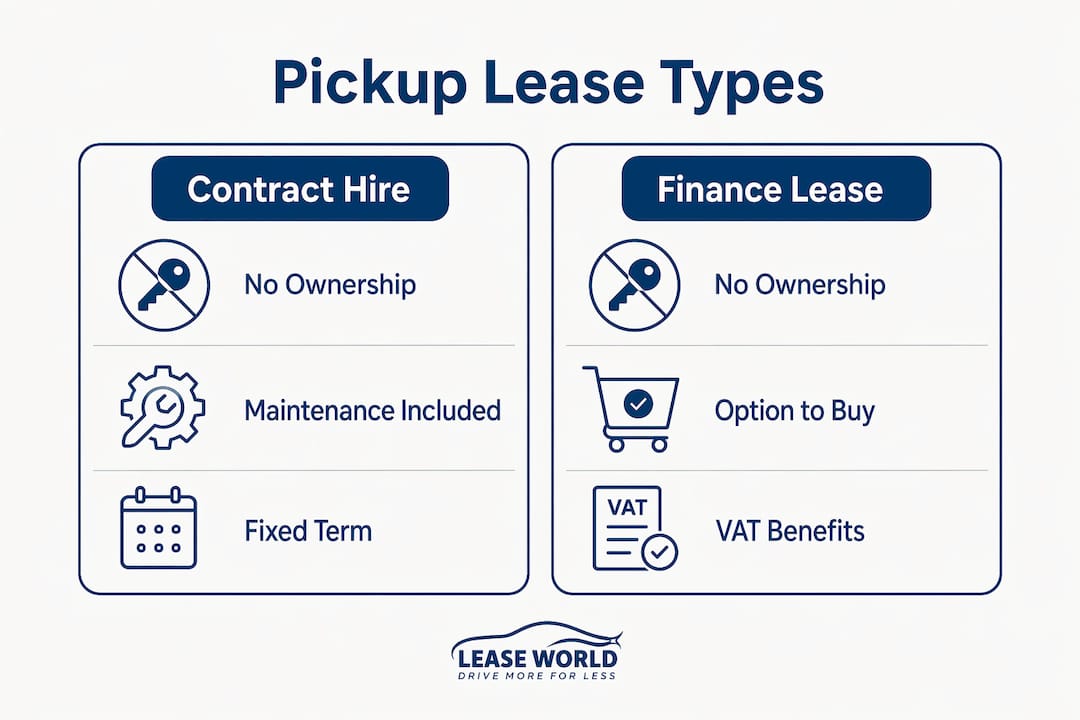
- Contract hire (operating lease / PCH or BCH): The most common pickup lease type. You pay monthly, return the vehicle, and have no option to buy. Personal Contract Hire (PCH) is for individuals; Business Contract Hire (BCH) is for companies and sole traders.
- Finance lease: The funder owns the vehicle, but you take on more of the financial risk. At the end, you can sell the vehicle (with proceeds going partly to the funder) or extend the lease. More common in fleet and commercial contexts.
- Personal Contract Purchase (PCP): Monthly payments plus an optional final "balloon" payment to buy the vehicle. Pickups are available on PCP, though it's less common than contract hire.
- Hire Purchase (HP): You pay in instalments and own the vehicle outright at the end. No mileage restrictions, but you carry depreciation risk.
- Short-term contract hire: Agreements from one to eleven months. Useful for project-based work or bridging between vehicles.
| Feature | Contract hire (PCH/BCH) | Finance lease | PCP | HP |
|---|---|---|---|---|
| Own the vehicle? | No | No (option to sell) | Optional (balloon payment) | Yes |
| End-of-term options | Return | Sell or extend | Buy, return, or part-exchange | Keep |
| VAT recovery potential | BCH: yes (commercial vehicles) | Yes (commercial use) | Limited | No |
| Mileage limit | Yes | Flexible | Yes | No |
For most UK pickup lessees, contract hire is the default starting point. Personal leasing options suit private drivers; business contract hire suits VAT-registered businesses.
What do leasing costs and contract terms actually mean?
A lease quote contains several figures that are easy to confuse. Here's what each one means in practice.
- Initial rental: An upfront payment, typically expressed as a multiple of the monthly payment (e.g. "3+35" means three months upfront, followed by monthly payments for the remainder of the term). It is not a deposit — you do not get it back.
- Monthly payment: The fixed amount you pay each month for the duration of the contract. This covers the vehicle's depreciation over the term, plus the funder's margin.
- Mileage allowance: The total annual mileage agreed in the contract. Exceeding it triggers excess-mileage charges.
- Excess-mileage charge: A pence-per-mile penalty for every mile over the agreed limit. Rates vary but can be significant over a long contract.
- Maintenance package: An optional add-on covering scheduled servicing, tyres, and sometimes MOTs. Useful for businesses wanting fully predictable costs.
- End-of-term charges: Costs for damage beyond fair wear and tear, or for excess mileage. These are the most common source of end-of-contract disputes.
Worked example: Suppose a pickup has a list price of £38,000. You agree a 3-year contract hire at 10,000 miles per year, with an initial rental of 3 months. If the monthly payment is a fixed amount, your initial rental is calculated as a multiple of this, and your total paid over the entire term sums these payments. You return the vehicle at the end with no additional purchase options. You return the vehicle at the end. No balloon payment, no resale.
Watch out for early termination fees. Ending a contract hire agreement early typically means paying a substantial penalty — often 50% or more of the remaining rentals. Unauthorised modifications (roof racks, tow bars not specified in the contract) can also trigger charges at return. Check the T&Cs before you make any changes to the vehicle.
For a full glossary of lease terminology, the car lease terminology guide is a useful reference.
Pickup-specific checks: payload, towing, insurance, and classification
Pickups are not cars, and that distinction matters for both practical and tax reasons. Before committing to a lease, work through this checklist:
- Payload plate: Check the vehicle's payload rating on the manufacturer's plate. For VAT classification as a commercial vehicle, a pickup generally needs a payload of one tonne or more. This threshold remains relevant for VAT recovery even after the April 2025 tax changes.
- Towing capacity: Confirm the braked towing capacity matches your actual needs. A figure on a brochure and a figure on the vehicle's type approval document can differ.
- Bed dimensions: Measure the load bed against what you actually need to carry. Fixed bed vs. dropside matters for site work.
- Tailgate load limits: If you plan to load motorcycles or heavy equipment via the tailgate, check the tailgate's rated capacity. Guidance on tailgate load checks is worth reviewing before you load anything heavy.
- Insurance: Pickup insurance is typically arranged as a commercial vehicle policy. Personal use on a commercial policy needs to be declared explicitly. Mixing private and business use without the right cover is a common and costly mistake.
- VAT classification: HMRC guidance treats incidental private use (roughly 3–4 times a year, around 5% of total use) differently from regular private use. If private use is more than incidental, VAT recovery on the lease payments may be blocked or restricted.
- Commercial vehicle classification: A pickup with a payload of one tonne or more is generally treated as a commercial vehicle for VAT purposes. For benefit-in-kind and capital allowances, the rules changed in April 2025 — see the tax section below.
Advantages and disadvantages of leasing a pickup
Advantages:
- Fixed monthly payments make budgeting straightforward, with no surprise depreciation costs.
- VAT-registered businesses can often recover VAT on commercial vehicle lease payments, which materially reduces the net cost.
- Access to newer vehicles with current safety technology and manufacturer warranties, replaced at the end of each term.
- No large capital outlay; cash stays in the business.
- Optional maintenance packages remove the uncertainty of servicing costs.
Disadvantages:
- You never own the vehicle. There is no asset at the end of the contract.
- Mileage penalties can be expensive if your usage is unpredictable.
- The April 2025 tax changes mean most double cab pickups are now taxed as cars for benefit-in-kind and capital allowances purposes, making business leasing less tax-efficient than it was.
- Early termination is costly.
- Modifications are restricted.
When leasing wins: a building contractor who needs a reliable, fully maintained pickup for three years, wants to keep capital free, and can accurately predict annual mileage. When buying is likely better: a farmer who puts 40,000 miles a year on a pickup, modifies it heavily, and keeps vehicles for ten years or more.
Should you lease or buy a pickup?
Leasing is generally the better option when you want predictable costs, regular vehicle upgrades, and you are VAT-registered with genuine commercial use. Buying makes more sense when you drive high mileage, plan to modify the vehicle, or intend to keep it for many years.
Decision checklist:
- Do you drive more than 20,000 miles per year? High mileage makes leasing expensive due to excess-mileage charges. Buying may be cheaper.
- Is the pickup for genuine commercial use (towing, site access, payload)? Business contract hire with VAT recovery is worth exploring.
- Do you need to modify the vehicle (specialist bodywork, permanent fittings)? Leasing restricts modifications. Buy instead.
- Is cash flow a priority? Leasing avoids a large upfront purchase cost.
- Are you a sole trader? Self-employed leasing is available, but weigh the administrative overhead of BIK reporting against the tax benefits.
| Reader profile | Recommended route |
|---|---|
| Sole trader, commercial use, VAT-registered | Business contract hire (BCH) |
| Private family owner, moderate mileage | Personal contract hire (PCH) or PCP |
| Small fleet, regular replacement cycle | Business contract hire (BCH) |
| High-mileage user, heavy modifications | Purchase (HP or outright) |
How long does a pickup lease take from quote to delivery?
The honest answer: anywhere from two weeks to six months, depending on the vehicle and specification.
- Quote to finance approval: typically 2–5 working days, assuming straightforward credit.
- Finance approval to order placement: 1–3 days once paperwork is signed.
- Manufacturer lead time: this is the biggest variable. Popular models in standard specification may be available from dealer stock within 2–4 weeks. Factory orders for specific colours or options can take 3–6 months.
- Pre-delivery inspection and delivery: 1–2 weeks once the vehicle arrives at the supplying dealer.
Common causes of delay include credit queries, specification changes after the order is placed, and factory production schedules. For readers who need a vehicle quickly, in-stock van and pickup deals with short delivery windows are worth checking.
Questions to ask your broker:
- What is the current manufacturer lead time for this model and specification?
- Is this vehicle in stock or a factory order?
- What happens to my agreement if the lead time extends significantly?
- Is there a cancellation window after signing?
- Who do I contact if delivery is delayed?
What to check in a pickup lease contract before you sign
The single most important checks are mileage allowance, excess-mileage rate, maintenance scope, insurance requirements, and early termination terms. Get these wrong and the contract that looked affordable becomes expensive.
Contract checklist:
- Confirm the annual mileage allowance matches your realistic usage, with a small buffer.
- Note the excess-mileage charge per mile in writing.
- Clarify whether a maintenance package is included or optional, and exactly what it covers.
- Check the insurance requirement — most funders require fully comprehensive cover.
- Read the early termination clause carefully. Understand the penalty calculation method.
- Request the funder's name and contact details (not just the broker's).
- Ask for the order acknowledgement in writing before any money changes hands.
- Check the complaints procedure. A reputable broker will have a clear process, and you can verify their Trustpilot reviews and customer feedback independently.
- Review the Lease World policies page for T&Cs and governance details.
| Question to ask the broker | Acceptable answer |
|---|---|
| Who is the finance funder? | A named, FCA-regulated finance company |
| What is the excess-mileage rate? | A specific pence-per-mile figure |
| What does the maintenance package cover? | An itemised list (servicing, tyres, MOT, etc.) |
| What is the early termination penalty? | A clear formula or percentage of remaining rentals |
| How is fair wear and tear assessed? | Reference to BVRLA guidelines |

UK tax and VAT update: what changed for pickups in April 2026
From 6 April 2025, HMRC now treats most double cab pickups as cars for benefit-in-kind and capital allowances purposes. Previously, many double cab pickups were taxed as vans, which meant significantly lower BIK charges for employees using them privately. That advantage has largely gone.
What this means in practice:
- Employees using a double cab pickup with private use now face car-rate BIK tax, not the flat van rate.
- Capital allowances for businesses purchasing double cab pickups changed accordingly.
- The one-tonne payload threshold for VAT classification as a commercial vehicle remains in place. A qualifying pickup can still attract VAT recovery on lease payments for genuine commercial use.
Transitional rules: if your pickup was ordered or leased before the April 2025 change, the old treatment may continue until the lease expires, the vehicle is disposed of, or 5 April 2029, whichever comes first. Check your order or lease date carefully.
This article is general information, not professional tax or financial advice. Confirm your specific position with a qualified accountant or tax adviser and check current HMRC guidance directly.
Key takeaways
A pickup lease is a fixed-term contract giving you use of a vehicle without ownership, and the April 2025 tax changes make professional advice essential before signing a business lease.
| Point | Details |
|---|---|
| Definition | A pickup lease gives you use of a vehicle for a fixed term with monthly payments; you return it at the end. |
| Tax change (April 2025) | Most double cab pickups are now taxed as cars for benefit-in-kind and capital allowances; transitional rules may apply to pre-April 2025 orders. |
| VAT still applies | The one-tonne payload threshold for VAT recovery as a commercial vehicle remains in place after April 2025. |
| Contract checks | Always confirm mileage allowance, excess-mileage rate, maintenance scope, and early termination terms before signing. |
| Lease World | Lease World offers tailored pickup lease quotes with no hidden fees, optional maintenance packages, and free mainland UK delivery on eligible vehicles. |
Is leasing a pickup always the right call?
There's a version of this question that gets asked constantly: "Should I lease or buy?" And the honest answer is that most people asking it have already decided they want the vehicle — they're really asking whether leasing is financially defensible. For a lot of business users, it was. The BIK advantage on double cab pickups made the numbers work almost automatically.
That era is over. The April 2025 changes mean the tax case for leasing a double cab pickup now depends on what you actually do with it, not what it's classified as. A pickup used for genuine site work, towing, and payload tasks still makes sense on a business lease. One used primarily as a family car with a tow bar attached occasionally is now a much harder case to make to an accountant.
What I'd push back on is the idea that leasing is inherently the wrong choice post-2025. The non-tax arguments — predictable costs, no depreciation risk, regular vehicle refresh, VAT recovery on qualifying commercial use — remain solid. The mistake is treating those arguments as secondary to a tax shortcut that no longer exists.
If you're a sole trader considering a pickup lease, the administrative overhead of BIK reporting and mileage tracking is real. For some, personal leasing is genuinely simpler. For others, the VAT recovery on a qualifying commercial vehicle more than justifies the paperwork. There is no universal answer, which is exactly why the accountant conversation matters more now than it did before April 2025.
Lease World can help you find the right pickup lease deal
Lease World takes a different approach to pickup leasing: transparent quotes, no hidden fees, and a broker process built around what you actually need rather than what's easiest to sell.
Whether you're a sole trader needing a workhorse pickup on a business contract hire, or a private driver after a practical vehicle with predictable monthly costs, Lease World can put together a tailored quote. The service includes optional maintenance packages, no-deposit options, and free mainland UK delivery on eligible vehicles. Browse current pickup lease deals or request a no-obligation quote to see what's available for your budget and usage. Customer reviews on Trustpilot reflect the straightforward, personal service that sets Lease World apart from larger corporate brokers.
Useful sources and further reading
- HMRC Business Leasing Manual — authoritative guidance on lease taxation in the UK.
- HMRC VAT Input Tax Manual (VIT55100) — VAT treatment of private use of commercial vehicles.
- Motoring Mojo: double cab pickup tax changes April 2025 — plain-English explanation of the BIK and capital allowances changes and transitional rules.
- Lease World leasing guides — guides to contract types, terminology, and the leasing process.
- HMRC Employment Status Manual ESM4211 — guidance on commercial vehicle leasing agreements and self-employment status.
For tax decisions, consult a qualified accountant with your specific contract details and usage pattern. For finance terms, always read the funder's T&Cs directly.
FAQ
How does leasing a pickup work?
You agree a fixed term (typically 2–5 years), a mileage allowance, and a monthly payment with a broker or dealer. A finance funder owns the vehicle throughout; you use it, maintain insurance, and return it at the end of the agreement.
What are the main types of lease available in the UK?
The four main types are contract hire (PCH for personal, BCH for business), finance lease, Personal Contract Purchase (PCP), and Hire Purchase (HP). Contract hire is the most common route for pickup leasing.
What are the disadvantages of leasing a pickup?
You build no equity, mileage penalties apply if you exceed the agreed limit, early termination is expensive, and modifications are restricted. After April 2025, most double cab pickups are taxed as cars for benefit-in-kind, so the previous BIK advantage has largely been removed.
Is it better to lease or buy a pickup truck?
Leasing suits lower-mileage users who want predictable costs and regular vehicle upgrades, particularly VAT-registered businesses with genuine commercial use. Buying is generally better for high-mileage drivers, those who need to modify the vehicle, or those planning to keep it for many years.
Can Lease World arrange a pickup lease for a sole trader?
Yes. Lease World arranges both personal and business pickup leases, including for sole traders. The right contract type depends on your VAT registration status and usage pattern — Lease World can help you compare options and get a tailored quote.