

Yes, you can transfer a car lease in the UK, but only with your finance company's approval and after the new driver passes a credit check. Check your lease agreement for an assignment clause today, note how many months remain, and call the funder before advertising anything. Get this right and you could dodge an early-termination bill that often costs more than seeing the contract through.
TL;DR:
- Most UK lease transfers require the new driver to undergo a credit check and secure approval from the funder, which often includes minimum remaining lease periods of at least 12 months.
- The process involves agreeing on terms privately, submitting a formal application, passing credit and income assessments, settling fees, signing paperwork, and receiving formal approval before the transfer is legally completed.
- Fees typically include a seller-paid admin fee to the funder and potential marketplace listing or success fees, with additional charges for excess mileage, damage, or missed servicing if applicable.
- Funders scrutinize the incoming driver’s credit history, proof of income, and address, and postponing transfer applications due to employment or address changes can cause delays.
- The transfer process generally takes two to four weeks, with the final approval only confirmed once the funder issues written confirmation, and tax implications are minimal for private individuals but vary for business leases.
Table of Contents
- Lease transfer UK: checking your contract and briefing the funder
- What happens from listing to completion
- Typical costs and who usually pays them
- What funders check before approving a new driver
- What lease marketplaces do (and don't do)
- Alternatives if a transfer is refused or not permitted
- Preparing the vehicle and documents for handover
- How long a lease transfer takes and your final checklist
- Tax implications of lease transfers in the UK
- Author perspective: what actually goes wrong with lease transfers
- Get help arranging your next lease with Lease World
- Sources
- FAQ
Lease transfer UK: checking your contract and briefing the funder
Your lease agreement should have a section headed "assignment" or "transfer of rights." Some funders forbid it outright; others allow it only after a minimum period, commonly at least 12 months. This single clause decides whether the rest of this guide even applies to you, so read it before you do anything else.
Before phoning the finance company, gather the details they will ask for immediately. Having answers ready shaves days off the process.
- Months remaining on the agreement and the original term length
- Current mileage against your contracted allowance
- Payment history, including any missed or late payments
- Outstanding balance or arrears, if any
When you call, ask directly: what is the admin fee, what paperwork does the new driver need, and how long does approval typically take? A thorough breakdown of lease agreement terms is worth reading first if your contract's wording is unclear.
What happens from listing to completion
A lease transfer moves through a fixed sequence, and skipping steps is how deals collapse midway. Here is the order that funders expect.
- Agree terms privately. Seller and buyer settle on price for any remaining deposit contribution, then agree who covers which fees.
- Buyer applies to the funder. The prospective new driver submits a formal application directly to the finance company, not the seller.
- Funder runs checks. The company carries out a full credit check and affordability assessment, confirming income, address history and driving licence status.
- Funder sets conditions. Approval often comes with requirements, such as a minimum income threshold or proof of employment.
- Fees are paid. Both parties settle any admin or transfer charges the funder specifies.
- Paperwork is signed. A new agreement or transfer document is executed, transferring liability formally.
- Handover date confirmed. Vehicle, keys and documents change hands only once the funder confirms the transfer is complete.
Contract terms, including monthly payments and mileage limits, usually stay the same after an approved transfer. What changes is who is legally liable, and that shift only happens once the funder signs off, not when money changes hands privately.
Typical costs and who usually pays them
Fees fall into two categories: what the funder charges and what a marketplace charges, if you use one. The finance company's admin fee typically covers processing the new agreement and running credit checks, and sellers usually pay this since they are ending their liability early.
Marketplaces add their own layer on top. One UK lease exchange platform cites a listing fee of £39.99 with a seller success fee equivalent to two months' rental once a transfer completes, though fee structures vary by platform.
Before you commit to a figure, check the contract for costs that catch people out:
- Excess mileage charges if you have overshot your allowance
- Damage or wear-and-tear costs assessed at handover
- Any missed servicing that the funder requires bringing up to date
Statistic Callout: A typical marketplace listing fee runs around £39.99, with seller success fees often set at two months' rental, according to Swap-a-Lease's published FAQ. Figures vary between platforms, so always confirm before listing.
What funders check before approving a new driver
Funders assess the incoming driver much as they would any new lease applicant. Expect a full credit history review, proof of address, a valid driving licence check and confirmation of income or affordability.
Most finance companies also want a minimum number of months remaining on the contract, often at least 12, before they will even consider approving a transfer. Arrears or a poor payment history on the existing agreement can block the process regardless of the new driver's own credit standing.
Have these ready before applying:
- Three months of payslips or accounts if self-employed
- Proof of current address, such as a recent utility bill
- Full UK driving licence details
- Bank statements showing existing financial commitments
Pro Tip: Apply for the transfer before you resign from a job or move house. Funders want stability, and a fresh address or new employer on your application can slow approval by weeks.
What lease marketplaces do (and don't do)
Online marketplaces exist to connect sellers with people looking to take over a lease. They list vehicles, advertise remaining terms, and often charge listing or success fees for that service. What they do not do is replace the funder's own approval process.
No marketplace can perform a credit check on your behalf or guarantee the finance company will accept a buyer, however keen that buyer seems. The marketplace's role is purely to generate leads; completion still depends entirely on the funder's decision.
Protect yourself when using one:
- Confirm the vehicle registration matches the lease documents before engaging
- Verify the funder's name directly rather than trusting a screenshot
- Never send a large payment privately before the funder confirms approval
If the sums are significant or the funder is slow to respond, a broker who liaises directly with finance companies can save considerable back-and-forth.
Alternatives if a transfer is refused or not permitted
Not every lease qualifies for transfer, and some funders decline applications even when the paperwork looks solid. A few routes remain open.
- Early termination ends the contract outright, but it is often the costliest option since funders typically charge a settlement figure covering the remaining rentals, sometimes more than continuing the lease. Our guide on ending a car lease early breaks down the likely costs.
- A short-term lease for the incoming driver can bridge the gap while the original contract runs its course, avoiding transfer complications entirely.
Preparing the vehicle and documents for handover
A smooth handover depends on both parties turning up prepared, not on trust alone.
- Gather the service history, current MOT certificate, original lease paperwork and the funder's contact details.
- Arrange an independent inspection before handover and photograph the vehicle from every angle, noting the exact mileage.
- The seller should cancel their insurance only once the transfer date is confirmed; the buyer must have cover active from that same date, not after.
Checking tyre condition, fluid levels and any warning lights before handover avoids disputes later, and Lease World's safety check guidance covers what to look for. A quick valet also helps both sides agree on the vehicle's condition without argument, and specialist guides like this one on preparing a car for handover cover the basics.
How long a lease transfer takes and your final checklist
Expect the process to take roughly two to four weeks from application to completion, though some stages clear faster. One marketplace reports funder approval and paperwork typically taking 14 to 28 business days, with individual steps sometimes clearing in 48 to 72 hours depending on how responsive everyone is.
The transfer becomes legally binding only once the funder issues written confirmation, not when you shake hands or exchange money. Keep that confirmation as proof.
Before calling, it done, verify:
- All fees are paid and receipted
- The new agreement is signed by the incoming driver
- Insurance is active in the buyer's name from the handover date
- Vehicle condition and mileage are documented with photos and timestamps
Tax implications of lease transfers in the UK
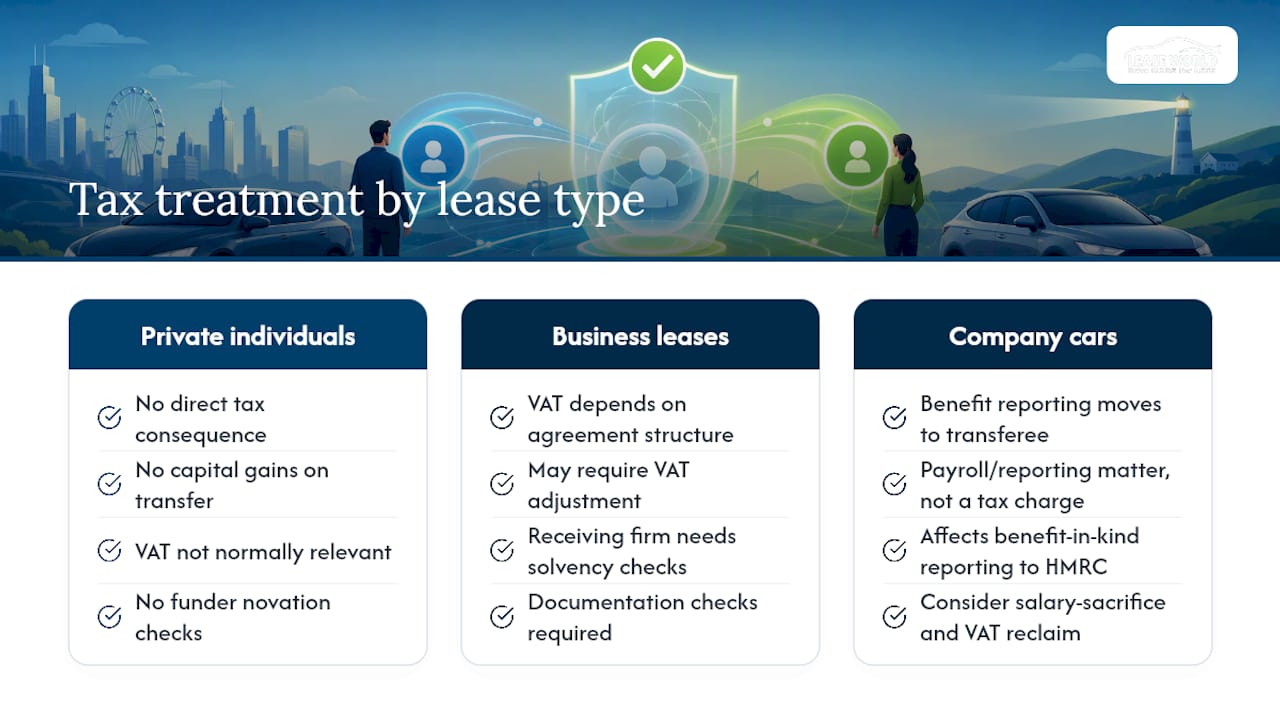
For most private individuals, transferring a personal car lease carries no direct tax consequence. You are not selling an asset you own outright, since the vehicle belongs to the funder throughout, so there is no capital gains position to consider on the transfer itself.
Business leases work differently. If a company transfers a lease to another business through novation, VAT treatment depends on how the original agreement was structured and whether VAT was being reclaimed on the rentals. A business novation needs the receiving company to satisfy the same solvency and documentation checks, and it is worth confirming with an accountant whether any VAT adjustment applies before signing.
Where a company car forms part of an employee's benefit-in-kind arrangement, transferring the lease to a different employee or a personal name changes who reports that benefit to HMRC from that point forward. This is a payroll and reporting matter rather than a tax charge triggered by the transfer itself. If your situation involves company cars, salary sacrifice, or VAT reclaim on rentals, it is sensible to check directly with your accountant or HMRC's own guidance rather than relying on general assumptions, since individual circumstances vary considerably.
Author perspective: what actually goes wrong with lease transfers
The mistake I see most is people treating a marketplace enquiry as a done deal. It isn't, until the funder says so in writing. Document the vehicle's condition and exact mileage before handover, because disputes almost always come down to "it wasn't like that when I took it." If the funder drags its feet or the numbers are large, get a broker on the phone with them directly.
— Jason
Get help arranging your next lease with Lease World
Chasing a funder for updates while trying to sort insurance and paperwork on your own timeline gets exhausting fast, and this is exactly where a broker earns its keep. A broker's team can liaise directly with finance companies on your behalf, check feasibility before you commit to anything, and talk you through fixed monthly payment options if a transfer stalls or a straightforward new lease turns out to be simpler.

Whether you're weighing up taking over an existing contract or starting fresh, our personal car leasing page shows current deals with no deposit options and free UK delivery on eligible vehicles. Business owners considering novation instead should look at business car leasing, and anyone who just needs a vehicle for a few months while a transfer works itself out can browse short-term leasing. Request a quote today and one of our team will talk you through the fastest route to the right car.
Sources
FAQ
What is the 1.25% rule of leasing?
This is a loose industry guideline sometimes used to estimate fair monthly lease pricing relative to a vehicle's value, but it is not a formal regulation and funders don't apply it when assessing transfers.
What happens when a lease is surrendered?
Surrendering a lease early typically ends the agreement before its term completes, and the funder charges a settlement figure covering remaining rentals, which is often costlier than completing a transfer.
Who pays lease assignment fees?
The funder's admin fee is usually paid by the seller since they're ending their liability, while marketplace listing or success fees depend on the specific platform's terms.
Can I extend my lease without a solicitor?
Yes, lease extensions on vehicle finance agreements are handled directly between you and the funder, and Lease World can advise on extension or renewal options as part of its broker service without needing legal representation.
Does a lease transfer affect my credit score?
Ending your liability early through an approved transfer generally has no negative impact if the account closes in good standing, but any missed payments before the transfer completes can still show on your credit file.