

Yes, every UK car lease application triggers a credit check. There are no exceptions for regulated lease finance — the lender must verify your identity, confirm you can afford the payments, and assess the risk of lending over the contract term. What that check finds determines whether you're approved, what initial rental you'll pay, and whether your monthly cost is standard or inflated.
Here's what to do right now if you're preparing to apply:
- Get free copies of your credit reports from Experian, Equifax, and TransUnion before you submit anything.
- Check you're on the electoral roll at your current address — lenders use this to verify identity.
- Use a broker's soft-eligibility tool to gauge your chances without leaving a mark on your file.
- Correct any errors on your reports before a formal application goes in.
Key takeaways
Every UK car lease application requires a credit check, and what lenders find determines your approval, your initial rental, and your monthly rate.
| Point | Details |
|---|---|
| Credit checks are mandatory | All regulated UK lease finance requires a credit and affordability check — no exceptions. |
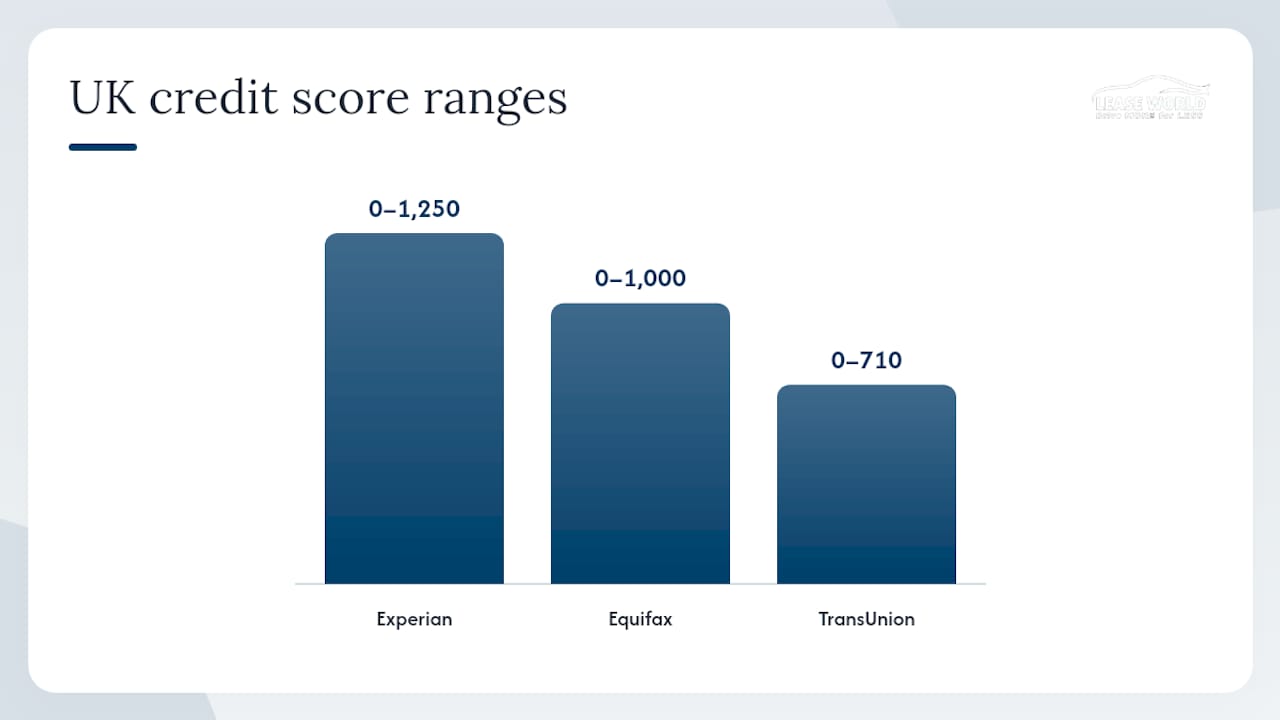
| Three CRAs, three different scales | Experian (0–1,250), Equifax (0–1,000), and TransUnion (0–710) use different ranges; check all three before applying. |
| Score is only part of the picture | Affordability, employment stability, and address history can outweigh a borderline credit score. |
| Soft searches protect your file | Use a broker's soft-eligibility check before any formal application to avoid unnecessary hard searches. |
| Lease World offers pre-checks | Lease World runs soft-eligibility checks across multiple funders, matching your profile to the most suitable option. |
Table of Contents
- Why do funders run a credit check for car leasing?
- Soft search vs hard search: what's the difference for your file?
- What credit score do you need to lease a car in the UK?
- What do lenders assess beyond the headline credit score?
- Can you lease with bad or no credit?
- Steps to improve your acceptance chances before you apply
- What to do if your lease application is declined
- Does leasing affect your credit score?
- Recent UK changes that affect how your credit is assessed
- What brokers actually see in borderline applications
- How Lease World can help with your application
- Sources
- FAQ
Why do funders run a credit check for car leasing?
Car leasing is regulated credit under the Consumer Credit Act, which means the funder — not the broker — is legally required to assess whether you can afford the agreement before signing you up. That's not optional paperwork; it's a statutory obligation. The checks car finance providers run typically cover your credit report, affordability (income versus existing commitments), proof of identity, and at least three years of address history.
Beyond compliance, funders have a straightforward commercial reason: a lease runs for two to four years, and the monthly payments fund a depreciating asset the funder still owns. They need confidence you'll pay every month, not just the first few.
Common reasons applications are declined at this stage include:
- A County Court Judgement (CCJ) registered in the past six years.
- Less than three years of continuous UK address history.
- A thin credit file with few or no credit accounts on record.
- Recent missed payments on existing credit agreements.
- Affordability shortfall — where your income minus outgoings leaves too little surplus for the monthly lease payment.
Understanding these triggers is useful because most of them are fixable, given enough lead time before you apply.
Soft search vs hard search: what's the difference for your file?
This is where a lot of applicants make an avoidable mistake. There are two types of credit search, and only one of them leaves a visible mark on your file.
| Soft search | Hard search | |
|---|---|---|
| What it is | A background check, often used for pre-qualification or eligibility tools | A full credit enquiry tied to a formal credit application |
| Visible to lenders? | No — only you can see it | Yes — all lenders can see it |
| Effect on score | None | Can temporarily reduce your score |
| When it's used | Broker eligibility checks, price comparison tools, checking your own file | Formal lease or finance applications |
| Stays on file for | Not visible to lenders at all | Typically six years |
A soft search car lease eligibility check is exactly what it sounds like: a preliminary look that tells you whether a funder is likely to approve you, without committing you to anything. Most brokers and some direct funders offer this before you submit a full application.
The risk comes when applicants apply to multiple funders in quick succession, each triggering a hard search. Lenders can see that cluster of enquiries and may interpret it as financial stress, even if you were simply shopping around. Spacing applications out, or using a broker who can check eligibility across several funders with a single soft search, avoids that problem entirely.
Pro Tip: Before submitting any formal lease application, ask the broker or funder whether they run a soft or hard search at the pre-qualification stage. A good broker will always offer a soft-eligibility check first — if they go straight to a hard search without asking, that's worth querying.
What credit score do you need to lease a car in the UK?
The honest answer: there is no single fixed minimum credit score for leasing. Different funders set different thresholds, and the same applicant can be approved by one lender and declined by another on the same day.
Part of the confusion comes from the fact that the three UK credit reference agencies (CRAs) use entirely different scoring scales. The ranges are:
- Experian: 0–1,250 (following the recent score expansion — more on that below)
- Equifax: 0–1,000
- TransUnion: 0–710
A score of 650 means something very different at Experian than it does at TransUnion. Comparing raw numbers across agencies is meaningless; what matters is which band your score falls into on each agency's own scale.
Broadly speaking, here's how bands tend to translate into lease outcomes:
- Poor/very poor: Approval is unlikely with mainstream funders. Specialist lenders may offer terms, but expect a larger initial rental and higher monthly cost.
- Fair: Approval is possible, particularly with a strong affordability profile. Some funders will offer standard terms; others may ask for a higher initial rental.
- Good: Most mainstream funders will consider the application. Terms are likely to be standard, though affordability still matters.
- Excellent/very good: Widest choice of funders and most competitive pricing.
One more thing worth knowing: the score you see on a consumer app is not the score the lender sees. Lenders build their own proprietary scoring models using CRA data combined with your application details, so your Experian score of 900 and the funder's internal score are two different numbers. The CRA score is a useful indicator of direction, not a firm approval threshold.
Because major lenders often use Experian or Equifax, while some use TransUnion, checking all three reports gives you the fullest picture of what any given funder might see. For a deeper look at what score is typically expected, Lease World's guide on what credit score you need to lease a car covers funder expectations in more detail.
What do lenders assess beyond the headline credit score?
The credit score is a starting point, not the whole story. A fair score paired with a stable income and low outgoings can outperform an excellent score with a stretched affordability position. Experian's guidance on car finance checks confirms that funders look at the full picture, not just the number.
Here's what a funder's affordability and identity assessment typically covers:
Affordability
- Gross and net monthly income (employed, self-employed, or benefits)
- Regular outgoings: rent or mortgage, existing loan and credit card payments, utilities
- Monthly surplus after committed outgoings — funders want to see the lease payment fits comfortably within that surplus
- Recent credit activity: new accounts opened, credit utilisation on cards
Identity and residency
- Proof of identity (passport or driving licence)
- Proof of address (utility bill or bank statement, usually within three months)
- Continuous UK address history for at least three years
- Electoral roll registration at your current address
Employment
- Employed applicants: employer name, length of service, payslips (usually three months)
- Self-employed applicants: two to three years of accounts or SA302 tax returns, plus bank statements
- Contract workers: copy of current contract and evidence of renewals
The documents required for a lease application are worth gathering before you start, not after a funder requests them. Having everything ready speeds up the process and signals to the funder that you're an organised applicant.
Can you lease with bad or no credit?
Yes, though the terms will reflect the additional risk the funder is taking on. The options narrow as the credit score drops, but they don't disappear entirely. For a full breakdown of routes available, Lease World's guide on leasing with bad credit covers the practical options in detail.
Here's a realistic look at what's available:
- Larger initial rental: Paying three, six, or nine months upfront reduces the funder's exposure. This is the most common route for fair or borderline applicants — the monthly payments remain the same, but the upfront cost is higher.
- Guarantor or joint applicant: A creditworthy guarantor agrees to cover payments if you default. This can unlock approval where it wouldn't otherwise be possible, but the guarantor's credit file is at risk if payments are missed.
- Specialist bad-credit funders: Some lenders specifically underwrite higher-risk applications. Rates and initial rentals are typically higher than mainstream deals, but approval rates are better for applicants with CCJs or defaults that are more than two years old.
- Short-term leasing: Contracts of three to twelve months carry less risk for the funder and can be easier to access. They cost more per month than a standard 24–48 month contract, but they're a practical option while you rebuild your file.
- Brokered applications: A broker with access to a wide funder panel can match your profile to the lender most likely to approve it, rather than sending you to the one with the most advertising spend.
A word of caution: if you see an advertisement for a "no credit check" car lease in the UK, treat it with scepticism. All regulated lease finance agreements require a credit check by law. Any provider claiming otherwise is either misrepresenting the product or operating outside the regulatory framework — neither is a position you want to be in as a consumer.
Steps to improve your acceptance chances before you apply
Timing matters here. Some improvements show up on your file within days; others take months. Working through this in the right order gives you the best chance of presenting a strong application.
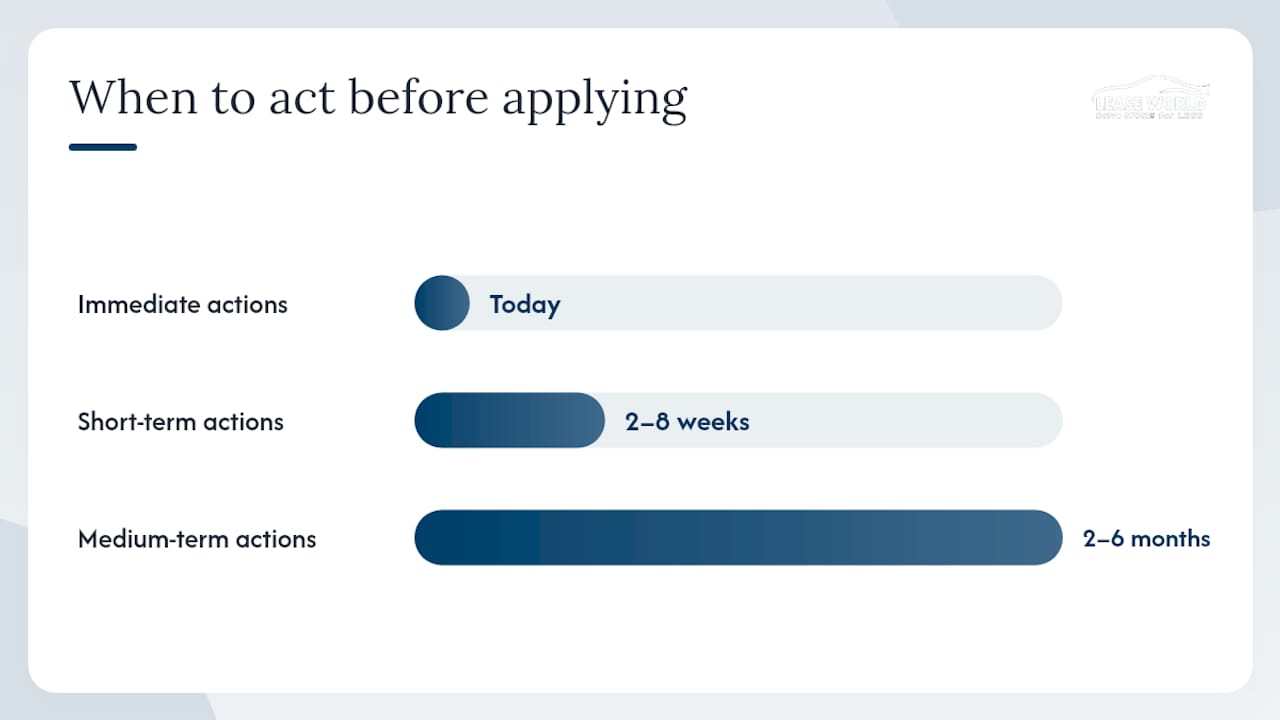
Immediate actions (do these today)
- Get your free credit reports from all three CRAs: Experian (via CreditExpert or the free statutory report), Equifax (via ClearScore), and TransUnion (via Credit Karma). Check all three — lenders may use any of them.
- Look for errors: wrong addresses, accounts you don't recognise, or defaults that should have been removed. Raise a dispute with the relevant CRA immediately.
- Check for unexpected hard searches. If you see enquiries you didn't authorise, report them.
- Register to vote at your current address if you haven't already. Electoral roll registration is one of the fastest legitimate ways to improve how lenders verify your identity, and its absence is a common reason for unnecessary friction on otherwise solid applications.
Short-term actions (two to eight weeks)
- Reduce credit card balances to below 30% of your credit limit where possible. High utilisation is a visible risk signal to funders.
- Stop applying for new credit. Every hard search in the weeks before a lease application adds noise to your file.
- If you rent your home, consider adding your rental payments to your credit file via a rent reporting service such as CreditLadder or Canopy. Consistent rent payments are evidence of financial reliability that many files don't currently capture.
Medium-term actions (two to six months)
- Build a consistent payment record across all existing accounts. Even a few months of clean payments after a difficult period can shift a lender's view.
- Save for a larger initial rental. Three months' upfront instead of one reduces the funder's risk and can tip a borderline application into approval.
- If you're self-employed, get your accounts and SA302 returns in order now. Missing documentation is a common reason for delays and declines that have nothing to do with the underlying credit position.
Pro Tip: Improvements to your credit file don't appear instantly. A corrected error can take four to six weeks to update across all three CRAs. Plan your application timeline around that lag, not around when you made the change.
What to do if your lease application is declined
A decline isn't the end of the road, but the next steps matter. Acting quickly and in the right order gives you the best chance of either overturning the decision or finding an alternative route.
Immediate steps after a decline
- Ask the lender or broker which CRA they used for the decision. Under data protection rules, they should tell you.
- Request a copy of the decision notice. This should state the reason for the decline, even if only in general terms.
- Pull the specific CRA file the lender used and look for the issue. Common culprits: an address mismatch, a default you weren't aware of, or a CCJ that should have been satisfied.
- If you find an error, raise a formal dispute with the CRA. Under UK data protection rules, you can request the file and raise a dispute, typically within 28 days of the decision.
- Gather supporting documents that address the specific reason for decline.
Documents that commonly help overturn a decline or support a reapplication:
- Proof of rent payments (bank statements showing regular payments to a landlord or letting agent)
- An employer's letter confirming salary, contract type, and length of service
- Three to six months of bank statements showing consistent income and manageable outgoings
- SA302 tax returns for self-employed applicants
- Proof that a CCJ has been satisfied (a certificate of satisfaction from the court)
Alternative routes if the decline stands
- Use a broker's soft-eligibility tool to check which funders on their panel are likely to approve your profile before any further hard searches go in.
- Consider a guarantor or joint applicant to strengthen the application.
- Look at short-term lease options as a bridge while you improve your file.
- A higher initial rental may be enough to shift the risk calculation for some funders.
The step-by-step leasing process guide covers what happens at each stage from application to delivery, which can help you understand where in the process the issue arose.
Does leasing affect your credit score?
It does, in both directions — and understanding which way depends on what you do during the contract.
When you apply: the formal application triggers a hard search, which is visible to other lenders for six years. Its practical influence on lenders' decisions fades significantly after about twelve months, but it's there. Multiple hard searches in a short window amplify the effect.
During the lease: the funder typically reports your payment record to one or more CRAs each month. This is actually an opportunity. Consistent on-time payments build a positive payment history, which is one of the most influential factors in any credit scoring model. A two or three-year lease with a clean payment record can meaningfully strengthen your file.
If you miss payments: a missed payment is recorded on your file and stays there for six years. A default — typically triggered after three to six consecutive missed payments — is more serious and will affect future credit applications across all product types, not just leasing.
Dos and don'ts while you're on a lease:
- Do set up a direct debit for the full monthly payment so you never miss a date.
- Do notify the funder immediately if you're facing financial difficulty — most have hardship processes that can prevent a formal default.
- Don't open multiple new credit accounts during the lease term if you're planning another credit application soon after.
- Don't ignore correspondence from the funder. Unresolved arrears escalate quickly.
Recent UK changes that affect how your credit is assessed
Experian's 0–1,250 score expansion
The most significant recent change for UK consumers is Experian's expanded score range, which moved from the previous 0–999 scale to a new 0–1,250 model. The expanded range allows Experian to incorporate additional data sources, including rent reporting, overdraft management behaviour, and mortgage overpayment history. For consumers who have been responsibly managing finances that weren't previously captured by traditional credit data, this is a meaningful shift.
If your Experian score looks different from what you expected, the new scale is likely the reason. A score that previously sat at 850 out of 999 doesn't map directly onto the new scale, so it's worth checking your current band rather than comparing the raw number to what you had before.
Additional data lenders are starting to use
Beyond the Experian change, there's a broader trend towards using a wider range of financial behaviour in affordability assessments:
- Rent payments reported via services like CreditLadder or Canopy now appear on Experian and Equifax files for participating landlords and tenants.
- Overdraft usage patterns are increasingly factored into affordability models, particularly for applicants who regularly use their full overdraft limit.
- Open Banking data, where applicants consent to share live bank account information, is being used by some funders as a real-time affordability check that supplements the CRA report.
Practical steps to check what's on your file now
- Log into your Experian, ClearScore (Equifax), and Credit Karma (TransUnion) accounts and check the data section, not just the score.
- If you've been using a rent reporting service, confirm the payments are appearing correctly.
- If you've consented to Open Banking with any lender, check what data was shared and whether it's reflected accurately.
What brokers actually see in borderline applications
Most declined applications have a fixable problem. After working through borderline cases, the same issues come up repeatedly: an address on the credit file that doesn't match the application, an employer name that doesn't match the payslip, or an electoral roll registration that lapsed when someone moved house and never got updated. None of these are credit problems in the traditional sense, but they're enough to trigger an automated decline.
The practical value of using a broker for a borderline application comes down to two things. First, a broker with a wide funder panel can run a single soft-eligibility check across multiple lenders simultaneously, identifying which funders are most likely to approve the specific profile without leaving a trail of hard searches. Second, a good broker knows which funders weight affordability more heavily than the headline score, and which ones are more flexible on thin files or recent address changes.
Realistic timelines: if your file has errors, allow four to six weeks for corrections to propagate across all three CRAs before submitting a formal application. If you're building a payment history from scratch, three to six months of consistent payments makes a visible difference. If the issue is a CCJ that's been satisfied, the certificate of satisfaction can be added to your file relatively quickly, but the CCJ itself remains visible for six years from the date it was registered.
One thing that often gets overlooked: a larger initial rental isn't just a workaround for bad credit. For borderline applicants with a fair score and strong income, offering three or six months upfront can be the difference between a standard approval and a declined application, without any change to the underlying credit position. It's a lever worth considering before spending months trying to move a score by a few points.
How Lease World can help with your application
Sorting out credit checks before you apply is exactly where Lease World adds the most value. As a UK-based vehicle leasing broker, Lease World runs soft-eligibility checks before any formal application goes in, which means you can find out where you stand without affecting your credit file.
Because Lease World works with a panel of funders rather than a single lender, borderline applicants get matched to the funder most likely to approve their specific profile. That includes options for higher initial rentals, short-term contracts, and specialist finance for applicants with fair or recovering credit. Pricing is transparent, there are no hidden fees, and the team walks you through what each funder is looking for before you commit to anything.
If you're ready to check your eligibility or get a personalised quote, start your enquiry with Lease World — have your income details, address history, and a rough idea of the vehicle you want ready, and the process moves quickly. For more guidance on what to expect at each stage, the leasing guides hub covers everything from eligibility criteria to delivery timelines.
Sources
These are the primary sources worth bookmarking if you're preparing a lease application or working through a credit issue:
- What Checks Are Done for Car Finance? | Experian
- How UK Credit Scores Work: 2026 Guide | Swift Money
- What Is a Credit Score Range in the UK — and What "Good" Actually Means | Personal Finance Clarity
- Register to vote
- Why is my credit score different on different sites? | Ocean Finance
- What credit score do you need to lease a car in the UK - The AA
This article is general information, not a substitute for advice from a qualified financial advisor. Consult a qualified financial professional about your own circumstances before acting on anything here.
FAQ
Do you need a credit check to lease a car in the UK?
Yes. All regulated car lease agreements in the UK require a credit check — there are no legal exceptions. The funder must verify your identity and assess your ability to make payments before the agreement is signed.
Does a car lease application affect your credit score?
A formal application triggers a hard search, which is visible to lenders for six years, though its practical impact fades significantly after around twelve months. Once the lease is running, on-time payments build a positive payment record; missed payments cause lasting damage.
Is a 550 credit score too low to lease a car in the UK?
It depends on which CRA's scale you're using and which funder you approach. A score in that range typically falls in the poor or fair band, which makes mainstream approval unlikely but doesn't rule out specialist funders, a larger initial rental, or a guarantor arrangement. For car leasing eligibility guidance specific to your situation, a broker soft-eligibility check is the most useful first step.
Can you lease a car with a 600 credit score?
Possibly, particularly if your affordability profile is strong. Fair-range scores can lead to approval by some funders who consider stable income and low existing commitments. A larger initial rental or a guarantor can also improve the outcome.
What's the difference between a soft and hard search for a car lease?
A soft search is used for pre-qualification and leaves no mark visible to lenders; a hard search is tied to a formal application and is visible on your file. Always ask whether a broker or funder is running a soft or hard search before you proceed.