

The Benefit-in-Kind rate for a fully electric company car is set at a low percentage of its P11D value for the 2026/27 tax year, currently around four percent. That percentage, multiplied by the car's list price, gives the taxable benefit your income tax is based on. Before you do anything else, dig out your car's P11D value and its zero-emission mileage figure (both sit in your P11D form or your leasing paperwork) so you can run your own numbers as you read on.
Key takeaways
| Point | Details |
|---|---|
| Current EV BiK rate | 4% of P11D value applies for the 2026/27 tax year, rising to 5% in 2027/28. |
| Formula to remember | Taxable benefit = P11D value × BiK percentage; tax due = taxable benefit × your income tax rate. |
| Salary sacrifice compounds savings | Combining salary sacrifice with the low EV percentage can reduce both income tax and National Insurance further. |
| Check these two figures first | Confirm your car's exact P11D value and zero-emission mileage figure with payroll or the manufacturer's spec sheet. |
| Revisit annually | Rates change with each Budget and at lease renewal, so recheck figures yearly or when comparing new deals via Lease World's electric car leasing page. |
Table of Contents
- What is electric car BiK and how does HMRC set the rate?
- The official BiK rate timeline for electric cars through 2029/30
- How to calculate your electric car BiK tax step by step
- Salary sacrifice, payrolling and what your employer must report
- Charging, second cars and other edge cases that change your bill
- How leasing choices affect your BiK exposure
- What actually matters here, and what gets overstated
- Get an EV lease that works with the BiK rules, not against them
- Sources
- FAQ
What is electric car BiK and how does HMRC set the rate?
Benefit-in-Kind tax exists because a company car is a perk, not a wage, but HMRC still wants its share. You pay income tax on a slice of the car's value each year; your employer pays Class 1A National Insurance on the same figure. Neither of you touches actual cash for the "benefit" itself. It's taxed as if it were extra income, at whatever rate applies to your earnings.
HMRC calculates that taxable slice using two things: the car's P11D value and an "appropriate percentage" tied to its CO2 emissions and, for low-emission cars, its electric range. This banding system is published in HMRC's Appendix 2 tables, and it's why a diesel estate and a fully electric hatchback with an identical list price can land you with wildly different tax bills.
The P11D value itself has strict rules. It includes:
- The manufacturer's list price on the day before first registration
- VAT
- Delivery charges
- Fitted accessories and factory options
It excludes:
- The first registration fee
- Annual Vehicle Excise Duty (road tax)
A common mistake is assuming P11D equals whatever your employer negotiated with the dealer or leasing company. It doesn't. HMRC uses the manufacturer's published list price, regardless of any fleet discount your employer secured, according to HMRC's guidance on working out company car benefit.
Pro Tip: Your zero-emission mileage figure and CO2 rating sit in the vehicle's Certificate of Conformity, on the manufacturer's technical spec sheet, or you can calculate it directly via HMRC's company car tool. Don't rely on a sales brochure figure. Always cross-check against the registration documents.
The official BiK rate timeline for electric cars through 2029/30
The 4% rate for 2026/27 isn't a one-off. It's a scheduled step on a published trajectory that HM Treasury has confirmed will run through the end of the decade.
| Tax year | BiK rate for zero-emission cars |
|---|---|
| — | 2% |
| — | 3% |
| 2026/27 | 4% |
| 2027/28 | 5% |
| 2028/29 | 7% |
| 2029/30 | 9% |
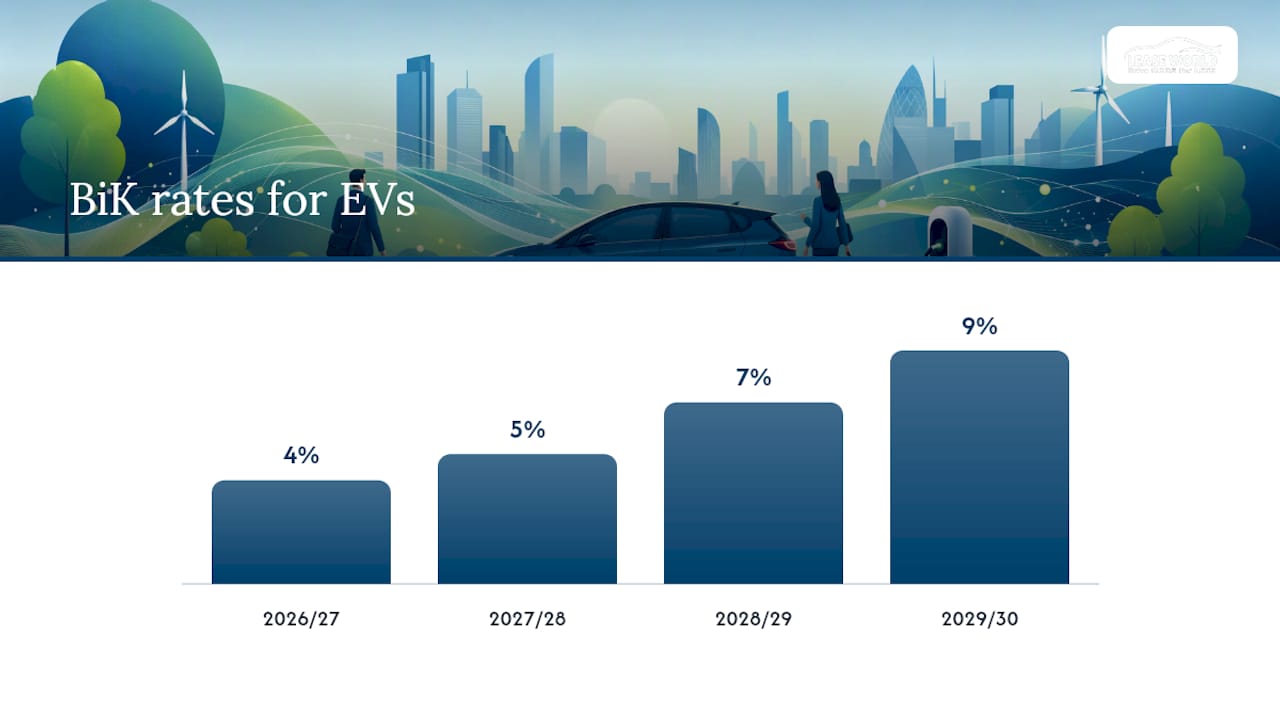
The government confirmed the 2028/29 and 2029/30 increases in its published rates document, stepping the rate up by 2 percentage points in each of those two years rather than the 1-point annual rises seen earlier in the decade, as set out in HMRC's company car tax rates for 2028 to 2030.
Even at a higher rate in 2029/30, electric cars will still be taxed at a rate significantly lower than typical petrol or diesel vehicles, which are taxed at substantially higher percentages depending on emissions. HMRC's own taxation policy for company cars confirms the whole regime is designed to keep pushing drivers towards zero-emission vehicles, not to erase the incentive.
This trajectory matters most if you're weighing up lease length. Sign a three-year deal starting in 2026/27 and your BiK percentage doesn't creep up with the annual Budget.
How to calculate your electric car BiK tax step by step
The arithmetic behind BiK is genuinely simple once you have the two key inputs. Three steps take you from list price to an actual monthly deduction.
- Work out the taxable benefit: P11D value × appropriate percentage (4% for 2026/27).
- Calculate your personal tax: taxable benefit × your marginal income tax rate (20%, 40%, or 45%).
- Check the employer's cost: Class 1A National Insurance = taxable benefit × 15%, paid by the employer, not deducted from your pay.
Here's how that plays out for a Tesla Model 3 with a P11D value of £42,000, a car regularly listed on UK leasing sites and a realistic proxy for the mid-range EVs most company car drivers are choosing.
Taxable benefit: £42,000 × 4% = £1,680
Only your personal deduction moves, and even at the additional rate you're paying under £64 a month on a car with a £42,000 list price, worked through using the same P11D-times-percentage method set out in this EV company car tax calculator and worked examples.
Making a one-off capital contribution toward the car reduces the P11D value used in calculations, but HMRC limits the maximum deductible contribution allowed. A substantial contribution can meaningfully lower the taxable benefit and associated tax figures. This detail sits in HMRC's chapter on company car benefit calculations and it's one of the more overlooked levers employees actually control.

Salary sacrifice, payrolling and what your employer must report
Salary sacrifice schemes stack an extra layer of saving on top of the low EV percentage. You give up a slice of gross salary in exchange for the car, which lowers your National Insurance and income tax on that sacrificed amount, while the car itself is still only taxed at 4% of its P11D value. Combine the two and the effective cost of driving a new electric car through work can undercut buying the same model privately by a wide margin, a point covered in more depth in Lease World's guide to electric car tax benefits.
Whether your employer "payrolls" the benefit changes how you experience the tax, not how much you pay. Payrolled benefits get taxed through your monthly payslip in real time; non-payrolled benefits get reported annually on a P11D form and HMRC adjusts your tax code retrospectively, sometimes months after the benefit started. Payrolling is generally easier to track. Non-payrolling can produce an unwelcome tax code surprise the following spring if the P11D wasn't submitted promptly.
Employers carry their own obligations here, and it's worth knowing what they are so you can ask sensible questions:
- Submit the P11D (or register for payrolling) by the annual HMRC deadline.
- Pay Class 1A National Insurance on the taxable benefit by 22 July following the tax year, per HMRC's guidance on tax for company cars.
- Keep accurate records of the car's list price, CO2 figure, and any employee capital contribution.
Before you accept payroll's figures at face value, ask for:
- The exact P11D value used in the calculation
- The BiK percentage applied
- Confirmation of whether the benefit is payrolled or reported via P11D
- The employer's Class 1A NIC treatment for that vehicle
Pro Tip: Always ask HR for the P11D breakdown in writing. A verbal "it's about £1,600" is not something you can query with HMRC if the figure turns out to be wrong.
Charging, second cars and other edge cases that change your bill
Most BiK confusion comes from situations that fall outside the textbook example. A handful of scenarios come up again and again.
- Employer-paid charging: electricity provided by your employer for a company car isn't taxed as a separate fuel benefit the way petrol is, but the rules depend on whether charging happens at a workplace unit or is reimbursed for home charging.
- Two company cars at once: if you have access to two vehicles simultaneously, HMRC generally taxes you on both, calculated separately using each car's own P11D value and percentage.
- Short-term unavailability: if the car is off the road for more than 30 consecutive days (a long repair, for instance), the taxable benefit is time-apportioned for the days you didn't have use of it.
- Fitted accessories: dealer-fitted extras added after the initial P11D calculation, above a £100 threshold, get added to the taxable value in later years.
The single most common query employees raise with payroll teams isn't about the percentage itself, it's about whether an accessory, a second vehicle, or a period off the road has actually been reflected correctly in the annual figure.
For anything genuinely unusual, HMRC's calculator for company car tax walks through the specific scenario rather than relying on the generic examples most guides publish.
How leasing choices affect your BiK exposure
Lease World is a vehicle leasing broker, not a tax adviser, so nothing here replaces checking your specific figures with HMRC or an accountant. What Lease World does have is direct visibility into how P11D values, lease lengths and BiK percentages interact across hundreds of electric vehicle deals each year, and that's genuinely useful when you're choosing a car rather than just calculating tax on one you already have.
A few concrete ways this helps in practice:
- Estimating the likely P11D value of a specific EV trim before you commit, since options and accessories can shift it noticeably.
- Comparing lease lengths against the published BiK trajectory, so a three-year contract locks in the 4% rate rather than exposing you to the 7% and 9% steps due in 2028/29 and 2029/30.
- Advising on how a capital contribution affects both the taxable benefit and the monthly lease payment.
- Explaining the practical difference between payrolled and P11D-reported benefits when you're deciding between a salary sacrifice scheme and a standard company car.
Pro Tip: If you're comparing several EVs for a company car scheme, ask for the P11D value of each trim level before you decide, since a mid-spec model with a lower P11D can sometimes beat a base model loaded with taxable accessories.
What actually matters here, and what gets overstated
The conventional advice on electric car BiK spends too much time on the headline percentage and not nearly enough on lease timing.
The other thing that gets underplayed is the capital contribution. A £5,000 upfront payment sounds like it defeats the point of leasing a car through work, and for some people it does. But run the numbers properly and that contribution can shave a meaningful chunk off your annual tax bill for the entire length of the lease, not just year one. Most guides mention it in passing. Few actually show you the arithmetic, which is precisely why it gets ignored by people who'd benefit from using it.
If there's one thing to prioritise above everything else in this article, it's checking your actual P11D value rather than trusting an estimate from a sales conversation. The percentage HMRC applies is fixed and public. The list price is where genuine confusion creeps in, and it's the one figure entirely within your control to verify before you sign anything.
Get an EV lease that works with the BiK rules, not against them
Lease World specialises in matching UK employees and businesses with electric company car deals that make sense once BiK is factored in, not just on sticker price. Because BiK rewards timing as much as it rewards the vehicle you pick, getting the lease length, P11D value and capital contribution right before you sign matters more with an EV than with a petrol car.

Lease World's team can talk you through P11D estimates for specific trims, compare lease terms against the published BiK trajectory through 2029/30, and explain whether payrolling or standard P11D reporting suits your situation better, all before you commit to a contract. Family-run and free from the hidden fees larger fleet brokers tend to bury in the small print, Lease World offers fixed monthly payments, no-deposit options, and free UK mainland delivery on eligible electric vehicles. If you're ready to see what a specific EV would actually cost you once BiK is factored in, get a personalised leasing quote and ask for the P11D breakdown alongside it.
This article is general information, not a substitute for advice from a qualified financial advisor. Consult a qualified financial professional about your own circumstances before acting on anything here.
Sources
For anyone who wants to verify the figures independently rather than take a payslip on trust, these are the primary sources this article draws on:
- Work out the appropriate percentage for company car benefits (480: Appendix 2)
Lease World's own guide to company car tax walks through these same rules in more consumer-friendly language, and readers wanting a third-party billing breakdown can also consult EV Risk Index's invoice analyser for a closer look at how P11D-relevant costs get itemised on dealer paperwork.