

TL;DR:
- Company car tax, known as Benefit-in-Kind, is paid based on a vehicle's P11D value, BiK percentage, and marginal income tax rate. Choosing a fully electric car with a 4% BiK rate in 2026/27 significantly reduces the tax liability compared to petrol cars, especially for higher-rate taxpayers. Employees should compare post-tax costs, including optional extras, before selecting a company vehicle to optimize tax savings.
Company car tax is the Benefit-in-Kind (BiK) charge you pay when your employer makes a vehicle available for private use. You pay income tax on the taxable value of that benefit, not on the car itself. The formula is straightforward: P11D value × BiK percentage × your marginal income tax rate. To get started, find your car's P11D value and CO₂ emissions, then run the numbers through HMRC's official calculator.
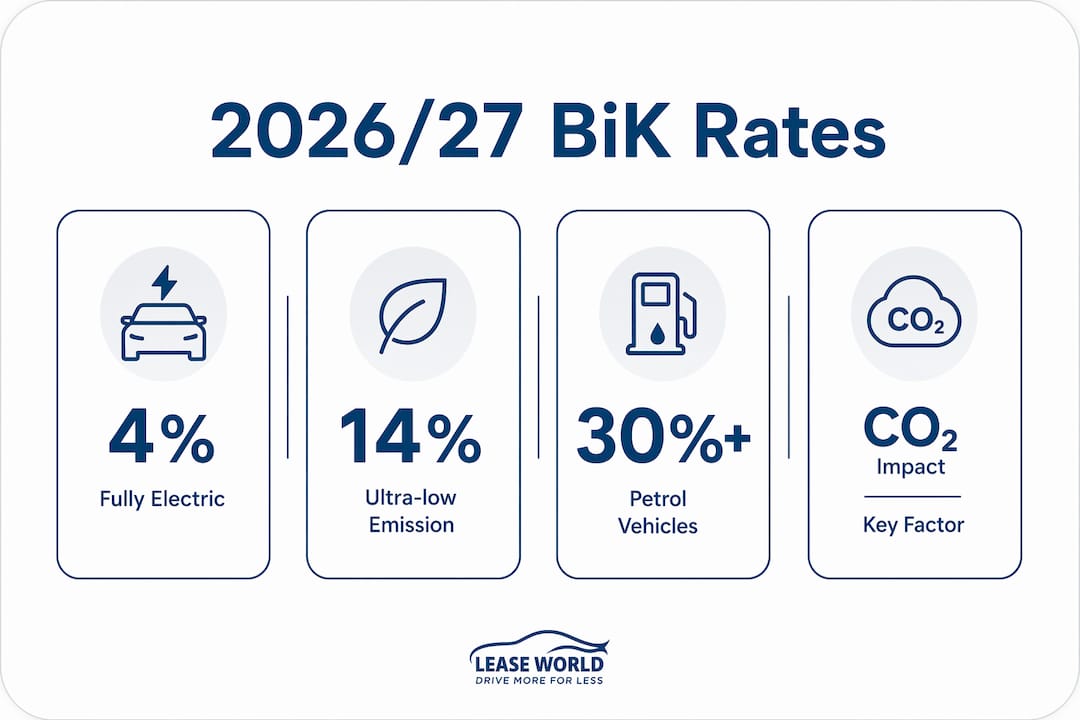
For 2026/27, a fully electric car carries a BiK rate of just 4%, while a typical petrol car can sit at 30% or above. That gap makes fuel type the single biggest lever on your annual bill.
Table of Contents
- How is company car tax actually calculated?
- What are the current BiK rates for 2026/27?
- What factors push your BiK bill up or down?
- How is the tax collected and what must your employer report?
- How can you legally reduce or avoid company car tax?
- Which tools help you calculate your company car tax?
- Key takeaways
- The number most employees never check before signing
- Thinking about your next company car lease?
- Useful sources
- FAQ
How is company car tax actually calculated?
The taxable benefit equals the car's P11D value multiplied by the BiK percentage for its emissions band. Your income tax is then applied to that figure at your marginal rate.
The formula:
- Taxable benefit = P11D value × BiK%
- Annual tax payable = Taxable benefit × your income tax rate (20%, 40%, or 45%)
- Monthly cost = Annual tax ÷ 12
What counts as the P11D value?
The P11D value is the manufacturer's list price including VAT, delivery charges, and any optional extras fitted before or at delivery. It excludes the first-year registration fee and annual vehicle tax (road tax). Optional extras matter more than most employees realise: a £1,500 panoramic roof added before delivery increases the P11D and therefore the taxable benefit for the entire time you keep the car.
Worked example
Say your employer provides a petrol car with a typical list price and CO2 emissions that place it in a higher BiK band for 2026/27.
- Taxable benefit: list price multiplied by the applicable BiK percentage
- Basic-rate taxpayer pays income tax on this resulting benefit at 20%
- Higher-rate taxpayer pays income tax on this resulting benefit at 40%
Run the same calculation for a fully electric car at the same list price:
- Taxable benefit is significantly lower due to reduced BiK percentage
- Tax payable is then that benefit multiplied by your marginal tax rate
That can represent a substantial difference in annual tax liability depending on your tax band. Your marginal rate is why two colleagues driving identical cars can face very different bills.
Tax is usually collected through a PAYE code adjustment, meaning your employer reduces your tax-free allowance so HMRC recovers the BiK tax across the year. Some employers payroll the benefit instead, which spreads the deduction monthly and avoids a lump-sum adjustment.
What are the current BiK rates for 2026/27?
BiK percentages are set by HMRC and updated each tax year. For 2026/27, the appropriate percentage for zero-emission cars rises by 1 percentage point to 4%; the roadmap then takes it to 5% by 2027/28 and to 9% by 2029/30. Petrol and diesel bands above 75g/km CO₂ are held at their 2025/26 levels through to April 2028, capped at a maximum of 37%.

| Vehicle type | CO₂ (g/km) | BiK % 2026/27 |
|---|---|---|
| Fully electric | — | 4% |
| Ultra-low emission (PHEV) | 1–50 mile EV range | 5% |
| Ultra-low emission (PHEV) | 1–50 mile EV range | 12% |
| Ultra-low emission (PHEV) | 1–50 mile EV range | — |
| Petrol / diesel | — | 30% |
| Petrol / diesel | — | 30% |
| Petrol / diesel | — | 37% |
Source: GOV.UK appropriate percentage tables
HMRC publishes the full CO₂ ready-reckoner tables on GOV.UK, and rates are confirmed at each Autumn Statement. Future rates beyond 2027/28 have yet to be announced for petrol and diesel vehicles.
What factors push your BiK bill up or down?
Several variables feed into the final number, and some are within your control.
Factors that increase the taxable benefit:
- A higher P11D/list price including optional extras added before delivery increases the taxable benefit.
- Higher CO₂ emissions place the car in a higher BiK band, increasing the taxable benefit.
- Private fuel provided by the employer — this creates a separate fuel benefit charge calculated using the same BiK percentage applied to a statutory fuel charge figure; paying for private fuel yourself removes it entirely
- The car being available for private use for the full tax year
Factors that reduce the taxable benefit:
- Choosing a lower-emission or fully electric car
- Making employee capital contributions (up to the statutory maximum) — these reduce the P11D value used in the calculation
- If the car is unavailable for private use for a sustained period, the taxable benefit is correspondingly reduced.
- Paying privately for all private fuel to eliminate the fuel benefit charge
Special cases worth knowing:
Plug-in hybrids registered on or after 1 January 2025 may qualify for a PHEV easement that allows a nominal CO₂ figure to be used, reducing the BiK percentage in qualifying cases. Employers must verify registration dates and documentation carefully before applying it.

Pro Tip: Optional extras fitted before delivery count towards the P11D value and raise your BiK bill for the life of the car. If your employer is ordering a new vehicle, check whether those extras are genuinely worth the ongoing tax cost.
How is the tax collected and what must your employer report?
For most employees, BiK tax arrives via a PAYE code adjustment. HMRC reduces your personal allowance by the taxable benefit amount, so more of your salary is taxed at source across the year. If your employer has opted to payroll the benefit, the deduction appears as a line on your monthly payslip instead.
Employers carry their own obligations. They must submit a P11D form for each employee with a company car by 6 July following the end of the tax year, reporting the P11D value, the BiK percentage used, and whether private fuel was provided. They also pay Class 1A National Insurance on the total taxable benefit at the current employer NI rate, with payment due by 19 July (22 July if paying electronically).
Errors in P11D reporting carry penalties, which is why HMRC recommends using its official calculator or reputable payroll software to confirm figures before submission.
Documents to request from your employer:
- The P11D value used for your car
- The BiK percentage applied (and the CO₂ figure or EV range it is based on)
- Confirmation of whether private fuel is being reported as a benefit
- Whether your BiK is being collected via PAYE code or payrolled
How can you legally reduce or avoid company car tax?
There are several legitimate routes, and the right one depends on your situation.
- Choose a fully electric car. An EV generally carries a much lower BiK percentage compared to petrol cars, making it more tax-efficient in 2026/27. Tax specialists note that EVs are the most effective single lever for reducing BiK liabilities, particularly for higher-rate taxpayers and directors.
- Make capital contributions. Paying a lump sum towards the car's cost reduces the P11D value used in the calculation, up to the statutory maximum. Contributions must be made within the tax year or by 6 July following it to count.
- Pay for private fuel yourself. If your employer provides fuel for private journeys, a separate fuel benefit charge applies. Paying for all private fuel removes that charge entirely.
- Use a pool car. A car used exclusively for business and not kept overnight at an employee's home is exempt from BiK. Pool car arrangements require active employer monitoring to maintain the exemption.
- Claim HMRC AMAP rates instead. Using your own car for business and claiming the Approved Mileage Allowance Payment avoids BiK altogether, though it suits lower-mileage drivers better.
- Salary sacrifice for an EV. Some employers offer salary sacrifice schemes that let you lease an EV from pre-tax salary. The BiK still applies, but the combined saving can be significant for basic and higher-rate taxpayers. Check the scheme terms carefully, as the tax treatment depends on the arrangement structure.
EV vs petrol at the same list price (2026/27):
Using the worked example above, a higher-rate taxpayer driving a £30,000 petrol car at 30% BiK pays £3,600/year in company car tax. The same driver in a £30,000 EV at 4% BiK pays £480/year. That is a saving of £3,120 annually, before any difference in fuel or running costs. For a comparison of real-world leasing costs between electric and petrol options, the Lease World EV vs petrol guide breaks down the full picture.
Pro Tip: If you are negotiating a new company car, ask your employer for the P11D value and CO₂ figure before you agree. Two cars with similar monthly lease costs can produce very different BiK bills — compare post-tax cost, not list price.
Which tools help you calculate your company car tax?
The authoritative starting point is HMRC's official company car tax calculator on GOV.UK. It is updated for each tax year and covers both the car benefit and the separate fuel benefit charge. Employers and employees can use it to confirm taxable values before P11D submission.
For a faster, more visual experience, Comcar (comcar.co.uk) is a well-regarded third-party calculator that lets you compare multiple cars side by side and shows the monthly tax cost at both 20% and 40% rates. It is particularly useful when choosing between vehicles. Bear in mind that third-party tools may lag slightly behind HMRC rate updates at the start of a new tax year, so always cross-check a significant figure against the GOV.UK source.
Employers typically use payroll software such as Sage, Xero, or BrightPay to handle BiK through payrolling, which automates the monthly deduction and reduces the risk of P11D errors.
Input checklist for any calculator:
- P11D (list) value of the car
- CO₂ emissions (g/km) or confirmation it is fully electric
- Electric-only range in miles (for PHEVs)
- Number of days the car was available for private use
- Any employee capital contributions made
- Whether private fuel is provided by the employer
- Your marginal income tax rate (20%, 40%, or 45%)
For a broader look at how company car arrangements compare with personal leasing, the company car vs personal lease guide from Lease World sets out the key differences clearly.
Key takeaways
Company car tax (BiK) is calculated as P11D value × BiK percentage × your marginal tax rate, and choosing a fully electric car at 4% BiK for 2026/27 is the single most effective way to reduce the bill.
| Point | Details |
|---|---|
| BiK formula | Taxable benefit = P11D value × BiK%; your tax = taxable benefit × marginal rate (20%, 40%, or 45%). |
| EV advantage | Fully electric cars carry a 4% BiK rate in 2026/27, versus 30% or more for typical petrol cars. |
| Reduction levers | Capital contributions, paying for private fuel, and pool car arrangements can all lower or eliminate the charge. |
| Tax collection | BiK is usually collected via a PAYE code adjustment or payrolled monthly; your employer reports it on a P11D by 6 July. |
| Lease World | Lease World's leasing guides and EV lease options help you compare tax-efficient vehicles before committing. |
The number most employees never check before signing
The conversation around company car tax tends to focus on the headline BiK percentage, and that is understandable. But the figure that actually determines your bill is the P11D value, and most employees sign off on a company car without ever asking what it is.
Optional extras are the quiet culprit. A metallic paint finish, upgraded alloys, or a technology pack can add several thousand pounds to the P11D, and that uplift compounds every year you keep the car. A £2,000 optional extra on a car with a 30% BiK rate costs a higher-rate taxpayer £240 per year in additional tax. Over a three-year lease, that is £720 for a colour choice.
The EV case is genuinely compelling, and not just for directors. Choosing an electric car over petrol at similar list prices can lead to significant company car tax savings for many taxpayers. The salary sacrifice route adds another layer of efficiency for those whose employers offer it, though the terms vary enough that it is worth reading the scheme rules rather than assuming the saving is automatic.
What employees rarely do is compare the post-tax cost of two or three shortlisted cars before agreeing with their employer. Financial advisers consistently point out that comparing post-tax cost rather than list price alone is what separates a genuinely good company car deal from one that looks attractive until the first payslip.
Thinking about your next company car lease?
If the BiK calculation has you leaning towards an electric car, Lease World makes it straightforward to compare EV lease deals without the usual back-and-forth. As a family-run business, Lease World offers fixed monthly payments, no-deposit options, and free UK delivery on eligible vehicles — so you can see the full cost clearly before you commit.

Browse the electric car leasing options on the Lease World website to find low-BiK vehicles with transparent pricing, or explore the full leasing guides for broader advice on making the most tax-efficient choice. Get a quote today and see how much you could save.
This article is general information, not tax or financial advice. Confirm current rates and your specific position with HMRC or a qualified tax adviser.
Useful sources
- Tax on company cars — GOV.UK: Official HMRC guidance on when BiK applies and how it is calculated.
- HMRC company car tax calculator — GOV.UK: The official tool for calculating car and fuel benefit values; updated each tax year.
- Appropriate percentage tables (480: Appendix 2) — GOV.UK: Full CO₂ ready-reckoner tables for petrol, diesel, hybrid, and electric cars.
- Appropriate percentages for 2025/26, 2026/27, 2027/28 — GOV.UK: Confirmed rate changes across three tax years.
- How to work out the benefit of a company car (480: Chapter 12) — GOV.UK: Detailed HMRC guidance on P11D value, capital contributions, and unavailability rules.
- PHEV BiK easement — GOV.UK: Official guidance on the easement for qualifying plug-in hybrids registered from 1 January 2025.
- Comcar company car tax calculator: Third-party calculator for side-by-side vehicle comparisons; cross-check results against HMRC figures.
- Fleet News BiK guide: Industry reference explaining how marginal tax rates affect the final BiK bill.
FAQ
What is company car tax and who pays it?
Company car tax is the Benefit-in-Kind (BiK) charge on private use of an employer-provided vehicle. The employee pays income tax on the taxable benefit value; the employer pays Class 1A National Insurance on the same amount.
How can you avoid paying company car tax?
The most effective legal routes are choosing a fully electric car (4% BiK in 2026/27), using a pool car that is never kept overnight at your home, or using your own car and claiming HMRC AMAP rates instead.
Do you pay 20% or 40% company car tax?
It depends on your income tax band. Basic-rate taxpayers pay 20% on the taxable benefit; higher-rate taxpayers pay 40%. A higher-rate taxpayer pays roughly twice the company car tax of a basic-rate taxpayer on the same vehicle, reflecting differences in marginal tax rates.
What is the company car tax rate for 2026/27?
The BiK rate for fully electric cars is 4% in 2026/27, rising to 5% in 2027/28. Petrol and diesel cars above 75g/km CO₂ are held at their 2025/26 rates through to April 2028, with a maximum of 37%. Full tables are published on GOV.UK.