

A zero-deposit car lease lets you drive away without paying an initial rental upfront. The cost does not disappear; it is spread across your monthly payments, which means you typically pay more each month and often more overall. For most UK drivers, the real benefit is cashflow preservation, not a cheaper deal overall.
That trade-off sits at the heart of this guide. You will find a worked cost example, a side-by-side comparison of deposit structures, a contract risk checklist, and a practical decision framework to help you choose the right option for your circumstances.
Table of Contents
- How zero-deposit car leasing works in the UK
- Zero deposit versus low deposit and traditional leasing
- Who benefits most from a no-deposit car lease?
- Eligibility, credit checks and what you need to apply in the UK
- What to watch for in the contract before you sign
- Decision checklist: how to choose between zero deposit and other options
- Lease World analysis: the cashflow trade-off in practice
- Key takeaways
- The real cost of convenience
- Lease World: get a transparent no-deposit quote
- Useful sources and further reading
- FAQ
How zero-deposit car leasing works in the UK
Standard personal contract hire (PCH) agreements ask for an initial rental at the start, usually equivalent to several months' payments. This lump sum reduces the capital the funder needs to finance over the term, which keeps monthly payments lower. A zero-deposit car lease removes that upfront payment entirely. As Kandoo explains, the deferred amount is folded into the monthly rentals, which raises them and can increase the total finance cost.
It is worth being precise about terminology. In leasing, the upfront payment is called an initial rental, not a deposit in the traditional sense. You do not get it back at the end of the contract. A zero-deposit deal simply means the initial rental is set to zero.
Key terms you will see on adverts:
- Initial rental: The lump sum paid at the start, expressed as a number of monthly payments (e.g. "3 months initial rental"). On a zero-deposit deal, this is £0.
- Monthly rental: The fixed payment you make each month for the duration of the contract.
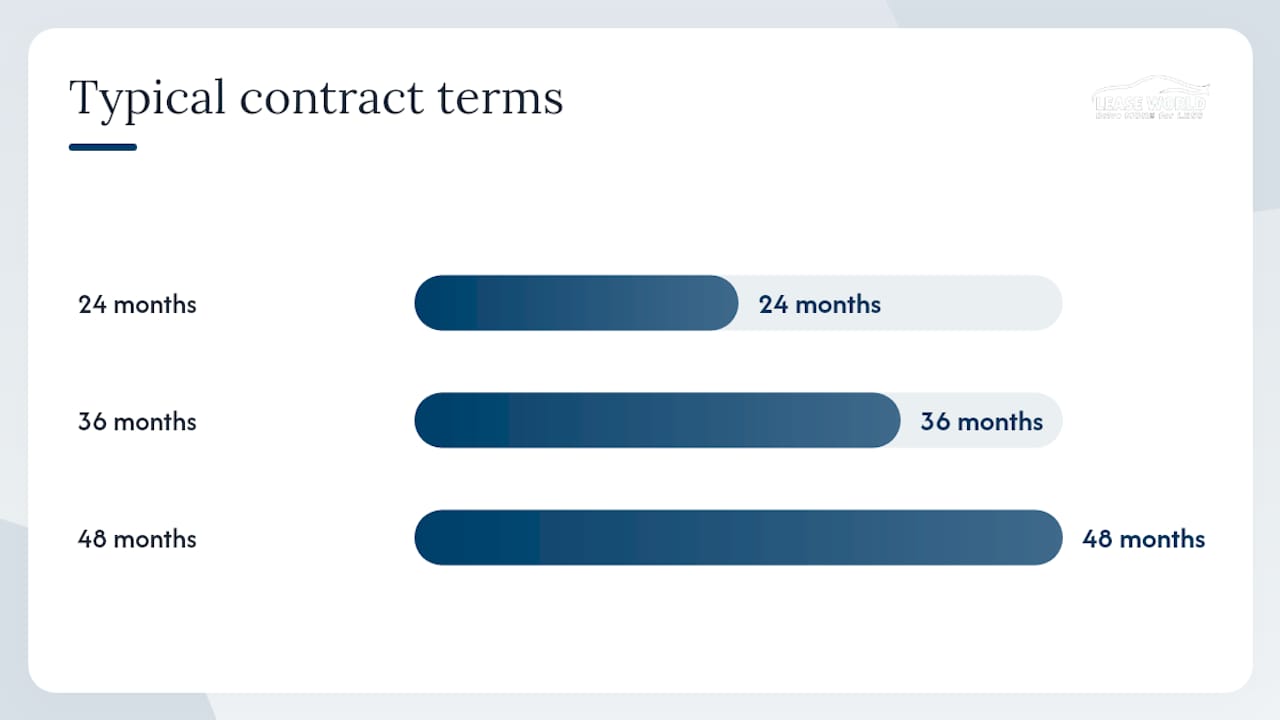
- Contract term: Typically 24, 36, or 48 months. Shorter terms usually mean higher monthly payments.
- Mileage allowance: The annual distance limit written into the contract. Exceeding it triggers excess mileage charges.
- Maintenance package: An optional add-on covering servicing, tyres, and sometimes breakdown cover, bundled into the monthly payment.
- Excess mileage charge: A per-mile fee applied at the end of the term for every mile over the agreed allowance.
The process from quote to delivery follows a broadly consistent path:
- Request a quote from a broker or funder, specifying term, mileage, and whether you want zero or low initial rental.
- Submit a credit application. The funder runs a hard credit search.
- Provide documentation: driving licence, proof of address, and proof of income.
- Sign the finance agreement with the funder (not the broker).
- Arrange delivery. Free mainland UK delivery is available on eligible vehicles through brokers such as Lease World.
Zero deposit versus low deposit and traditional leasing
No-deposit leasing changes the contract structure rather than removing cost. The table below shows how the three main upfront structures compare across the dimensions that matter most.
| Dimension | Zero deposit (£0 initial rental) | Low deposit (1–3 months initial rental) | Traditional (6 months initial rental) |
|---|---|---|---|
| Upfront payment | £0 | £200–£900 | £600–£2,700 |
| Monthly payment | Highest | Moderate | Lowest |
| Total lease cost | Often highest | Mid-range | Usually lowest |
| Best for | Cashflow-constrained drivers; frequent car changers | Balanced cashflow and cost | Budget-conscious long-term drivers |
| Eligibility / credit check | Standard to stricter, depending on funder | Standard | Standard; best rates for strong credit |
| Contract risk (excess mileage & damage) | Higher sensitivity: no upfront buffer | Moderate | Lower relative sensitivity |
| Maintenance / insurance inclusion | Optional add-on | Optional add-on | Optional add-on |
One point that trips up many drivers: the same car advertised at different monthly prices is often just the same deal with a different initial rental structure. A £149/month headline figure with nine months upfront is not cheaper than £199/month with zero upfront. You need to add the initial rental to the total monthly payments and compare the full contract cost. Mytips.com recommends keeping every variable identical, including model, trim, mileage, and term, before drawing any conclusion from the monthly figure alone.
Who benefits most from a no-deposit car lease?
Drivers preserving short-term savings. If you have savings earmarked for a house purchase, a business investment, or a family event in the next 12–18 months, tying up £1,000–£2,000 in a non-refundable initial rental is a poor use of that capital. A zero-deposit deal keeps the money working elsewhere.
People with irregular income. Freelancers, contractors, and self-employed drivers sometimes have strong annual earnings but uneven monthly cashflow. A zero-deposit deal avoids the pressure of a large payment in a lean month, though funders will still want to see consistent income evidence at application.
Drivers expecting a cash injection soon. If a bonus, inheritance, or property sale is expected within a few months, a zero-deposit deal bridges the gap without depleting current reserves.
Frequent car changers. Drivers who prefer to switch every 24–36 months avoid paying a fresh initial rental each time. Over two or three consecutive leases, that adds up.
The deal tends to be a poor fit for drivers focused on minimising total cost, those who regularly exceed mileage allowances, and anyone on a tight monthly budget where the higher payment would cause genuine strain. Long-term drivers who keep the same car for 48 months or more will almost always find a low initial rental structure cheaper overall.
Contract length and mileage allowance choices amplify the effect. A 48-month zero-deposit deal carries the financing premium for longer than a 24-month one. Setting a realistic mileage allowance at the start is especially important when monthly payments are already higher.
Eligibility, credit checks and what you need to apply in the UK
Funders assess three things: your credit history, your income, and your existing financial commitments. A strong credit score improves both your approval odds and the monthly rate you are offered. Approval for zero-deposit deals depends on credit score and income, and some funders reserve their best zero-deposit rates for applicants with clean credit files.
Documents typically required:
- Valid UK driving licence (photocard)
- Proof of address dated within the last three months (utility bill, bank statement)
- Proof of income: three months' payslips for employed applicants; two years' accounts or SA302 forms for self-employed drivers
- Bank details for the direct debit
When you apply through a broker such as Lease World, the broker submits your application to the funder on your behalf. The funder then runs a hard credit search, which appears on your credit file. Some brokers offer a soft search at the quotation stage, which does not affect your credit score. Ask specifically whether a quote involves a soft or hard search before proceeding.
To improve approval odds: check your credit report with Experian, Equifax, or TransUnion before applying; correct any errors; avoid making multiple credit applications in a short period; and make sure your address history is accurate and up to date. The Lease World FAQ on no-deposit leasing covers eligibility criteria and documentation in more detail.
What to watch for in the contract before you sign
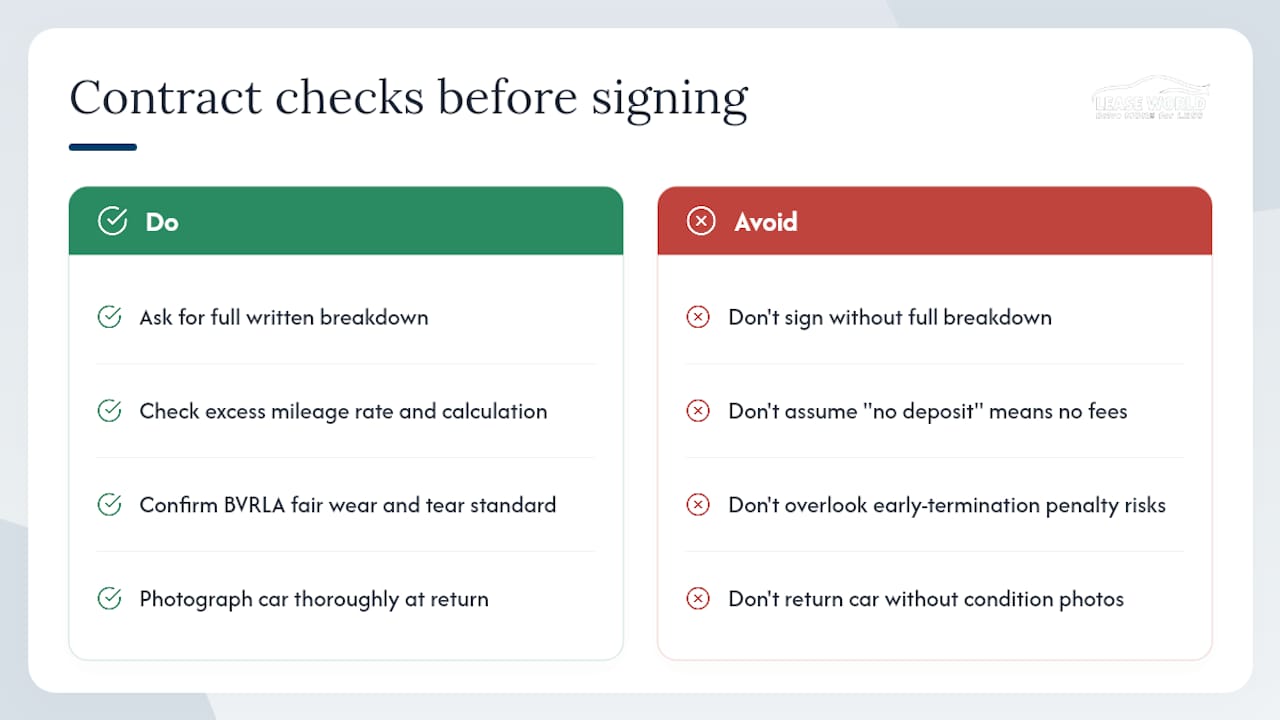
Excess mileage charges are the most common source of unexpected costs at the end of a lease. The charge is applied per mile for every mile over the agreed annual allowance, and it is calculated on the total overage across the full term, not year by year. If your contract allows 8,000 miles per year over 36 months and you return the car having covered 30,000 miles, you pay for 6,000 excess miles in one bill.
Fair wear and tear is a defined standard, not a subjective judgement. The British Vehicle Rental and Leasing Association (BVRLA) publishes a fair wear and tear guide that most UK funders reference. Damage beyond that standard, including chips, dents, scratched alloys, and interior stains, is charged at collection. Photograph the car thoroughly at return and keep the images.
Early termination is expensive. Most personal contract hire agreements allow you to terminate early, but the penalty typically amounts to 50% of the remaining rentals, sometimes more. Understanding the risks of exiting a lease early is worth doing before you sign, even if you do not expect to need it.
Administration and delivery fees may appear in the small print even when the advert says "no deposit." These are separate from the initial rental and are not always included in the headline monthly figure.
Pro Tip: Before signing, ask the funder or broker for a full written breakdown of: total amount payable over the contract, the excess mileage rate, the early termination formula, and any administration or delivery fees. If any of these are missing from the paperwork, request them in writing before you commit.
Decision checklist: how to choose between zero deposit and other options
Work through these steps before accepting any lease quote.
- Calculate total contract cost. Multiply the monthly payment by the number of months, then add the initial rental. Compare this figure across all upfront structures for the same car.
- Set a realistic mileage allowance. Review your last 12 months of driving. Add 10–15% as a buffer. Underestimating mileage on a zero-deposit deal is particularly costly.
- Confirm what is included. Check whether maintenance, tyres, and breakdown cover are in the monthly figure or priced separately.
- Test your eligibility. Ask the broker whether a soft search is available before a full application. Check your credit report in advance.
- Ask these questions of the broker or funder:
- What is the total amount payable over the full term?
- What is the excess mileage charge per mile?
- What does early termination cost at month 12, 18, and 24?
- Are there any administration, delivery, or documentation fees?
- Is the initial rental refundable in any circumstance?
- Compare like-for-like. Same model, same trim, same mileage, same term. A lower monthly figure with a higher initial rental is not automatically cheaper.
- Use Lease World to compare quotes. Lease World's no-deposit car lease deals page lists current zero-deposit offers with transparent monthly and total cost figures, so you can compare structures side by side without doing the arithmetic manually.
Lease World analysis: the cashflow trade-off in practice
The core funding mechanic is consistent across the market: deferring the initial rental increases the capital financed, which increases the total finance charge. Lease World's best-practice guidance reinforces this, advising drivers to compare total contract cost rather than headline monthly figures.
Using the worked example from the costs section above, the zero-deposit structure costs approximately £183 more over 36 months than the three-month initial rental option. That is the price of keeping roughly £897 in your account at the start of the contract. Whether that trade-off makes sense depends entirely on what you would do with that £897 and how much the higher monthly payment affects your budget.
Rule of thumb: If the zero-deposit monthly payment is more than 10% higher than the equivalent low-deposit monthly payment for the same car and term, the total cost premium is likely to be material. At that point, paying a small initial rental may be worth considering unless cashflow is genuinely constrained.
Lease World's no-deposit leasing page provides current deal comparisons and personalised quote tools so you can run this calculation for the specific car you have in mind.
Key takeaways
Zero-deposit car leasing is a cashflow tool, not a cost-saving one: it preserves upfront cash but typically raises monthly payments and often increases the total amount paid over the contract term.
| Point | Details |
|---|---|
| Cashflow benefit, not a discount | Zero-deposit deals defer cost into monthly payments; total outlay is usually higher than a low-deposit equivalent. |
| Compare total contract cost | Add initial rental to all monthly payments and compare the full figure, not the headline monthly price. |
| Mileage and return charges matter more | Higher monthly payments make excess mileage and damage charges proportionally more painful at end of term. |
| Eligibility depends on credit strength | Funders assess credit score and income; stronger credit improves access to better zero-deposit rates. |
| Lease World for transparent comparisons | Lease World offers personalised no-deposit quotes with clear total cost breakdowns and free mainland UK delivery on eligible vehicles. |
The real cost of convenience
Zero-deposit leasing gets marketed as though it removes a barrier, and in one narrow sense it does: you do not need cash on the day. But the framing obscures something worth saying plainly. The initial rental in a standard lease is not a fee; it is a prepayment that reduces what you owe each month. Removing it does not make the car cheaper. It makes the car accessible now, at a higher running cost.
That is a legitimate trade-off for plenty of drivers. Someone preserving savings for a house deposit, or a contractor managing uneven monthly income, has a genuine reason to prefer the zero-deposit structure even knowing it costs more overall. The problem is when drivers choose it simply because the upfront figure is £0 without checking what that does to the total.
The question worth asking before you sign is not "can I afford the monthly payment?" but "have I compared the total contract cost across all the upfront structures available for this car?" Most drivers who do that calculation end up choosing a small initial rental. Some still choose zero deposit, with full awareness of the premium. Both are reasonable decisions. The one to avoid is choosing zero deposit by default because the advert made it look like the obvious option.
Lease World: get a transparent no-deposit quote
Paying nothing upfront sounds straightforward, but the difference between a good zero-deposit deal and an expensive one comes down to the total contract cost, the mileage allowance, and what is included in the monthly figure. That is exactly where Lease World's personalised brokerage service earns its keep.
Lease World is a family-run UK broker that specialises in transparent lease comparisons, including personal car leasing with no-deposit options across a wide range of makes and models. Rather than presenting a single funder's deal, Lease World compares contract structures so you can see the total cost difference between zero, low, and standard initial rental options for the same car.
- Personalised quotes tailored to your mileage, term, and budget
- Optional maintenance packages bundled into a single fixed monthly payment
- Free mainland UK delivery on eligible new vehicles
- Clear breakdown of total repayable figures, not just headline monthly prices
Ready to see what a zero-deposit deal actually costs for the car you want? Request a quote and get a side-by-side comparison with no obligation.
Useful sources and further reading
- Zero Deposit Car Finance: How It Works in the UK finance guide | Kandoo
- Car Leasing in the UK: No Deposit Options Explained — wondermapped.com
- Understanding Personal Car Leasing: A Guide to No-Deposit — mytips.com
- No Deposit Car Leasing UK | Low Upfront Lease Options
- Car leasing best practices 2026: your complete guide
- Can You Lease a Car With No Deposit?
FAQ
What is a zero-deposit car lease?
A zero-deposit car lease is a personal contract hire agreement with no initial rental due at the start. The upfront amount is spread across the monthly payments, which are higher as a result.
Does a no-deposit lease cost more overall?
Usually, yes. Deferring the initial rental increases the capital financed, which raises monthly payments and typically increases the total amount paid over the contract term compared with a low-deposit equivalent.
What credit score do you need for a zero-deposit lease in the UK?
There is no single minimum score, as each funder sets its own criteria. A clean credit history with no missed payments and a stable income gives the best chance of approval and the most competitive monthly rate.
What happens at the end of a zero-deposit lease?
You return the vehicle to the funder's collection agent. The car is inspected against the BVRLA fair wear and tear standard. Any excess mileage or damage beyond that standard is charged separately.
Can Lease World help me compare zero-deposit and low-deposit options?
Yes. Lease World offers personalised quote comparisons across multiple upfront structures for the same vehicle, including a clear total cost breakdown, so you can see the actual difference before committing.