

The leasing company, as registered keeper, will normally get the first Notice of Intended Prosecution within 14 days of the offence, then ask you to confirm who was driving. You must return that Section 172 form, usually within 28 days, or risk prosecution for a separate offence. If you were the driver, expect a fixed penalty of a £100 fine and 3 points, or a speed awareness course if you qualify, plus a possible admin fee from your lease provider.
TL;DR:
- The first Notice of Intended Prosecution is sent to the leasing company within 14 days, but driver details must be submitted within 28 days to avoid further penalties.
- Failing to respond correctly to a Section 172 form, especially when you were the driver, can lead to penalties or a criminal record, even if the initial speeding offence is minor.
- Most fixed penalties for modest speeding are a £100 fine and three points, with optional speed awareness courses available depending on the speed and previous offences.
- Leasing companies typically forward the notice to the driver, pay the fine themselves, or dispute the charge, with the process governed by lease agreement clauses and regulations.
- Reviewing lease terms beforehand, especially related to penalty handling and admin fees, helps prevent costly surprises, and responses to notices should be prompt and accurate.
Table of Contents
- How the notice process works for a leased speeding ticket
- Section 172: your legal duty to identify the driver
- Penalties for speeding: fines, points and awareness courses
- What leasing companies commonly do about speeding fines
- Step by step: how to respond when your leased car is caught speeding
- How to contest a speeding notice: late NIPs and evidence
- Insurance, points and lease payments: what to check in your contract
- Publisher perspective: reducing administrative surprises
- Getting a lease with clearer terms from the start
- Sources
- FAQ
How the notice process works for a leased speeding ticket
A Notice of Intended Prosecution, or NIP, is the formal letter warning that a driving offence may lead to prosecution. For speeding caught on camera, the law requires this first notice to reach the registered keeper of the vehicle within 14 days of the alleged offence, under the timing rules confirmed on Gov.
On a leased car, the registered keeper is almost always the leasing company, not you. That single fact explains most of the confusion drivers feel when a speeding notice seems to "arrive late" from their point of view.
The sequence usually runs like this:
- A speed camera or police device records the offence and the vehicle's registration.
- The police send the NIP to the registered keeper (the leasing company) within the 14 day window.
- The leasing company checks its hire records and nominates the driver on file for that date.
- Police then issue a separate notice, often including a Section 172 form, directly to you as the named driver.
That final notice can genuinely land weeks after the offence. Solicitors who deal with these cases regularly point out that the 14 day rule only ever applies to the first notice, sent to the keeper. It says nothing about when your own paperwork has to arrive, according to LawClarity's guide on late NIPs. Knowing this early saves a lot of wasted arguing later.
Section 172: your legal duty to identify the driver
Section 172 of the Road Traffic Act 1988 gives the police power to demand that the registered keeper, or anyone else who might know, identifies who was driving at the time of an alleged offence. When you lease a car, that demand typically gets passed to you because the leasing company's own records point to you as the driver on that date.
You need to act correctly and promptly:
- Read the form carefully and confirm the registration, date and time match what you remember.
- Complete every field yourself, in your own name, if you were driving.
- Return it within 28 days of the date it was issued, which is the standard period referenced in guidance from JMW Solicitors on Section 172 compliance.
- Keep a copy and proof of postage or, better, use whatever online response service the notice offers.
Failing to provide driver details is a distinct offence in its own right, separate from the speeding allegation, and can carry points and a fine even if you were never the driver. Motoring solicitors flag this as the mistake that causes far more damage than the original camera flash, because ignoring the form converts a manageable fine into a criminal record for non‑compliance, per Drivers with Convictions.
Pro Tip: If you genuinely cannot recall who was driving, do not simply ignore the form. Contact the Central Ticket Office named on the notice and explain your situation before the deadline passes.
Penalties for speeding: fines, points and awareness courses
Most first offences caught by camera at modest speeds over the limit result in a fixed penalty notice: a £100 fine and 3 penalty points on the driver's licence, as set out on GOV.UK. Faster breaches, or repeat offences, push the case towards court, where fines scale with income and can run into thousands of pounds, alongside longer bans.
Many forces offer a speed awareness course as an alternative to points, though eligibility depends on the speed recorded and how recently you last attended one:
- Courses are generally reserved for lower‑level breaches, not excessive speeds.
- Most forces will not offer a repeat course within a set period, often around three years.
- Completing one usually avoids points and keeps your record cleaner for insurance purposes.
Three points on a clean licence rarely wrecks a premium, but insurers do factor endorsements into renewal pricing, and the endorsement codes and points system on GOV.UK confirms points typically stay visible on your licence for four years from the offence date for standard speeding endorsements.
What leasing companies commonly do about speeding fines
Your leasing company is not a passive bystander here. It receives the initial notice because it is the registered keeper, and it holds the rental or hire agreement records that identify who was driving on any given date. That puts it in the middle of every camera‑detected offence involving one of its vehicles.
In practice, three outcomes are common:
- The company forwards the notice to you as the named driver so you deal with the police directly.
- The company pays the penalty itself to avoid enforcement delay, then invoices you for the fine plus an administration fee.
- Occasionally, disputes arise over whether recovery was fair, which can escalate to a formal complaint.
That second route is well established. Regulation 6 of the Civil Enforcement of Road Traffic Contraventions (England) Regulations 2022 sets out when a penalty charge can be treated as payable by a hirer rather than the vehicle's owner, often through a signed statement of liability in the hire agreement. Published Financial Ombudsman decisions show real cases where hire firms paid first and reclaimed later, with the outcome resting entirely on what the contract actually said, according to one Ombudsman ruling on recovered penalty charges. Check your own lease agreement terms for exactly this clause before you assume the worst.
Step by step: how to respond when your leased car is caught speeding
Getting the sequence right matters more than getting it fast. Rushing a Section 172 reply with the wrong details can cause almost as much trouble as ignoring it.
- Secure the paperwork. Keep the envelope, note the notice number, registration, and both the offence date and the date the letter was issued.
- Check who the notice is addressed to. If it names your leasing company, wait for them to pass on the driver notice rather than responding on their behalf.
- Complete Section 172 accurately. Fill in every field yourself if you were driving, and return it well before the 28 day deadline.
- Request the evidence. Ask for the photograph, device reading, and calibration record if anything about the date or location seems off. Some forces will release this evidence to help you confirm identity, as Askthe.
- Decide how to proceed. Accept the fixed penalty and points, ask about a speed awareness course if eligible, or prepare to contest the notice through the court process if you believe it was served incorrectly.
Pro Tip: Never assume a late-arriving letter means the case is dead. The 14 day rule protects the timing of the keeper's notice, not yours, so check dates carefully before you rely on it as a defence.
If your case involves clean air zone or congestion charges rather than a criminal speeding offence, the process differs entirely. Those are civil penalty charge notices with their own service windows, distinct from the criminal fixed penalty route described here, and it is worth knowing the difference between ULEZ charges and speeding fines on a leased vehicle.
How to contest a speeding notice: late NIPs and evidence
A genuinely late first notice to the registered keeper can, in some circumstances, defeat a prosecution. The legal test turns on whether the notice was properly served within 14 days, not simply when it happened to be received, and courts allow exceptions such as reasonable diligence delays or cases involving an accident, as explained by RoadTrafficLaw.
Before building any challenge around timing, gather the actual evidence:
- Request the camera photograph or device log showing the recorded speed and location.
- Ask for the calibration certificate for the speed detection device used.
- Confirm the exact date the first notice was posted to the leasing company, not just the date you personally received your copy.
Police forces vary in how readily they release this material, and response times differ by force. Where the figures involved are significant, such as a case heading to court rather than a straightforward fixed penalty, it is worth getting advice from a motoring solicitor before the hearing. Magistrates' courts deal with speeding prosecutions routinely, and a poorly prepared timing defence rarely succeeds without documented evidence behind it.
Insurance, points and lease payments: what to check in your contract
Three points on your licence will usually nudge your next insurance renewal upward, and that endorsement typically stays on record for four years, per GOV.UK's endorsement guidance. It is worth reviewing your lease car insurance arrangements once points are confirmed, since some insurers ask you to declare them immediately rather than at renewal.
Your lease payments are unaffected by points or even a driving ban. You still owe the monthly rental regardless of whether you are legally allowed to drive the vehicle yourself, because the finance agreement is separate from your driving entitlement.
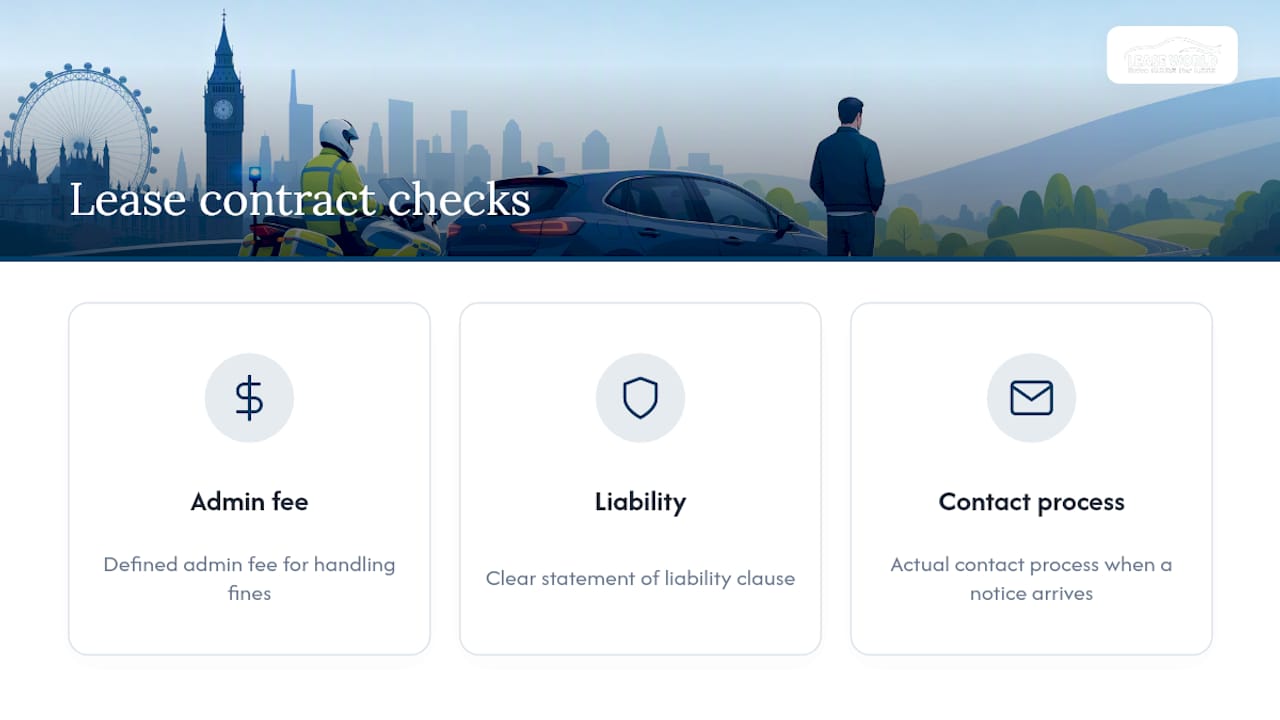
Before any of this becomes an issue, it is worth knowing where to look in your own paperwork. Check for a defined admin fee for handling fines, a clear statement of liability clause, and the actual contact process the leasing company uses when a notice arrives. Vague wording here is where most disputes start.
Publisher perspective: reducing administrative surprises
Most disputes over speeding fines and leased cars come down to one thing: nobody read the admin fee clause until the invoice arrived. Lease World builds its contracts around fixed monthly payments and transparent terms specifically so that a penalty notice does not turn into a billing surprise months later.
Before signing any lease, ask directly how the provider handles penalty notices, whether there is a cap on admin fees, and who you contact when a notice lands. A provider willing to answer those questions plainly, before you sign, tends to be the one that handles them fairly afterwards.
— Jason
Getting a lease with clearer terms from the start
This leasing provider offers an alternative to larger corporate leasing firms, focusing on fixed monthly payments, no deposit options, and contracts that clearly state fees rather than burying them in small print. If a murky admin fee clause is what worries you most about leasing a car, that transparency is the practical difference worth paying attention to before you sign anything.
Every enquiry gets a genuine comparison of contract terms, not just a headline monthly figure, so you know exactly what happens if a fine ever lands on your desk. Whether you are after personal car leasing or need to sort out a fleet's worth of vehicles under business car leasing, the same principle applies: ask about penalty handling and admin fee caps before you commit. If you want to see how your current contract compares, request a quote and get straight answers before you sign.
This article is general information, not a substitute for advice from a qualified lawyer. Consult a qualified legal professional about your own circumstances before acting on anything here.
Sources
- Gov
- How to complete a Section 172 notice form correctly - JMW Solicitors
- Civil Enforcement of Road Traffic Contraventions (Approved Devices, Charging Guidelines and General Provisions) (England) Regulations 2022 — regulation 6
- Askthe
FAQ
What happens if you get a speeding ticket on a lease car?
The leasing company usually receives the first notice as registered keeper, then either forwards it to you or pays the fine and recharges you with an admin fee, depending on your contract terms. You remain personally liable for any points and the underlying fine as the driver.
What happens if you get a speeding ticket in a rental car in the UK?
The same principle applies as with a lease. The rental firm is the registered keeper and gets the initial notice, then nominates you as the driver using its booking records, per GOV.UK guidance. You will then receive your own Section 172 request and any fixed penalty directly.
Will I get a fine for doing 74 in a 70?
Four miles per hour over the limit sits within the margin most forces use for discretion, and enforcement thresholds vary by force and camera type. If a fixed penalty is issued, expect the standard £100 fine and 3 points set out on GOV.UK, though many drivers at this level are instead offered a speed awareness course.
Will I get a ticket if I go 33 in a 30?
Three miles per hour over the speed limit is also commonly within enforcement tolerance, though this varies by force and is never guaranteed. Where action is taken, the same fixed penalty structure applies: a fine and 3 points, or a course if you are eligible.