

Yes, electric car range holds up well for most daily commutes, and no, that doesn't mean every EV suits every driver. Since the average UK commute sits well under 30 miles each way, most drivers have far more buffer than they think, and interior protection can help maintain vehicle condition in high-use daily travel, as explained in the benefits of interior ceramic coating.
TL;DR:
- Most EVs deliver around 82% of their WLTP range in real-world driving, with larger SUVs falling closer to 80% or less, especially in cold weather.
- Cold temperatures, motorway speeds, and frequent rapid charging significantly reduce range and accelerate battery degradation over time.
- Urban driving and stop-start routes tend to preserve range better, while sustained motorway speeds and winter conditions can cut mileage by 30% or more.
- Proper charging habits, such as overnight home charging and avoiding frequent rapid charging, can help maintain long-term battery health and range.
- Leasing an EV allows testing actual commute conditions without long-term purchase risks, especially when selecting the right battery size for variable seasonal demands.
Table of Contents
- Electric car range commuting: real-world numbers by vehicle class
- What actually drains electric car battery life on the school run and motorway
- Battery degradation and long-term reliability for daily commuters
- Charging habits that protect range without overcomplicating your week
- Planning for a longer or variable commute
- Is an EV suitable for your commute? A quick decision checklist
- How much do the seasons really change your commute?
- How much do popular commuter EVs actually differ in range?
- What commuters actually experience on the road
- Do hills and terrain change your commute range?
- Does running the heater or infotainment actually cost you miles?
- What leasing an EV for commuting actually teaches you
- Getting the right EV lease for your daily commute
- Sources
- FAQ
Electric car range commuting: real-world numbers by vehicle class
Forget the number on the windscreen sticker. WLTP testing happens in controlled conditions that rarely match a wet Tuesday commute at 70mph with the heater on. Independent Which? testing found real-world range averaging around 18% below WLTP across the models it examined, with larger SUVs falling short by closer to 19%. Autodoc's analysis of WLTP versus real-world range puts the typical gap at 10 to 30%, widening to 30 to 40% in cold, motorway-heavy conditions.
Statistic Callout: Independent lab testing from Which? shows the average EV delivers roughly 82% of its official WLTP figure in mixed real-world driving, dropping further for larger, heavier vehicles.
Rough commuter-ready ranges once you strip out the optimism:
- City and small EVs: 120 to 160 real-world miles, plenty for urban commutes under 20 miles a day
- Compact hatchbacks and crossovers: 160 to 220 miles
- Family/medium EVs: 200 to 260 miles
- Large SUVs and executive EVs: 220 to 280 miles, though weight erodes efficiency
- Long-range models: 280 to 320+ miles, built for drivers who mix commuting with regular longer trips
What actually drains electric car battery life on the school run and motorway
Range doesn't disappear evenly. Four factors do most of the damage, and you can control at least three of them.
Cold weather is the biggest single hit. Battery chemistry slows down below freezing, and cabin heating draws directly from the same pack that drives the wheels.
Motorway speed punishes aerodynamic drag disproportionately. Range that looks generous at 30mph in town can evaporate at 70mph, because drag increases with the square of speed, not in a straight line.
Other levers worth knowing:
- Heating and air conditioning can strip 10 to 20% off range in extreme temperatures
- Roof boxes, bike racks and a boot full of shopping all add drag or weight
- Under-inflated tyres increase rolling resistance and quietly cost you miles
- Aggressive acceleration and late braking waste energy that smoother driving recovers
Pro Tip: Lift off the accelerator early and let regenerative braking do the work instead of hitting the brake pedal hard. On a stop-start commute this alone can add real miles back over a week.
Battery degradation and long-term reliability for daily commuters
The question every commuter asks eventually: will the battery still work in five years? Fleet telemetry from Geotab's battery health study gives a genuinely reassuring answer.
Statistic Callout: Geotab's analysis of real-world fleet data found average annual battery degradation of about 2.3%, meaning a car with 250 miles of range when new would typically still offer well over 200 miles after five years of ownership.
What actually drives that number:
- Frequent high-power DC rapid charging correlates with faster degradation than gentle overnight AC charging
- Hot climates add roughly another 0.4% degradation per year on top of the baseline
- Degradation is gradual, not a cliff edge, which is why long-term fleet performance data shows high-mileage EVs still delivering usable range years into service
- Battery ageing research suggests most packs retain meaningful usable capacity well beyond typical ownership periods, supporting a healthy second-life market for older cells
For a commuter doing 12,000 miles a year, that 2.3% figure translates into a battery that ages more slowly than most people expect, and far more slowly than a smartphone battery under similar daily use.
Charging habits that protect range without overcomplicating your week
Home charging should be your default, not your backup. Plug in overnight, wake up to a full battery, and rapid chargers become an occasional convenience rather than a routine.
- Charge at home overnight wherever you have access to a driveway or private charger, ideally scheduled for off-peak electricity rates.
- Treat the 80/20 rule as a guideline, not gospel. Charging to 80% protects long-term battery health, but there is nothing wrong with an occasional full charge before a longer commute day.
- Reserve rapid DC chargers for genuine need. Geotab's fleet data links frequent high-power charging with higher degradation rates, so save the 150kW stop for the motorway trip, not the Tuesday top-up.
- Pre-condition before cold mornings. Warming the cabin and battery while still plugged in protects winter range and means you're not drawing that energy from the pack once you set off.
Pro Tip: Set your car's charging schedule to finish just before you leave, rather than as soon as it's plugged in. A battery that sits fully charged overnight ages slightly faster than one that reaches full charge closer to departure.
Planning for a longer or variable commute
Most days, range anxiety is a non-issue. The trickier days are the ones where you're covering double your usual distance, or motorway miles replace your normal urban crawl.
Build in a buffer before you need it, not after you're stranded on the hard shoulder:
- Keep a reserve of at least 20% of your battery for the unexpected diversion, traffic jam, or forgotten charge
- Check charger locations along your route in advance, and favour rapid chargers with a strong reliability track record over unfamiliar ones
- Expect noticeably higher consumption on sustained motorway stretches, and factor in an extra stop if these trips happen more than occasionally
- Time charging stops around a break you'd take anyway, coffee, lunch, a stretch, so the wait doesn't feel like dead time
If your commute regularly swings between a short urban hop and an occasional 150-mile motorway dash, a longer-range model earns its keep. Gov is a useful starting point for checking what's actually available along your regular routes.
Is an EV suitable for your commute? A quick decision checklist
Work through these in order and you'll have your answer in a few minutes.
- Record your typical daily miles and your longest regular day. Most UK commuters travel well under 30 miles each way, according to ONS travel-to-work data.
- Apply the WLTP conversion rule. Take the advertised range, knock off 10 to 30% for normal driving or plan for 60 to 70% on a winter motorway day, and compare that to your longest regular trip.
- Confirm charging access. Home charging makes almost any EV workable; relying entirely on public charging changes the calculation.
- If you're still unsure, try before you commit. A short-term lease lets you test a specific battery size against your actual commute before signing up for years.
How much do the seasons really change your commute?
Summer and winter are not the same car. In warm weather, most EVs get close to their real-world average range, sometimes slightly better, because the battery operates near its ideal temperature and the heater sits idle.
Winter changes the equation in three ways at once. Battery chemistry becomes less efficient below freezing, cabin heating draws power that would otherwise drive the wheels, and cold, dense air adds aerodynamic resistance at speed.
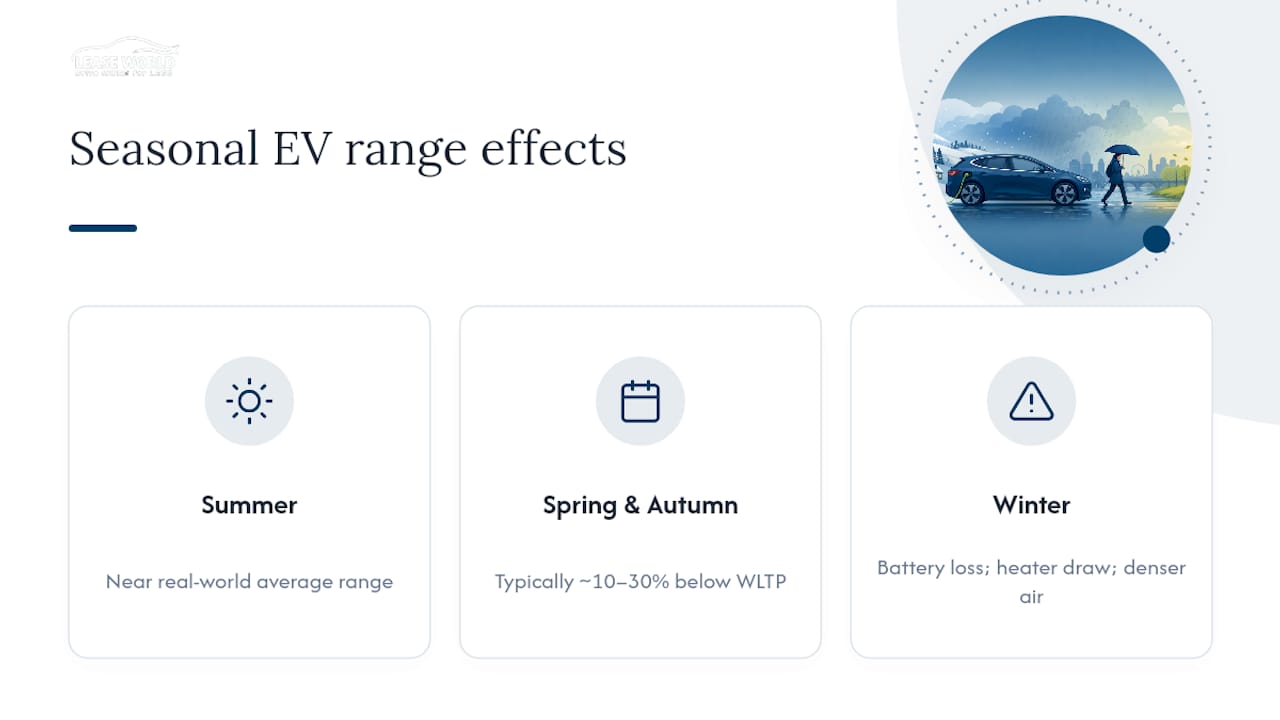
Spring and autumn sit in between, with moderate temperatures giving range that typically tracks close to the 10 to 30% real-world gap seen in standard testing. The practical takeaway for commuters: don't judge an EV's suitability purely on a mild September test drive. Ask what the range looks like in January, because that's the day your buffer actually gets tested.
How much do popular commuter EVs actually differ in range?
Not all EVs lose range at the same rate, and the gap between models matters more than most buyers realise. A city-focused EV and a large SUV badged with similar "official" ranges can behave very differently once you're actually driving to work.
Smaller, lighter EVs tend to hold up relatively well against their WLTP figures in town, because urban driving plays to their strengths: regenerative braking on stop-start roads, lower speeds, less aerodynamic penalty, as found across its test programme](https://www.which.co.uk/news/article/revealed-the-truth-about-electric-car-mileage-aC1bt9t5jU50), making them dependable for the 20 to 40 mile daily round trip that describes most UK commutes.
Larger SUVs and executive models often carry bigger batteries and therefore bigger absolute ranges, but they also lose a larger percentage against their own WLTP number, partly down to weight and partly down to worse aerodynamics at motorway speed. Long-range specialist models close that gap again, built with efficiency as the priority rather than outright size.
The practical lesson: don't compare EVs purely on the headline WLTP number. Two cars quoting 260 miles on paper can deliver noticeably different real-world figures once winter and motorway driving get involved. Where possible, check independent test data for the specific model you're considering rather than relying on the manufacturer's own figure alone.
What commuters actually experience on the road
The gap between spec sheet and steering wheel becomes obvious fast once an EV is doing real commuting duty. Drivers doing a steady 25 to 30 mile round trip on B-roads and dual carriageways generally report range holding close to, or even slightly ahead of, their car's real-world average, because that kind of driving avoids the two biggest drains: sustained high speed and stop-start traffic.
The pattern shifts for motorway-heavy commuters. A 45 minute run at a steady 70mph consumes noticeably more energy per mile than the same distance covered on urban roads at lower, more variable speeds, even though it feels like the "easier" drive. This is consistent with the wider testing data: real-world range tends to disappoint most precisely in the conditions that feel least demanding on the driver but most demanding on the battery.
Winter is where the experience gap widens further. A commute that comfortably manages five days on one charge in July can need a mid-week top-up in January, purely down to heating demand and colder ambient temperatures. None of this suggests EVs are unreliable for commuting. It suggests that planning around a single average figure is the mistake, not the car.
Do hills and terrain change your commute range?
Elevation changes hit EV range asymmetrically, and that asymmetry is actually good news for most commuters. Climbing a hill costs energy, sometimes a lot of it on a steep or sustained gradient, but descending the same hill gives a meaningful chunk of it back through regenerative braking. A round-trip commute that goes up and over the same hill twice a day, rather than one direction only, tends to net out close to flat-road consumption.
The exception is a commute that's genuinely one-way uphill, gaining altitude on the way out and never fully recovering it on the return, or vice versa. Drivers in hilly regions with an asymmetric elevation profile should expect their outbound and return legs to consume noticeably different amounts of charge, even though the mileage is identical.
Stop-start hill driving, the kind found on urban routes with frequent junctions on a slope, tends to favour EVs over petrol or diesel equivalents, because regenerative braking recovers energy on every downhill section that a combustion engine simply wastes as heat. For commuters weighing up range on a hilly route, the honest answer is that terrain matters less than sustained motorway speed, but more than flat-road testing figures would suggest.
Does running the heater or infotainment actually cost you miles?
Yes, and the air conditioning or heater matters far more than most drivers assume. Climate control isn't a minor accessory draw the way it is in a petrol car.
Air conditioning in summer draws less dramatically but is far from free, particularly on short trips where the compressor works hardest during the first few minutes of cooling a hot cabin. Heated seats and a heated steering wheel, by contrast, are genuinely efficient: they warm the person rather than the whole cabin, and can meaningfully cut heater reliance on a cold commute without the same range penalty.
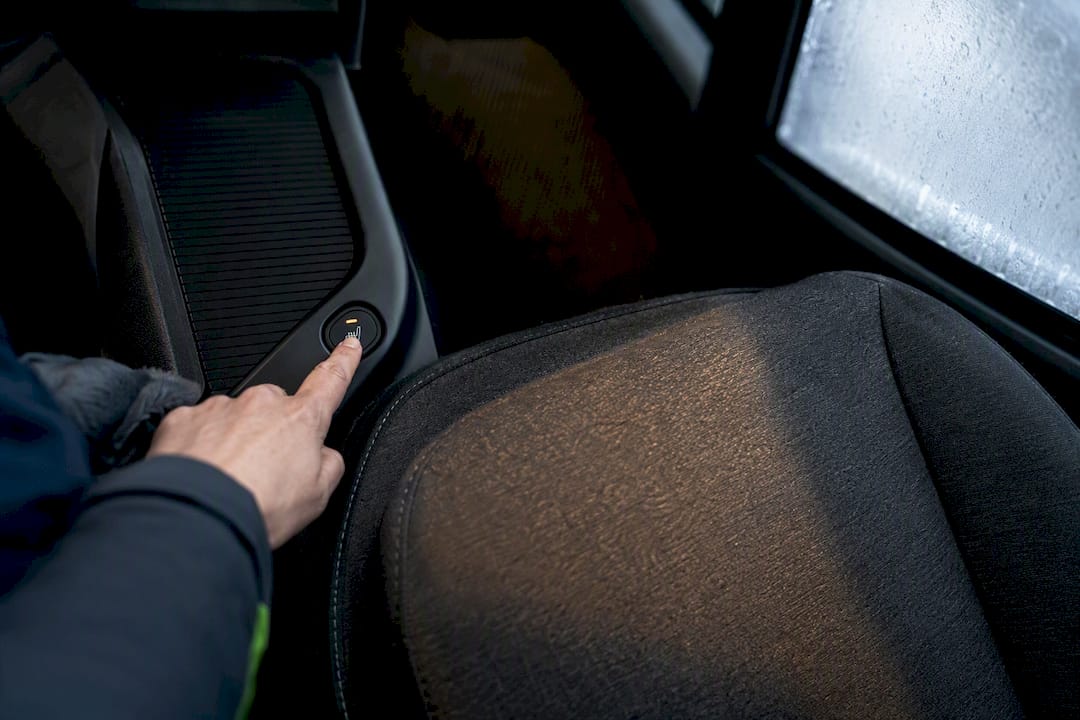
Infotainment, headlights and other electronics draw comparatively little. A screen and a sound system barely register against the energy needed to move a car's mass down a road. The practical guidance: on a cold commute, favour seat heating over blasting the cabin heater where you can tolerate it, and don't worry about turning off the radio to "save range". It won't move the needle. The heater will.
What leasing an EV for commuting actually teaches you
Choosing the right battery size for your commute is a genuine gamble if you're buying outright, because a car that suits your route in September might come up short in January. Leasing sidesteps that risk entirely: you get to run the exact model against your exact commute for a fixed term, without carrying the depreciation risk if it turns out to be the wrong fit. For anyone weighing up a longer-range model against a cheaper compact EV, that's a genuinely useful way to settle the question with real data rather than a guess. Readers working through the numbers can find more detail in Lease World's guide to electric car range.
— Jason
Getting the right EV lease for your daily commute
A leasing service can be a practical route into EV ownership when you'd rather test a battery size against your real commute than gamble on a purchase. Leases often come with fixed monthly payments and options that help avoid tying up cash upfront.

Free mainland UK delivery may be included on eligible new vehicles, and some leasing services provide guidance on real-world range for specific models beyond brochure figures. If you're weighing up a compact EV against a longer-range model for a mixed commute, start with the personal car leasing page to see current EV deals, or head straight to the leasing enquiry page for a tailored recommendation based on your daily mileage and charging setup. For business drivers and fleet decisions, the electric car leasing hub covers both personal and business contracts side by side.
Sources
FAQ
Can electric cars go 500 miles on one charge?
No current mainstream EV realistically covers 500 real-world miles on one charge; even the longest-range models deliver roughly 280 to 320 miles in typical driving, with WLTP figures inflating the headline number further.
Which EV is best for long commutes?
Long-range models built for efficiency rather than outright battery size tend to hold up best on motorway-heavy commutes, since they lose a smaller percentage of their WLTP figure than larger, heavier SUVs.
Is 70,000 miles a lot for an electric car?
No, 70,000 miles is well within normal territory for an EV battery. At an average degradation rate of around 2.3% per year, most batteries covering that mileage still retain the large majority of their original range.