

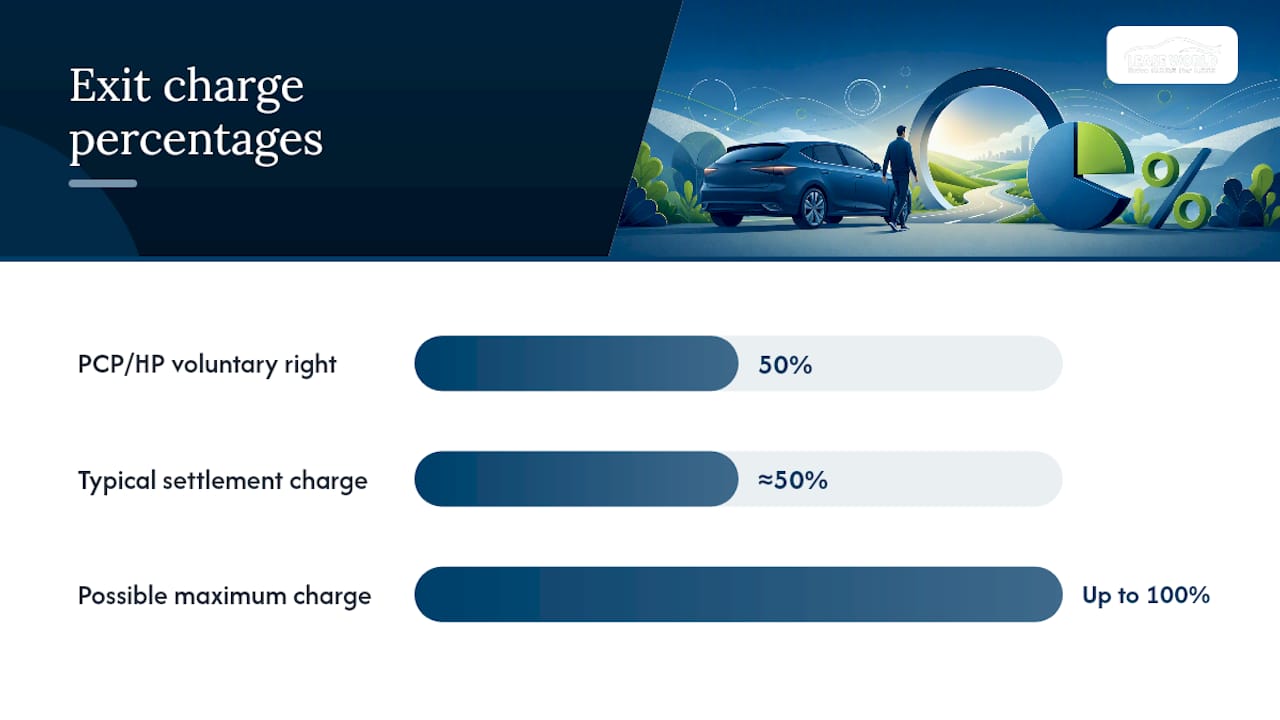
You can end most UK vehicle leases early, but you will almost always pay for the privilege. Contract hire agreements typically charge a settlement figure worth roughly 50% of your remaining rentals, though some contracts push that as high as 100%. Whether that charge is fair is exactly the kind of question the Financial Ombudsman Service rules on regularly, and the Consumer Credit Act 1974 gives some finance agreements (though rarely standard leases) statutory exit rights. Lease World deals with these calls every week.
Expect one or more of the following once you give notice:
- A settlement figure based on remaining rentals, sometimes reduced by an "accrued benefit" calculation
- Excess mileage or damage charges assessed at handover
- A possible mark against your credit file if payments lapse before a figure is agreed
Key Takeaways
Early termination costs hinge on your contract type, timing, and calculation method, and any figure a provider quotes can be challenged if it isn't justified.
| Point | Details |
|---|---|
| Check your contract type first | PCH exit terms are set by contract; PCP/HP carry Consumer Credit Act protections including a 50% voluntary termination right. |
| Expect a settlement charge | Commonly around 50% of remaining rentals, sometimes up to 100%, depending on the calculation method used. |
| Demand an itemised figure | Always request the settlement breakdown in writing, including any accrued benefit deduction and fees. |
| Compare against running to term | Sum your remaining monthly rentals before agreeing to a settlement, particularly late in the contract. |
| Escalate unreasonable charges | Use Citizens Advice for guidance and the Financial Ombudsman Service if a provider's figure seems unjustified. |
| Get Lease World's help if unsure | Lease World can review your contract, request an itemised figure, and outline alternative leasing options. |
Table of Contents
- What does early termination mean for your type of lease?
- What are your options for ending a lease early?
- How do providers calculate your settlement figure?
- What steps should you take right now?
- What might early termination actually cost you?
- When should you get free advice or formal help?
- Why the contract always beats the general advice
- How Lease World can help you review your options
- Sources
- FAQ
What does early termination mean for your type of lease?
Your rights hinge on one question: is your agreement a hire contract or a credit purchase? Personal Contract Hire (PCH) and standard business contract hire are rental agreements. There is no ownership option, no option to purchase clause, and the exit terms sit entirely inside your contract wording. PCH is treated in law as long-term rental, not a regulated credit sale, so the statutory 50% voluntary termination right available to hire purchase and PCP customers generally does not apply.
PCP and hire purchase agreements are different animals. Because they are regulated credit agreements, they carry Consumer Credit Act protections, including the right to hand the vehicle back once you have paid half the total amount payable. A narrow additional right also exists under section 101 of the Consumer Credit Act 1974, allowing termination of some regulated consumer hire agreements after 18 months. It rarely helps modern car leases, though, because high contract values and business use frequently exempt agreements from it.
Check your paperwork for the words "hire agreement" versus "conditional sale" or "hire purchase". That single distinction determines whether statutory protection exists at all, or whether your exit cost is purely a matter of contract terms.
Look for a purchase option fee, a final "balloon" payment, or references to "option to purchase" — all signs you are in PCP or HP territory rather than a pure lease.
What are your options for ending a lease early?
Six realistic routes exist, and they carry very different costs.
- Request an early settlement figure. The most common route. The provider calculates what it believes it is owed for handing back early.
- Voluntary surrender. Usually only meaningful within PCP/HP agreements where the 50% rule applies; rarely relevant to standard PCH.
- Lease transfer or novation. Someone else takes over your remaining payments. Transfers can cut your net cost significantly, but plenty of funders simply do not allow it, and those that do usually charge an admin fee.
- Buy-out. Paying the remaining value to own the vehicle outright, if your contract permits it and the sums make sense against current market value.
- Refinancing into a new agreement. Rolling negative equity into a fresh deal, generally the most expensive option overall.
- Running to term. Often overlooked, but sometimes genuinely the cheapest path once you add up a settlement figure against remaining monthly payments.
Speed, cost, and credit impact rarely align. Voluntary surrender and buy-outs move fast but cost more; transfers take longer to arrange but can save the most money where they are permitted.
Pro Tip: If a transfer market exists for your vehicle type, a specialist broker or online marketplace can handle the paperwork and often finds a taker faster than trying to advertise it yourself.
How do providers calculate your settlement figure?
There is no single formula. Some contracts state they will apply whichever produces the lower figure, which is worth checking before you assume the worst.
The Financial Ombudsman Service does not accept these figures at face value. Its published decisions set a clear test: a settlement charge cannot leave the provider better off than it would have been had the contract run its full term. The Ombudsman compares likely full-term receipts against what the early termination figure delivers, and where a provider cannot justify the gap, it gets challenged.
A provider charging 100% of remaining rentals must be able to show that figure genuinely reflects what it would have received anyway, not an inflated number designed to recover profit it never actually earned.
Pro Tip: Always request an itemised settlement figure in writing, broken down by rentals owed, any accrued benefit deduction, VAT, and administration fees. A vague total with no working is the first thing an Ombudsman investigation will ask about.
What steps should you take right now?
Move in this order, and keep everything in writing from the first contact.
- Contact your leasing provider and request an itemised settlement figure. Ask specifically for the calculation method used, not just the headline number.
- Pull together your documentation. Contract clause references, the agreement start date, mileage readings, photographs of the vehicle's current condition, and service records all matter if you end up disputing anything.
- Negotiate before you pay. Ask whether the figure can be reduced, particularly if you suspect the accrued benefit deduction is understated.
- Escalate if the figure still looks wrong. Raise a formal complaint with the provider first, then involve Citizens Advice or the Financial Ombudsman Service if you get nowhere.
A short written request works better than a phone call because it creates a paper trail. Draft two things: a brief note asking for an itemised quote, and, if needed later, a formal complaint email referencing the specific contract clauses you believe have been misapplied. Keep both simple and factual rather than emotional.
- Contract clauses and page references
- Correspondence dates and names of anyone you spoke to
- Photos taken the day you request termination, not weeks later
What might early termination actually cost you?
Numbers vary enormously depending on how much of the contract remains, so treat these as illustrations rather than quotes.
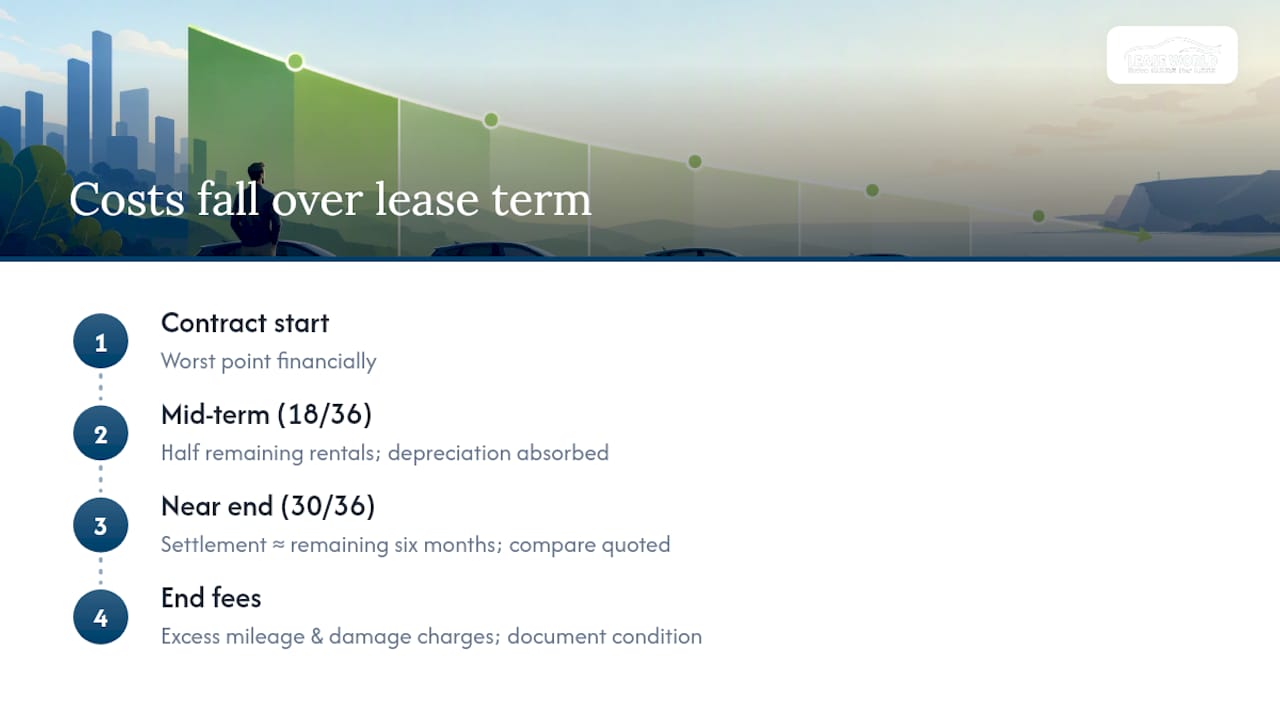
This is the worst point to exit financially.
Mid-term (18 months into 36), the maths gets more forgiving. Half the remaining 18 months' rentals is a smaller absolute figure, and depreciation on the vehicle has already been absorbed by the lease structure rather than landing on you directly.
Near the end (30 months into 36), a settlement figure often barely exceeds simply paying the remaining six months, which is precisely why comparing the quoted settlement against your remaining rentals before agreeing to anything is the single most useful check you can run.
Add to any of these scenarios the standard end-of-lease extras: excess mileage charges calculated per mile over your contracted allowance, and repair costs for damage beyond fair wear and tear under BVRLA standards. Document the vehicle's condition before handover, because disputed damage charges are one of the most common areas of dispute.
When should you get free advice or formal help?
If you cannot afford the quoted settlement, or your monthly payments have already become unmanageable, contact a free debt charity or Citizens Advice before missing a payment. A missed lease payment on its own is rarely catastrophic, but defaulting on a lease repeatedly can lead to repossession and lasting credit damage.
Use Citizens Advice for general consumer rights questions and help understanding your contract. Reserve the Financial Ombudsman Service for cases where you believe the provider's calculation or explanation is genuinely unreasonable and internal complaints have gone nowhere.
- Cannot afford the settlement at all → speak to a debt charity or Citizens Advice immediately
- Settlement figure looks inflated or unexplained → formal complaint, then the Financial Ombudsman Service
- Complex business-use contract or large sum involved → consider a regulated adviser or solicitor
Pro Tip: Never ignore letters from your leasing provider while you're deciding what to do. Silence tends to accelerate default action; a holding email buys you time to gather evidence.
Why the contract always beats the general advice
Having reviewed hundreds of these disputes at Lease World, the pattern is consistent: people assume there's a standard early termination rule, and there isn't one. Every contract is different, and the figure your provider quotes first is rarely their final position. Check the clause references before you accept anything, request the calculation in writing, and weigh the settlement against simply running to term... We're not a funder and won't pretend to be impartial about our own services, but the maths here doesn't lie either way.
How Lease World can help you review your options
If you're staring at a settlement letter and it doesn't add up, Lease World can review your contract wording, request an itemised settlement figure on your behalf, and lay out realistic alternative leasing options if a fresh vehicle makes more sense than paying to exit early.
We're honest about the limits here: Lease World can negotiate, question a provider's assumptions, and point you towards a better-value replacement lease, but we cannot force a funder to waive a contractual charge that's genuinely justified. What we can do is make sure you're not paying more than the figure actually supports, and help you compare that against a personal car leasing deal if you decide moving on makes more sense. Before you get in touch, gather the documents outlined earlier, your contract clause references, mileage evidence, and any correspondence, and then get a quote so we can look at your specific situation properly.
Sources
Keep copies of every written quote you receive. For further reading and support, consult the Financial Ombudsman Service's decision guidance, section 101 of the Consumer Credit Act 1974, Citizens Advice for consumer rights support, and Lease World's leasing guides hub for further contract terminology and process explanations.
This article is general information, not a substitute for advice from a qualified financial advisor. Consult a qualified financial professional about your own circumstances before acting on anything here.
- Decision Reference DRN-5476488
- Section 101 Right to terminate hire agreement | Consumer Credit Act 1974
- Ending a car lease early in the UK | Autotrader
- Can you end a car lease early? | Carwow
FAQ
Can I cancel my car lease early in the UK?
Yes, in most cases, though you will typically pay a settlement figure worth roughly 50% to 100% of your remaining rentals, depending on your contract's calculation method.
What happens if you miss a lease payment?
A single missed payment usually triggers a warning and a request to bring the account up to date, but repeated missed payments can lead to default, repossession, and lasting credit file damage.
Is voluntary termination different from early settlement?
Yes. Voluntary termination is a statutory right under the Consumer Credit Act that applies to PCP and hire purchase agreements once you've paid half the total amount payable, while early settlement is a contractual arrangement typically used for standard leases.
Can I dispute a settlement figure I think is unfair?
Yes. Request an itemised breakdown, raise a formal complaint with your provider if the figure seems unjustified, and escalate to the Financial Ombudsman Service if you cannot reach agreement.
Will ending a lease early affect my credit score?
It can, particularly if you default on payments or the vehicle is repossessed, though paying an agreed settlement figure in full and closing the account correctly should limit any lasting damage.
Can Lease World help me end my current lease early?
Lease World can review your contract terms, request an itemised settlement figure on your behalf, and advise on alternative leasing options, though it cannot override a funder's contractual charges.