

Most UK car leases do not include motor insurance. The monthly rental covers the vehicle, and in most cases road tax, but the responsibility for arranging fully comprehensive cover sits firmly with you, the lessee. That said, a growing number of brokers and funders do offer insured or "total care" packages that bundle cover, maintenance, breakdown, and sometimes a replacement vehicle into a single monthly payment for an extra fee.
The default contractual position, confirmed by MoneyHelper's guidance on personal contract hire, is clear:
You are normally required to arrange fully comprehensive motor insurance yourself, name the leasing company as an interested party on the policy, and maintain that cover without a break for the entire lease term.
If you want the all-in-one route, it exists, but you need to know what is actually bundled, what is not, and whether the premium is worth paying. The sections below cover exactly that: what insured packages typically include, your contractual obligations, GAP insurance, how to compare costs, and a checklist to use before you sign anything.
Key takeaways
Car leasing including insurance is possible in the UK, but the default position is that the lessee arranges their own fully comprehensive cover and names the lessor as an interested party.
| Point | Details |
|---|---|
| Default insurance position | Most UK leases do not include insurance; the lessee must arrange fully comprehensive cover independently. |
| What insured bundles cover | Total care packages typically include insurance, maintenance, breakdown, road tax, and sometimes a replacement vehicle. |
| GAP insurance matters | Standard cover pays market value; GAP covers the shortfall against the outstanding finance balance on a write-off. |
| Key pre-signing checks | Verify the policy excess, claims process, approved repairers, named-driver rules, and whether GAP is included. |
| Lease World's role | Lease World compares insured and unbundled lease options across the UK market with tailored quotations and contract checks. |
Table of Contents
- What does car leasing including insurance actually cover?
- What UK lease contracts require from you on insurance
- Why maintenance packages are not the same as motor insurance
- GAP insurance and what happens if your leased car is written off
- How to compare the cost of a bundled insured lease with arranging cover separately
- Driver eligibility rules for insured lease packages
- What to check in your lease contract before you sign
- How to arrange motor insurance for a leased vehicle
- When does a bundled insured lease actually make sense?
- Lease World can help you find the right insured or maintained lease
- Sources
- FAQ
What does car leasing including insurance actually cover?
"Total care" or "insured lease" packages vary by provider, but most bundle the following:
- Fully comprehensive motor insurance (the core addition that separates these deals from a standard lease)
- Breakdown cover, usually UK-wide and sometimes European
- Routine maintenance: servicing, oil changes, and replacement filters at manufacturer intervals
- Tyre replacement for fair wear and tear
- Road tax (VED) for the lease term
- MOT when the vehicle reaches three years old
- Accident management and, in some packages, a courtesy or replacement vehicle while yours is off the road
Parkers notes that these bundles can increase convenience considerably but are not universally cheaper than arranging each element separately.
What bundled packages typically exclude
Exclusions matter as much as inclusions. Common ones to watch for:
- Policy excess: you still pay the agreed excess on any claim, even in a bundled deal
- Named-driver limits: some policies restrict the number of additional drivers or impose age limits on them
- Geographic restrictions: cover may not extend to all European countries or may require a separate green card
- Cosmetic or wear-and-tear damage: scratches, kerbed alloys, and interior staining are usually charged separately at the end of the lease under the lessor's fair wear-and-tear guidelines
- Modifications: any non-factory changes to the vehicle can void or restrict cover
Pro Tip: Bundling often cuts admin and gives you one monthly bill, but it ties you to the insurer the funder has chosen. If you have a clean licence and a strong claims history, shopping the insurance market separately may beat the bundled premium by a meaningful margin.
What UK lease contracts require from you on insurance
The lessee is contractually required to hold continuous, fully comprehensive motor insurance that meets the lessor's criteria. This is not optional, and it is not just good practice. Promise Money's explainer on lease finance insurance confirms that because the leasing company remains the registered owner of the vehicle throughout the term, most agreements make comprehensive cover a binding condition.
Here is what a typical lease agreement will stipulate:
- Level of cover: fully comprehensive only. Third-party, fire and theft is rarely, if ever, acceptable.
- Interested party notation: the leasing company must be named on your policy as an interested party. This protects the owner's financial interest in the event of a total loss.
- Policy duration: cover must run continuously from the day of delivery to the day the vehicle is returned. Gaps in cover, even brief ones, can constitute a breach.
- Permitted drivers: the agreement will specify who may drive the vehicle. Adding an undisclosed driver can invalidate the policy and breach the lease.
- Mileage consistency: the mileage declared to your insurer should broadly match the contracted annual mileage in the lease.
Failing to maintain the required cover is not just a policy issue. It can trigger early termination of the lease, expose you to financial penalties, and leave you personally liable for any unrepaired damage or third-party claims.
LeasePlan's personal contract hire guide confirms that lessees must provide proof of adequate cover before the vehicle is released, and that administration fees apply to fines or breaches of the agreement. The Lease World guide to lease car insurance sets out these obligations in plain language for UK drivers.
Why maintenance packages are not the same as motor insurance
This is one of the most common points of confusion in leasing, and it is worth being direct about it.

A maintenance package covers the cost of keeping the car in working order: scheduled servicing, replacement tyres, brake pads, wiper blades, and similar wear-and-tear items. It does not cover accidental damage, theft, or any liability to a third party. If you hit another car, a maintenance package pays for nothing.
Motor insurance covers accidental damage to the vehicle, theft, fire, and your legal liability to other road users. It does not cover the cost of a service or a set of tyres worn down through normal use.
Many contract hire deals include VED and some include a maintenance package, but these are distinct from damage insurance. Parkers confirms that leasing packages commonly include road tax and that maintenance add-ons cover servicing and wear-and-tear, while the manufacturer's warranty handles defects. None of those elements replace the need for a separate insurance policy.
Pro Tip: A maintained lease is genuinely useful for budgeting routine costs, particularly on a higher-mileage contract where tyre wear adds up. Where it does not help is after a collision: you will still be claiming on your motor insurance policy, not the maintenance package.
GAP insurance and what happens if your leased car is written off
Carwow's guide to leasing and insurance makes the position clear: GAP insurance is separate from standard comprehensive cover and is strongly recommended for leased vehicles. Here is why.
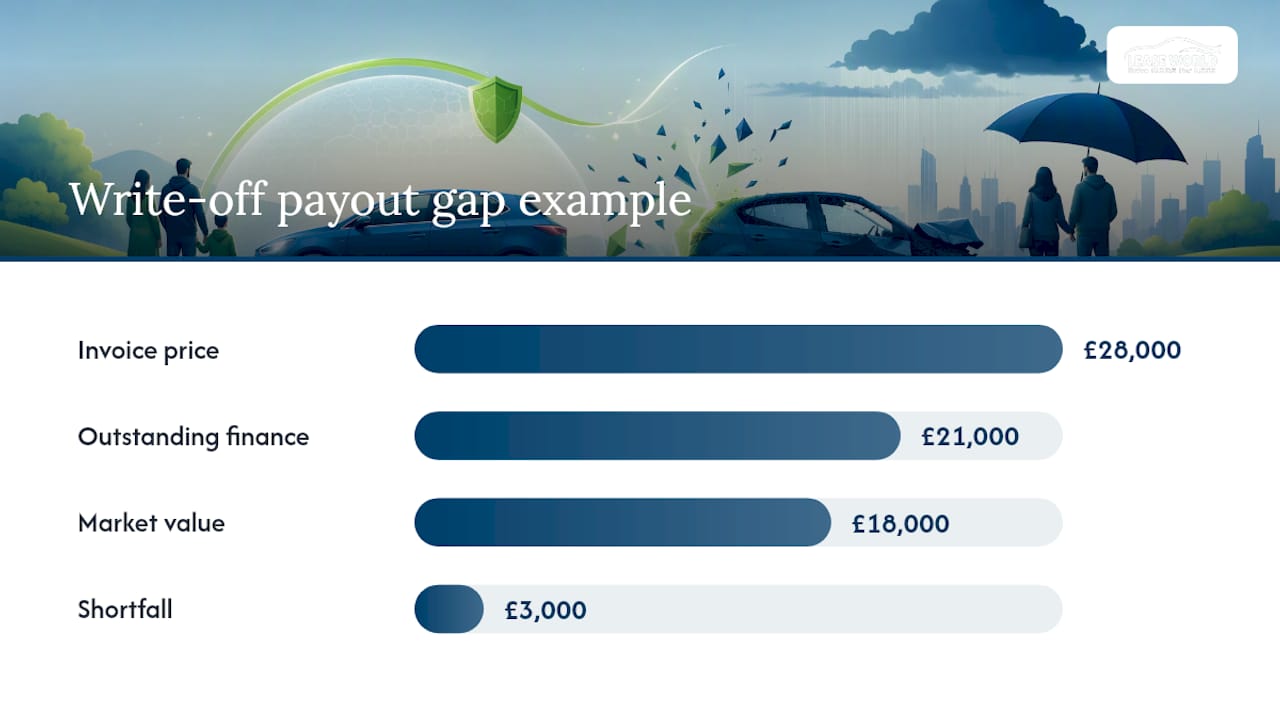
When a car is written off or stolen and not recovered, your insurer pays out its current market value. A car that cost £28,000 new may be worth £18,000 two years into a lease. If the outstanding finance settlement figure is £21,000, your standard insurer pays £18,000 and you owe the leasing company the remaining £3,000 from your own pocket. GAP insurance covers that shortfall.
The three main types of GAP cover are:
- Finance GAP: pays the difference between the insurer's market-value payout and the outstanding finance balance. The most directly relevant type for a leased vehicle.
- Return-to-invoice GAP: pays the difference between the payout and the original invoice price. Less common on leases since you did not purchase the car outright.
- Vehicle replacement GAP: covers the cost of replacing the written-off car with an equivalent new model at current prices. Useful when replacement costs have risen since the lease started.
The scenario where GAP matters most is an early-term write-off. In the first 12–18 months of a lease, the gap between market value and outstanding finance is typically at its widest, because depreciation is steepest in the first year.
GAP is not usually included in a standard insured lease bundle. Ask specifically whether it is offered and, if not, arrange it separately. The cost is generally modest relative to the protection it provides.
How to compare the cost of a bundled insured lease with arranging cover separately
Bundled insured leases often carry a higher monthly rental than an equivalent uninsured deal, but they reduce admin and give you one predictable bill. Whether that premium is worth paying depends on your personal insurance profile and how you value convenience.
MoneySuperMarket's leasing explainer confirms that lease terms commonly run 2–4 years, with annual mileage bands typically ranging from around 8,000 to 30,000 miles and initial rentals of one, three, six, or nine months' equivalent. These parameters directly affect the monthly payment and must be standardised when you compare a bundled quote against an unbundled one.
| Parameter | What to standardise |
|---|---|
| Lease term | Same number of months for both quotes |
| Annual mileage | Identical mileage band |
| Initial rental | Same number of months upfront |
| Insurance cover level | Fully comprehensive, same excess |
| Named drivers | Same list of drivers on both policies |
Pro Tip: Get your own insurance quote before you accept a bundled deal. Use the VIN (or vehicle registration once confirmed), your declared annual mileage, and the exact driver list. If your standalone quote is materially lower, the bundled premium is costing you for convenience alone. That may still be worth it, but you should know the number.
For a full breakdown of what monthly lease payments include and exclude, the Lease World guide to monthly lease payments is a useful reference.
Driver eligibility rules for insured lease packages
Many insured bundles carry stricter eligibility criteria than a standard uninsured lease, because the insurer's underwriting rules sit on top of the funder's own credit and vehicle criteria.
Common eligibility factors include:
- Minimum age: many insurers will not include drivers under 21, and some set the minimum at 25 for certain vehicle categories
- Licence duration: a full UK or EU licence held for at least one year is typically required; some funders ask for two or more years
- Convictions: motoring convictions (particularly DR10 drink-driving endorsements) can disqualify a driver from the bundled policy or significantly increase the premium
- Recent claims: two or more fault claims in the last three years often triggers a decline or a loading that removes the cost advantage of the bundle
- Business vs private use: if the vehicle will be used for business purposes, the policy must reflect that; many standard bundled policies cover social, domestic, and pleasure use only
- Named-driver restrictions: some bundled policies limit the total number of named drivers or exclude drivers under a certain age entirely
The AA's guidance on insuring a lease car notes that insurers will want the leasing company recorded correctly on the policy, and that failing to do so can complicate claims and settlement with the finance provider. For a deeper look at how underwriting differs for leased vehicles, the Lease World guide on why insurance differs for leased cars covers the practical differences.
What to check in your lease contract before you sign
A lease that claims to include insurance needs careful scrutiny. Work through this checklist before you commit:
- What is and is not covered: request the full policy wording, not just a summary. Confirm the cover level, geographic limits, and any named exclusions.
- Policy excess: check the compulsory and voluntary excess amounts. A bundled deal with a £1,000 excess may be less attractive than it first appears.
- Who handles claims: does the claim go through the insurer directly, or through the lessor? Understand the process before you need it.
- Approved repairers: many bundled policies require repairs at a network of approved bodyshops. Confirm whether you have any choice.
- Replacement vehicle terms: is a courtesy car guaranteed, or just "subject to availability"? What category of vehicle?
- Administration fees: check what fees apply for mid-term changes, adding a driver, or a change of address.
- Chargeable damage definitions: request the lessor's fair wear-and-tear guide. Know what counts as acceptable return condition versus chargeable damage.
- GAP insurance: ask whether it is included, offered as an add-on, or not available through the bundle at all.
Pro Tip: Ask for a sample certificate of insurance or a specimen policy document before you sign the lease. Any provider offering a genuine insured bundle should be able to supply this. If they cannot, treat that as a warning sign.
How to arrange motor insurance for a leased vehicle
Whether you are taking a bundled deal or arranging cover yourself, the process follows the same sequence.
- Confirm the lessor's requirements in writing before you start shopping. Ask for the minimum cover level, the exact name and address the leasing company needs to appear as an interested party, and any other policy conditions.
- Get quotes early, ideally two to three weeks before delivery. Use the vehicle's confirmed registration or VIN, your declared annual mileage, and the full list of drivers who will use the car.
- Arrange the policy to start on the delivery date. Cover must be in place from the moment the vehicle leaves the compound.
- Name the leasing company as an interested party on the policy. This is not the same as a named driver. It records the lessor's financial interest in the vehicle.
- Send proof of cover to the leasing company before delivery. Most funders require the policy number, insurer name, and cover start and end dates. LeasePlan's PCH agreement documentation confirms that some funders will not release the vehicle without this.
- Notify the lessor promptly after any claim, even a minor one. The lease agreement will specify a notification window, and missing it can create complications at return.
- Handle mid-term changes carefully: adding a driver, changing your address, or altering your annual mileage all require updates to both the insurer and, in some cases, the lessor.
Pro Tip: For multi-driver households, declare all regular drivers upfront rather than adding them later. Mid-term additions can trigger a premium adjustment and, in some bundled deals, require lessor approval.
When does a bundled insured lease actually make sense?
The honest answer is: it depends on who you are, not just what the deal costs.
Insured bundles suit drivers who want a single, predictable monthly outgoing with no separate renewal dates to manage. For a business running several vehicles, the administrative simplicity of one invoice covering lease, insurance, maintenance, and tax is genuinely valuable. For a driver with a clean licence and several years of no-claims discount, the bundled premium will often be higher than what they could arrange independently, because the insurer is pricing for an average pool of drivers rather than their specific risk profile.
The drivers who typically benefit most from bundled insured leases are:
- Drivers with limited claims history who want a known monthly cost without the risk of a surprise renewal premium
- Small businesses that want single-vendor management and simplified expense reporting
- Drivers new to leasing who want fewer moving parts to manage in the first term
- Anyone whose personal insurance profile sits close to the average risk pool the bundle is priced for
Arranging your own cover makes more sense if you have a strong no-claims record, specific insurer preferences, or a household where multiple drivers need to be added flexibly. The Lease World leasing guides hub covers both routes in detail for UK drivers.
Lease World's role as a broker is to compare insured and unbundled options across funders, request sample policy wordings, and help you understand the total monthly cost before you commit. That comparison is where the real value sits.
Lease World can help you find the right insured or maintained lease
Fixed monthly payments that cover the vehicle, insurance, maintenance, and tax are genuinely available in the UK market. The challenge is that the quality of what is bundled varies considerably between funders, and the headline monthly figure rarely tells the whole story on excesses, approved repairers, or named-driver limits.
Lease World works as a brokerage across the UK market, comparing insured and maintained lease packages alongside standard contract hire deals so you can see the true total cost side by side. Whether you want a personal car lease with full cover included, a maintained deal without insurance, or a standard lease where you arrange your own policy, Lease World can source tailored quotations, check contract terms, and arrange free mainland UK delivery on eligible vehicles. To get a personalised comparison that includes sample policy wordings and a breakdown of what each bundle actually covers, request a quote and a member of the team will come back to you with options matched to your driver profile and budget.
Sources
The following official and industry sources underpin the guidance in this article:
- Leasing a car with personal contract hire (PCH) | MoneyHelper
- Car leasing explained: how it works, costs and whether it’s right for you | Parkers
- Is vehicle insurance included in lease finance agreements? | Promise Money
- Car leasing explained | MoneySuperMarket
- Does car leasing include insurance? | Carwow
The guidance in this article is general information for UK motorists and does not constitute legal, financial, or insurance advice. Confirm current policy terms, contract conditions, and regulatory requirements with your insurer, leasing company, or a qualified adviser before signing any agreement.
This article is general information, not a substitute for advice from a qualified financial advisor. Consult a qualified financial professional about your own circumstances before acting on anything here.
FAQ
Does a standard UK car lease include insurance?
No. Standard UK car leasing does not include motor insurance; you must arrange fully comprehensive cover yourself and name the leasing company as an interested party on the policy.
What are the main disadvantages of leasing a car?
The three most cited drawbacks are that you never own the vehicle, mileage limits apply with charges for excess miles, and you are responsible for maintaining insurance and returning the car in acceptable condition to avoid end-of-lease damage charges.
What is the smartest way to lease a car in the UK?
Fix your annual mileage honestly, compare total monthly costs across the full term (including insurance, maintenance, and initial rental), get your own insurance quote before accepting a bundled deal, and always request the fair wear-and-tear guide before signing.
Are there hidden costs when leasing a car?
Common additional costs include excess mileage charges, end-of-lease damage fees beyond fair wear and tear, administration fees for mid-term changes, and the cost of arranging GAP insurance if it is not included in the package.
Does bundled lease insurance affect your no-claims discount?
It can. When insurance is arranged through the lessor's bundled policy rather than your own personal policy, any claim may not accrue to your personal no-claims discount in the same way. Confirm with the insurer how claims are recorded before you commit to a bundled deal.