

TL;DR:
- Leasing a car for Uber in the UK requires written permission from the lessor, PHV insurance that covers leased vehicles, and vehicle eligibility approval from Uber and local authorities. If any of these conditions are missing, it is illegal to accept fares with that vehicle. Proper sequence of verification before signing a lease can prevent costly issues and ensure legal compliance.
Yes, you can lease a car and use it to drive for Uber in the UK — but only if three conditions are met simultaneously. You need written permission from the leasing company for 'hire or reward' use, a private-hire vehicle (PHV) insurance policy that explicitly covers a leased vehicle, and a car that meets both Uber's eligibility criteria and your local council's PHV licensing rules. Miss any one of those three and you cannot lawfully accept fares, regardless of what the other two say.
The three non-negotiable conditions at a glance:
- Written lessor permission authorising 'hire or reward' or private-hire use
- PHV insurance that names the leased vehicle and underwrites it for private hire
- Vehicle accepted by Uber's requirements and your local council's PHV licence rules
If you want to skip straight to sourcing a compliant agreement, Lease World can check lease terms for PHV clauses and help you find a suitable vehicle. Read on for the full checklist.
Table of Contents
- How does leasing a car for Uber differ from a standard lease?
- What are the three things that must align before you can drive?
- How do you secure a lease you can legally use with Uber?
- What should you budget for, and how long does it take?
- Which lease contract clauses should you watch out for?
- What are the viable alternatives if a standard lease does not work?
- Ten questions to ask before you sign anything
- Key takeaways
- The part most guides get wrong about leasing for Uber
- Lease World helps you get a PHV-compliant lease without the guesswork
- Useful sources
- FAQ
How does leasing a car for Uber differ from a standard lease?
A standard personal or business lease is written on the assumption you will drive the car for private use. The monthly payment reflects that risk profile. The moment you start accepting fares, the legal and contractual picture changes entirely.
| Feature | Standard personal lease | PHV-capable lease or hire |
|---|---|---|
| Insurance included | No — you arrange separately | No — PHV policy required |
| 'Hire or reward' use | Usually prohibited | Permitted with written lessor consent |
| Mileage allowance | High mileage | Needs to reflect actual driving volume |
| Wear-and-tear standard | Fair wear and tear (BVRLA guide) | Same standard — but higher mileage accelerates wear |
| Owner permission letter | Not required | Required by Uber and most councils |
As the RAC notes, many lease contracts explicitly ban hire or reward uses unless the contract states otherwise. That single clause catches more aspiring Uber drivers off guard than any other.
Beyond the contract, mileage is the practical pressure point. A typical Uber driver in a busy city can cover high mileage each year. A lease written for low mileage will generate significant excess-mileage charges at return. Understanding the difference between leasing and short-term rental matters here, because for some drivers a weekly rental scheme is a better fit than a multi-year contract.
Uber also operates its own Vehicle Marketplace, which pairs drivers with rental and purchase options from partner providers — a turnkey route for those who need a compliant vehicle quickly without negotiating a bespoke lease.
What are the three things that must align before you can drive?
Experts frame this as a 'triple alignment' problem: lessor permission, insurer acceptance, and vehicle eligibility must all be in place at the same time. If one pillar is missing, the other two are irrelevant — you cannot legally accept fares.
Pillar 1: Written permission from the leasing company
The leasing company owns the vehicle throughout the contract. Using it for private hire without their consent is a breach of the agreement and, in most cases, voids the insurance. You need a letter or written clause in the contract that explicitly authorises 'hire or reward' or 'private-hire' use. A verbal agreement is not sufficient. Uber's documentation requirements confirm that for any vehicle a driver does not personally own, a hire agreement or permission letter from the vehicle owner or funder is mandatory.

Pillar 2: PHV insurance that covers a leased vehicle
Standard comprehensive car insurance does not cover you for carrying paying passengers. You need a PHV policy, and that policy must specifically underwrite a leased vehicle. Some insurers will not cover leased cars at all; others will, but require the leasing company's permission letter before issuing the certificate. In London, Uber uses a digital verification process and accepts only specified insurers integrated with its system. Outside London, the insurer pool is broader, but you still need a certificate Uber will accept. The guide on why insurance differs for leased cars explains the mechanics in detail.
Pillar 3: Vehicle eligibility for Uber and your local council
Uber's vehicle requirements vary by city and service tier. Local councils add their own layer: minimum vehicle age, Euro emission standards, seating capacity, and accessibility requirements all differ by authority. London is the most demanding — from 1 January 2026, certain Uber service categories require vehicles registered from 1 January 2020 or later, and zero-emission-capable (ZEC) standards apply to some options. A car that qualifies today may not qualify in 18 months if Uber updates its eligible-vehicles list.

Pro Tip: Before you sign any lease, cross-check the specific vehicle make, model, and year against both Uber's current eligible-vehicles page for your city and your local council's PHV vehicle standards. Do this on the same day — both lists can change.
How do you secure a lease you can legally use with Uber?
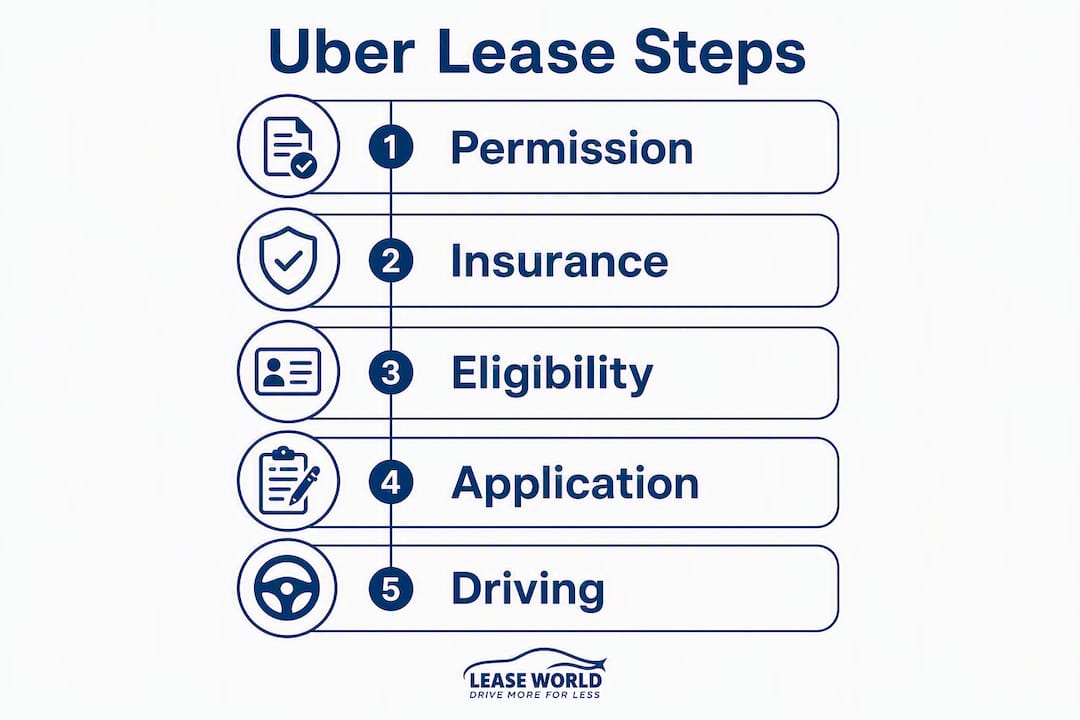
Follow this sequence before you commit to any agreement.
- Check your local council's PHV rules. Contact the licensing authority for your area and confirm vehicle age limits, emission standards, and any accessibility requirements. If you plan to drive in London, check TfL's private hire vehicle licence page directly.
- Verify Uber's vehicle eligibility for your city. Use Uber's eligible-vehicles page for your region. Note the service tier you intend to offer (UberX, Comfort, Exec) — each has different requirements.
- Contact the leasing company before signing. Ask explicitly whether the contract permits 'hire or reward' or 'private-hire' use. Request this permission in writing, either as a clause in the agreement or as a separate letter on headed paper.
- Arrange PHV insurance. Approach insurers that specifically cover leased vehicles for private hire. Confirm they will issue a certificate in a format Uber accepts. In London, check Uber's approved insurer list first.
- Gather your documents. Uber requires a valid PHV licence, an insurance certificate covering private hire, and proof of vehicle ownership or a hire agreement/permission letter from the leasing company.
- Upload documents to the Uber app. Once you have all three pillars confirmed, submit your PHV licence, insurance certificate, and hire agreement or permission letter through the Uber driver app. Processing times vary.
- Apply for your PHV licence if you do not already hold one. Allow several weeks for council processing — some authorities take longer during busy periods.
Key questions to ask the leasing company at step 3:
- "Does this contract permit use for private hire or hire or reward?"
- "Will you provide a written permission letter for my PHV licence application and Uber registration?"
- "What mileage allowance can you offer, and what is the excess-mileage rate?"
What should you budget for, and how long does it take?
Costs for leasing a car to drive for Uber in the UK fall into several distinct categories. None of these figures are fixed nationally — they vary by vehicle, leasing company, council, and insurer — but the headings below cover every cost you should plan for.
- Initial rental (upfront payment): Most contract hire agreements require an initial rental equivalent to three, six, or nine monthly payments. Understanding car lease payment profiles before you sign helps you compare deals accurately.
- Council PHV licence fees: — Fees vary by authority. TfL's private hire vehicle licence carries its own fee schedule, separate from the driver licence fee.
On timeline, allow four to eight weeks from starting the process to being live on the app. The PHV licence application is usually the longest step. If you are ordering a new vehicle through a lease, manufacturer delivery times add further lead time — sometimes several months for popular models. Vehicles already in stock can cut that significantly.
Vehicle eligibility lists are updated regularly; a model listed as eligible today may fail future cutoffs for premium services. That risk is worth pricing into any long lease commitment.
Which lease contract clauses should you watch out for?
Most standard lease contracts were not written with ride-hailing in mind. Several common clauses will either block PHV use outright or create financial exposure that makes the arrangement unworkable.
- Explicit 'no hire or reward' clause. The most common blocker. If the contract contains this language and the leasing company will not amend it, the vehicle cannot be used for Uber under any circumstances.
- Low mileage caps with steep excess charges. A 10,000-mile-per-year cap with a 10–15p per-mile excess charge will generate a large bill at contract end for a full-time Uber driver. Always negotiate a mileage allowance that reflects your actual expected usage.
- Wear-and-tear definitions. The British Vehicle Rental and Leasing Association (BVRLA) fair wear-and-tear guide sets the industry standard. High-mileage PHV use accelerates interior wear, tyre wear, and minor bodywork damage. Understand what the leasing company will charge for at return.
- Insurance exclusions. If your PHV insurer excludes certain types of damage or sets a high excess, you may face out-of-pocket costs that also constitute a breach of the lease return conditions.
- Early termination charges. If Uber changes its vehicle eligibility rules mid-contract and your car no longer qualifies, you may need to exit the lease early. Early termination fees on contract hire can be substantial. Review the lease agreement terms guide before signing.
Pro Tip: Ask the leasing company for their BVRLA fair wear-and-tear guide before you sign. Compare it against the interior condition standards Uber expects drivers to maintain. The two documents together tell you exactly what you are liable for.
If a lease contract will not permit PHV use, do not attempt to use it for Uber anyway. The consequences — voided insurance, lease breach, and potential licence revocation — are far more costly than finding a different vehicle.
What are the viable alternatives if a standard lease does not work?
Not every driver needs a long-term lease. Three routes are worth comparing.
| Route | Best for | Key trade-off |
|---|---|---|
| Short-term / weekly rental | Drivers testing Uber before committing | Higher cost per week; no long-term mileage exposure |
| Specialist PHV lease | Full-time drivers wanting fixed monthly costs | Requires upfront credit check; longer commitment |
| Uber Vehicle Marketplace | Drivers who need a compliant car immediately | Convenience comes at a premium; less vehicle choice |
Short-term rental reduces mileage and wear-and-tear risk because you return the vehicle frequently. The weekly rate is higher than the equivalent monthly lease payment, but there is no end-of-contract damage bill and no long-term commitment if Uber changes its eligibility rules.
Specialist PHV leasing — agreements written explicitly for private-hire drivers — already include the hire-or-reward permission and are structured around higher mileage. These are the cleanest route for full-time drivers. Lease World can source these agreements and check the contract terms on your behalf.
Uber's Vehicle Marketplace connects drivers with rental and purchase options from partner providers. It is the fastest route to a compliant vehicle, but the cost per mile tends to be higher than a brokered lease, and you have less flexibility over vehicle choice. For drivers who need wheelchair-accessible or larger-seat vehicles, MPV lease options are worth exploring separately.
Ten questions to ask before you sign anything
Use this list during your calls with the leasing company, insurer, and council.
Leasing company:
- Does this contract permit use for private hire or 'hire or reward'?
- Will you provide a written permission letter I can submit to my council and Uber?
- What is the annual mileage allowance, and what is the excess-mileage rate per mile?
- What wear-and-tear standard applies at return, and do you follow the BVRLA guide?
- What are the early termination charges if I need to exit the contract?
Insurer:
- Does your PHV policy cover leased vehicles, and do you need the lessor's permission letter first?
- Will you issue an insurance certificate in a format Uber accepts for driver registration?
- In London: are you on Uber's approved insurer list for digital verification?
Local council / TfL:
- What are the vehicle age and emission standards for a PHV licence in this area?
- What is the current processing time for a new PHV vehicle licence application?
Getting written answers to questions 1, 2, 6, and 7 before you sign protects you if any party later disputes the arrangement.
Key takeaways
Leasing a car for Uber in the UK is legal and workable, but only when lessor permission, PHV insurance covering a leased vehicle, and Uber/council vehicle eligibility all align at the same time.
| Point | Details |
|---|---|
| Triple alignment is mandatory | Lessor permission, PHV insurance, and vehicle eligibility must all be confirmed before accepting fares. |
| Written permission is non-negotiable | A verbal agreement with the leasing company is not sufficient — Uber and councils require a hire agreement or permission letter. |
| Check eligibility before signing | Uber's eligible-vehicles list changes; a long lease on a car that later fails cutoffs creates real financial risk. |
| Budget for PHV insurance uplift | PHV cover for a leased vehicle costs more than standard insurance — factor this into your monthly cost calculation. |
| Lease World can help | Lease World checks lease terms for PHV clauses and sources compliant agreements with suitable mileage allowances. |
The part most guides get wrong about leasing for Uber
The standard advice is to "check with your leasing company." That advice is correct but incomplete, and the gap between that advice and what actually happens is where drivers lose money.
The real problem is sequencing. Most drivers find a car they like, get excited about the monthly payment, and then ask about PHV permission as an afterthought. By that point, they have already run a credit check, received a formal quote, and mentally committed. When the leasing company says no — or says yes but the mileage cap is 10,000 miles — the driver either walks away from the deal or, worse, signs anyway and hopes for the best.
The correct order is the reverse: confirm all three pillars before you even shortlist a vehicle. That means calling your council first, then checking Uber's eligible-vehicles page, then approaching leasing companies with a specific brief. It takes an extra day or two. It saves weeks of wasted effort and, in some cases, thousands of pounds in early termination fees.
There is also a subtler risk that almost nobody mentions: vehicle eligibility drift. Uber updates its eligible-vehicles lists, and TfL's ZEC requirements for London are tightening. A car that qualifies for UberX today may not qualify for the service tier you want in two years. If you are signing a three-year lease, you are betting on that car remaining eligible for the full term. For London drivers in particular, that is a bet worth scrutinising carefully before you commit.
Lease World helps you get a PHV-compliant lease without the guesswork
Finding a lease that genuinely works for Uber driving means more than just getting a low monthly payment. You need a contract that permits private-hire use in writing, a mileage allowance that reflects real driving volumes, and a vehicle that clears both Uber's eligibility checks and your council's PHV standards.
Lease World reviews lease contracts for PHV clauses, helps source insurers that underwrite leased vehicles for private hire, and offers no-deposit personal leasing options with fixed monthly payments and free mainland UK delivery on eligible vehicles. Whether you need a standard saloon for UberX or an MPV for a larger-capacity licence, the team can match you with a suitable agreement and walk you through the documentation Uber requires. Request a PHV-capable quote today and get a tailored lease search started.
Useful sources
The sources below let you verify requirements directly and access Lease World's own guides.
Uber and licensing:
Insurance and lease guidance:
Lease World resources:
FAQ
Can I do Uber with a lease car in the UK?
Yes, provided the leasing company grants written permission for 'hire or reward' use, your PHV insurance covers a leased vehicle, and the car meets Uber's vehicle requirements and your local council's PHV licence standards.
Does Uber provide a car if you do not own one?
Uber's Vehicle Marketplace connects drivers with rental and purchase options from partner providers, so you can access a compliant vehicle without owning one. Alternatively, a specialist PHV lease arranged through a broker such as Lease World gives you a fixed monthly payment and a vehicle written for private-hire use.
Can I lease a car specifically for taxi or private-hire work?
Yes. Specialist PHV leasing agreements are written explicitly for private-hire drivers and include the hire-or-reward permission as standard. These differ from standard personal leases, which typically prohibit commercial use unless amended in writing.
How long does it take to get set up to drive for Uber with a leased car?
Allow four to eight weeks in total. The PHV licence application is usually the longest step; vehicle delivery lead times add further time if you are ordering a new car rather than taking a stock vehicle.