

If your priority is the lowest headline monthly payment, a 36-month lease usually wins. If you want to change cars sooner, stay under warranty as standard, and keep more flexibility, a 24-month lease tends to suit better. The caveat: always compare the effective monthly cost, including any initial rental and fees, not just the number quoted at the top of the page. Car leasing brokers can run both terms side by side so you're comparing like with like.
TL;DR:
- A 24-month lease typically results in higher monthly payments but can be more cost-effective overall due to better residual values and lower depreciation.
- Comparing effective monthly costs requires accounting for initial rentals, fees, and incentives, as these significantly impact the total expense.
- Maintaining a lease within the manufacturer's warranty is easier with a 24-month term, while a 36-month lease may approach the warranty's end, affecting maintenance costs.
- Residual values are generally higher for shorter leases, but lower interest rates and subsidies on 24-month deals can make them surprisingly competitive.
- Always compare identical quotes with the same mileage and initial payments to determine which lease length offers the best total and monthly costs for your driving needs.
Table of Contents
- 24 vs 36 month lease at a glance
- Why the residual and money factor alter payments
- Fees, initial rentals and incentives: the hidden levers
- Who should choose 24 months, and who should choose 36?
- A worked example: same car, two terms
- Why Lease World recommends running both quotes side by side
- Get a tailored 24- or 36-month quote
- Sources
- FAQ
24 vs 36 month lease at a glance
The headline monthly figure usually moves in a predictable direction. A 36-month lease spreads depreciation and finance charges over more payments, so the monthly cost is typically lower even though the car ages further before you hand it back. A 24-month lease concentrates the same depreciation into fewer months, which usually pushes the monthly payment up, even though 24-month agreements often carry higher residual percentages that should, in theory, work in your favour.
Total commitment doesn't always follow the same pattern as the monthly price. A shorter lease can cost less overall, but you'll go through the sign-up process, and any associated admin fees, more often over the same stretch of driving.
A few things worth scanning on any quote before you decide:
- The headline monthly rental, and whether it includes maintenance
- The initial rental amount (often called the deposit, though it isn't refundable)
- The annual mileage allowance and excess-mileage charge per mile
- Whether the manufacturer's warranty runs out before, during, or after the contract ends
Most UK manufacturer warranties run three years, so a 24-month lease keeps you covered throughout, while a 36-month lease can brush right up against the warranty's edge in the final months. A guide on warranty coverage on leased cars breaks this down by manufacturer if you want specifics before you commit.
Why the residual and money factor alter payments
Two figures drive every lease quote: the residual value and the money factor. The residual value is what the finance company predicts the car will be worth at the end of your contract, expressed as a percentage of its original price. The money factor (or equivalent interest rate baked into the payment) is the cost of borrowing against the difference between that original price and the residual.
Here's the mechanic that trips people up: residuals are generally strongest at 24 months and lower at 36 months, because the car has depreciated less by the two-year mark. A high residual should mean lower monthly payments, since you're only financing the depreciation gap between the price and that residual figure. But because you're spreading that smaller gap over fewer months, the payment often still comes out higher on the 24-month deal.
A few things can flip that expectation on its head:
- Manufacturers sometimes subsidise, or "subvent," the money factor on specific terms to hit sales targets, occasionally making a 24-month deal surprisingly competitive
- Multiple security deposits can lower the money factor further where the funder permits them
- Mileage choice moves the residual: pick a lower annual allowance and the predicted resale value rises, which usually reduces the monthly payment too
Statistic to know: a residual sitting above 50% on a 36-month mainstream car is generally viewed as strong. Anything below that on a shorter, lower-mileage deal should prompt a second look at whether you're getting a fair rate.
Fees, initial rentals and incentives: the hidden levers
The monthly figure on a quote rarely tells the whole story. Fees and incentives shift the real cost more than most drivers expect, and they behave differently depending on the term length.
- Acquisition and administration fees apply once per contract, so signing two 24-month leases back to back means paying them twice over the same six years a single 36-month deal would cover once.
- Disposition fees at handback follow the same pattern, more common if you swap cars more frequently.
- The initial rental (commonly one, three, six or nine months' payments upfront) needs folding into your monthly cost. Divide the total rental cost, initial payment included, by the number of months to get the effective monthly figure, which is the only number worth comparing between two quotes.
- Incentives turn up more often on 36-month deals, since manufacturers use longer terms to move stock, but genuine 24-month specials do exist, usually tied to end-of-plate clearance.
Maintenance packages add another wrinkle. Bundling servicing into a 24-month lease often costs less overall, because the car stays newer and needs less work, while a 36-month contract may need at least one set of consumables replaced. A breakdown of hidden costs that catch UK drivers out covers the fees dealers don't always volunteer upfront.
Pro Tip: Ask for the total rental cost figure, not just the monthly price, when you request a quote. Every reputable broker can produce it, and it's the fastest way to spot a deal that looks cheap but isn't.
Who should choose 24 months, and who should choose 36?
Neither term is objectively "better." They suit different driving habits and different attitudes to commitment.
- Choose 36 months if your main goal is the lowest monthly outgoing, your mileage is steady and well within a generous allowance, and you'd rather deal with fewer contract renewals over several years.
- Choose 24 months if you like driving newer models with the latest tech, want to stay comfortably inside manufacturer warranty and servicing schedules, and don't mind sourcing a new lease more often.
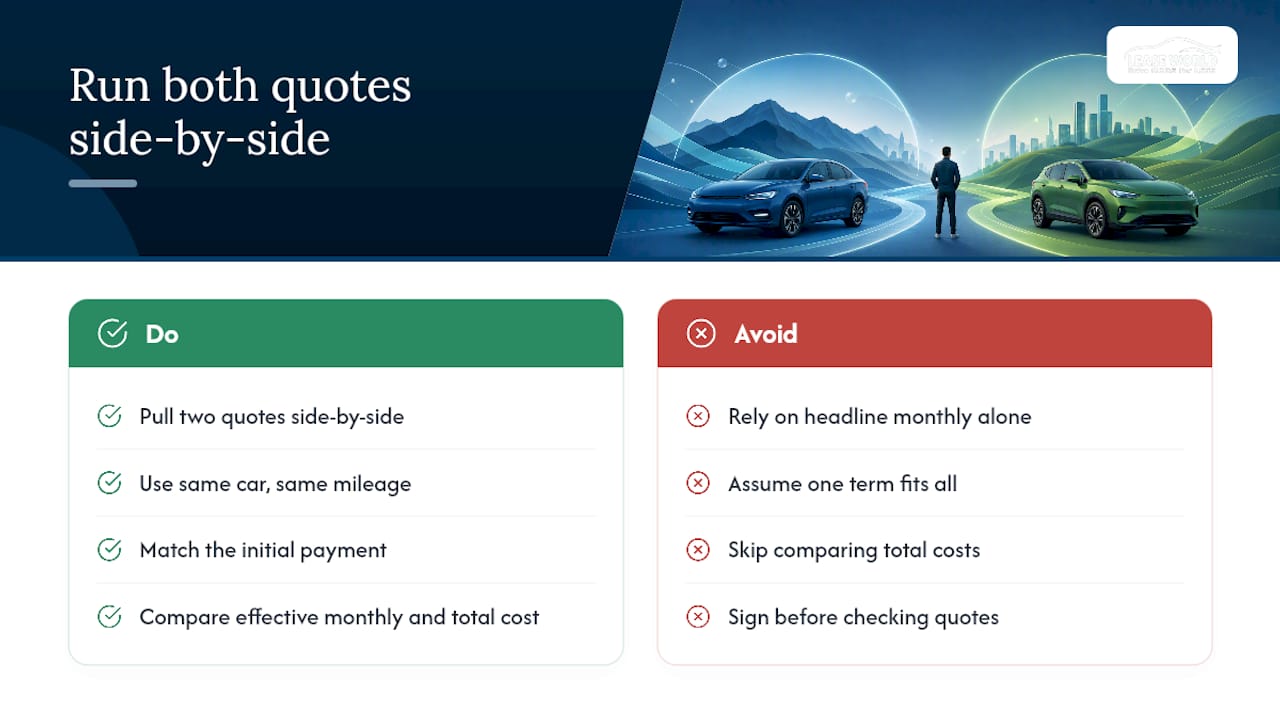
- Run both quotes when you're genuinely torn. Ask for identical mileage and initial payment on each, then compare the effective monthly cost, the total rental cost, and the residual percentage side by side.
Business users and driving instructors often lean towards 36 months for the payment stability, while private motorists chasing the newest electric models tend to favour the shorter cycle. If flexibility matters more than either, a short-term lease of three to twelve months sits at the opposite end of the spectrum entirely, and it's worth knowing that option exists before ruling it out.
A worked example: same car, two terms
Take a car with a capitalised cost of £30,000, no initial rental beyond one month upfront, and identical mileage on both quotes.
- 24-month quote: residual set at 55% (£16,500). Depreciation to finance is £13,500. Add a money factor equivalent to roughly 4% APR, and the finance charge comes to around £600 over the term. Total to finance: £14,100 over 24 months, giving a base payment near £588 a month.
- 36-month quote: residual set at 48% (£14,400). Depreciation to finance is £15,600. With the same 4% APR equivalent, the finance charge over the longer term comes to roughly £940. Total to finance: £16,540 over 36 months, giving a base payment near £460 a month.
- Fold in the initial rental (one month's payment upfront on each) and divide by the contract length to get the effective monthly cost. On this example, the 36-month deal still comes out lower per month, but the 24-month deal finances roughly £2,440 less overall, a gap worth checking against your own priorities.
The residual figures used here are illustrative. Run a real quote using your chosen model, since residuals swing by trim, colour, and mileage band as much as by term length.
Why Lease World recommends running both quotes side by side
Jason has spent years inside the UK leasing sector, working through the funder-side maths that decides what a headline monthly figure actually hides. That's the lens behind this comparison: numbers first, opinions second.
Some UK leasing brokers are family-run businesses and may offer fixed monthly payments, no deposit options where eligible, and free UK delivery on qualifying vehicles. Term-length comparisons often start from real quote structures rather than theory. Guides on term length can cover periods from 12 to 60 months, since the right answer depends on your mileage and your appetite for renewal admin, not a fixed rule. When customers ask for a 24- or 18-month lease comparison, the practical next step is usually to pull two quotes on the same car, same mileage, same initial payment, then compare the effective monthly and total cost before signing anything.
— Jason
Get a tailored 24- or 36-month quote
Comparing two quotes properly means having the right numbers ready before you call, and Lease World builds every comparison around fixed monthly payments with no hidden fees buried in the small print. Unlike a generic online calculator, a real conversation with Lease World's team means you get residual and money factor figures specific to your chosen model, not a generic estimate.
Before you request quotes, have three things ready: your expected annual mileage, whether you'd prefer no deposit or a larger initial rental to lower the monthly cost, and your preferred term. Lease World's personal car leasing page covers the full range of terms available, including short-term options for drivers who want maximum flexibility. If you already know roughly what you're after, submit your details through the quote enquiry page and a real person will run the 24- and 36-month numbers against each other for your exact model, mileage, and budget.
Sources
Verifying the maths yourself is straightforward with the right tools.
- Can you lease a car for 24 months? – CarsPlan
- Lease car residual value calculator – Depreication Calculator
- Car finance depreciation calculator – Depreication Calculator
FAQ
Should I do a 24 or 36 month lease?
Choose 36 months if the lowest monthly payment matters most; choose 24 months if you want to change cars sooner, stay within manufacturer warranty, and don't mind renewing more often. Run identical quotes on both terms with the same mileage and initial payment, then compare the effective monthly and total cost before deciding.
What is the 90% rule in leasing?
Some commentators use it loosely to describe checking that a lease's total cost stays close to, or below, a substantial portion of the car's retail price, but treat this as a rough sanity check rather than a fixed formula.
What is the best length for a lease?
There's no single best length. It depends on your mileage, how often you want a new car, and whether a lower monthly payment or shorter commitment matters more to you. Lease World arranges terms from short-term options right through to 60 months, so the right length is whichever one matches your driving pattern and budget.
What is the 1.25% rule of leasing?
This is a rough industry shorthand some brokers use to sanity-check whether a lease's monthly payment looks reasonable relative to the car's price, but it isn't a formal or universally applied standard. It's more useful as a quick gut check than a substitute for comparing actual residuals, money factors, and fees on a real quote.