

Manufacturers offer low monthly payments and low interest rates as deliberate financial tools, not acts of generosity. The core reason is straightforward: by subsidising the cost of borrowing through their own finance arms, manufacturers make expensive vehicles feel affordable without permanently cutting the price on the forecourt. This protects brand value, clears stock, and keeps buyers coming back on shorter replacement cycles. In the UK, these promotions are almost always structured around Personal Contract Purchase (PCP) agreements, which spread the cost across fixed monthly instalments with a balloon payment at the end.
- Low payments attract price-sensitive buyers who focus on monthly affordability rather than total outlay.
- Manufacturers subsidise finance costs via deposit contributions, typically £500 to £2,000 per deal, paid directly to the finance company.
- Promotions shift specific models or trim levels without triggering permanent price reductions.
- PCP structures lower the visible monthly cost by deferring a large portion of the vehicle's value to the end of the contract.
- Short-term sales boosts are achieved while headline prices and residual values stay intact.
How manufacturer low payment promotions actually work
The mechanics behind these deals are more layered than the adverts suggest. A manufacturer wanting to shift a particular model will instruct its finance arm to offer a subsidised Annual Percentage Rate (APR) or contribute a lump sum towards the customer's deposit. That deposit contribution, known as a Manufacturer Deposit Contribution (MDC), is treated by HMRC as a discount on the vehicle's taxable price, reducing the VAT base rather than simply being a cash gift.
On the interest side, the manufacturer pays its finance company the difference between the commercial rate and the promotional rate. The Peugeot Motor Company case before the VAT tribunal confirmed this structure explicitly: PMC paid PSA Finance a precisely calculated weekly subsidy to compensate for the interest foregone on zero-rate or low-rate deals. Customers saw an attractive monthly figure; the finance company was made whole behind the scenes.

PCP is the dominant vehicle for these promotions. Between 2009 and 2021, PCP's share of new car consumer financing rose from 55% to 87% of the market. The structure works by setting a Guaranteed Future Value (the balloon), which means the customer only finances the depreciation portion of the car, keeping monthly payments low. Understanding how PCP agreements work is the foundation for evaluating any manufacturer finance offer.
The catch behind low finance offers you need to know
Low payment deals come with conditions that are easy to miss when the headline figure looks attractive.
- Eligibility is not guaranteed. Advertised rates are representative APR, meaning manufacturers must only ensure at least 51% of applicants qualify. The rest receive a higher personal rate after a credit check.
- Balloon payments can be substantial. The deferred sum at the end of a PCP is what keeps monthly costs low, but it must be paid, refinanced, or absorbed by part-exchanging the car.
- Mileage limits are strict. Exceeding them triggers per-mile penalty charges that can quickly erode any saving made on the monthly rate.
- Shorter contracts often accompany 0% deals. Interest-free agreements typically run 24–36 months with larger deposits, meaning higher monthly payments than a longer deal at a modest APR.
- The total cost of credit is what matters. Subsidising interest makes a car look affordable monthly but the overall amount repaid can exceed what a cash buyer would pay.
Pro Tip: Before signing, ask the dealer for the total amount payable over the full contract, not just the monthly figure. Compare that against the cash price and any available personal loan rate. The gap is often revealing.
Why manufacturers prefer finance deals over cutting prices
Cutting the sticker price is a one-way door. Once a manufacturer publicly reduces a model's price, residual values fall, used car prices soften, and the brand's premium positioning erodes. Finance subvention avoids all of that.
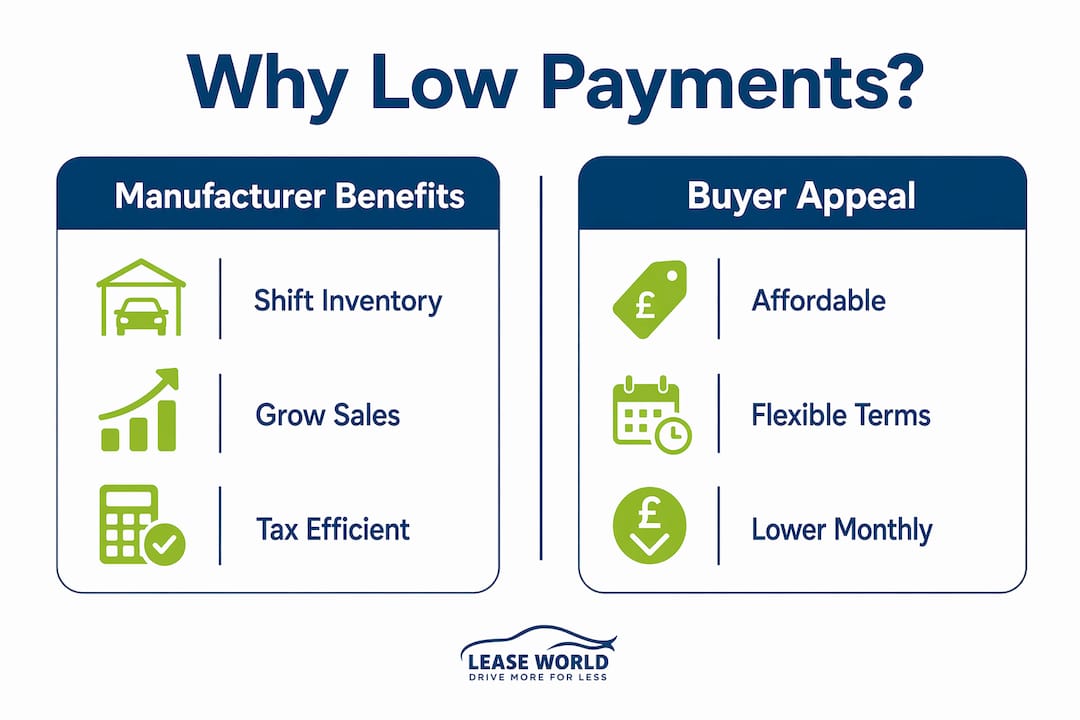
Low APR promotions act as flexible, temporary levers that can be switched on for a quarter and withdrawn without leaving a permanent mark on the price list. MG demonstrated this in early 2026, dropping its APR from 6.9% to approximately 2.9% while adding around £2,000 in discounting, which pushed monthly payments from £558 down to roughly £470. That repositioning was deliberate and reversible. Toyota took the opposite approach with the C-HR, maintaining sustained discounting alongside a higher APR, using price reduction as the primary lever while protecting finance margin.
MDCs are also tax-efficient. HMRC treats them as discounts reducing the taxable vehicle price, a fact manufacturers leverage for tax efficiency, so the manufacturer accounts for less VAT on each subsidised deal. Finance incentives, in short, serve commercial, brand, and tax objectives simultaneously.
Why UK buyers focus on monthly payments
FCA consumer research found that the majority of current motor finance holders chose their deal primarily because monthly payments were within their budget. Total cost of credit came a distant second. Manufacturers know this, and they engineer their PCP offers accordingly, setting residual values and APRs to hit a target monthly figure rather than a target total price.
The financialisation of car consumption research found that as PCP penetration rose, the average amount financed per new car climbed substantially over the period considered. Buyers were accessing more expensive cars because the monthly number stayed manageable. This is precisely the outcome manufacturers want: higher transaction values without buyer resistance. If you want to understand why people lease cars rather than buy outright, this monthly-payment psychology sits at the heart of it.
Manufacturer finance versus a bank or personal loan
Manufacturer-linked finance companies often offer rates that independent lenders cannot match, precisely because the manufacturer is subsidising the gap, making leasing vs buying a car a crucial decision for financial success. Dealer finance regularly includes 0% APR or deposit contributions typically in the range of several hundred to a few thousand pounds on new PCP deals, making it genuinely cheaper than a personal loan in some cases.
The trade-off is flexibility. A personal loan from a bank gives you the freedom to negotiate as a cash buyer, potentially unlocking dealer discounts that disappear when you take the manufacturer's finance package. Which? notes that some dealers offer bigger discounts to buyers who express an interest in finance, because the dealer earns commission on the finance deal. You can sometimes use that dynamic to your advantage even if you intend to pay cash. When weighing your options, the car finance vs leasing comparison is worth reading before you commit.
How long these promotions last and who qualifies
Manufacturer finance promotions in the UK typically run in quarterly cycles, aligned with registration plate changes in March and September. A campaign might last 8–12 weeks before the APR or deposit contribution is revised. Stock-specific deals can be shorter, sometimes covering only cars already on the forecourt.
Eligibility hinges on credit score. Representative APR advertising requires that at least 51% of applicants qualify, which means a meaningful share of buyers will be offered a higher personal rate. Credit eligibility affects access to headline promotions, and buyers with near-prime or sub-prime profiles may find the advertised rate unavailable to them. Checking your credit file before applying avoids the awkward mid-process discovery that the 0% deal is out of reach.
How deals differ across vehicle segments
Manufacturers do not apply the same financing strategy across every model. New cars receive the most aggressive subvention because manufacturers control the full supply chain and can coordinate APR, residual values, and deposit contributions as a package. Used cars rarely qualify for manufacturer-backed 0% deals; those are almost exclusively reserved for new vehicles.
Electric vehicles have attracted particularly sharp promotional financing in 2026, as manufacturers push adoption to meet emissions targets. Higher residual values on popular EV models allow lower monthly payments without deep APR subsidisation. Entry-level models in competitive segments tend to use low APR as the primary lever, while premium models rely more on high residual values to keep monthly costs competitive without sacrificing margin. The Nissan Qashqai illustrates the middle ground: an APR of approximately 2.5% paired with a residual value of around 42%, holding monthly payments in the £600–£650 band through programme management rather than aggressive rate cutting.
If you want to cut through the complexity of manufacturer finance and find a deal that genuinely works for your budget, Lease World's leasing guides cover everything from PCP structures to monthly payment profiles in plain language.
Key takeaways
Manufacturers offer low monthly payments primarily to shift inventory and grow transaction values without cutting headline prices, a strategy that works because most UK buyers prioritise monthly affordability over total cost.
| Point | Details |
|---|---|
| Subsidised finance, not free money | Manufacturers pay their finance arms to cover the gap between commercial and promotional rates. |
| MDCs reduce taxable price | HMRC treats deposit contributions of £500–£2,000 as discounts, lowering the VAT base on each deal. |
| Most buyers prioritise monthly payments | FCA research shows a majority of UK buyers choose finance based on monthly affordability, not total credit cost. |
| Representative APR limits access | Only 51% of applicants need to qualify for an advertised rate; many buyers receive a higher personal rate. |
| PCP share reached 87% by 2021 | PCP dominates new car financing because its structure keeps monthly payments low by deferring the balloon. |
FAQ
Why do manufacturers offer 0% finance if it costs them money?
Manufacturers subsidise the interest directly to their finance arm, treating it as a marketing expense. The goal is to shift specific models and increase transaction values without permanently reducing the vehicle's list price.
Is 0% car finance actually a good deal?
It can be, but only if you qualify for the representative rate and the total amount payable is genuinely lower than the cash price or a personal loan alternative. Shorter contract lengths and larger deposits often offset the interest saving.
What happens if I cannot pay the balloon payment at the end of a PCP?
You can return the vehicle to the manufacturer with no further liability, provided you have kept within the mileage limit and the car is in acceptable condition. Alternatively, you can part-exchange or refinance the balloon into a new agreement.
What does 0% APR for 24 or 36 months mean in practice?
It means no interest is charged during the contract term, so your monthly payments cover only the depreciation portion of the car's value plus any fees. The manufacturer compensates the finance company for the lost interest behind the scenes.
Do manufacturer finance deals beat a personal loan from a bank?
Not always. When a manufacturer is running a genuine 0% or sub-2% APR promotion with a deposit contribution, dealer finance often wins on total cost. Outside those campaigns, a personal loan can be cheaper and gives you more negotiating power as a cash buyer.