

TL;DR:
- A plug-in hybrid lease is a fixed-term contract that allows drivers to use a PHEV without owning it, paying a set monthly fee. Success depends on regular charging and matching the lease to driving habits, especially daily electric range. Proper understanding of lease terms and incentives can help drivers choose the best deal suited for their needs.
A plug-in hybrid lease is a fixed-term contract that lets you drive a plug-in hybrid electric vehicle (PHEV) for an agreed period, paying a set monthly amount without owning the car. PHEVs combine a petrol engine with a rechargeable electric motor, giving you the option to run on electricity for short journeys and petrol for longer ones. PHEV registrations surged 47.3% year-on-year as of january 2026, reaching 12.9% of total vehicle registrations. That growth reflects a clear shift in driver priorities toward lower running costs and reduced emissions, without the commitment of full electric ownership.
How does a plug-in hybrid lease work?
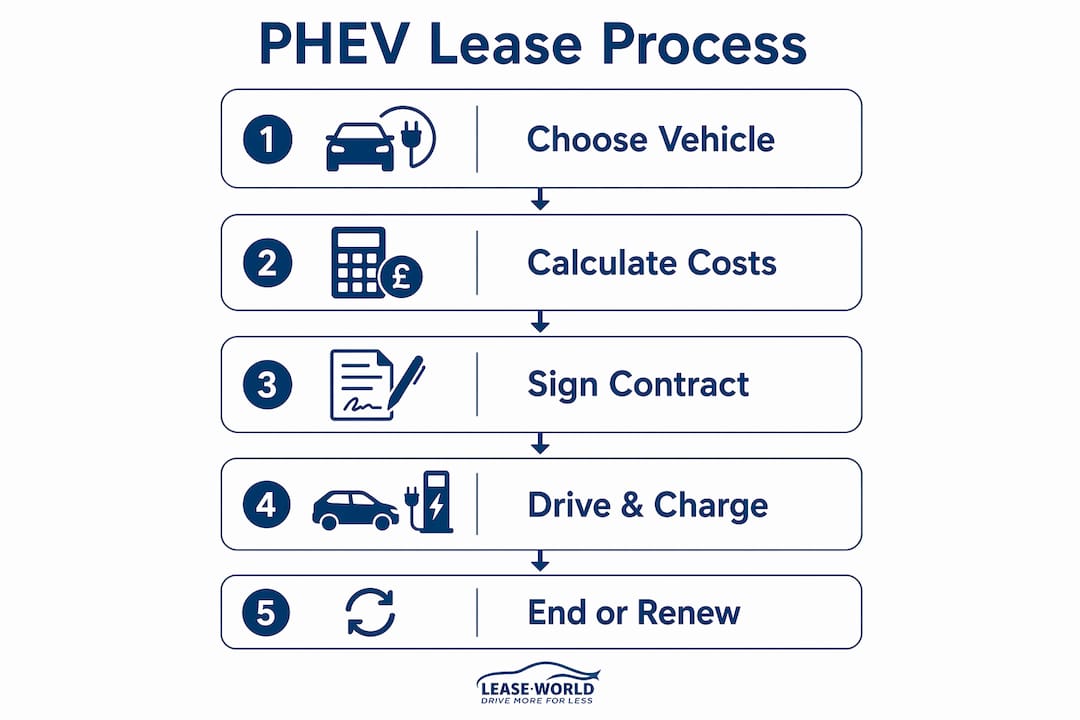
A plug-in hybrid lease operates like any standard personal contract hire (PCH) agreement, but the vehicle itself has two power sources. You agree a contract length, a mileage allowance, and an initial payment, then make fixed monthly payments for the duration. Typical lease terms run 24–36 months, which suits drivers who want to upgrade as battery technology improves.

The monthly payment you see advertised is rarely the full picture. Dealers often quote a low monthly figure alongside a significant upfront payment. The true measure of any deal is the effective monthly cost, which spreads the initial payment across the full term and adds it to the monthly figure. Effective monthly cost is the real benchmark for comparing PHEV lease deals, not the headline price alone.
Here is how a typical PHEV lease is structured:
- Initial payment. Usually equivalent to three to nine monthly payments, paid before you collect the vehicle.
- Monthly payments. Fixed for the contract term, covering depreciation and finance charges.
- Mileage allowance. Agreed upfront; exceeding it triggers a per-mile excess charge.
- End-of-lease return. You hand the car back in good condition, with no ownership obligation.
- Manufacturer incentives. Subsidies from the manufacturer can reduce the monthly cost, though these vary by model and region.
Pro Tip: Calculate the effective monthly cost before signing. Add all upfront fees, divide by the contract length, and add that figure to the monthly payment. This gives you the true cost of the deal.
It is also worth noting that federal tax credit changes in late 2025 shifted the leasing market. Manufacturer incentives now carry more weight than government subsidies, so comparing deals across models matters more than it did previously.
What are the benefits of leasing a plug-in hybrid?
Leasing a PHEV delivers a combination of financial and practical advantages that outright purchase rarely matches for drivers who want flexibility.
- Fixed monthly costs. You know exactly what you pay each month, with no surprise depreciation losses when you come to sell.
- Depreciation protection. Leasing shields you from depreciation because you return the vehicle at the end of the term rather than absorbing its resale value drop.
- Technology flexibility. Leasing allows vehicle upgrades every 24–36 months as battery standards and electric ranges improve, so you are never stuck with outdated technology.
- Lower fuel costs. Drivers who charge regularly can cover most short commutes on electricity alone, cutting fuel spend significantly compared to a petrol-only vehicle.
- Manufacturer warranty. Most PHEV leases run within the manufacturer's warranty period, so mechanical repairs are covered without extra cost.
- Environmental credentials. PHEVs produce lower tailpipe emissions than petrol cars when driven on electric power, which can support company car tax savings for business drivers.
Pro Tip: If your employer offers workplace charging, a PHEV lease becomes considerably more cost-effective. Free daytime charging effectively eliminates your fuel bill for commuting.
Lease World offers personal car leasing options across a wide range of PHEVs, with transparent pricing and no hidden fees, which makes comparing the true cost of each deal straightforward.
How do charging habits affect the cost of a PHEV lease?
Charging discipline is the single factor that most determines whether a plug-in hybrid lease saves you money or costs you more than a standard petrol car. A PHEV that is never plugged in carries the weight of a battery pack while running entirely on petrol, which reduces fuel efficiency compared to a lighter conventional car.
Most PHEVs offer an electric-only range of 20–40 miles. That covers the average UK daily commute comfortably when the battery is fully charged each morning. Drivers who charge overnight at home and top up at work can run almost entirely on electricity for everyday use, reserving the petrol engine for motorway journeys.
"Without consistent access to charging, a PHEV lease can become costly as the vehicle behaves like a heavy petrol car with poor fuel economy. Charging availability and use are vital for both the financial and environmental gains from leasing a PHEV." Source: Recharged
Honest assessment of your charging habits is the most critical step before signing a PHEV lease. Drivers without home charging or a reliable workplace charger will not realise the fuel savings that make PHEV leasing financially attractive.
Consider these questions before committing:
- Do you have a driveway or garage where you can install a home charger?
- Does your workplace offer charging points?
- Is your typical daily mileage within the 20–40 mile electric range?
- Do you regularly drive long distances that would require the petrol engine regardless?
If you answered yes to the first three questions, a PHEV lease is likely to deliver genuine savings. If you answered no to all four, a standard hybrid or electric car lease may suit your driving pattern better.
Key leasing terms to understand before you sign
Every PHEV lease contract contains terms that directly affect your total cost. Understanding them before you sign prevents expensive surprises at the end of the agreement.
| Term | What it means |
|---|---|
| Effective monthly cost | Monthly payment plus prorated upfront costs, divided across the full term. The true cost benchmark. |
| Residual value | The predicted value of the car at lease end. A higher residual value lowers your monthly payment. |
| Mileage allowance | The maximum miles agreed for the contract. Excess mileage is charged per mile, typically 5–15 pence. |
| Acquisition fee | An admin charge from the finance company, sometimes called a documentation fee. |
| Fair wear and tear | The acceptable level of use-related marks and scuffs. Damage beyond this standard is charged on return. |
Residual value is particularly important for PHEVs. Because battery technology is advancing quickly, lenders factor in potential depreciation when setting residual values. A lower residual value means higher monthly payments, so models with strong resale histories tend to offer better lease rates.
Understanding leasing terminology before you compare deals puts you in a stronger position to identify which contract genuinely offers value. The Lease World leasing glossary covers every term you are likely to encounter in a PHEV contract.
Manufacturer incentives now play a larger role in pricing since federal tax credit changes in late 2025 reduced the uniformity of government subsidies. This means the same model can carry very different effective monthly costs depending on which manufacturer deal is active at the time you sign. Timing your lease to coincide with strong manufacturer offers can make a material difference to what you pay.
For drivers considering what happens after a lease ends, off-lease vehicle options are worth understanding, particularly given how incentive changes have affected residual values in 2026.
Practical tips for choosing the best plug-in hybrid lease deal
Selecting the right PHEV lease requires more than picking the lowest monthly figure. These steps will help you identify a deal that genuinely fits your needs.
- Calculate the effective monthly cost first. Strong PHEV lease deals in mid-2026 carry effective monthly costs in the range of £380–£450 for mainstream models. Use this figure, not the headline payment, to compare deals.
- Match the mileage allowance to your actual driving. Underestimating your annual mileage leads to excess charges at the end of the term. Overestimating means paying for miles you will never use.
- Choose a 24 or 36-month term. Shorter terms give you more flexibility to switch to newer technology. Longer terms may offer lower monthly payments but lock you in as the market evolves.
- Check charging infrastructure before you commit. Confirm you have reliable home or workplace charging before signing. Without it, the running cost advantage disappears.
- Compare manufacturer incentives across models. With government subsidies less predictable, manufacturer deals vary significantly. A model with a strong incentive this quarter may not carry the same offer next quarter.
Pro Tip: Ask the leasing broker for the residual value percentage used in your contract. A residual value above 50% of the car's list price generally signals a competitive deal.
The Lease World leasing guides cover each of these points in detail, with up-to-date information on current PHEV deals and contract terms across personal and business leasing.
Key takeaways
A plug-in hybrid lease delivers fixed costs, depreciation protection, and technology flexibility, but only delivers its full financial benefit to drivers who charge regularly and choose terms that match their actual driving habits.
| Point | Details |
|---|---|
| Effective monthly cost | Always calculate total upfront fees plus monthly payments to find the true cost of any deal. |
| Charging discipline | Regular charging is essential. Without it, a PHEV runs as a heavy petrol car with worse fuel economy. |
| Contract length | A 24–36 month term protects you from battery technology obsolescence and keeps options open. |
| Residual value | Higher residual values mean lower monthly payments. Check this figure before comparing deals. |
| Incentive timing | Manufacturer deals now drive PHEV lease pricing. Compare offers across models and sign when incentives are strong. |
Why I think most drivers underestimate the charging commitment
Most articles about PHEV leasing focus on the monthly payment and gloss over the single factor that determines whether the deal actually saves you money: how often you plug in. I have seen drivers sign attractive PHEV leases, skip the home charger installation, and end up paying more per mile than they would have in a standard petrol car. The vehicle is heavier, the engine works harder, and the fuel savings never materialise.
The technology itself is genuinely impressive. A well-chosen PHEV lease in 2026 gives you a car that handles a daily commute on electricity, takes a motorway trip without range anxiety, and costs a predictable amount each month. That combination is hard to beat for drivers who are not yet ready to commit to a full electric vehicle.
My honest view is that PHEV leasing suits a specific type of driver: someone with home or workplace charging, a daily commute under 40 miles, and a preference for flexibility over ownership. If that describes you, the PHEV leasing options available in 2026 represent genuinely good value. If it does not, a standard hybrid or a full electric lease will likely serve you better.
The incentive landscape has also shifted. With government subsidies less reliable than they were before late 2025, you need to do more homework on manufacturer deals and residual values. The drivers who get the best PHEV leases in 2026 are the ones who understand the numbers, not just the headline price.
— Jason
Lease World's plug-in hybrid leasing options
Lease World makes finding the right PHEV lease straightforward, with transparent pricing and no hidden fees across a wide range of models.
Whether you are new to plug-in hybrid car leasing or looking to upgrade from a previous contract, Lease World's team provides clear comparisons and personalised guidance. Fixed monthly payments, no-deposit options on selected vehicles, and complimentary UK delivery mean you can focus on choosing the right car rather than decoding the contract. Browse current deals or get a tailored quote through the Lease World leasing guides hub, or submit a leasing enquiry directly to speak with the team about your specific requirements.
FAQ
What is a plug-in hybrid lease in simple terms?
A plug-in hybrid lease is a fixed-term contract to drive a PHEV for an agreed monthly payment, without owning the vehicle. At the end of the term, you return the car and can choose a new model.
How long does a typical PHEV lease last?
Most plug-in hybrid leases run for 24–36 months. This term length balances affordable monthly payments with the flexibility to upgrade as battery technology advances.
Does leasing a PHEV save money on fuel?
Leasing a PHEV saves on fuel only if you charge the battery regularly. Drivers who charge daily and cover most journeys on electricity can cut fuel costs significantly compared to a petrol car.
What happens if I exceed my mileage limit on a PHEV lease?
Exceeding your agreed mileage triggers a per-mile excess charge, typically set out in your contract. Agreeing a realistic mileage allowance upfront avoids this cost at the end of the term.
Is a PHEV lease better than buying a plug-in hybrid?
Leasing protects you from depreciation and gives you access to the latest technology every two to three years. Buying suits drivers who want long-term ownership and are comfortable absorbing resale value risk as battery technology evolves.