

A closed-end lease, known in the UK as Contract Hire, is a fixed-term vehicle rental agreement where you pay a set monthly amount and simply hand the car back at the end. The leasing company carries all the risk if the vehicle's market value drops below expectations. You never own the car, and you are never on the hook for what it is worth when the contract finishes.
Here is what that means in practice:
- Fixed monthly payments agreed upfront, covering estimated depreciation and a profit margin for the lessor
- A mileage allowance set at the start; exceed it and you pay a per-mile penalty
- Responsibility for routine maintenance and keeping the vehicle within BVRLA fair wear and tear standards
- At contract end, you return the vehicle with no purchase obligation
- Potential end-of-lease charges for excess mileage or damage beyond fair wear and tear
The BVRLA confirms that under Contract Hire, the leasing company bears the depreciation risk entirely, a key insight explored in detail by Auto Excellence LLC Franchise Opportunity. That single feature is what separates a closed-end lease from most other finance products.
Table of Contents
- How does a closed-end lease work in the UK?
- Why a closed-end lease suits many drivers and businesses
- How do open-end and closed-end leases compare?
- Common mistakes to avoid with a closed-end lease
- How Lease World supports you through the leasing process
- Who qualifies for a closed-end lease in the UK?
- Lease World: straightforward contract hire for individuals and businesses
- FAQ
- Key takeaways
How does a closed-end lease work in the UK?
The mechanics are straightforward, though the detail matters.
-
Agree the contract terms. You choose the vehicle, contract length (typically 24–48 months), and an annual mileage allowance. The monthly payment is calculated from the vehicle's expected depreciation over that period, plus any included services.
-
Make fixed monthly payments. Nothing fluctuates. The payment you agree on day one is what you pay every month until the contract ends, regardless of what happens to used-car prices.
-
Maintain the vehicle correctly. You are responsible for servicing, tyres, and keeping the car in a condition that meets BVRLA fair wear and tear guidelines. Maintenance packages can often be bundled into the monthly cost.
-
Return the vehicle at term end. The leasing company inspects the car. If mileage is within the agreed limit and condition meets the standard, you walk away with no further payment.
-
Choose your next step. Most lessees simply start a new contract on a different vehicle. Some agreements include an option to purchase at a pre-agreed price, though this is less common in personal Contract Hire than in other finance products.
Early termination is where things get expensive. Ending a contract before the agreed date typically triggers a settlement fee, and early termination costs often exceed 50% of the remaining payments. Budget for the full term when you sign.
Mileage penalties are the other pressure point. Charges are calculated per mile over the agreed limit, and they add up quickly on longer contracts. Setting a realistic annual mileage from the outset is the single most effective way to control costs.
Why a closed-end lease suits many drivers and businesses
The core appeal is financial certainty. You know exactly what you are paying each month, and you carry no exposure to the used-car market.
- No depreciation risk. If the vehicle's residual value collapses, that is the leasing company's problem, not yours.
- Lower upfront cost. No large deposit is required in many cases, and you avoid tying up capital in a depreciating asset.
- Regular vehicle upgrades. At the end of each contract, you can move straight into a newer model, which suits businesses wanting up-to-date fleets and individuals who prefer driving a car under warranty.
- Predictable budgeting. Fixed payments make monthly cash-flow planning straightforward, particularly for businesses managing multiple vehicles.
- No disposal hassle. Selling a used car takes time and carries uncertainty. With Contract Hire, you hand the keys back and that is the end of it.
Closed-end leases suit moderate-mileage drivers and businesses that want to refresh their fleet every few years without the administrative burden of vehicle disposal.
How do open-end and closed-end leases compare?

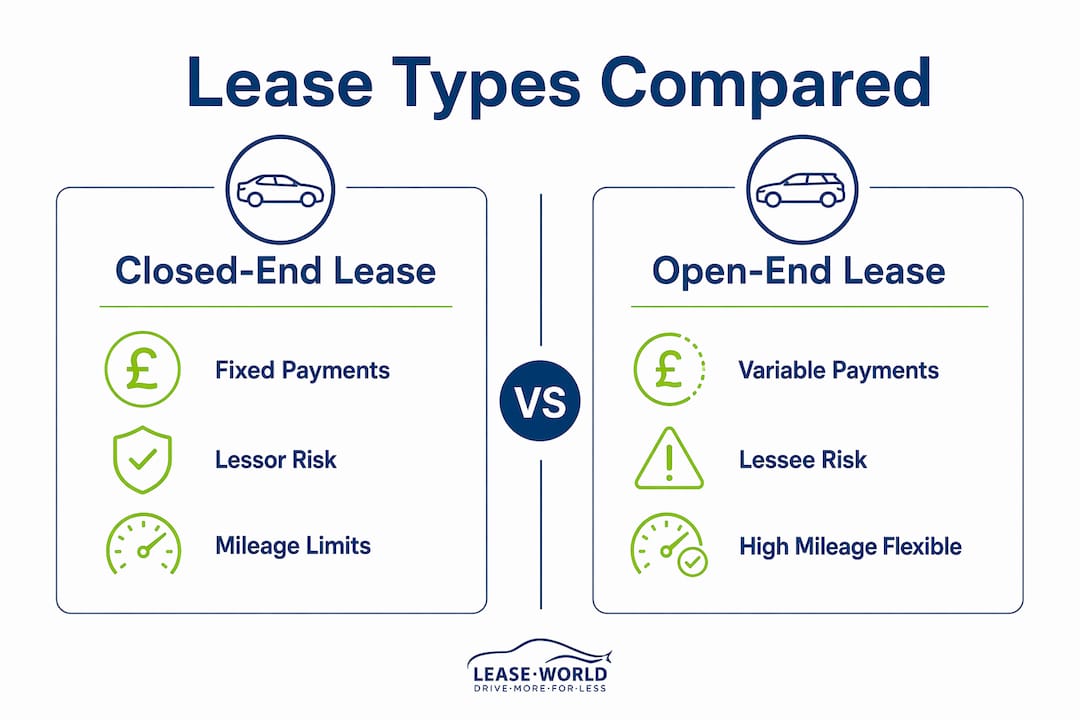
The fundamental difference is who carries the residual value risk. In a closed-end lease, the lessor does. In an open-end lease, the lessee does. That distinction shapes everything else about the two products.
Open-end leases are used almost exclusively for commercial fleets in the UK, where high mileage or specialist use makes it impractical for a leasing company to predict residual values accurately.
| Closed-end lease (Contract Hire) | Open-end lease | |
|---|---|---|
| Residual value risk | Lessor bears the risk | Lessee bears the risk |
| Mileage restrictions | Fixed allowance; penalty per excess mile | Often no fixed cap; lessee absorbs depreciation impact |
| End-of-lease obligation | Return vehicle; no purchase required | May owe a balloon payment if vehicle value falls short |
| Payment predictability | Fixed throughout the term | Can vary; final settlement uncertain |
| Typical lessee responsibilities | Maintenance and fair wear and tear | Maintenance plus residual value shortfall |
| Early termination fees | Substantial; often over 50% of remaining payments | Varies; typically includes outstanding depreciation |
For most private individuals and small businesses in the UK, a closed-end lease is the lower-risk option by a considerable margin.
Common mistakes to avoid with a closed-end lease
Most problems with Contract Hire come down to two things: mileage and condition.
- Underestimating annual mileage. BVRLA leasing advice consistently highlights this as the most frequent lessee error. Excess mileage charges accumulate over a three or four-year contract and can produce a significant bill at handover.
- Confusing fair wear and tear with perfect condition. The BVRLA standard allows for normal ageing, minor scuffs, and light stone chips. It does not cover dents, deep scratches, or interior damage. Many lessees are surprised by charges they did not anticipate because they assumed minor damage would be overlooked.
- Underestimating early termination costs. Life changes. If there is any chance you will need to exit the contract early, factor in that a settlement fee can be substantial before you sign.
- Ignoring the small print on included services. Some contracts bundle maintenance; others do not. Know exactly what your monthly payment covers.
Pro Tip: Track your mileage every three months against your annual allowance. If you are running ahead of pace, contact your leasing provider early. Adjusting the mileage allowance mid-contract is often possible and almost always cheaper than paying excess mileage charges at the end.
How Lease World supports you through the leasing process
Lease World specialises in personal and business Contract Hire across the UK, with a focus on transparency that larger corporate leasing firms rarely match. Every agreement comes with fixed monthly payments and no hidden costs, and UK delivery is included on eligible vehicles.
- Personalised agreements for both individuals and businesses, with no-deposit options available
- Detailed guides covering contract hire terminology and leasing obligations, so you understand exactly what you are signing
- Dedicated support from initial enquiry through to vehicle delivery
- Transparent cost breakdowns with no surprises at contract end
Lease World's customer reviews reflect a consistent record of satisfaction, built on straightforward advice and honest pricing. For anyone new to Contract Hire, having a leasing partner who explains the process clearly is worth more than a marginally lower monthly payment from a provider who leaves you to work it out alone.
Who qualifies for a closed-end lease in the UK?
Eligibility for Contract Hire in the UK follows standard credit assessment principles. Leasing companies are lending money in effect, so they assess your ability to meet monthly payments reliably.
For personal leases, providers typically check your credit score, employment status, and income. A strong credit history makes approval straightforward and can improve the rates available to you. County Court Judgements (CCJs) or a history of missed payments will reduce your options, though some specialist providers work with applicants who have imperfect credit.
Business Contract Hire has slightly different criteria. Limited companies are assessed on trading history and financial accounts, typically requiring at least two years of filed accounts. Sole traders and partnerships are assessed more like individuals, with personal credit playing a larger role. New businesses may need to provide a personal guarantee from a director.
There is no universal minimum income threshold publicly stated by the BVRLA, and individual leasing companies set their own criteria. The practical rule: if you can demonstrate stable income that comfortably covers the monthly payment, most mainstream providers will consider your application.
Lease World: straightforward contract hire for individuals and businesses
Fixed monthly payments, no residual value risk, and a vehicle you hand back at the end. That is the closed-end lease in one sentence, and it is exactly what Lease World delivers through its personal car leasing and business Contract Hire agreements.
Lease World is a family-run leasing specialist built around the kind of service that larger firms rarely offer: a real person who knows your file, transparent pricing from the first conversation, and no-deposit options that make leasing accessible without a large upfront commitment. Whether you are leasing your first car or managing a small fleet, the process runs from enquiry to delivery with dedicated support at every stage. Browse Lease World's leasing guides to compare options, or request a quote and get a personalised Contract Hire deal built around your mileage, budget, and vehicle preference.
FAQ
What is another name for a closed-end lease in the UK?
In the UK, a closed-end lease is called Contract Hire. The terms refer to the same product: a fixed-term agreement where the lessee returns the vehicle at the end with no purchase obligation.
How does a closed-end lease differ from an open-end lease?
The key difference is residual value risk. In a closed-end lease, the leasing company absorbs any shortfall if the vehicle is worth less than expected at contract end; in an open-end lease, the lessee carries that risk, which can result in an unexpected balloon payment.
Can you end a closed-end lease early?
Yes, but it is costly. Early termination typically triggers a settlement fee that often exceeds 50% of the remaining payments, calculated on the outstanding contract value at the time of exit.
What happens at the end of a closed-end lease?
You return the vehicle. If mileage is within the agreed limit and condition meets BVRLA fair wear and tear standards, no further payment is due. Excess mileage or damage beyond those standards will incur additional charges.
Key takeaways
A closed-end lease (Contract Hire) transfers residual value risk entirely to the lessor, giving the lessee fixed monthly costs and a clean exit at the end of the term.
| Point | Details |
|---|---|
| Residual value risk | The leasing company bears all depreciation risk; the lessee owes nothing if the car's value falls. |
| Contract length | Terms typically run 24–48 months with a fixed mileage allowance agreed at the start. |
| Early termination | Exiting early often costs over 50% of the remaining payments, so plan for the full term. |
| Wear and tear standard | BVRLA guidelines define acceptable condition; damage beyond this standard incurs charges at handover. |
| Lease World | Offers transparent, no-hidden-cost Contract Hire for individuals and businesses, with UK delivery included on eligible vehicles. |