

TL;DR:
- Leasing a car through a broker like Lease World offers a quick, regulated way to access fixed monthly payments without ownership burdens.
- Choosing the right lease type and setting accurate mileage are crucial to avoid costly overage or underutilization charges.
If you want a new car on fixed monthly payments without the hassle of ownership, leasing via a broker like Lease World is one of the fastest routes to a deal that fits your budget. Private drivers use Personal Contract Hire (PCH); VAT-registered businesses use Business Contract Hire (BCH) to reclaim tax and reduce costs. Both routes are regulated by the Financial Conduct Authority, governed by BVRLA fair wear and tear standards, and carry HMRC implications for company car users. To start, you need your budget, expected annual mileage, and whether you are leasing personally or through a business. That is enough to get an instant quote.
Pro Tip: Before you request a quote, decide your annual mileage honestly. Underestimating it is the single most common and most expensive mistake in UK car leasing.
Table of Contents
- What do current UK car lease deals look like?
- How do you search for the best car lease deals in the UK?
- PCH versus BCH: which type of lease is right for you?
- What do monthly payments cover, and what extra charges should you budget for?
- How does the leasing process work from quote to delivery?
- How do you compare brokers and spot a bad deal?
- Why Lease World is worth your time
- How are lease customers protected in the UK?
- Key takeaways
- The part most guides skip
- Ready to get a Lease World quote?
- Useful sources and further reading
- FAQ
What do current UK car lease deals look like?
The deal landscape in 2026 is broad. Entry-level hatchbacks and city cars typically sit in an affordable monthly range on a 36-month PCH. Family SUVs and crossovers generally cost more, while premium saloons and larger SUVs start higher and climb steeply. These figures assume a standard initial rental and 10,000 miles per year; adjust either variable and the monthly cost shifts noticeably.

Manufacturer and funder support has made EV lease deals particularly competitive right now. Battery electric vehicles often carry lower monthly payments than equivalent petrol models, partly because funders price in strong residual values and partly because manufacturers are actively subsidising deals to hit registration targets.
Key deal features to look out for:
- Initial rental: — paid upfront; a higher amount lowers the monthly figure but is not recoverable if the car is written off early.
- In-stock deals: — cars already built and ready for delivery faster than factory orders.
How do you search for the best car lease deals in the UK?
Getting to a shortlist quickly comes down to using the right filters in the right order. Here is a practical sequence:
- Set your monthly budget before you choose a model. It is easy to fall for a car and then rationalise the cost upwards.
- Lock your annual mileage. Business leases commonly allow higher allowances, sometimes notably more than personal leases, which tend to be set lower. Set your allowance slightly above your realistic annual use rather than at the minimum.
- Choose body style and fuel type. Narrowing to hatchback, SUV, estate, or EV early removes dozens of irrelevant results.
- Select contract length. Thirty-six months suits most drivers; 24 months costs more per month but gives flexibility sooner.
- Decide on maintenance. Adding a maintenance package at quote stage is almost always cheaper than adding it later.
- Compare lead times. If you need a car within a month, filter for in-stock deals. If you can wait, factory orders often carry better specs or colour choices. Check current UK delivery times before committing to a timeline.
- Request at least three quotes across different funders or brokers to see how pricing varies for the same vehicle.
Pro Tip: Excess mileage charges typically range from 6p to 18p per mile depending on the vehicle and contract. On typical leases, significant over-mileage costs can add up at return. Set your allowance above your expected use, not at it.
PCH versus BCH: which type of lease is right for you?

Personal Contract Hire (PCH) is for private individuals. Payments come from post-tax income, there is no VAT to reclaim, and the car never appears on a balance sheet. It is clean and simple.
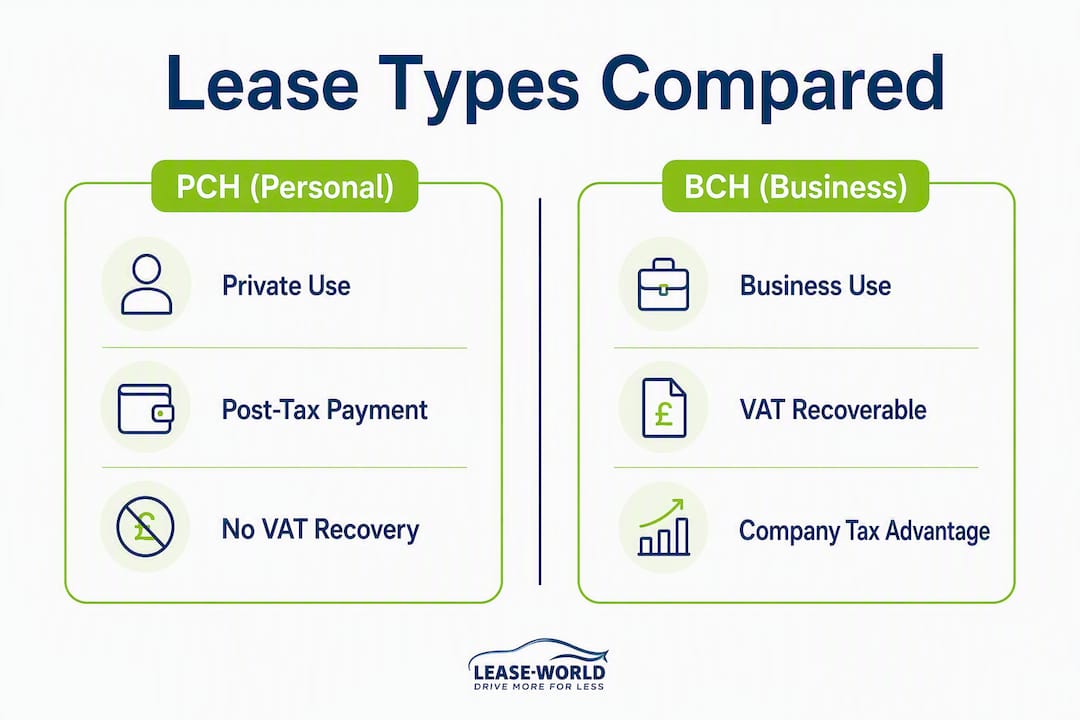
Business Contract Hire (BCH) is for VAT-registered businesses. The key financial difference is VAT recovery: businesses can generally reclaim 50% of the VAT on the finance rental for a car used for both business and private purposes, and 100% for a vehicle used exclusively for business. That alone can make BCH materially cheaper in after-tax terms than the headline monthly figure suggests.
| Feature | PCH (Personal) | BCH (Business) |
|---|---|---|
| Who can use it | Private individuals | VAT-registered businesses |
| VAT treatment | Paid in full, not reclaimable | 50% or 100% reclaimable depending on use |
| Monthly cost basis | Post-tax income | Pre-tax business expense |
| Benefit-in-Kind (BIK) tax | Not applicable | Applies to employees using the car privately |
| Corporation tax deduction | Not applicable | Rental payments generally deductible |
| Balance sheet impact | None | None (operating lease) |
The BIK point catches many business drivers off guard. When a company provides a car for private use, the employee pays income tax on a notional benefit calculated from the car's list price and its CO₂ emissions. Low-emission and electric vehicles attract much lower BIK rates, which is one reason company EV deals are so popular in 2026.
Accountancy experts advise that the PCH versus BCH decision should be driven by strategic intent rather than tax alone. Model the total personal and corporate tax impact before deciding, ideally with an accountant, because the right answer depends on your salary, dividend strategy, and how much private mileage the car will cover.
What do monthly payments cover, and what extra charges should you budget for?
A standard monthly rental covers the depreciation of the vehicle over the contract term plus the finance cost, and in most cases includes VAT. What it does not cover is fuel, insurance, or any damage beyond normal wear.
Common additional charges to plan for:
- Excess mileage: charged per mile above your contracted allowance, typically 6p–18p per mile.
- Damage beyond BVRLA fair wear and tear: the BVRLA standard defines what is acceptable; anything beyond it is charged at funder repair rates, which are usually higher than a local bodyshop.
- Early termination: breaking a lease early typically costs 50% of the remaining rentals, sometimes more depending on the funder.
- Admin and collection fees: some funders charge an end-of-contract collection fee; check the T&Cs before signing.
- Gap insurance: if the car is written off, your insurer pays market value, which may be less than the outstanding lease liability. Gap insurance covers that shortfall and is worth considering, particularly in the first two years of a contract.
| Vehicle segment | Monthly cost (representative) | Initial rental | Contract length | Mileage allowance | Maintenance included | Excess mileage charge |
|---|---|---|---|---|---|---|
| Entry hatchback | £175 | 3 months | 36 months | 10,000 miles/yr | Optional | 6p–18p per mile depending on vehicle and contract |
| Family SUV | £320 | 3 months | 36 months | 10,000 miles/yr | Optional | 6p–18p per mile depending on vehicle and contract |
| Premium saloon | £480 | 6 months | 36 months | 10,000 miles/yr | Optional | 6p–18p per mile depending on vehicle and contract |
Representative examples only; actual quotes vary by funder, specification, and credit profile.
How does the leasing process work from quote to delivery?
A typical lease timeline runs: quote request → credit check → order placed → delivery. For an in-stock vehicle, the gap between quote and delivery can be as short as two to three weeks. A factory-ordered car from a popular manufacturer can take three to six months, sometimes longer for high-demand models.
Documents and eligibility checks you will need:
- Photo ID (passport or driving licence)
- Proof of address (utility bill or bank statement, usually within three months)
- Bank details for the direct debit
- VAT registration number for BCH
- Credit check consent
Lease agreements are subject to credit checks. Poor credit typically increases the required initial rental or can result in rejection. Specialist brokers can sometimes help non-standard credit profiles, though usually at a higher cost. Being upfront about your credit history at quote stage saves time.
Delivery: most funders deliver to your home or workplace address on mainland UK. Lease World includes free mainland UK delivery on eligible vehicles. You will receive a delivery notification, and the driver will walk you through the car's condition on arrival. Check it carefully and note any marks before signing.
At the end of the contract:
- Book a pre-return inspection at least four weeks before the return date. This lets you identify and repair any chargeable damage more cheaply than accepting the funder's repair estimate at collection.
- Check the car against the BVRLA fair wear and tear guide before the inspector arrives.
- Arrange collection or return to the designated compound.
- Consider a short-term bridge lease if your next vehicle is not ready.
Pro Tip: A pre-return inspection is one of the most cost-effective steps in the whole leasing process. Fixing a scuff at a local bodyshop before return almost always costs less than the funder's repair charge.
How do you compare brokers and spot a bad deal?
Not all brokers operate the same way. Here is a numbered checklist for evaluating any broker or deal:
- Total cost of ownership: add initial rental, all monthly payments, and any maintenance package to get the true contract cost.
- VAT handling: confirm whether quoted prices include or exclude VAT, and whether your business can reclaim it.
- Maintenance cover: check exactly what is included (servicing, tyres, MOT) and what is excluded (cosmetic damage, fuel).
- Lead time commitment: get the expected delivery date in writing, not just a verbal estimate.
- Deposit and no-deposit options: confirm whether a no-deposit route is available and whether it affects the monthly rate.
- T&Cs clarity: read the early termination clause and the excess mileage rate before signing anything.
- Complaint procedure: the broker should have a published complaints process and be FCA-authorised.
Questions to ask any broker:
- Are you FCA-authorised, and can I see your commission disclosure?
- Which funder will hold the agreement?
- What is your credit check policy, and will it leave a hard footprint?
- Is gap insurance available, and who provides it?
- What are the exact early-termination terms?
Red flags to walk away from:
- Vague or missing T&Cs
- Refusal to disclose commission (required by FCA Consumer Duty rules)
- No mention of BVRLA membership or FCA authorisation
- Unrealistically short lead times on factory-order vehicles
- Pressure to sign before you have seen the full agreement
Pro Tip: Ask for the funder's name before you sign. The broker arranges the deal, but the funder holds the contract. Knowing who you are contracted with matters if a dispute arises.
Why Lease World is worth your time
Lease World operates as a UK vehicle leasing broker, arranging personal and business deals across a wide range of makes and models. The service is built around a few concrete commitments: tailored quotations rather than generic price lists, free mainland UK delivery on eligible vehicles, no-deposit options on selected deals, and transparent commission disclosure in line with FCA requirements.
Key service features:
- Personal and business leasing (PCH and BCH) across multiple funders
- Specialist deals for driving instructors and NHS staff
- Optional maintenance packages quoted at the start, not added on later
- Eligibility checks handled before a hard credit search
- Commission disclosure published and available on request
- Support throughout the contract, not just at the point of sale
The step-by-step leasing guide on the Lease World blog walks through the full process in plain language, from quote to return. Policies, T&Cs, and the complaints procedure are published at Lease World Policies.
Pro Tip: Ask Lease World about in-stock deals if you need a car quickly. These are vehicles already built and ready to deliver, often available within two to three weeks.
How are lease customers protected in the UK?
Three bodies set the standards that matter most:
- Financial Conduct Authority (FCA): authorises and supervises credit brokers, including vehicle leasing brokers. The FCA's Consumer Duty requires brokers to act in customers' best interests and to disclose commission clearly. If a broker refuses to disclose commission, that is a regulatory breach.
- BVRLA: the British Vehicle Rental and Leasing Association sets the Fair Wear and Tear standard used to assess vehicle returns. BVRLA membership is a meaningful quality signal; members commit to a code of conduct and an independent dispute resolution service.
- HMRC: governs the tax treatment of leased vehicles, including BIK rates for company cars, VAT recovery rules for businesses, and corporation tax deductions on rental payments.
| Body | What it covers | Where to check |
|---|---|---|
| FCA | Broker authorisation, commission disclosure, Consumer Duty | FCA Register (register.fca.org.uk) |
| BVRLA | Fair wear and tear standard, member code of conduct, dispute resolution | bvrla.co.uk |
| HMRC | BIK tax rates, VAT recovery, corporation tax deductions | gov.uk/hmrc |
If something goes wrong, the first step is the broker's published complaints procedure. If unresolved, FCA-authorised brokers fall under the Financial Ombudsman Service. BVRLA members have access to the BVRLA's own conciliation service for vehicle return disputes.
Key takeaways
UK car leasing works best when you choose the right contract type (PCH or BCH), set your mileage accurately, and use a transparent, FCA-authorised broker like Lease World to compare deals across multiple funders.
| Point | Details |
|---|---|
| Choose PCH or BCH first | PCH suits private drivers; BCH suits VAT-registered businesses that can reclaim 50% or 100% of VAT. |
| Set mileage above your expected use | Excess mileage charges typically range from 6p to 18p per mile; overestimating slightly is cheaper than paying at return. |
| Budget for extras | Early termination, damage beyond BVRLA standards, and gap insurance are the three most overlooked costs. |
| Check broker credentials | Confirm FCA authorisation and commission disclosure before signing any agreement. |
| Lease World as your starting point | Lease World offers free mainland UK delivery on eligible vehicles, no-deposit options, and transparent pricing across personal and business deals. |
The part most guides skip
Most leasing articles spend their energy on the headline monthly figure. The real cost of a lease lives in three places almost nobody talks about at the start: the mileage allowance, the maintenance decision, and the end-of-contract inspection.
Mileage is a financial commitment, not an estimate. Set it too low and you pay per mile at the end; set it too high and you pay for miles you never drove. Neither is ideal, but overpaying at return is almost always more expensive than a slightly higher monthly payment for a realistic allowance.
The maintenance question is similar. Drivers who skip a maintenance package often do so because the monthly saving looks attractive. Then a tyre blows at month 28, a service falls due at month 30, and suddenly the saving has gone. Pricing maintenance in at the start, when the broker can bundle it efficiently, is almost always the cheaper route over the full contract.
The end-of-contract inspection is where a surprising amount of money changes hands. Funders price their repair estimates at commercial rates. A pre-return inspection, booked four to six weeks before return, gives you time to fix chargeable items at a local bodyshop for a fraction of what the funder would charge. That single step can save hundreds of pounds on a standard family car.
Ready to get a Lease World quote?
Lower monthly payments, no hidden fees, and free mainland UK delivery on eligible vehicles: that is the concrete difference Lease World offers compared with going direct to a single manufacturer or using a broker that works with only one funder.
For private drivers, the personal car leasing page is the right starting point. Business owners and company car drivers should head to the business car leasing section, where BCH deals, VAT handling, and BIK guidance are covered in detail. If you need a vehicle quickly, ask about in-stock options when you enquire.
The fastest next step is a quote. Lease World's team will match your budget, mileage, and contract preferences to deals across multiple funders, with no obligation to proceed. Start your quote here and have your expected annual mileage and monthly budget to hand before you call or submit the form.
Useful sources and further reading
Official primary sources for the rules and standards covered in this guide:
- FCA: communicating commission to customers — the FCA's guidance on broker commission disclosure and Consumer Duty obligations; the reference to check if a broker's conduct is compliant.
- BVRLA: about us — the BVRLA's fair wear and tear standard and member code of conduct; the document to read before a vehicle return.
- HMRC via gov.uk — the primary source for tax rules, BIK rates, and VAT recovery guidance on leased vehicles.
Lease World resources for deeper reading:
- Car leasing process step by step: UK guide 2026 — a full walkthrough of the process from enquiry to return.
- Car lease terminology explained — plain-language definitions for initial rental, BIK, excess mileage, and other terms used throughout this guide.
- Lease World policies — T&Cs, complaints procedure, and commission disclosure in one place.
- Leasing guides hub — background reading on pros and cons, payment profiles, and delivery times.
FAQ
What is the difference between PCH and BCH?
PCH (Personal Contract Hire) is for private individuals paying from post-tax income with no VAT to reclaim. BCH (Business Contract Hire) is for VAT-registered businesses, which can generally reclaim 50% of the VAT on the finance rental for mixed use, or 100% for exclusive business use.
How much does it cost to lease a car in the UK?
Entry-level hatchbacks and city cars typically sit in an affordable monthly range on a 36-month PCH; family SUVs and crossovers generally cost more. Actual figures depend on initial rental, mileage allowance, contract length, and your credit profile.
What happens if I go over my mileage allowance?
Excess mileage is charged at a rate agreed in your contract, typically 6p–18p per mile depending on vehicle and contract. The charge is applied at the end of the contract, so it is worth reviewing your mileage mid-contract and contacting your broker if you are consistently over.
Do I need a deposit to lease a car?
Not always. No-deposit leases are available on selected vehicles, though they usually result in a slightly higher monthly payment. Lease World offers no-deposit options on eligible deals.
How do I know if a leasing broker is trustworthy?
Check that the broker is FCA-authorised (searchable on the FCA Register), ask for their commission disclosure, and confirm BVRLA membership. A published complaints procedure and clear T&Cs are also baseline requirements.