

Yes, a suitable guarantor can help you get a car lease in the UK even with poor or no credit, but only if that guarantor meets the lender's own criteria. Both of you will face credit and affordability checks before anything gets approved. Read on for who qualifies, how the process runs, and what it actually risks.
TL;DR:
- Guarantors must meet specific criteria, such as being over 21, UK residents with stable income, and having a clean credit history, though homeowner status varies by lender.
- The application process involves a soft search first, followed by a full credit and affordability assessment on both parties, which can impact their future credit profiles.
- Guarantors are liable for the full remaining balance if the borrower defaults, and missed payments can negatively affect both credit files and ability to secure future credit.
- Alternatives like larger deposits, co-signers, or specialist bad-credit lenders may avoid guarantor obligations, but each comes with its own trade-offs.
- Proper preparation, including checking credit files and understanding the guarantee terms, is crucial before approaching a guarantor or lender for car leasing.
Table of Contents
- What is a guarantor and how does it differ from a joint applicant?
- Who can be a guarantor: the UK eligibility checklist
- How does the guarantor application and credit check process work?
- What are the risks for guarantors and borrowers?
- Alternatives to using a guarantor
- How do you choose and prepare a guarantor?
- Lease World's perspective on guarantor arrangements
- Ready to check your options with Lease World?
- Sources
- FAQ
What is a guarantor and how does it differ from a joint applicant?
A guarantor is someone who legally promises to cover the payments if you, the leaseholder, fall behind or default. You keep sole use and control of the vehicle. The guarantor gets no ownership rights at all; they're providing security for the lender, not a share of the car, as Go Car Credit explains.
That's different from a joint applicant, who is named on the agreement itself and shares responsibility (and often usage rights) from day one. Guarantor arrangements show up most often on hire-purchase, PCP, and personal loans used to fund a car purchase. Not every lease product accepts a guarantor, and LeaseFetcher notes that acceptance varies by broker and funder, so it's worth confirming this before you build a whole application plan around finding one.
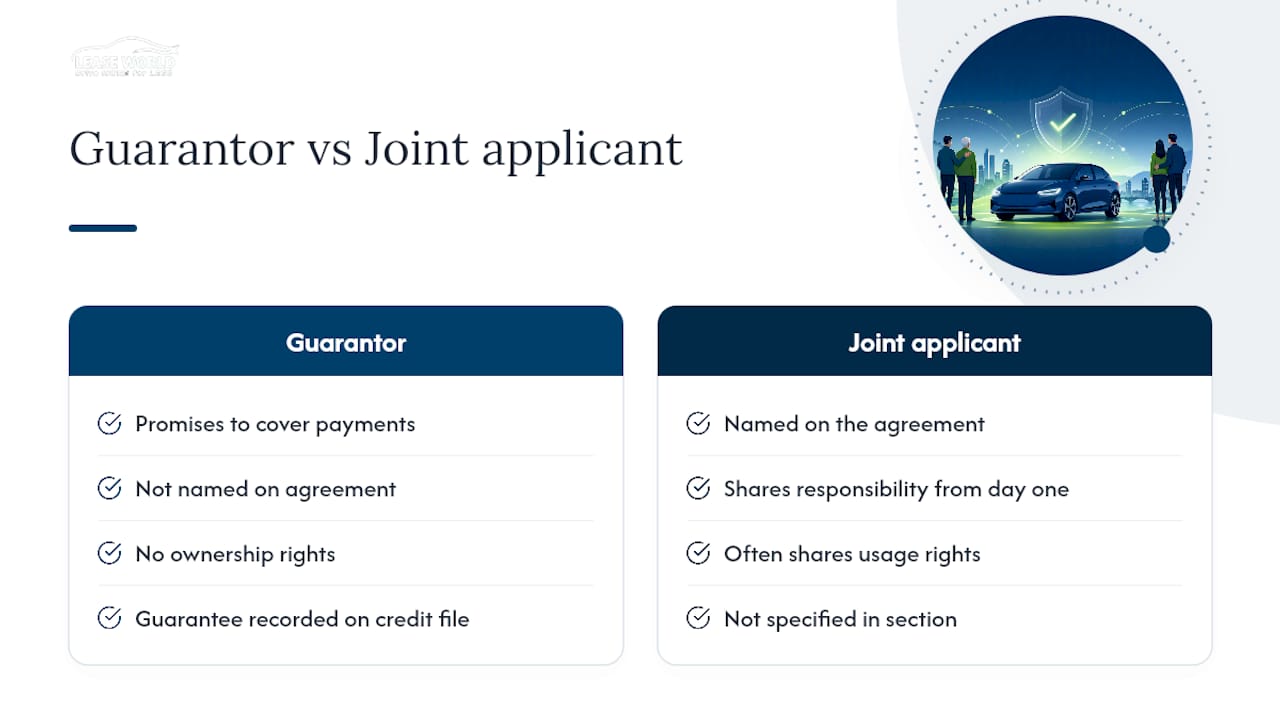
The guarantee itself gets recorded on credit files. If things go wrong later, that record can follow the guarantor into future mortgage or loan applications, even years down the line.
Who can be a guarantor: the UK eligibility checklist
Lenders don't treat "guarantor" as a box to tick. They're underwriting a second person almost as carefully as the first. According to Experian, the typical baseline looks like this:
- Aged 21 or over, with some lenders setting an upper age limit
- A UK resident with a UK bank account
- Stable, provable income, usually via payslips or bank statements
- A strong, clean credit history with no recent defaults or CCJs
- Homeowner status, which some lenders prefer as a proxy for financial stability, though it isn't universal
That last point catches people out. Plenty assume you need a homeowner guarantor full stop. You don't, always, but you do need to check the specific lender's rules before you approach anyone, because criteria genuinely vary from one funder to the next. A sibling with a decent income and no mortgage might sail through one lender's check and get declined by another purely on the homeowner point.
Financial links matter too. If your prospective guarantor already has a joint account or existing guarantee with someone else who has credit problems, that association can complicate their own application.
How does the guarantor application and credit check process work?
The sequence usually runs in a predictable order, and knowing it upfront saves both of you unnecessary credit damage.
- You (the borrower) get a soft search first, either through a broker or a lender's eligibility checker, to gauge whether guarantor finance is even the right route.
- You choose your guarantor and they agree, in full knowledge of what they're signing up to.
- The lender runs a full hard credit check and affordability assessment on the guarantor, not just a light-touch review.
- Both applications get assessed together before any offer is confirmed.
The affordability check on step three is the part people underestimate. Under FCA rules, lenders must be satisfied the guarantor could realistically afford the repayments if called upon, not just that they look creditworthy on paper. That means income verification, existing debt review, and sometimes bank statement analysis, run with the same rigour applied to the borrower.
Expect to provide payslips, bank statements, proof of address, and photo ID for both parties. Turnaround typically takes a few days once documents are in, though it can stretch longer if income is self-employed or irregular.
Pro Tip: Ask a broker to run a soft search across their lender panel before you commit to a guarantor route. It costs you nothing on your credit file and often reveals whether you'd even need a guarantor in the first place.
What are the risks for guarantors and borrowers?
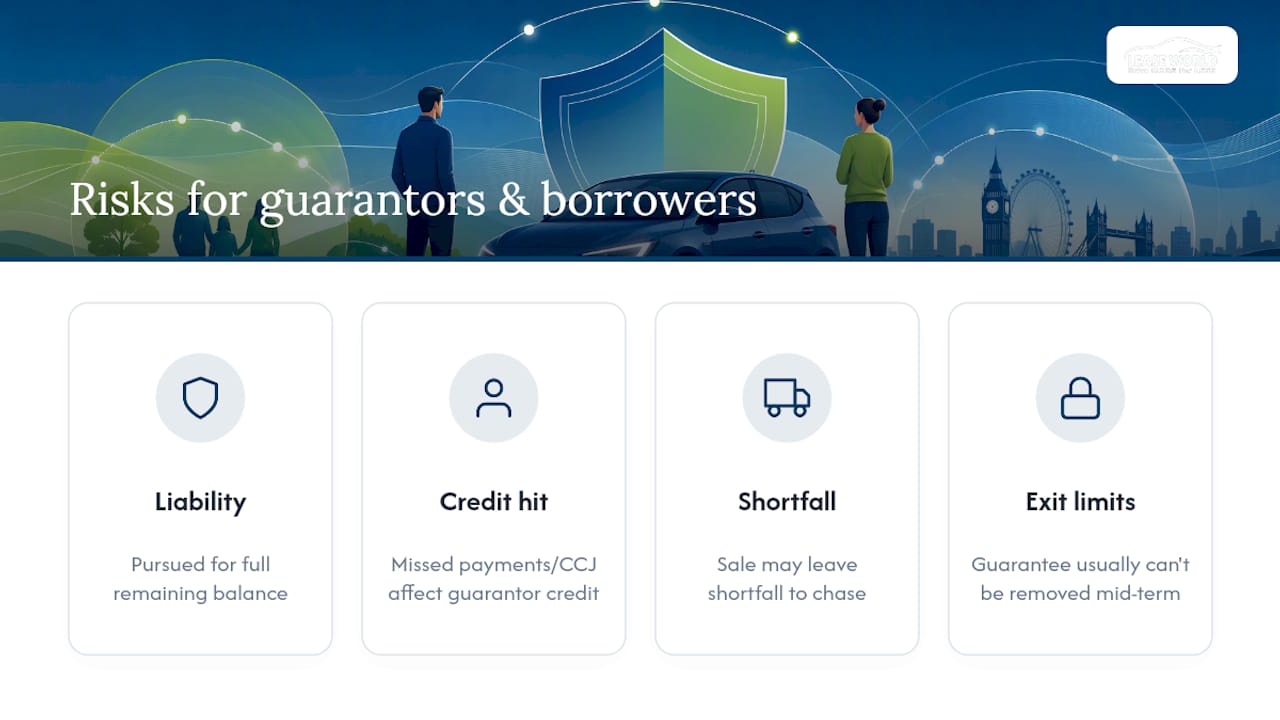
The guarantor's liability isn't symbolic. If the borrower defaults, the guarantor can be pursued for the full remaining balance, including interest and charges, not just the missed instalments. That liability is generally enforceable under the terms of the agreement, and the FCA's guidance on guarantor loans makes clear this isn't a soft commitment.
Missed payments create a financial association between both credit files. A CCJ against the borrower can drag the guarantor's own credit standing down with it, sometimes affecting their ability to get a mortgage or loan years later. If the vehicle is repossessed and sold for less than the outstanding balance, both parties can be left chasing a shortfall, which is where gap insurance sometimes earns its keep.
Once signed, a guarantee usually can't be lifted mid-term just because someone changes their mind. The realistic exits are refinancing the agreement into the borrower's name alone, settling the balance in full, or persuading the lender to agree a variation, which they're under no obligation to do.
Alternatives to using a guarantor
A guarantor isn't the only route if your credit history is thin or bruised, and it's worth trying the others first.
- Specialist bad-credit lenders: several UK lenders manually underwrite applications rather than relying on automated declines, as Motorly notes, though expect higher rates and a narrower choice of vehicles.
- Joint applicant or co-signer: similar in spirit to a guarantor but the second person is named on the agreement and shares responsibility from the outset, which some people find a fairer arrangement than a one-sided guarantee.
- A bigger deposit or shorter term: reducing the monthly commitment or the lender's exposure can shift a marginal application into an approval without anyone else needing to be involved.
- Broker-run soft checks: a broker checking your profile against multiple lenders can sometimes surface an approval you'd never have found searching alone, without touching your credit file.
If your credit position sits somewhere between "clean" and "declined everywhere," it's worth reading how lease brokers assess bad credit applications before assuming a guarantor is your only option.
How do you choose and prepare a guarantor?
Getting this right on paper matters as much as picking the right person.
- Ask your prospective guarantor to check their own credit file with one of the main agencies (Experian, Equifax, or TransUnion) before you approach a lender.
- Gather the paperwork early: recent payslips, three to six months of bank statements, proof of address, ID, and proof of homeownership if the lender asks for it.
- Have a frank conversation about capacity, not just willingness. Could they genuinely absorb the payments for several months if things went wrong?
- Time the applications so the guarantor's hard search only happens once you're reasonably confident the deal will go ahead.
- Ask the lender for written confirmation of exactly what the guarantee covers, the full balance, interest, or a capped amount, before either of you signs anything.
Pro Tip: Don't let a guarantor sign anything the same day you introduce the idea. Give them a few days to read the actual agreement terms, not just your summary of them.
Confirming what documents a specific lender wants in advance avoids a frustrating back-and-forth once the application is already underway, and it's worth checking what documents you'll typically need to lease a car so both parties turn up prepared the first time.
Lease World's perspective on guarantor arrangements
We see too many applicants treat a guarantor as a rubber stamp rather than a genuine financial commitment. Lenders don't see it that way, and neither should you. Soft eligibility checks can help determine whether a guarantor route is necessary, as in some cases a specialist lender might approve the application without one. When a guarantor genuinely is the best path, we'd rather explain the liability honestly upfront than let someone discover it after signing.
— Jason
Ready to check your options with Lease World?
Soft eligibility checks across lender panels can help you find out where you stand before anyone's credit file takes a hard search. If a guarantor turns out to be the right route, it is important to understand exactly what the obligation covers before signing anything.

Have your recent payslips, bank statements, and ID ready, along with your prospective guarantor's details if you're going down that route. You can browse personal car leasing deals to see what's realistic for your budget, or head straight to our quote enquiry page to start the conversation. A guarantor arrangement is a genuine legal commitment for whoever signs it, so we'll always talk it through properly before recommending it.
Sources
See the FCA's guarantor loan guidance, Experian's guarantor explainer, and Equifax's guidance on leasing with guarantors.
FAQ
Can you get a guarantor on a car lease?
Yes, some UK lenders and brokers accept a guarantor on lease and hire purchase agreements, though acceptance varies by lender, so it's worth confirming with your chosen provider first.
How can I get a guarantor if I don't know anyone suitable?
If nobody you know meets the lender's criteria, your realistic options are a specialist bad-credit lender, a joint applicant arrangement, or building a larger deposit to reduce the lender's risk instead.
Who qualifies as a UK guarantor?
Most lenders expect someone aged 21 or over, UK resident with a UK bank account, in stable provable employment, and with a strong credit history, and some prefer homeowners specifically.
Is it hard to get accepted for a car lease?
Approval depends far more on affordability and credit history than difficulty in the abstract; a thin or damaged credit file makes standard approval harder, but a guarantor, specialist lender, or larger deposit can each improve your chances.