

TL;DR:
- A credit score of 700 or above on Experian's scale unlocks the best car lease deals with lower initial payments and favorable terms. Improving your score by registering to vote, correcting errors, and checking all three credit reports enhances approval chances and reduces costs. Soft eligibility checks offer realistic approval insights without harming your credit profile, helping you prepare effectively before applying.
A score of 700 or above on Experian's scale (or the equivalent band on Equifax and TransUnion) is the practical threshold where UK car lease funders start offering their most competitive monthly rates and lowest initial rentals. Scores of 750 or above typically unlock the best lease deals, with the strongest approval odds and the least friction on affordability checks. If you are below 700, you can still get approved, but expect a larger initial rental, a higher effective APR, or a more restricted choice of vehicles.
The single fastest action you can take right now: register to vote if you are not already on the electoral roll. It is free, takes five minutes, and directly strengthens the identity data on your credit file.
| Score band (Experian scale) | Likely approval outcome |
|---|---|
| 750+ (Excellent) | Strong approval odds, best pricing |
| 700–749 (Good) | Good approval odds, competitive rates |
| 620–699 (Fair) | Possible approval, higher initial rental |
| Below 620 (Poor) | Difficult; specialist funders or guarantor needed |
Immediate next steps:
- Check your credit file with all three agencies before applying
- Register to vote if you have not already done so
- Correct any address or name errors on your file
- Run a soft eligibility check rather than a full application to compare deals
Pro Tip: Use a soft eligibility tool first. It gives you a realistic picture of your approval odds without leaving any mark on your credit file that other lenders can see.
Table of Contents
- Why do lenders treat car leases like credit agreements?
- What do Experian, Equifax, and TransUnion each show on your file?
- Soft checks versus hard checks: how do you compare deals safely?
- What do credit score bands mean for your lease terms in 2026?
- Six things to check and fix before you apply
- What are your realistic options if your credit profile is borderline?
- What is the typical timeline and what costs should you expect?
- Three realistic 2026 scenarios: which path fits you?
- Key takeaways
- A broker's view on the mistakes that cost people the best deals
- Lease World: get a personalised quote matched to your credit profile
- Useful sources and official links
- FAQ
Why do lenders treat car leases like credit agreements?
A car lease is a credit agreement. The funder owns the vehicle and you pay for the right to use it over a fixed term, so from the lender's perspective the risk is identical to a personal loan: if you stop paying, they lose money. That is why credit checks for car finance follow the same logic as any other lending decision.
Risk pricing is the mechanism that connects your score to your monthly cost. A lower score signals a statistically higher chance of missed payments, so the funder either declines the application or compensates by charging a higher effective interest rate (often called the money factor in leasing), requiring a larger initial rental, or restricting the vehicle value they will fund. A stronger score does the opposite: it reduces the funder's perceived risk, which flows through to lower monthly payments and more flexible terms.
The Financial Conduct Authority's affordability rules require lenders to carry out reasonable affordability assessments on every application. This means a good credit score alone is not enough. The funder must also be satisfied that you can comfortably service the payments from your income, even if your score is excellent.
Concrete consequences for consumers by credit band:
- Higher APR or money factor on the finance element of the lease
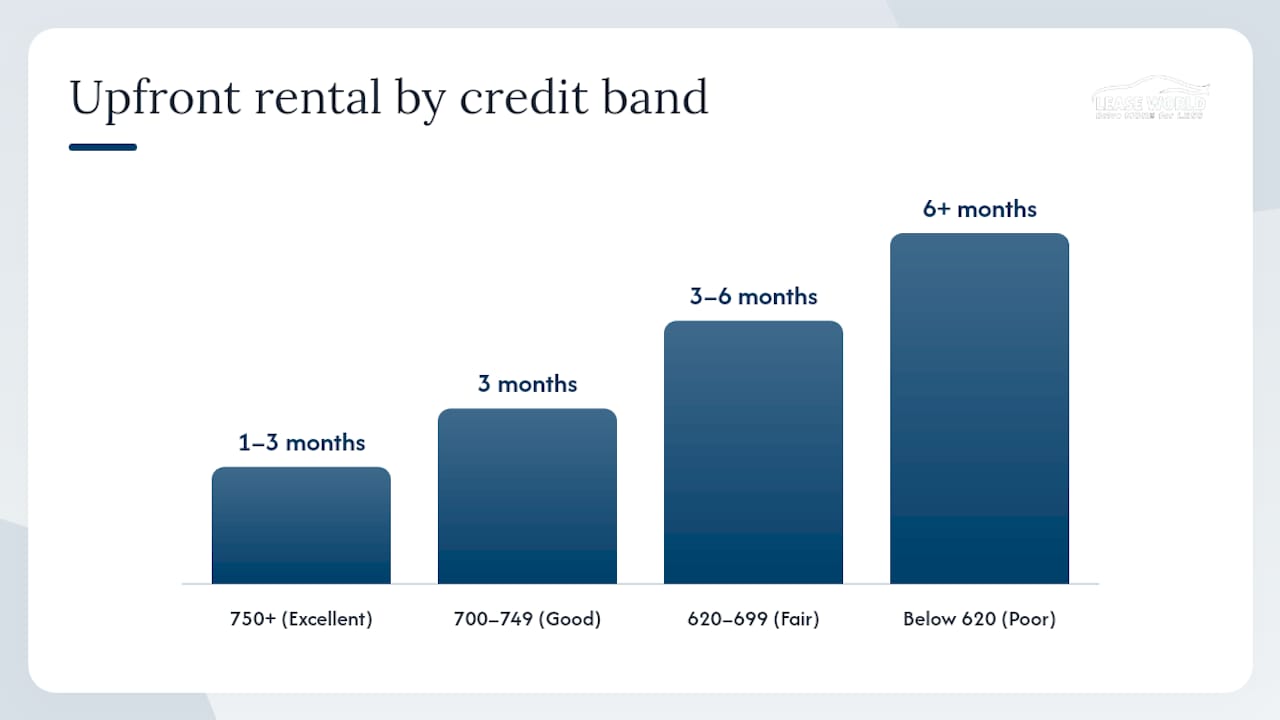
- Larger initial rental (sometimes three to six months upfront instead of one to three)
- Stricter vehicle value caps (funders may decline high-value vehicles for borderline profiles)
- Shorter maximum contract terms offered
- Requirement for a guarantor or additional documentation
What do Experian, Equifax, and TransUnion each show on your file?
Experian, Equifax, and TransUnion are the three credit reference agencies (CRAs) that UK lenders draw on. Each holds its own version of your credit history, and each uses a different scoring scale. A lender may check one, two, or all three, and you have no way of knowing in advance which they will use, so checking all three files before you apply is worth the effort.
| Agency | Score range | Key data visible to lenders | How long adverse items stay |
|---|---|---|---|
| Experian | — | Payment history, CCJs, defaults, searches, electoral roll | Up to 6 years |
| Equifax | — | Payment history, credit utilisation, address history, CCJs | Up to 6 years |
| TransUnion | — | Payment history, open accounts, searches, public records | Up to 6 years |
The scales look very different, but the underlying data is broadly similar. What varies is which lenders report to which agency and how recently. A default that appears on your Experian file may not yet show on TransUnion, or vice versa.
Practical steps to pull each report:
- Experian: — Free statutory report at experian.co.uk; paid CreditExpert subscription for ongoing monitoring and Experian Boost
- Electoral roll: — Register to vote at gov.uk to add your address to the electoral roll, which all three agencies use as an identity anchor
Check each report for address mismatches, accounts you do not recognise, and any defaults or CCJs you were unaware of. Errors are more common than most people expect, and correcting one can move your score meaningfully within a few weeks.
Soft checks versus hard checks: how do you compare deals safely?
A soft eligibility check lets you see your likely approval odds without leaving any trace that other lenders can see. A hard search, by contrast, is recorded on your credit file and is visible to every lender who checks it for the following months. The practical rule: use soft checks to shop around, then submit one full application when you have identified the right deal and lender.
When each type of check is used:
- Soft check: — Eligibility tools, pre-qualification, initial broker assessments. Visible only to you. No impact on your score.
- Hard check: Full credit application, formal finance agreement. Visible to all lenders. Can remain on your file for around 12 months.
Checking your eligibility via a soft search tool is the standard first step recommended across the industry. It filters out deals you are unlikely to get, saving you from hard searches that serve no purpose. The FCA's affordability rules mean a positive soft result is not a guaranteed offer, but it is a reliable signal of where to focus your full application.
Pro Tip: Space out any hard searches by at least 30 days where possible, and avoid applying to multiple funders simultaneously. A cluster of hard searches within a short window can look like financial stress to a lender reviewing your file.
What do credit score bands mean for your lease terms in 2026?
The table below gives realistic, approximate guidance on how score bands typically translate into lease outcomes. These are not guaranteed figures; individual funders set their own thresholds and the vehicle value, term length, and your income all affect the final offer.
| Score band | Likely approval | Typical monthly impact | Initial rental expectation |
|---|---|---|---|
| 750+ (Excellent) | Strong | Best available rate | 1–3 months upfront |
| 700–749 (Good) | Good | Competitive, minor premium | 3 months upfront typical |
| 620–699 (Fair) | Possible | Moderate premium on rate | 3–6 months upfront |
| Below 620 (Poor) | Difficult | Significant premium or decline | 6+ months or guarantor |
The 1.25% rule is a rough industry benchmark sometimes used to sense-check whether a monthly lease payment is reasonable relative to the vehicle's value: divide the monthly payment by the vehicle's retail price and multiply by 100. A result at or below 1.25% is generally considered good value. Applicants with excellent credit are far more likely to achieve deals that pass this test, because their lower risk profile allows funders to offer a more favourable money factor.
If your score sits in the 700–749 band, you are in a strong negotiating position. Understanding what credit score you need gives you leverage: you can present competing soft-check results to a broker and ask them to match or beat the best offer, or request a longer contract term to reduce the monthly figure.
Pro Tip: If you are in the excellent band, ask your broker about extended contract terms (48 months versus 36) and lower mileage allowances. Both reduce the monthly payment and, combined with your strong profile, can produce deals well below the 1.25% benchmark.
Six things to check and fix before you apply
Do these six items before you trigger any hard searches. The combined effect on your approval odds and pricing can be significant, and most of them cost nothing.
-
Register to vote — If your name and address are not on the electoral roll, your credit file identity data is weaker. Register at gov.uk and allow a few weeks for the update to appear on your file.
-
Pull and review all three CRA files — Look for errors in your name, address history, and account details. Dispute anything incorrect directly with the agency. A corrected error can lift your score within 28 days.
For more detail on initial rental structures and how payment profiles affect your upfront cost, Lease World's guide explains the options clearly.
What are your realistic options if your credit profile is borderline?
Poor or borderline credit does not automatically mean no lease. It does mean the terms will cost more or require more flexibility on your part. Leasing with bad credit is possible through several routes, each with a clear trade-off.
- Lower vehicle value: — Funders are more comfortable with lower-value vehicles for borderline profiles. A £15,000 vehicle is a smaller risk than a £40,000 one, and approval thresholds are correspondingly lower.
What is the typical timeline and what costs should you expect?
From soft eligibility check to vehicle delivery, the process typically runs as follows. The hard search typically happens at the point of full application, not at delivery.
| Stage | Typical timeframe | Notes |
|---|---|---|
| Soft eligibility check | Same day | No impact on credit file |
| Full application and hard search | 1–3 days | Score recorded; decision usually within 48 hours |
| Finance approval and documentation | 3 days | ID, payslips, bank statements may be requested |
| Vehicle order placed | After approval | Manufacturer lead times vary; check current delivery times |
| Vehicle delivery | 2 weeks | Depends on make, model, and stock availability |
Common costs to budget for:
- Initial rental: — Typically one to nine months of the monthly payment, paid upfront
Three realistic 2026 scenarios: which path fits you?
Scenario 1: Strong credit (750+)
Verdict: You are in the best position to secure top lease deals for 2026. Use it.
- Run two or three soft eligibility checks across different funders or via a broker
- Compare the effective monthly cost and initial rental across offers
- Ask your broker to negotiate on the money factor or initial rental, citing competing offers
- Submit one full application to the preferred funder
- Expect approval within 48 hours and delivery within the manufacturer's standard lead time
At this level, the conversation with a broker like Lease World shifts from "will I be approved?" to "what is the best deal available for this vehicle right now?"
Scenario 2: Near-prime or rebuilding (620–699)
Verdict: Approval is achievable, but preparation matters more than at higher bands.
- Complete all six pre-application checklist items before running any hard search
- Check whether registering to vote or correcting a file error moves your score into the 700+ band
- Run soft checks to identify which funders are likely to approve at your current score
- Choose a vehicle value and term that sits comfortably within your income
- Consider a three-month initial rental to improve approval odds without overcommitting cash
A broker who knows which funders are more flexible with near-prime profiles can save you from unnecessary hard searches.
Scenario 3: Poor credit (below 620)
Verdict: Options exist, but the cost is higher. Be clear-eyed about the trade-offs.
- Pull all three CRA files and identify the specific negative items dragging your score down
- Dispute any errors immediately; settled defaults or CCJs that are incorrectly recorded as outstanding can be corrected
- Assess whether a six-to-twelve-month rebuild period is more cost-effective than applying now
- If you need a vehicle now, discuss a guarantor agreement or higher initial rental with a specialist broker
- Avoid applying to multiple funders directly; each hard search makes the next application harder
Key takeaways
A score of 700 or above gives you realistic access to competitive 2026 lease terms; 750 or above puts you in the strongest negotiating position, with the lowest initial rental and best monthly rates available.
| Point | Details |
|---|---|
| Score band matters most | 750+ typically secures the best lease pricing; below 620 requires specialist funders or a guarantor. |
| Register to vote first | Adding your address to the electoral roll is the fastest free action to strengthen your credit file identity. |
| Soft checks protect your file | Use eligibility tools before any full application; hard searches stay visible to lenders for around 12 months. |
| Fix errors before applying | Incorrect addresses or settled defaults still showing as open can be corrected within weeks and may lift your score. |
| Match vehicle to your profile | A lower-value vehicle on a standard term is easier to approve and builds a positive payment record for future leases. |
| Lease World can help | Lease World runs soft eligibility checks and matches applicants to suitable funders, including borderline profiles. |
A broker's view on the mistakes that cost people the best deals
Most applicants who miss out on the best lease terms in 2026 do not have a fundamentally weak credit profile. They have a fixable one that they did not fix before applying.
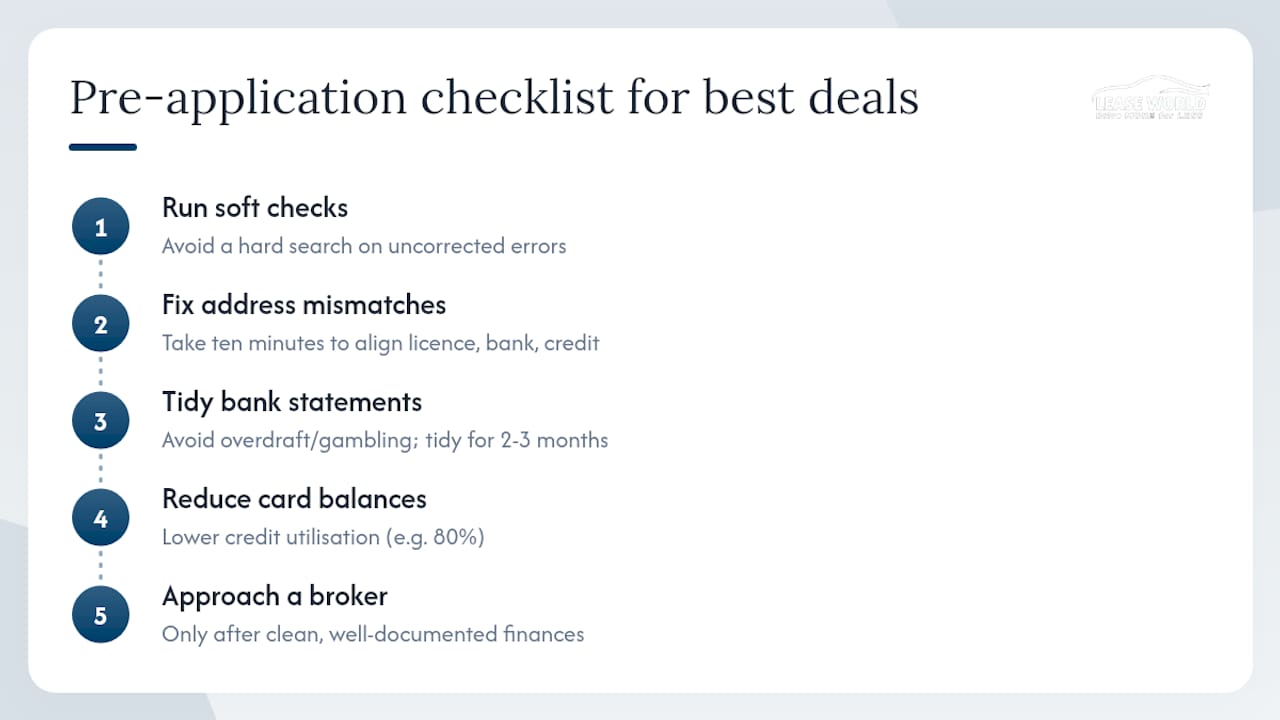
The most common mistake is rushing straight to a full application without running any soft checks first. A hard search on a file that has an uncorrected address mismatch, or a credit utilisation rate sitting at 80%, is a wasted search. The decline goes on the file, and the next lender sees it.
Address mismatches deserve more attention than they get. If your driving licence, bank account, and credit file all show slightly different versions of your address, a lender's automated system can flag the application for manual review or decline it outright. It takes ten minutes to check and fix, but most people never think to look.
On bank statements: lenders are not just checking your income figure. They are looking at the pattern. Regular overdraft use in the weeks before application, or a series of gambling transactions, can override a perfectly good credit score. If your statements look untidy, spend two or three months tidying them before you apply.
The readers who get the best deals are the ones who treat the pre-application period as preparation, not paperwork. Check your files, correct the errors, reduce the card balances, and then approach a broker with a clean, well-documented picture of your finances. That is when the conversation about the best available deal can actually begin.
Lease World: get a personalised quote matched to your credit profile
Knowing your credit score band is useful. Knowing which funders are most likely to approve you at that band, and at what terms, is where a broker earns its keep.
Lease World runs soft eligibility checks on your behalf, so you can see realistic approval odds across multiple funders without a single hard search on your file. For applicants with strong credit, that means identifying the best available deal quickly. For borderline profiles, it means finding the funders who are genuinely flexible rather than wasting hard searches on lenders who will decline.
The service covers personal and business car lease deals across a wide range of makes and models, with no-deposit options, optional maintenance packages, and free mainland UK delivery on eligible vehicles. Fixed monthly payments and no hidden fees are standard.
Get a personalised quote and let Lease World match you to the right funder for your profile in 2026.
Useful sources and official links
- What checks are done for car finance? | Experian
- Soft search car finance: what it really tells you before a lender runs a hard check — Motoring Mojo
- Soft vs Hard Credit Search Explained — CarMoney
- Will Checking Car Finance Eligibility Affect Your Credit Score? | Marsh Finance
- 7 Eligibility Criteria to Qualify for Car Finance in the UK | Exchange My Car
FAQ
What is a good credit score for leasing a car in the UK?
On Experian's scale, a score of 700 or above is generally considered good for car leasing, with 750 or above providing the strongest approval odds and the best monthly rates. Each lender sets its own threshold, so the same score can produce different outcomes with different funders.
Does leasing a car affect your credit score?
Yes. The application triggers a hard search, which is visible to lenders for around 12 months. After that, each on-time payment builds a positive record on your file, while missed payments can remain as adverse marks for up to six years.
What is the 1.25% rule of leasing?
The 1.25% rule is an informal benchmark: divide your monthly lease payment by the vehicle's retail price and multiply by 100. A result at or below 1.25% is generally considered good value. Applicants with excellent credit are most likely to achieve deals that meet this test.
Is leasing a good idea in 2026?
Leasing can be a cost-effective way to drive a new vehicle with fixed monthly payments and no depreciation risk, particularly for those with a strong credit profile who can access the most competitive 2026 car lease rates. Whether it suits you depends on your mileage, how long you want the vehicle, and your credit position.
Does checking my eligibility for a lease hurt my credit score?
No, provided the lender or broker uses a soft eligibility check. Soft searches are only visible to you and have no impact on your score. A hard search is only triggered when you submit a full credit application, so always confirm which type of search will be run before you proceed.