
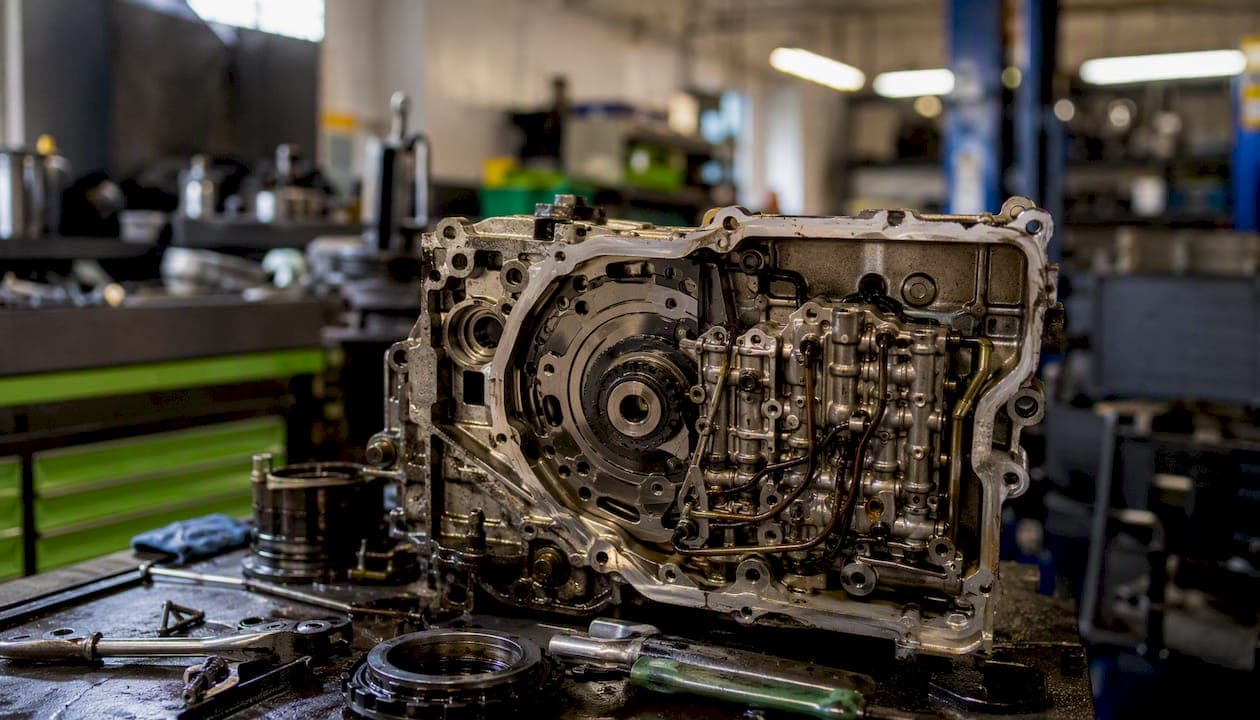
An automatic gearbox shifts gears on your behalf, with no clutch pedal to operate. For most UK city drivers, that is the practical headline: less physical effort, smoother progress through stop-start traffic, and a natural fit for the electric vehicles that now dominate new car sales. The trade-off is real, though. Pass your driving test in an automatic and the DVLA adds code 78 to your licence, restricting you to automatics until you pass a separate manual practical test.
Before reading further, three things worth doing now:
- Check your licence for code 78 if you already hold a full UK licence.
- Decide whether your test vehicle will be automatic or manual before booking lessons.
- Confirm the gearbox type on any car you are buying or leasing — the type affects running costs significantly.
Key takeaways
Choosing the right automatic gearbox type matters as much as choosing automatic over manual — the type determines running costs, driving feel and long-term reliability.
| Point | Details |
|---|---|
| Code 78 licence restriction | Passing in an automatic adds DVLA code 78; you cannot legally drive a manual until you pass a separate manual practical test. |
| Gearbox type determines costs | DCTs need fluid changes every 40,000–80,000 miles; skipping them is the leading cause of expensive clutch pack failure. |
| Best type by use case | Torque converter for motorway and towing; CVT or wet-clutch DCT for city; single-speed for EVs. |
| Automatic pass rate is lower | The automatic practical test records a pass rate of around 42–43%, lower than the manual rate of roughly 48%. |
| Lease World for automatic leasing | Lease World offers automatic car and van lease deals with optional maintenance packages and free mainland UK delivery on eligible vehicles. |
Table of Contents
- How does an automatic gearbox work?
- The main automatic gearbox types and when each suits you
- How to drive an automatic car: step-by-step basics
- Advantages and disadvantages of automatics vs manuals
- Routine servicing, common faults, and typical UK costs
- How to check which gearbox is fitted to a car
- UK licence rules and insurance implications for automatic-only drivers
- Which automatic gearbox should you choose?
- What the automatic gearbox debate gets wrong
- Lease World: automatic car and van leasing with maintenance options
- Sources
- FAQ
How does an automatic gearbox work?
The mechanics vary by type, but every automatic shares one job: selecting the right gear ratio without you pressing a clutch. Here is how the key components do that.
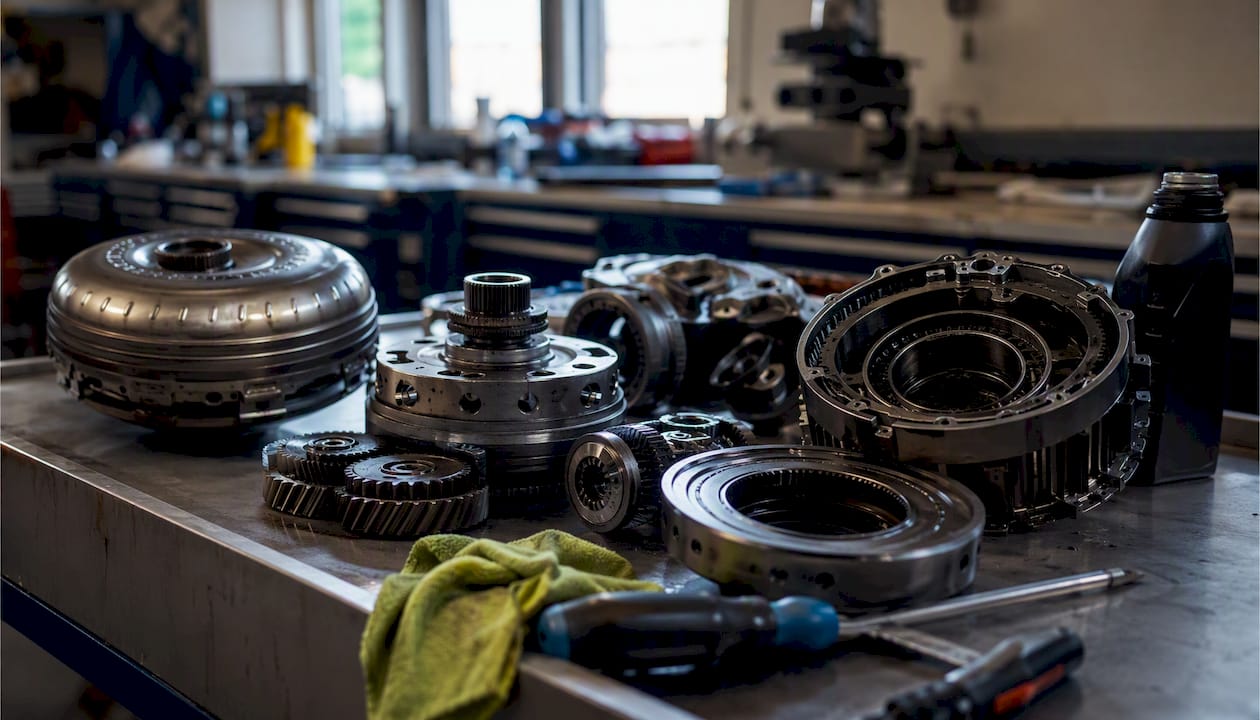
Torque converter. A torque converter couples the engine to the gearbox using transmission fluid rather than a mechanical clutch. At low speeds the fluid slips, letting the engine idle without stalling. As revs rise, the fluid coupling locks up and transfers power efficiently. This is why a torque-converter car creeps forward the moment you lift your foot from the brake.
Planetary gearset. Inside most traditional automatics sits a planetary gearset: a sun gear at the centre, planet gears orbiting it, and a ring gear around the outside. By locking or releasing different elements using clutch packs and brake bands, the transmission produces multiple gear ratios from a compact unit.
Clutch packs and dual clutches. Clutch packs are stacks of friction plates that engage or release specific gear ratios under hydraulic pressure. In a dual-clutch transmission (DCT), two separate clutch assemblies handle odd and even gears simultaneously, so the next gear is pre-selected before the current one disengages. The result is a shift measured in milliseconds.
Hydraulic and electronic control units. Older automatics relied on hydraulic pressure alone to decide when to shift. Modern units use an electronic control unit (ECU) that reads throttle position, vehicle speed, load and driver mode to select gears. This is why sport mode, eco mode and paddle shifters are possible.
CVT pulley and belt. A continuously variable transmission (CVT) replaces fixed gear ratios with two variable-diameter pulleys connected by a steel belt or chain. As the pulleys change diameter, the ratio changes infinitely between its limits, keeping the engine at its most efficient speed.
Single-speed reduction gear (EVs). Electric motors produce maximum torque from zero rpm, so they need only one fixed reduction gear rather than multiple ratios. There is no shifting at all. Every battery-electric vehicle on sale today is, by definition, an automatic.
Here is a quick-reference summary of the main components:
- Torque converter: fluid coupling that replaces the clutch pedal
- Planetary gearset: compact multi-ratio gear arrangement
- Clutch packs / dual clutches: engage and release individual ratios
- Hydraulic/electronic control unit: decides when and how to shift
- CVT pulleys and belt: deliver infinite ratio variation
- Single-speed reduction gear: the only ratio an EV needs
Pro Tip: If a car creeps forward at idle with your foot off the brake, it almost certainly has a torque converter or a wet-clutch DCT. A dry-clutch DCT tends to feel more hesitant at very low speeds — useful to know when test-driving.
The main automatic gearbox types and when each suits you
Modern automatic transmissions broadly fall into four categories plus the EV single-speed. Each suits a different kind of driver.
Torque converter automatic
The oldest and most proven design. A fluid coupling handles low-speed manoeuvring, and multiple planetary gearsets deliver smooth, progressive shifts. Most large saloons, SUVs, and American-market vehicles use this layout. It is the most comfortable choice for long motorway runs and towing, though it adds weight and can be less fuel-efficient than a CVT in urban cycles.
Dual-clutch transmission (DCT / DSG)
Two clutches, two input shafts, and lightning-fast gear changes. DCTs are common in performance hatchbacks and many mainstream European cars. Wet-clutch variants (submerged in oil) handle higher torque and suit frequent stop-start use; dry-clutch variants are lighter and more efficient but can judder at low speeds. DSG oil changes are typically recommended every 40,000–80,000 miles depending on the variant, and skipping them is one of the most common causes of premature clutch wear.
CVT (continuously variable transmission)
No fixed gears at all. The CVT keeps the engine in its efficiency sweet spot, which is why it dominates hybrid drivetrains (Toyota, Honda) and many smaller city cars. The trade-off is a characteristic "rubber-band" sensation under hard acceleration, where engine revs rise before the car actually accelerates. Smooth and economical in town; less satisfying on a fast A-road.
Automated manual transmission (AMT)
Mechanically a manual gearbox with an actuator replacing the clutch pedal and gear lever. Common in budget city cars and some commercial vehicles. Shifts are noticeably slower than a DCT and can feel jerky at low speeds. The upside: lower purchase price and simpler mechanics than a full torque-converter unit.
Single-speed reduction gear (EVs)
Not a gearbox in the traditional sense. A fixed reduction ratio converts motor speed to wheel speed, and the motor's torque curve makes multiple ratios unnecessary. Every EV is classed as automatic for UK licence purposes.
| Type | Smoothness in traffic | Fuel efficiency | Shift speed | Maintenance complexity | Best use case |
|---|---|---|---|---|---|
| Torque converter | Excellent | Moderate | Moderate | Moderate | Motorway, towing, SUVs |
| DCT / DSG | Good (wet clutch) / variable (dry) | Good | Very fast | Higher (fluid changes critical) | Performance, mixed driving |
| CVT | Very smooth | Excellent | Seamless | Low–moderate | City, hybrids, economy cars |
| Automated manual | Variable / jerky | Moderate | Slow | Low | Budget city cars, light vans |
| Single-speed (EV) | Excellent | N/A (electric) | Instant | Very low | All-electric vehicles |
Which type is fitted to a car you are considering? The manufacturer's spec sheet will say, but the driving feel often gives it away before you even check.
- City commuter: CVT or wet-clutch DCT for smoothness and economy.
- Motorway driver: torque converter for relaxed cruising.
- Towing: torque converter — it handles sustained load better than a dry-clutch DCT.
- Sporty driving: DCT for rapid, precise shifts.
- EV adopter: single-speed; no choice needed.
How to drive an automatic car: step-by-step basics
The selector positions are standard across almost every automatic: P (Park), R (Reverse), N (Neutral), D (Drive). Some cars add S (Sport) or numbered positions for manual override.
Starting and moving off
- Sit in the car with your foot firmly on the brake pedal.
- Start the engine. The car must be in P or N to start on most models.
- Select D for forward driving or R for reversing, keeping the brake pressed.
- Release the handbrake if it is not electronic.
- Ease off the brake gently. The car will creep forward. Apply throttle smoothly.
Stopping and parking
- Lift off the throttle and press the brake progressively.
- Come to a complete stop.
- Select P before releasing the brake or leaving the car. Never rely on P alone on a slope — apply the handbrake too.
- Switch off the engine.
Hill starts
Apply the footbrake, select D, then use the handbrake (or the hill-start assist if fitted) to hold the car while you transfer to the throttle. The torque converter's creep will hold you momentarily on gentle slopes, but do not rely on it on steep hills.
Reversing
Select R only when fully stationary. Use the footbrake to control speed — the car will creep in reverse just as it does in Drive. Never select R while moving forward.
Pro Tip: Throttle control is the skill that separates smooth automatic drivers from jerky ones. In a car park or slow traffic, use the brake to modulate speed rather than alternating between throttle and brake. The car's creep does the work; you just control how fast.
Common beginner mistakes and quick fixes:
- Selecting N on a hill: Neutral removes engine braking and leaves you relying entirely on the footbrake. Stay in D on descents.
- Resting a foot on the brake: Causes brake fade and confuses following drivers. Keep your left foot away from the pedals entirely.
- Forgetting P before leaving: The transmission pawl in P is not a substitute for the handbrake on any gradient. Use both.
- Rushing from R to D while moving: Always come to a complete stop before changing direction. Doing otherwise stresses the transmission.
Checklist for test candidates taking an automatic test:
- Confirm your test vehicle is booked as automatic with your instructor.
- Practise selecting P, R, N, D smoothly without looking at the selector.
- Know where the handbrake or electronic park brake is and when to use it.
- Practise hill starts using footbrake and throttle, not N.
Automatic vs manual cars — the RAC notes that automatics let drivers concentrate more fully on hazard perception, which is a genuine advantage during a test.
Advantages and disadvantages of automatics vs manuals
The honest answer is that neither is universally better. The right choice depends on where you drive, what you drive next, and what you can afford to repair.
Advantages of an automatic gearbox:
- Less physical effort in stop-start city traffic, reducing fatigue on long commutes.
- Easier for drivers with mobility limitations affecting the left leg or left hand.
- Smoother towing in many cases, particularly with torque-converter units.
- Natural fit for hybrid and electric vehicles, which are increasingly the only new cars available.
- Allows full attention on road positioning and hazard perception.
Disadvantages:
- Higher purchase price on equivalent models, particularly for used cars.
- Potentially higher repair bills when things go wrong, especially DCTs and CVTs.
- Passing your test in an automatic restricts your licence to automatics (code 78).
- Older automatics can be less fuel-efficient than equivalent manuals, though modern units have largely closed that gap.
Market analysis shows that automatics are increasingly common in new cars and can offer better fuel economy in many modern models, while manuals often remain cheaper to buy and insure on older used cars.
| Trade-off | Automatic | Manual |
|---|---|---|
| Comfort in city traffic | High | Lower (clutch operation) |
| Purchase cost (used) | Higher | Lower |
| Insurance (older used) | Often higher | Often lower |
| Fuel economy (modern) | Comparable or better | Comparable |
| Repair complexity | Higher (type-dependent) | Generally lower |
| Licence flexibility | Restricted if tested in auto | Full (can drive both) |
Decision criteria by driver type:
- Daily commuter in a city: automatic wins on comfort and fatigue.
- Learner on a budget: manual keeps licence options open and used cars cheaper.
- Driver planning to go electric: automatic is the logical direction of travel.
- Driver concerned about repair costs: manual is simpler and cheaper to fix on older cars.
Routine servicing, common faults, and typical UK costs
The most common automatic gearbox failures are fluid leaks, solenoid faults, clutch pack wear (DCTs), and belt or pulley degradation (CVTs). Catching them early is almost always cheaper than a full rebuild.
Fluid leaks are the most frequent issue across all types. Transmission fluid lubricates, cools, and transmits hydraulic pressure. A slow leak often shows as a reddish puddle under the car or a burning smell after a run. Left unchecked, low fluid causes overheating and accelerated wear throughout the unit.
Solenoid and electronic faults trigger warning lights and erratic shifting. Modern ECU-controlled gearboxes rely on solenoids to direct hydraulic pressure; a failed solenoid can lock the transmission in one gear or cause harsh shifts. Replacement costs vary widely by model, but a single solenoid swap is far cheaper than a full rebuild.
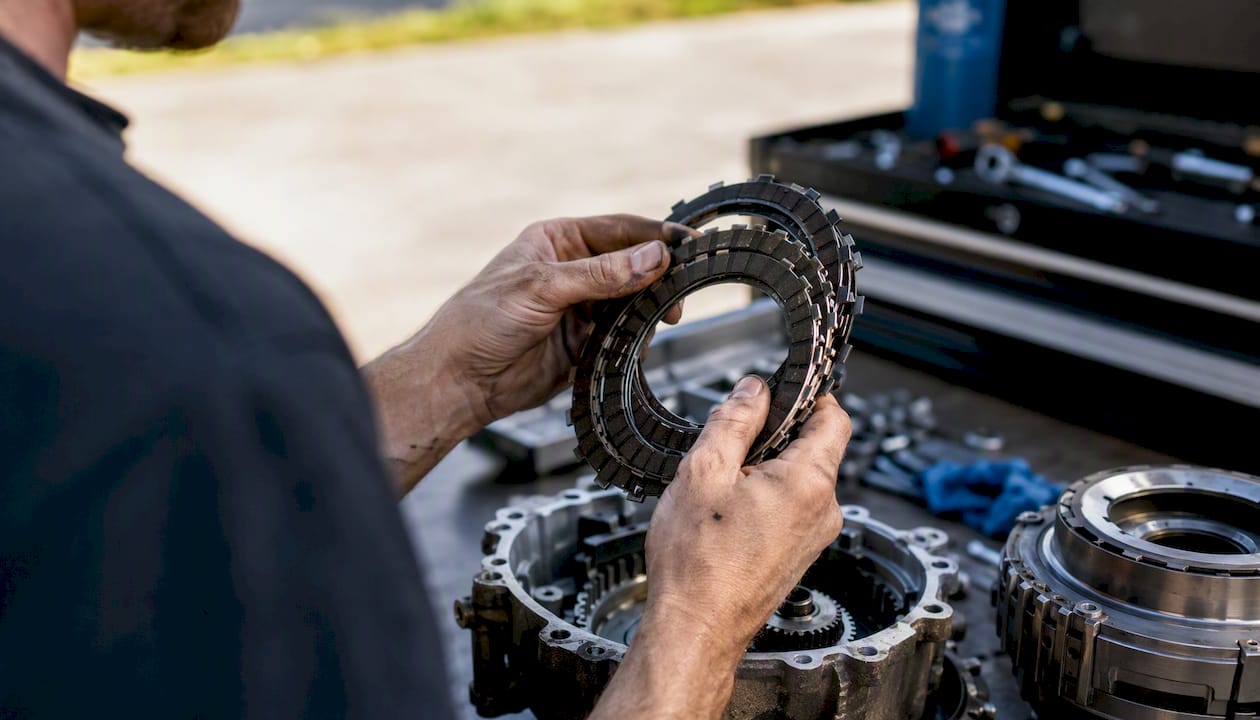
Clutch pack wear (DCTs) typically shows as juddering at low speeds or hesitation when pulling away. Type-specific maintenance guidance is clear: DSG/DCT oil changes at the manufacturer's recommended interval (often 40,000–80,000 miles) are the single most effective way to extend clutch life. Owners who skip fluid changes on wet-clutch DCTs frequently face clutch pack replacement, which can run to £800–£1,500 at an independent specialist. For DSG clutch repair kits, suppliers such as BorgWarner DSG components are available through specialist parts suppliers if you are going down the independent repair route.
CVT belt and pulley wear tends to manifest as a slipping sensation or a high-pitched whine. CVT fluid is often overlooked because manufacturers sometimes label it "lifetime fill" — a claim that independent specialists widely dispute. Changing CVT and transmission fluid at sensible intervals (every 30,000–40,000 miles in hard use) is cheap insurance against a belt failure that can write off the unit entirely.
Approximate UK cost ranges for common service tasks:
| Service task | Approximate UK cost range |
|---|---|
| Transmission fluid change (torque converter) | £80 |
| DSG / DCT fluid and filter service | £350 |
| CVT fluid change | £250 |
| Solenoid replacement (single) | £400 |
| Clutch pack replacement (DCT) | £800–£1,500 |
| Full gearbox rebuild or replacement | £1,500–£4,000+ |
These are indicative ranges from independent specialists; main dealer rates are typically higher.
Warning signs to act on immediately:
- Slipping between gears or unexpected neutral engagement while driving.
- Juddering or shuddering when pulling away from rest.
- Delayed engagement when selecting D or R.
- Burning smell, particularly after motorway driving.
- Transmission warning light on the dashboard.
- Visible reddish fluid under the car after parking.
Keep a record of every fluid change with date and mileage. When buying a used automatic, ask specifically for transmission service receipts, not just the general service history. A car with 80,000 miles and no record of a DSG fluid change is a risk, regardless of how clean the rest of the history looks.
How to check which gearbox is fitted to a car
Knowing the type before you buy or lease saves surprises later. Here is how to confirm it quickly.
Check the manufacturer's spec sheet first. The official configurator or brochure will name the transmission type explicitly: "7-speed DSG", "CVT", "8-speed automatic" and so on. If you are looking at a used car, the same information appears on the original order confirmation or in the handbook.
Look at the gear selector. A traditional P-R-N-D layout with a rotary dial or conventional lever suggests a torque converter. A DCT often has paddle shifters behind the steering wheel. A CVT may show a D position with no numbered positions. An EV will show P-R-N-D with no other options.
Feel for creep. Release the brake at idle in D. A torque converter or wet-clutch DCT will creep forward noticeably. A dry-clutch DCT may hesitate or feel reluctant at very low speeds.
Listen at low speed. DCTs can produce a faint clunk or vibration when changing between first and second at low speeds in traffic. CVTs produce a continuous drone rather than distinct shift points.
Check the V5C and online databases. The V5C does not always state the gearbox type explicitly, but the vehicle's VIN can be run through the manufacturer's own parts or spec lookup to confirm the exact transmission fitted at the factory.
Buyer's checklist when asking a seller or leasing broker:
- What type of automatic gearbox is fitted (torque converter, DCT, CVT)?
- When was the transmission fluid last changed, and is there a receipt?
- Has the DSG or CVT been serviced at the manufacturer's recommended intervals?
- Is the wet or dry clutch variant fitted (for DCT cars)?
- Does the lease or warranty include a maintenance package covering transmission servicing?
UK licence rules and insurance implications for automatic-only drivers
Passing your driving test in an automatic car adds DVLA code 78 to your licence. Code 78 means you are legally restricted to vehicles with automatic transmission. Driving a manual car on a code 78 licence is illegal, voids your insurance, and counts as driving otherwise than in accordance with your licence — a serious offence.
To remove the restriction, you must pass a manual practical driving test. The theory test does not need to be retaken. According to GOV.UK guidance, most drivers need around six to ten focused manual lessons before they are test-ready, though this varies by individual.
National pass rate data shows that automatic-only practical tests record a pass rate of around 42–43%, compared with roughly 48% for manual tests. Experts attribute the gap largely to candidates booking automatic tests earlier than they should, assuming the absence of a clutch makes preparation less demanding. It does not.
DVLA code 78 at a glance:
- Added automatically when you pass a practical test in an automatic vehicle.
- Restricts you to automatic and semi-automatic vehicles only.
- Removed only by passing a manual practical test (no new theory required).
- EVs count as automatic, so code 78 drivers can legally drive any electric car.
- Motorcycles and other vehicle categories have separate licence codes and are unaffected.
Insurance implications for automatic-only licence holders:
- Some insurers charge higher premiums for code 78 drivers, particularly younger drivers, because the pool of vehicles they can legally drive is smaller.
- Driving a manual on a code 78 licence invalidates your policy entirely — not just the code 78 restriction.
- When declaring your licence to an insurer, always disclose code 78 if it appears on your licence.
- Upgrading to a full manual licence typically reduces premiums, though the saving varies by insurer and driver profile.
Checklist for learners deciding which test to take:
- Do you plan to drive mainly in a city and move to an EV within a few years? An automatic test may suit you.
- Do you want maximum flexibility to drive any car, including older used manuals? Take the manual test.
- Do you have a mobility condition affecting clutch operation? An automatic test is the practical choice.
- Are you in a hurry to pass? Be aware that the automatic pass rate is lower, not higher, than the manual rate.
Which automatic gearbox should you choose?
The right transmission depends on what you actually drive, where, and how often.
City commuter. A CVT or wet-clutch DCT suits stop-start urban driving best. Both handle repeated low-speed cycling without the heat stress that can affect dry-clutch DCTs in heavy traffic.
High-mileage motorway driver. A torque-converter automatic is the most relaxed choice for sustained cruising. Modern eight- and nine-speed units are fuel-efficient and mechanically proven over very high mileages.
Towing or van use. Torque converter, without question. It handles sustained load and repeated hill starts better than any other automatic type. If you are considering an automatic van lease, confirm the gearbox type with the broker — not all vans with automatic labelling use a torque converter.
Performance driver. A wet-clutch DCT delivers the fastest shifts and the most engaging driving experience. Just budget for the fluid changes.
EV adopter. No decision needed. Every electric car uses a single-speed reduction drive, and every EV is legally automatic. If you are planning to go electric within the next few years, an automatic-only licence is not the limitation it once was.
For learners, the honest advice from driving instructors is: learn manual if you want full flexibility and plan to buy older used cars. Choose automatic if your driving will be primarily urban and you intend to move to a hybrid or electric car, where the advantages of an automatic gearbox are built into the vehicle itself.
Final purchase checks before signing anything:
- Confirm the exact gearbox type and variant (wet or dry clutch for DCTs).
- Request transmission service records, not just general service history.
- Ask whether a maintenance package covering gearbox fluid changes is available.
- Check whether the warranty or lease agreement covers gearbox faults.
- For leased vehicles, ask Lease World about automatic car lease deals that include a maintenance package.
What the automatic gearbox debate gets wrong
The conversation about automatics versus manuals tends to collapse into two camps: people who think automatics are lazy, and people who think manuals are obsolete. Both miss the point.
The real question is not which type is better in the abstract. It is which type fits your actual driving life for the next three to five years. A dry-clutch DCT is a genuinely poor choice for someone who spends two hours a day in London traffic, not because automatics are bad, but because that specific variant was not designed for that use. A torque-converter automatic in the same situation is excellent. The technology matters as much as the category.
The licence question is where most learners make a mistake they later regret. The assumption that an automatic test is easier is not supported by the pass rate data. What an automatic test does is narrow your options permanently until you take a second test. For a learner who is certain about their driving future, that is a reasonable trade. For anyone uncertain, the manual test preserves every option.
One more thing worth saying: the shift to electric vehicles has changed the calculus. If you are buying or leasing a new car in 2026, the probability that your next vehicle after this one is electric is high. An automatic licence is no longer the restriction it was in 2015, when the used car market was overwhelmingly manual. The market has moved. Your licence decision should reflect where the market is going, not where it has been.
Lease World: automatic car and van leasing with maintenance options
Fixed monthly payments, no hidden fees, and free mainland UK delivery on eligible vehicles. Lease World is a family-run vehicle leasing broker that specialises in making the leasing process straightforward for private drivers and businesses alike, including those specifically looking for automatic cars and vans.
Where automatics matter most for leasing is maintenance. A DCT or CVT on a lease without a maintenance package can produce unexpected bills if the previous driver skipped fluid changes. Lease World offers maintenance packages alongside lease agreements, which means transmission servicing is covered and you are not left negotiating a repair bill mid-contract. The range covers everything from compact automatics to MPV lease deals and automatic van leasing for business users who need reliability above all else.
Ready to find an automatic that fits your driving life? Request a personalised lease quote and Lease World will match you with the right vehicle, gearbox type, and contract terms.
Sources
Authoritative UK sources used in this guide:
- Automatic gearboxes explained: what are the different types of automatic car
- Driving licence codes
- Automatic vs manual cars: which is better? | RAC
- Types of automatic gearbox: A complete UK driver's guide 2025 - AutoHit
- Automatic vs manual cars: UK price, insurance & MPG compared (2026 guide) | Regit
FAQ
What usually fails in an automatic transmission?
The most common failures are fluid leaks, solenoid faults, and clutch pack wear in DCTs. CVTs are prone to belt and pulley degradation when fluid changes are skipped.
How much does an automatic gearbox repair cost in the UK?
Routine fluid changes run £80–£350 depending on type; clutch pack replacement on a DCT typically costs £800–£1,500 at an independent specialist, while a full rebuild or replacement can reach £1,500–£4,000 or more.
How do you drive a car with an automatic gearbox?
Select D to drive forward, R to reverse, and P before leaving the car. Use the footbrake to control speed at low speeds and always apply the handbrake on any gradient before releasing the footbrake.
Which cars have the most reliable automatic gearboxes?
Torque-converter automatics fitted to Japanese and Korean models have a strong long-term reliability record. Wet-clutch DCTs are reliable when serviced correctly; dry-clutch variants and older CVTs have a more mixed reputation in high-mileage use.